Modern Submarine Torpedo Attacks Are Nothing Like What You See In The Movies现代潜艇鱼雷攻击与电影里演的完全不同。
We break down how modern torpedo attacks really go down and the types of torpedoes that are used to sink ships and other submarines.
新闻视频
Updated Apr 16, 2020 12:03 PM EDT
Most modern submarine-launched torpedoes are dual-purpose, meaning they are able to sink a ship or submarine, but they have different characteristics and methods for achieving those goals. Single-purpose torpedoes have a very specific method of attack and can be difficult to evade. In this article, we will cover the capabilities of both kinds of submarine-launched torpedoes and how they actually work, which is very different than what you have probably seen in the movies.
Modern submarine torpedoes come in two variants: thermal and electric. Thermal torpedoes use a fuel, such as OTTO Fuel II , which can be burned without an external oxygen source. A gas turbine or axial piston engine converts this fuel into torque that spins counter-rotating propellers, propelling the torpedo up to speeds in excess of 60 knots. Higher speeds can be achieved if Hydroxylammonium Perchlorate (HAP) is injected during fuel combustion. A HAP boost gives thermal torpedoes a speed advantage over electric torpedoes.
Thermal torpedoes can have a much longer-range at higher-speeds than their electric counterparts. Liquid fuel stores more energy and can be burned more efficiently in modern gas turbines engines, giving these lethal weapons the engagement range and speed required to hit any target from outside detection range.
Gas turbine engines have replaced older external combustion, axial piston-driven engines in some modern torpedoes. The higher RPM of a gas turbine engine coupled with sound silencing modifications to the torpedo chassis and exhaust have made thermal torpedoes as quiet as the submarines that launch them. It is likely that if a modern torpedo uses passive sonar for homing, a target will never know it’s being attacked until just before it explodes.
The propulsion section of a Chinese Yu-6 Torpedo. Note the counter-rotating propellers and the wire hanging out of its central hub., Public Domain
Electric torpedoes are more common because they are easier to make, maintain, and are less risky to handle. They also have some capabilities thermal torpedoes do not. These high-torque, permanent magnet electric motor torpedoes ramp up to speed in under a second. They go from sitting in a torpedo tube to 50 knots in a near-instant because they don’t have the mechanical lag and inertia thermal torpedoes must overcome during startup.
Another big advantage of electric torpedoes is that they can be modular in design, such as Germany’s DM2A4 Sea Hake Mod 4 torpedo. The batteries are connected in series allowing each weapon to have 2, 3, or 4 batteries. More batteries give the weapon more range. Fewer batteries make the weapon much lighter and more agile, but at the cost of range. Both can maintain 50 knots and, like modern thermal torpedoes, are very quiet.
High energy zinc-oxygen Batteries and some types of energy cells are also used in submarine torpedoes today. They provide much more sustained power than standard electric batteries. Specific capabilities of high energy batteries are closely guarded secrets, but Israeli contractor Electric Fuel Limited has been working with Germany to develop heavyweight torpedo batteries since 1995 .
Submarine movies such as Crimson Tide and Hunter Killer use torpedo chase scenes for dramatic effect. The reality is that a torpedo maneuvering and hunting submarines that are frantically trying to evade is the least likely scenario in a modern submarine attack. As already noted, in a 21st Century torpedo attack, the target will likely never know it’s about to be destroyed. Modern submarine torpedoes have sound silencing built into their design and, unless they use their active sonar modes, they may not be detected until the moment before detonation.
A common event observed in naval exercises is two submarines passing within a few hundred meters of each other, detecting each other at the same time, and racing to get a shot off before the other. The other type of engagement is when one sub detects the other sooner, and often at range, resulting in a first shot, first kill. So, the underwater prolonged dogfights that are such beloved set pieces of modern submarine thrillers are just not the reality. Actual underwater combat occurs silently with very little reaction time to fend off an impending attack.
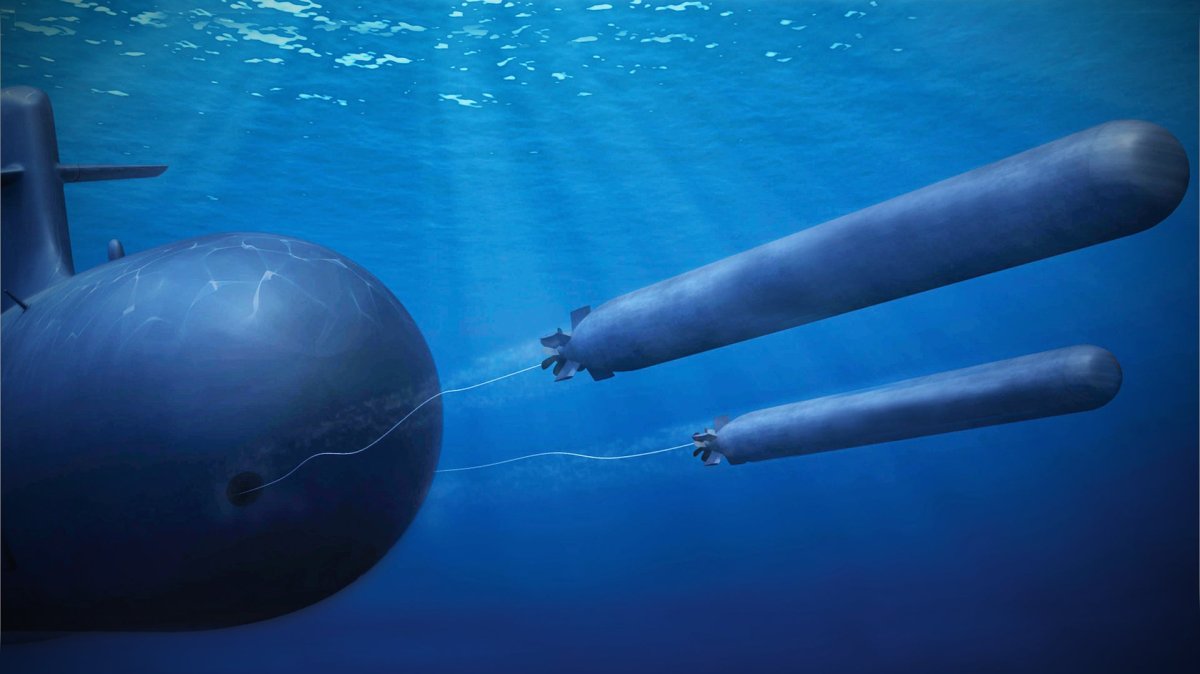
In addition, many modern torpedoes have a command wire or fiber optic cable that reels out from behind the torpedo and establishes a data link with the submarine’s fire control system. Before a torpedo is launched, it must know three things:
What are the torpedo’s course and depth after launch?
At what range will it enable a search for a target?
What are the kill box boundaries?
With command wire capabilities, the weapon can change its attack geometry or even shut down if directed by the fire control operator. Detected targets can be changed, depth and range limitations can be set, and countermeasures, such as decoys and jammers, can be ignored using the submarine’s sonar data instead of the torpedo’s lower-fidelity onboard sonar data. If the data link is lost, the weapon will follow its last given command and execute pre-programmed countermeasure defeating profiles, if necessary.
Virginia class SSN firing a Mk48 Mod6 torpedo. , Raytheon
After launch, the weapon will do a short dive below the submarine, so the submarine doesn’t run into the command wire, potentially tangling it around the submarine’s sail and propeller. The wire or fiber optic cable is fed from a dispenser that is either mounted in the torpedo tube or from the torpedo feeding out as it moves through the water. In some cases, there is wire fed from a dispenser and the torpedo simultaneously. This decreases the chance of wire stretch or a break.
The submarine’s fire control system has given the weapon digital boundaries, or a “kill box.” These boundaries are designed to prevent the weapon from attacking the firing platform or any other target outside the designated area. These boundaries shape a three-dimensional cube of water space and can be very large or small as determined by the Weapons Officer before firing.
The torpedo will run out on a predetermined course and depth to the kill box. During this transit, the weapon is measuring ambient background noise and getting to its search depth, unless otherwise directed. It can calculate how strong it will transmit its high-frequency active sonar without reverb, distortion, or saturating detections with background echos. During the search, the torpedo will lower its speed and its sonar transmit power level to maximize detection capabilities. This is especially critical in complex, shallow water, noisy, and icy environments.
BAE Systems’ Spearfish heavyweight torpedo in profile and in action during a SINKEX drill. , BAE Systems
When the weapon reaches this kill box, it activates its own sensors and begins hunting for a target. If the data link between the submarine and the torpedo is maintained, the fire control operator can change the size and dimensions of the kill box at any time. They can also manually steer or shut down the weapon on command. If the weapon ever leaves the kill box, it will inert its warhead, shut down its engine, and sink to the bottom of the ocean. A torpedo cannot be ‘command-detonated’ as seen in the movie Hunt for Red October .
It is possible for the firing platform—the submarine that fired the torpedo—to enter the kill box during a torpedo attack. If not shut down, the torpedo would consider it a valid target. Situational awareness is key during a torpedo attack to prevent this. During wargame exercises, submarines have crossed into their own kill boxes while evading counter-fire torpedoes.
MM2 (SS) Joe Hackett inspects the MK 48 ADCAP torpedo for proper alignment as it enters the torpedo tube during exercise RIMPAC ’98., National Archives
Torpedoes have three basic target detection methods: passive sonar, active sonar, and wake homing:
Passive sonar simply listens for specific target noises generated by an expected foe or it can also home in on the loudest noise source detected. There are thresholds that must be exceeded before homing logic is enabled, but the passive mode is the most effective mode to surprise the target as the weapon is nearly undetectable outside very close-range. Older torpedoes will physically turn their rudder side to side giving the torpedo path a snake-like approach. This increases the search area the torpedo can see at the cost of speed and range. Modern torpedoes can digitally beamform their sonars in wide search arcs. This eliminates the need for physical maneuvering for scanning and allows for a more efficient search because the weapon will not lose speed making repeated small turns.
Active sonar simply emits a sonar energy pulse at a high frequency. The transmit power level is determined by the background noise it measured after launch. It will search its kill box in the most efficient means possible. During an active attack, it is likely the target will employ sonar maskers and jammers. Countermeasure logic will filter through these jamming techniques, although how this is done is still secret.
Wake Homing is becoming more common on dual-purpose torpedoes today. Both 53cm and 65cm torpedoes can have wake homing logic, but the 65cm wake homing torpedoes are single purpose and specifically designed for this kind of attack.
65cm Wake homing torpedoes, like the Russian 65-76A , are large long-range torpedoes designed to search for a ship’s wake and follow it. 65cm torpedoes have enough fuel to travel in excess of 100 kilometers at 50 knots for just over an hour. This makes evasion a very time-consuming affair, allowing the attack submarine time to evade and re-engage. There are ways to actively defeat a wake homing torpedo, but a salvo of this kind of weapon is a carrier killer .
Terminal Homing is the final stage of the torpedo attack. Once the torpedo has detected a valid target, it will transmit the target location, speed, depth, and course back to the submarine’s fire control system. This data will be compared with the fire control solution. Unless otherwise directed, the weapon will enter terminal homing. Terminal homing is an active sonar ping that retransmits on reception becoming more rapid as the range to target closes at maximum speed.
The active sonar transmission cycle becomes shorter in interval as the range closes, similar to a doomsday clock countdown. The target is alerted to the attack, but there is nothing it can do to defeat the weapon at this point. The weapon is too close and moving too fast to allow time for a countermeasure to be effective.
Combination fusing is the most common in today’s torpedoes. This combines proximity fusing, which is both magnetic and measured distance, and contact fusing which detonates on physical impact. It is best if the weapon detonates within a meter of the hull, but a contact detonation can have devastating effects against even the largest warships.
Modern submarine torpedoes are highly capable and amazingly lethal machines. Cold War science and experience has been improved with 21st-century technology and engineering. Torpedoes like the BAE Systems Spearfish , Atlas Electronik SeaHake Mod 4 , Naval Group’s F21 , and Russia’s UGST -M are examples of how far the technology has come.
A potent cocktail of high-speed, lethality, long-range, and low-detectability give the modern torpedo attack a significant advantage over other naval weapons.
Aaron Amick is a retired U.S. Navy submarine sonarman. He served in both Atlantic and Pacific Oceans on 688 Los Angles Class Fast Attack and Ohio class ballistic missile submarines. He has published two audiobooks on Cold War-era submarines, Akula SSN Project 971 Sub Brief and USS Nautilus SSN-571 Sub Brief . Now, Aaron manages a small Patreon page and contributes to The War Zone.
Contact the editor: Tyler@thedrive.com
Comments couldn’t be loaded. Please refresh the page.
更新于美国东部时间2020年4月16日下午12:03
大多数现代潜射鱼雷都是双用途的,这意味着它们既能击沉舰船也能击沉潜艇,但它们的特性和实现目标的方式有所不同。单用途鱼雷则具有非常具体的攻击方式,并且难以躲避。在本文中,我们将介绍这两种潜射鱼雷的性能以及它们的实际工作原理,这与你可能在电影中看到的截然不同。
现代潜艇鱼雷分为两种类型:热能鱼雷和电能鱼雷。热能鱼雷使用一种无需外部氧气即可燃烧的燃料,例如奥托II型燃料。燃气轮机或轴流式活塞发动机将燃料转化为扭矩,驱动反向旋转的螺旋桨,从而推动鱼雷达到超过60节的速度。如果在燃料燃烧过程中注入高氯酸羟铵(HAP),则可以获得更高的速度。HAP的注入使热能鱼雷在速度上优于电能鱼雷。
热能鱼雷的射程和速度都远超电鱼雷。液态燃料储存的能量更多,在现代燃气轮机发动机中燃烧效率更高,这使得这些致命武器拥有所需的射程和速度,能够从探测范围之外击中任何目标。
在一些现代鱼雷中,燃气涡轮发动机已经取代了老式的外燃式轴向活塞发动机。燃气涡轮发动机更高的转速,加上对鱼雷底盘和排气系统的消音改进,使得热能鱼雷的噪音与发射它们的潜艇一样低。如果现代鱼雷采用被动声呐进行制导,目标很可能在鱼雷爆炸前才会意识到自己正遭受攻击。
中国鱼-6鱼雷的推进部分。请注意反向旋转的螺旋桨以及从中心轮毂垂下的钢丝。(公共领域)
电动鱼雷更为常见,因为它们更容易制造、维护,而且操作风险更低。它们还具备一些热能鱼雷所不具备的性能。这些高扭矩、永磁电机驱动的鱼雷能在不到一秒的时间内加速到所需速度。由于它们不像热能鱼雷那样在启动时需要克服机械滞后和惯性,因此几乎可以瞬间从鱼雷发射管中加速到50节。
电动鱼雷的另一大优势在于其模块化设计,例如德国的DM2A4“海鳕”Mod 4型鱼雷。电池串联连接,每枚鱼雷可配备2块、3块或4块电池。电池数量越多,鱼雷射程越远;电池数量越少,鱼雷重量越轻,机动性越强,但射程也会相应缩短。两种鱼雷都能保持50节的航速,并且与现代热能鱼雷一样,噪音极低。
目前,潜艇鱼雷也使用高能量锌氧电池和某些类型的能量电池。它们比标准电池提供更持久的动力。高能量电池的具体性能属于高度机密,但以色列承包商 Electric Fuel Limited 自 1995 年以来一直与德国合作开发重型鱼雷电池。
像《红潮风暴》和《猎杀潜航》这样的潜艇电影经常使用鱼雷追逐的场景来增强戏剧效果。但实际上,在现代潜艇攻击中,鱼雷机动并猎杀那些拼命躲避的潜艇,这种情况发生的概率极低。正如前文所述,在21世纪的鱼雷攻击中,目标很可能根本不会意识到自己即将被摧毁。现代潜艇鱼雷的设计中内置了消音装置,除非使用主动声呐模式,否则它们可能直到爆炸前一刻才会被探测到。
在海军演习中,经常可以看到两艘潜艇在几百米的范围内擦肩而过,同时发现对方,并竞相抢先开火。另一种交战方式是,一艘潜艇先发现另一艘,而且通常是在远距离,从而先发制人,击沉目标。因此,现代潜艇惊悚片中常见的长时间水下缠斗并非现实。真正的水下战斗悄无声息地发生,几乎没有反应时间来抵御即将到来的攻击。
此外,许多现代鱼雷都配备有控制线或光纤电缆,从鱼雷后方伸出,与潜艇的火控系统建立数据链路。鱼雷发射前必须知道三件事:
鱼雷发射后的航向和深度是多少?
它的探测范围是多少?
杀伤区域的边界是什么?
凭借线控指令功能,该武器可以根据火控操作员的指令改变攻击几何形状,甚至关闭。探测到的目标可以更改,深度和射程限制可以设置,并且可以利用潜艇声呐数据(而非鱼雷自身精度较低的声呐数据)忽略诱饵和干扰器等对抗措施。如果数据链路丢失,该武器将遵循其最后收到的指令,并在必要时执行预先设定的对抗措施规避程序。
弗吉尼亚级核潜艇发射Mk48 Mod6鱼雷。,雷神公司
发射后,该武器会短暂下潜至潜艇下方,以避免潜艇撞到控制线,导致控制线缠绕在潜艇的指挥塔和螺旋桨上。控制线或光纤电缆由安装在鱼雷发射管内的分配器或鱼雷在水中航行时伸出的分配器提供。在某些情况下,控制器和鱼雷会同时提供控制线。这可以降低控制线拉伸或断裂的风险。
潜艇的火控系统为武器设定了数字边界,或称“杀伤区”。这些边界旨在防止武器攻击发射平台或指定区域外的任何其他目标。这些边界构成一个三维水域立方体,其大小由武器操作员在发射前确定。
鱼雷将按照预定的航向和深度驶向目标杀伤区。在此过程中,除非另有指示,鱼雷会测量环境背景噪声并到达搜索深度。它可以计算出发射高频主动声呐信号的最佳强度,以避免混响、失真或背景回波干扰探测。在搜索过程中,鱼雷会降低航速和声呐发射功率,以最大限度地提高探测能力。这在复杂、浅水、嘈杂和冰冻的环境中尤为重要。
BAE系统公司的“矛鱼”重型鱼雷在SINKEX演习中的侧面轮廓和作战画面。
当鱼雷进入杀伤区后,它会启动自身的传感器并开始搜索目标。如果潜艇与鱼雷之间的数据链路保持畅通,火控操作员可以随时调整杀伤区的大小和尺寸。他们还可以根据指令手动控制鱼雷的航向或关闭其电源。如果鱼雷离开杀伤区,它的弹头将失效,发动机将关闭,然后沉入海底。鱼雷无法像电影《猎杀红色十月》中那样进行“指令引爆”。
在鱼雷攻击过程中,发射平台(即发射鱼雷的潜艇)有可能进入敌方杀伤区。如果未采取紧急措施,鱼雷会将其视为有效目标。在鱼雷攻击中,保持良好的态势感知至关重要,以避免这种情况发生。在军事演习中,潜艇在躲避反击鱼雷时,曾多次进入己方杀伤区。
在1998年环太平洋军演期间,二级军士长(SS)乔·哈克特正在检查MK 48 ADCAP鱼雷进入鱼雷发射管时的对准情况。(美国国家档案馆)
鱼雷有三种基本目标探测方法:被动声呐、主动声呐和尾流自导:
被动声呐只需监听预期敌方产生的特定目标噪声,或者也能追踪探测到的最强噪声源。虽然需要超过一定的阈值才能启用自动寻的逻辑,但被动模式是出其不意攻击目标的最有效方式,因为这种武器在极近距离之外几乎无法被探测到。老式鱼雷会通过左右转动舵来改变航向,使其飞行轨迹呈蛇形。这虽然能扩大鱼雷的搜索范围,但会降低速度和射程。现代鱼雷则可以利用数字波束成形技术,以宽广的搜索弧进行声呐探测。这无需进行物理操纵即可完成扫描,并且由于武器不会因反复小幅转向而损失速度,因此搜索效率更高。
主动声呐以高频发射声呐能量脉冲。发射功率取决于发射后测得的背景噪声。它会以最高效的方式搜索目标区域。在主动攻击过程中,目标很可能会使用声呐掩蔽器和干扰器。反制逻辑能够穿透这些干扰技术,但其具体实现方式仍属机密。
如今,尾流自导技术在双用途鱼雷上越来越常见。53厘米和65厘米鱼雷都可以采用尾流自导逻辑,但65厘米尾流自导鱼雷是单用途的,专门为这类攻击而设计。
65厘米尾流自导鱼雷,例如俄罗斯的65-76A型,是一种大型远程鱼雷,其设计目的是搜索并追踪目标的尾流。65厘米鱼雷的燃料足以使其以50节的速度航行超过100公里,持续时间略超过一小时。这使得规避尾流鱼雷变得非常耗时,从而为攻击型潜艇提供了规避和重新交战的时间。虽然有一些方法可以主动防御尾流自导鱼雷,但这种武器的齐射足以摧毁航母。
末端制导是鱼雷攻击的最后阶段。一旦鱼雷探测到有效目标,它会将目标的位置、速度、深度和航向信息传回潜艇的火控系统。这些数据将与火控系统的计算结果进行比对。除非另有指示,否则鱼雷将进入末端制导阶段。末端制导是一种主动声呐脉冲,接收后会立即重新发送,并且随着目标距离的缩短和鱼雷速度的加快,发送频率也会越来越高。
随着距离缩短,主动声呐的发射周期也随之缩短,如同末日倒计时一般。目标会察觉到攻击,但此时已无力反制。武器距离太近,移动速度太快,根本来不及采取有效的反制措施。
组合式引信是当今鱼雷中最常见的类型。它结合了近炸引信(利用磁力和距离感应引爆)和接触引信(撞击目标后引爆)。理想情况下,鱼雷应在距离船体一米以内引爆,但即使是最大的战舰,接触引爆也能造成毁灭性打击。
现代潜艇鱼雷性能卓越,杀伤力惊人。冷战时期的科学研究和经验与21世纪的技术和工程技术相融合,得到了进一步的提升。例如,英国航空航天系统公司(BAE Systems)的“矛鱼”(Spearfish)、阿特拉斯电子公司(Atlas Electronik)的“海钩”(SeaHake)Mod 4、法国海军集团(Naval Group)的F21以及俄罗斯的UGST-M等鱼雷,都充分展现了这项技术的发展历程。
现代鱼雷攻击兼具高速、高杀伤力、远射程和低可探测性等优点,使其比其他海军武器具有显著优势。
亚伦·阿米克是美国海军退役潜艇声纳兵。他曾在大西洋和太平洋服役,先后在洛杉矶级快速攻击潜艇(688型)和俄亥俄级弹道导弹潜艇上服役。他出版了两本关于冷战时期潜艇的有声读物:《阿库拉号核潜艇971项目简报》和《鹦鹉螺号核潜艇571项目简报》。如今,亚伦运营着一个小型Patreon页面,并为《战区》网站撰稿。
联系编辑:Tyler@thedrive.com
评论加载失败,请刷新页面。