Is This Concept Art Of A Mysterious Space Launch Mothership A Missing Link In Area 51’s Past?这幅神秘太空发射母舰的概念图,是否是揭开51区历史中缺失的一环?
There's a long and colorful trail of circumstantial evidence, rumor, historical context, and patent info that points to such an aircraft existing.
By Tyler Rogoway and Joseph Trevithick
Updated Sep 28, 2020 1:19 PM EDT
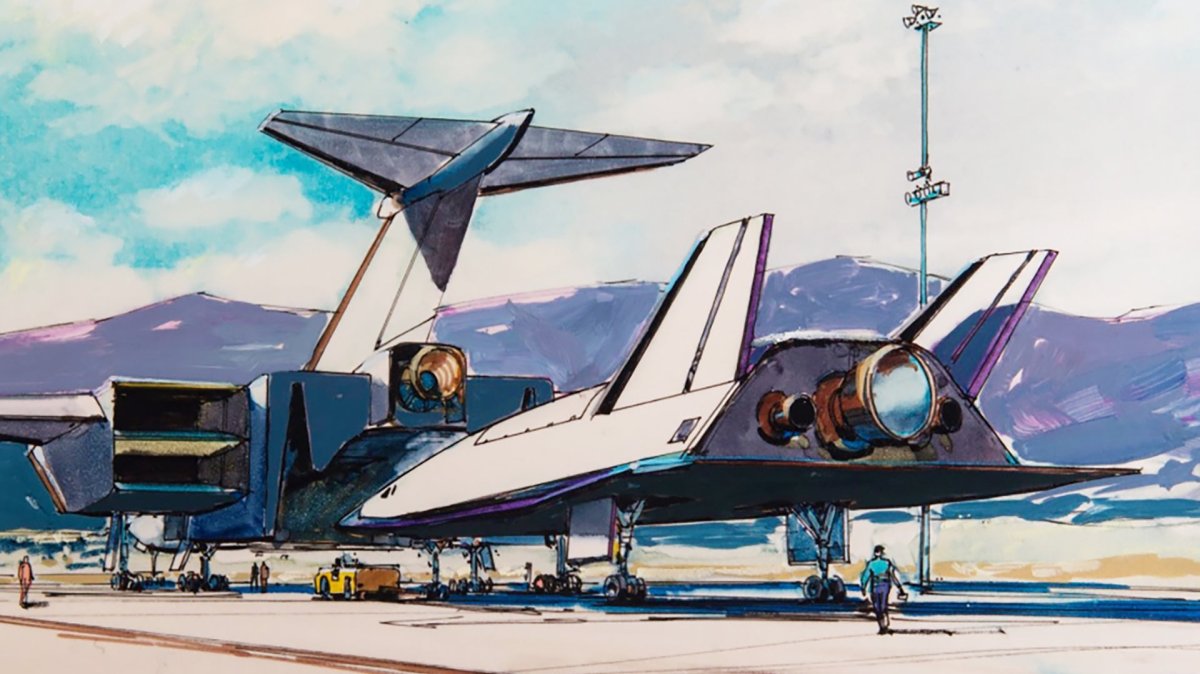
On January 14th, 2019 Boeing released a series of concept art images showing a very large, high-speed, high-altitude, mothership aircraft and its payload, a reusable air-launched space vehicle. The images are quite interesting for a number of reasons. First off, the setting seems to depict Groom Lake, aka Area 51. Second, they closely match a patent for just such a launch system that was filed by Boeing in 1986 and awarded in 1989. Finally, this concept is pretty much identical to a rumored program that supposedly flew from the base during the last decade of the 20th Century and possibly into the 21st Century. The timing of the patent and concept drawings also correlates with a number of factors that would support the existence of, or at least the logic behind procuring such an exotic space access system.
What we see in the images themselves is a huge mothership aircraft that features at least two types of propulsion. Air-breathing jet engines set in large boxy nacelles and a rocket engine that sits below a high T-style tail. The belly of the launcher aircraft is designed to fit the exact mold-line of a space-launch parasite vehicle. This vehicle appears to be a lifting body delta design with twin tails and a large set of payload doors atop its fuselage, presumably for deploying payloads into low earth orbit. The craft appears to have a heat shield similar to the one found on the belly of the Space Shuttle.
The design of the mothership aircraft is clearly optimized for high speed and high altitude operations while also retaining a large internal volume for fuel storage.
The next image shows how the spacecraft would be lowered below the fuselage and launched while in a high-speed and high-altitude climb:
In another image, the space vehicle is seen recovering on a runway with a T-38 Talon in chase. It’s important to note that windows are present at least on the side of the nose section of the vehicle, indicating that it would have been flown by onboard pilots and not under an unmanned concept of operations.
As I mentioned in the opening of this piece, what makes these renderings even more interesting is that they seem to show this combination of exotic aircraft being flown out of Area 51 . The hills in the background and the general details shown match up near perfectly with the clandestine flight test location.
It’s interesting to think that concept art would include such specific details, especially in an age long before Area 51 was as known as it is today or tools like Google Earth existed. The chances of this being some coincidence seem low. Considering the tech being shown and the fact that these renderings remained unreleased for decades, it does make sense that they would show the system operating at its intended base of operations.
A rough view from the old runway at Area 51 of the mountains that are something of an iconic backdrop to the secretive base. , Google Earth
The Ford Bronco and the T-38 chase plane also dates the art back to at least the mid 1990s, but more likely the late 1980s. This is quite important because a Boeing patent from that time period describes a very similar space-launch system.
Patent US4802639A that was filed in 1986 and granted to Boeing in 1989 describes its claims as such:
“This invention is directed toward providing a transatmospheric launch system that is essentially totally reusable, provides wide flexibility in choice of orbit, and may be launched quickly on short notice. The system of the invention is a two-stage horizontal takeoff and landing system. An orbiter vehicle is integrated into the underside of an aircraft. Aircraft has a cavity opening aftwardly and downwardly to receive vehicle. Vehicle and aircraft are releasably connected by struts. Aircraft and vehicle proceed to staging conditions under air breathing and then rocket power. Rocket engine of aircraft is throttled to produce a thrust differential with rocket engine of vehicle. This differential causes vehicle to automatically pivot away from aircraft on struts. After pivoting out of cavity, vehicle is disengaged from struts and proceeds on its own to orbit. Aircraft makes a conventional landing. Following reentry, vehicle makes an unpowered horizontal landing. Separation is accomplished at a Mach number of about 3.3. In a second embodiment, the main engine of the orbiter is a scramjet instead of a rocket.”
The patent goes on to talk all about why such a system is attractive over traditional rockets, including its attributes of reusability, unpredictability, flexibility, scheduling, turnaround time, infrastructure requirements, access to multiple orbits, and cost. It also delves into great detail about how the system would work, including the use of jet and liquid hydrogen and liquid oxygen fueled rocket engines on the mothership, and similar rocket engines on the space vehicle.
What’s especially interesting is that another vehicle option is discussed in the patent—a hypersonic vehicle that uses a scramjet engine. The patent even shows the cutaway of a scramjet engine for the secondary payload aircraft and a drawing of that aircraft itself. It looks very much like a hypersonic airplane concept as we have come to know them, one that is far sleeker than its rocket-powered stablemate. So, one would infer that this system could be used to launch very high-speed suborbital flights and even flights well within the earth’s atmosphere as well as space launch missions.
The Patent also discusses how the mothership could tank the spacecraft to replenish its fuel during pre-launch ascent and especially how utilizing an under-body carrying system makes mating the vehicles far easier than an over-fuselage mounting configuration. This design attribute also means many more airfields could be accessed by the system with minimal infrastructure requirements. But overall, we are talking about a multirole concept here that could haul larger stuff into space and potentially send a hypersonic craft on an unannounced overflight of overseas locales or even inserting small payloads into orbit.
Boeing’s patents also date to a time when the U.S. military is rumored to have been developing a two-stage-to-orbit system, like the one seen in the Boeing patent and renderings. This supposed system has been associated with a number of purported program codenames including Brilliant Buzzard, Snow Bird, Big Bird, and Blue Eyes and has been linked to the near-mythical Aurora aircraft . The U.S. military had already been interested in reusable space plane concepts for decades by this time, with the X-20 Dyna-Soar being among the earliest and most notable projects. The X-20, however, used a traditional rocket booster to get into orbit.
Dyna-Soar was amazingly ahead of its time, but it never came to fruition. The program ran from 1957 to 1963., DoD
There were other concepts that came and went throughout the Cold War as well. In fact, there are still classified elements of the A-12/SR-71 Blackbird family’s history , which could have been related to a possible space launch concept using a similar configuration as seem with the M-21/D-21 combination .
M-21 and D-21 mated and flying as one., USAF
The massive runway at Area 51 that would have been ideal for supporting such a heavily laden and high-speed, high-altitude optimized aircraft was upgraded in the latter 1980s. The runway was extended to the south by some 5,000 feet, which made it nearly 24,000 feet long, all including the northern runoff area. This extension was supposedly made partly due to winter flooding issues on the lakebed portion of the northern runway extension, but there were likely operational requirements that also prompted the construction project. The timing of this project would match with the possible advent of a high-speed mothership space launch system.
The upper runway in this photo was built in the 1960s and has since been closed and replaced with the one just beside it, spanned nearly 24,000 feet, with an extension being installed in the late 1980s. , Google Earth
Brilliant Buzzard, or any of the other reportedly associated programs, along with Aurora itself, have also been linked to a history of unexplained sonic booms , strange rumblings in the sky, and reported sightings of a large, high-performance mothership plane in California and Nevada throughout the 1990s. The most common descriptions of the aircraft from purported sightings claim it was white or light gray, had a large delta-wing planform, featured rectangular underwing engine nacelles, forward mounted canards, and vertical wingtip stabilizers. Overall, the aircraft was somewhat reminiscent of the abortive North American XB-70 Valkyrie supersonic bomber. This led some to dub the rumored plane the “Super XB-70.”
A variation of the Mach 3 capable XB-70 experimental bomber has long been referenced as the basis for a two-stage to orbit system, or at least an aircraft that resembles it. , USAF
The reported sightings and rumblings over Southern California in the 1990s became so pronounced that both Aviation Week and Jane’s reported on the phenomenon, as well as many local outlets including the LA Times . Many of the deep booms emanated from off the Southern California coast where the military controls a vast training and testing range complex—a near ideal launching area for such a system. Others centered around the Mojave Desert, in the heart of flight test country and home to Edwards AFB. But there remains no conclusive evidence that a top-secret spy plane or mothership/space vehicle combination was the culprit. At the same time, the Air Force blamed some of the sonic booms on F-4 Phantom fighter jets operating in the area, but this explanation didn’t account for anywhere near all the reports.
Fast forward to the new Millennium, in 2006, Aviation Week reported on the possible existence of another two-stage-to-orbit system supposedly named Blackstar. It purportedly consisted of a large delta-winged supersonic mothership aircraft, notionally dubbed the SR-3, and an eXperimental Orbital Vehicle (XOV).
Beyond also having a delta wing planform, the description of the SR-3 was significantly different from the purported configuration of the Brilliant Buzzard. Namely, the SR-3 carried the XOV underneath rather than on top of its fuselage, according to Aviation Week . This is the same unique trait seen in the Boeing patent and renderings.
In a typical mission, the SR-3 would lug the XOV up into the stratosphere to an altitude of around 100,000 feet, according to the article. Once there, the space vehicle’s rocket motors would boost itself either to the edge of space or into orbit proper, depending on its payloads and mission profile.
After the mission was over, the XOV would glide back to earth and be able to land on a conventional runway. Aviation Week and subsequent reports posited that the space vehicle could be useful for extremely high-altitude intelligence-gathering missions over denied areas, providing more flexibility than a traditional spy satellite and the element of surprise.
The system would have offered a way to rapidly place satellites in orbit in case they were destroyed or otherwise rendered non-functional during a conflict and it would have also furnished a more clandestine and unpredictable way to insert payloads into orbit. There was also a possibility that it could have carried some sort of weapon system, either for attacking targets in space or on the ground.
As with Brilliant Buzzard, there remains no official confirmation of this program. Aviation Week reported at the time that the Air Force had said it was unaware of any such program, leading to speculation that an intelligence agency, such as the super-secretive National Reconnaissance Office, might be the space vehicle’s actual operator.
The fact that the Air Force did not necessarily claim the purported Blackstar at the time does not necessarily indicate it doesn’t or didn’t exist, even if only in concept, either. In January 2018, SpaceX launched a satellite called Zuma that Northrop Grumman reportedly built for a U.S. government agency. There is no question that that satellite exists , or at least existed, but both the Air Force and NRO have said it didn’t belong to them.
This satellite could be part of a test program and still be contractor owned and operated, which could further obscure the U.S. government entity behind the program. Aviation’s Week ’s 2006 story includes certain details that could point to this being the case with Blackstar, as well. Alternatively, the USAF may have just decided to deny the existence of what would have been a highly sensitive program.
Aviation Week’s Blackstar story received some criticism at the time of publishing. Pieces in both Space Daily and The Space Review were particularly skeptical of the content and cited Aviation Week ’s record of “revealing” non-existent advanced aviation projects in the past, such as claims about a Soviet nuclear-powered bomber in the late 1950s.
But what is known now for certain is that during the 1980s and 1990s, the U.S. Air Force, the Defense Advanced Research Projects Agency (DARPA), and NASA did explore the potential of both single-stage- and two-stage-to-orbit systems as part of at least four publicly acknowledged, named programs. These were Science Dawn , Science Realm, Have Region , and Copper Canyon .
The last of these projects may have directly led to the Rockwell X-30 National Aero-Space Plane (NASP). That was real, but highly ambitious single-stage-to-orbit space vehicle program, before its cancelation in 1993.
Rockwell X-30., NASA
Having a functional reusable space vehicle to rapidly deploy satellites would have fit especially well with the Reagan-era Strategic Defense Initiative’s final space-based missile defense proposal, known as Brilliant Pebbles , which first emerged in 1987. This plan envisioned a massive constellation of small satellites each containing a small kinetic interceptor.
The concept of operations would have required the quick deployment of additional interceptors in the aftermath of an attack to ensure continued protection against subsequent waves of missiles. The sensor layer of this proposed missile defense system was known as Brilliant Eyes and the use of the first word “brilliant” for both of these programs could potentially point to a connection with Brilliant Buzzard. A two-stage to orbit space-launch system based on a mothership concept seems like it would have been an ideal match for this program’s lofty goals, if not the only potentially attainable option at the time.
This image shows a Brilliant Pebble anti-ballistic missile interceptor emerging from its protective “life jacket”, the white shell. This illustration shows an earlier model of the interceptor design with three fuel tanks, later designs had four much larger tanks wrapped around the missile body., USAF/Public Domain
In addition, while the U.S. military and Intelligence Community have certainly been interested in reusable space planes for decades, the desire for a new system would have become much more pronounced after the Space Shuttle Challenger disaster in January 1986. Between at least 1982 and 1992, multiple Space Shuttle missions carried classified U.S. government payloads, reportedly including spy satellites.
This had been part of the Space Shuttle plan all along and the orbiter’s cavernous payload bay had reportedly been designed specifically to accommodate the KH-9 Hexagon spy satellite. Just months after the Challenger incident, the final KH-9 mission failed , with the expendable Titan 34D booster rocket exploding after launch and destroying the payload. This event would have only created additional impetus for a new, more flexible system for satellite deployment.
The Challenger disaster was also largely to blame for the Air Force’s decision to mothball Space Launch Complex 6 at Vandenberg Air Force Base in California in 1987. The service would completely terminate plans for exclusive Space Shuttle operations not long after. This would have freed up funding for other space launch initiatives, possibly including an experimental two-stage-to-orbit system.
A huge investment was made in SLC-6 at Vandenberg AFB for independent DoD Space Shuttle operations. The site was never used for this purpose having been mothballed after the loss of Challenger. , USAF
Also, if the mothership aircraft was also capable of boosting a high-speed scramjet equipped aircraft to launch speed as Boeing’s patent clearly states, its development could have helped build the case for the retirement of the SR-71 Blackbird in 1990. The reactivation of a small Blackbird force in 1995 also pairs somewhat with the period of highest activity of the supposed craft.
Whether or not Brilliant Buzzard, Blackstar, or any of the other reported mothership-based space-launch programs or reusable space vehicle initiatives actually produced flying aircraft and space vehicles, the U.S. military interest in such systems has hardly waned. In recent years, multiple programs of a similar nature have been officially confirmed, not to mention the Boeing’s operational X-37B .
The X-37B after returning from another long mission in low earth orbit. The craft is much smaller than the ones rumored to exist on a number of mothership-based, two-stage to orbit concepts., DoD
In 2017, DARPA hired Boeing to develop the new XS-1 hypersonic space plane , which has the stated mission of being able to rapidly deploy small satellites. Both the X-37B and XS-1 use a traditional rocket booster to get into orbit rather than a mothership aircraft, though. This drastically limits their flexibility when compared to a two-stage to orbit mothership concept.
But in 2016, the Air Force Research Laboratory (AFRL) did indicate that it was still looking at two-stage to orbit concepts, as well. This new proposal returned to a configuration with the smaller orbital vehicle sitting on top of a high-speed mothership aircraft based on a U.K. based company’s concept known as Skylon . The Air Force and NRO are also sure to be watching developments in the private space sector very closely.
All of this makes good sense. The U.S. military is in the midst of both expanding its space-based capabilities and coming to grips with the growing array of threats to those assets. As we at The War Zone have highlighted repeatedly, Russia and China , in particular, have been developing a variety of anti-satellite weapons in order to challenge the United States’ long-held advantages in space-based communications and networking , navigation and weapon guidance , early warning , intelligence gathering , and more.
As we mentioned earlier, at present, programs such as DARPA’s XS-1 are specifically focused on providing options to quickly replace lost or otherwise disrupted space-based capabilities during a crisis, as well as increasing access to space for military purposes overall. Though the U.S. military and Intelligence Community have had a decades-long interest in two-stage to orbit mothership-centric concepts, making that capability a reality would be increasingly a priority now, if it doesn’t actually already exist in one form or another.
Boeing’s XS-1 Spaceplane., DARPA
There is also some potential evidence that a new mothership space-launch concept may be deep in development, or that an old system has been revived. The new massive hangar at Area 51 has dimensions and features that would make it ideal to house just this type of aircraft as I have discussed before in the past . Even the remote position of this hangar seems ideal for a highly classified project that features a very large and oblong aircraft that uses especially volatile fuel. It’s also worth noting that since that hangar was built, some reports of strange rumblings in Southern California have popped up again.
All this may seem to build a somewhat compelling case that an aircraft like the one in shown in Boeing’s patent and artwork actually exists or existed. Certainly, the confluence of events in the latter half of the 1980s really seems like the perfect breeding ground for such a concept to be pursued. But we have no hard proof this was indeed the outcome. The truth is that the evidence remains largely circumstantial.
It’s probably safe to assume that if a Brilliant Buzzard or Blackstar did become a reality, it either failed to produce the results that were expected of it, or it was sacked due to fiscal reasons, which is quite likely if this thing was born in the Reagan era and fought for its life in the post-Cold War military draw-down of the 1990s. And even if it did exist, it would have been an entirely experimental vehicle, or at best a very low density, high-value and highly classified asset, never really making it out of a semi-operational state and into larger production.
It’s somewhat intriguing to think that once again we are in a near-perfect threat environment for such a concept to flourish into existence. And the strange nature of the new hangar at Area 51 does point to this possibility. With all the fiscal weight the Pentagon is now putting behind flexible space launch, hypersonic capabilities , and time-sensitive strike and reconnaissance , it’s almost a bit hard to imagine that companies like Boeing aren’t dusting off their old plans—or even old planes—and applying 30 years of technological advancement to them in an attempt to make the Air Force’s dreams come true.
Contact the author: Tyler@thedrive.com
Comments couldn’t be loaded. Please refresh the page.
作者:泰勒·罗戈韦和约瑟夫·特雷维西克
更新于美国东部时间2020年9月28日下午1:19
2019年1月14日,波音公司发布了一系列概念图,展示了一架体型庞大、高速、高空飞行的母舰飞机及其有效载荷——一架可重复使用的空射航天器。这些图片之所以引人注目,原因有几点。首先,图片的背景似乎描绘的是格鲁姆湖,也就是所谓的51区。其次,这些图片与波音公司于1986年申请并于1989年获批的一项发射系统专利高度吻合。最后,这一概念与传闻中在20世纪末期甚至可能延续到21世纪的从该基地起飞的航天计划几乎完全相同。此外,这项专利和概念图的发布时间也与一些因素相吻合,这些因素支持了这种奇特太空进出系统的存在,或者至少解释了其背后的逻辑。
从图片中我们可以看到一架巨大的母舰飞行器,它至少采用了两种推进方式:一种是安装在大型方形发动机舱内的吸气式喷气发动机,另一种是位于高耸的T型尾翼下方的火箭发动机。这架发射飞行器的腹部设计与航天器发射寄生飞行器的外形完全吻合。该飞行器似乎采用了升力体三角翼布局,配备双垂尾,机身顶部设有一组大型有效载荷舱门,推测用于将有效载荷送入近地轨道。该飞行器似乎还配备了类似于航天飞机腹部的隔热罩。
母舰飞机的设计显然针对高速和高空作业进行了优化,同时还保留了较大的内部空间用于燃料储存。
下一张图展示了航天器如何被放置在机身下方,并在高速高空爬升的同时发射升空:
另一张图片显示,这架航天器正在跑道上回收,一架T-38“鹰爪”教练机紧随其后。值得注意的是,航天器头部侧面至少有舷窗,这表明它是由机载飞行员驾驶的,而非无人驾驶。
正如我在文章开头提到的,这些渲染图之所以更加引人入胜,是因为它们似乎展现了这些奇特的飞机从51区起飞的场景。背景中的山丘和整体细节几乎与这个秘密飞行测试地点完全吻合。
有趣的是,概念图竟然会包含如此具体的细节,尤其是在51区远未像今天这样广为人知,谷歌地球这类工具也尚未出现的年代。这不太可能是巧合。考虑到图中展示的技术,以及这些渲染图尘封数十年之久,它们展现系统在其预定运行基地的运作状态也就不足为奇了。
从51区旧跑道上看到的山脉大致景色,这些山脉已成为这座神秘基地的标志性背景。(谷歌地球)
福特野马汽车和T-38护航飞机也表明,这幅画的创作时间至少可以追溯到20世纪90年代中期,但更有可能是80年代末。这一点非常重要,因为波音公司当时的一项专利描述了一种非常类似的太空发射系统。
美国专利US4802639A于1986年提交申请,并于1989年授予波音公司,其权利要求描述如下:
本发明旨在提供一种基本完全可重复使用的跨大气层发射系统,该系统在轨道选择方面具有广泛的灵活性,并且可以在短时间内快速发射。本发明的系统是一种两级水平起降系统。轨道飞行器集成在飞机的底部。飞机具有一个向后向下开口的空腔,用于容纳轨道飞行器。飞行器和飞机通过支柱可拆卸地连接。飞机和飞行器在吸气式和火箭动力下进入分离状态。飞机的火箭发动机推力增大,以产生与飞行器火箭发动机推力的差值。该差值使飞行器在支柱上自动旋转脱离飞机。旋转脱离空腔后,飞行器与支柱脱离,并自行进入轨道。飞机进行常规着陆。再入大气层后,飞行器进行无动力水平着陆。分离在约3.3马赫数下完成。在第二实施例中,轨道飞行器的主发动机是超燃冲压发动机,而不是火箭发动机。
该专利进一步阐述了这种系统相较于传统火箭的诸多优势,包括其可重复使用性、不可预测性、灵活性、调度性、周转时间、基础设施要求、进入多个轨道的能力以及成本优势。此外,专利还详细介绍了该系统的工作原理,包括母舰上使用喷气式、液氢和液氧燃料火箭发动机,以及航天器上使用类似的火箭发动机。
尤其引人注目的是,该专利中还讨论了另一种飞行器方案——一种使用超燃冲压发动机的高超音速飞行器。专利甚至展示了用于辅助有效载荷飞行器的超燃冲压发动机剖面图以及该飞行器本身的图纸。它看起来非常像我们所熟知的高超音速飞机概念,而且比其火箭动力同类产品更加流线型。因此,我们可以推断,该系统可用于发射超高速亚轨道飞行器,甚至可以在地球大气层内进行飞行,以及执行太空发射任务。
该专利还探讨了母舰如何在发射前上升阶段为航天器补充燃料,尤其着重介绍了采用机身下方承载系统如何使飞行器对接比机身上方安装方式更加便捷。这一设计优势也意味着该系统能够以极低的配套设施需求,在更多机场起降。总而言之,我们讨论的是一种多用途概念,它能够将更大的物体送入太空,并有可能将高超音速飞行器送入海外地区进行未事先通知的飞越,甚至将小型有效载荷送入轨道。
波音公司的专利也与美国军方据传正在研发两级入轨系统的时期相吻合,该系统与波音专利和效果图中所示的系统类似。这个所谓的系统曾与多个据称的代号联系在一起,包括“睿智秃鹰”(Brilliant Buzzard)、“雪鸟”(Snow Bird)、“大鸟”(Big Bird)和“蓝眼睛”(Blue Eyes),并且与近乎神话般的“极光”(Aurora)飞机有关。在此之前,美国军方已经对可重复使用的航天飞机概念感兴趣数十年,X-20“动力滑翔机”(Dyna-Soar)是最早也是最著名的项目之一。然而,X-20使用的是传统的火箭助推器进入轨道。
Dyna-Soar 的设计理念非常超前于时代,但最终未能实现。该项目从 1957 年持续到 1963 年。
冷战期间还有其他一些概念出现又消失。事实上,A-12/SR-71“黑鸟”系列飞机的历史中仍有一些机密信息,这些信息可能与一种可能的太空发射概念有关,该概念采用了与M-21/D-21组合类似的配置。
M-21 和 D-21 已完成配对,合二为一飞行。(美国空军)
51区那条巨大的跑道非常适合支撑这种重载、高速、高空飞行器起降,在20世纪80年代后期进行了升级改造。跑道向南延伸了约5000英尺,使其总长度接近24000英尺,其中包括北部的缓冲带。据称,此次扩建的部分原因是由于北部跑道延伸段湖床部分冬季容易发生洪水,但很可能也存在一些运营方面的需要促成了这项建设工程。该项目的时机与高速母舰航天发射系统的可能问世时间相吻合。
照片中的上层跑道建于 20 世纪 60 年代,现已关闭,并被其旁边的一条跑道取代。这条跑道长近 24,000 英尺,并在 20 世纪 80 年代末进行了延伸。(谷歌地球)
“聪明秃鹰”(Brilliant Buzzard)或其他据称与之相关的项目,以及“极光”(Aurora)项目本身,都与上世纪90年代加利福尼亚州和内华达州发生的一系列无法解释的音爆、天空中的奇怪隆隆声以及目击大型高性能母舰飞机的事件有关。根据目击报告,这架飞机最常见的描述是:白色或浅灰色,采用大型三角翼布局,机翼下方设有矩形发动机舱,前置鸭翼,以及垂直翼尖稳定器。总体而言,这架飞机与夭折的北美XB-70“瓦尔基里”超音速轰炸机有些相似。因此,一些人将这架传闻中的飞机称为“超级XB-70”。
长期以来,具备3马赫飞行能力的XB-70实验轰炸机的改进型一直被认为是两级入轨系统的基础,或者至少是与之类似的飞机的基础。(美国空军)
上世纪90年代,南加州上空出现的目击事件和隆隆声愈演愈烈,以至于《航空周刊》和《简氏防务周刊》以及包括《洛杉矶时报》在内的许多地方媒体都对此现象进行了报道。许多深沉的音爆都来自南加州海岸附近,那里是军方控制的大型训练和测试靶场——对于此类系统而言,这几乎是一个理想的发射区域。另一些音爆则集中在莫哈韦沙漠附近,那里是飞行测试区的中心地带,也是爱德华兹空军基地的所在地。但至今仍没有确凿证据表明,罪魁祸首是某种绝密间谍飞机或母舰/航天器组合体。与此同时,空军将部分音爆归咎于在该地区活动的F-4“鬼怪”战斗机,但这种解释远不能解释所有的报告。
时间快进到新千年,2006年,《航空周刊》报道了另一种名为“黑星”的两级入轨系统可能存在。据称,该系统由一架大型三角翼超音速母机(暂定名为SR-3)和一架实验轨道飞行器(XOV)组成。
除了同样采用三角翼布局外,SR-3 的描述与此前传闻中的“睿智秃鹰”(Brilliant Buzzard)构型有显著不同。据《航空周刊》报道,SR-3 将 XOV 发动机安装在机身下方而非上方。这一独特特征也出现在波音公司的专利和渲染图中。
根据文章所述,在典型的任务中,SR-3 火箭会将 XOV 送入平流层,高度约为 10 万英尺。到达该高度后,根据有效载荷和任务计划,航天器的火箭发动机将自身推升至太空边缘或进入轨道。
任务结束后,XOV 将滑翔返回地球,并可在常规跑道上着陆。《航空周刊》及后续报道指出,该航天器可用于在敌对区域执行超高空情报搜集任务,与传统间谍卫星相比,它更灵活,且更具出其不意的优势。
该系统本可提供一种快速将卫星送入轨道的方法,以防卫星在冲突中被摧毁或以其他方式失效;它还能提供一种更加隐蔽和难以预测的有效载荷入轨方式。此外,它还有可能携带某种武器系统,用于攻击太空或地面目标。
与“睿智秃鹰”计划一样,目前仍未有官方证实该计划的存在。《航空周刊》当时报道称,空军表示对此计划毫不知情,这引发了人们的猜测,认为某个情报机构,例如高度保密的国家侦察局,可能是该航天器的真正操作者。
空军当时未必声称拥有所谓的“黑星”卫星,但这并不一定意味着它不存在,即便它只是概念上的存在。2018年1月,SpaceX发射了一颗名为“祖玛”(Zuma)的卫星,据报道,这颗卫星是诺斯罗普·格鲁曼公司为美国政府机构建造的。毫无疑问,这颗卫星确实存在,或者至少曾经存在过,但空军和国家侦察局(NRO)都表示它不属于他们。
这颗卫星可能属于某个测试项目,并且仍然由承包商所有和运营,这可能会进一步掩盖该项目背后的美国政府实体。《航空周刊》2006年的一篇报道中包含的一些细节也可能表明“黑星”项目的情况也是如此。另一种可能是,美国空军只是决定否认这项高度敏感项目的存在。
《航空周刊》关于黑星的报道在发表时受到了一些批评。《太空日报》和《太空评论》的文章都对报道内容表示特别怀疑,并指出《航空周刊》过去曾“揭露”过一些并不存在的先进航空项目,例如在20世纪50年代末声称苏联拥有核动力轰炸机。
但现在可以确定的是,在20世纪80年代和90年代,美国空军、国防高级研究计划局(DARPA)和NASA确实探索了单级和两级入轨系统的潜力,这至少是四个公开承认的、有名称的项目的一部分。这些项目分别是“科学黎明”、“科学领域”、“哈夫地区”和“铜峡谷”。
最后一个项目可能直接促成了洛克威尔X-30国家航空航天飞机(NASP)的诞生。这是一个真实存在但雄心勃勃的单级入轨航天器项目,可惜在1993年被取消了。
洛克韦尔 X-30,美国宇航局
拥有功能齐全的可重复使用航天器来快速部署卫星,与里根时代战略防御倡议的最终天基导弹防御方案——“智能卵石”(Brilliant Pebbles)——尤其契合,该方案于 1987 年首次提出。该计划设想建立一个庞大的小型卫星星座,每颗卫星都包含一个小型动能拦截器。
该作战概念要求在遭受攻击后迅速部署更多拦截器,以确保持续防御后续导弹攻击。该导弹防御系统的传感器层被称为“睿智之眼”(Brilliant Eyes),而这两个项目名称中都使用了“睿智”(brilliant)一词,这可能暗示着它们与“睿智秃鹰”(Brilliant Buzzard)项目存在关联。基于母舰概念的两级入轨航天发射系统似乎与该项目的宏伟目标完美契合,即便它并非当时唯一可行的方案。
这张图片展示了一枚“闪亮卵石”(Brilliant Pebble)反弹道导弹拦截器从其保护性的白色外壳(俗称“救生衣”)中弹出的过程。图中所示为早期型号的拦截器,配备三个燃料箱;后期型号则配备四个更大的燃料箱,环绕导弹弹体。(图片来源:美国空军/公共领域)
此外,虽然美国军方和情报部门几十年来一直对可重复使用的航天飞机很感兴趣,但在 1986 年 1 月挑战者号航天飞机灾难发生后,对新系统的需求变得更加强烈。至少在 1982 年至 1992 年间,多次航天飞机任务携带了美国政府的机密有效载荷,据报道其中包括间谍卫星。
这原本就是航天飞机计划的一部分,据报道,航天飞机的巨大有效载荷舱就是专门为容纳KH-9“六角星”间谍卫星而设计的。挑战者号事故发生几个月后,KH-9的最后一次发射任务失败,一次性使用的泰坦34D助推火箭在发射后爆炸,摧毁了有效载荷。这一事件只会进一步推动研发一种新的、更灵活的卫星部署系统。
挑战者号航天飞机灾难也是导致美国空军于1987年决定封存位于加利福尼亚州范登堡空军基地的6号航天发射场的主要原因之一。此后不久,空军彻底终止了专门用于航天飞机发射的计划。这将为其他航天发射项目腾出资金,其中可能包括实验性的两级入轨系统。
美国国防部在范登堡空军基地的SLC-6发射台投入巨资,用于独立的航天飞机运行。然而,在挑战者号航天飞机失事后,该发射台被封存,从未用于此用途。
此外,如果母舰飞机真如波音公司的专利所述,能够将一架配备超燃冲压发动机的高速飞机加速到发射速度,那么它的研发或许有助于证明SR-71“黑鸟”在1990年退役的合理性。1995年小规模“黑鸟”部队的重新启用,也与该机型据称最为活跃的时期有所吻合。
无论“聪明秃鹰”、“黑星”或其他已报道的母舰发射计划或可重复使用航天器计划是否真的制造出了飞行器和航天器,美国军方对这类系统的兴趣几乎没有减弱。近年来,多个类似项目已得到官方确认,更不用说波音公司已投入使用的X-37B了。
X-37B 刚刚完成又一次近地轨道长期任务返回。这艘飞行器比传闻中基于母舰的两级入轨方案所搭载的飞行器要小得多。(美国国防部)
2017年,美国国防高级研究计划局(DARPA)委托波音公司开发新型XS-1高超音速空天飞机,其既定目标是快速部署小型卫星。然而,X-37B和XS-1都使用传统的火箭助推器进入轨道,而非母机。与采用两级入轨母机方案相比,这大大限制了它们的灵活性。
但2016年,美国空军研究实验室(AFRL)也曾表示,他们仍在研究两级入轨方案。这项新方案回归了之前的配置,即较小的轨道飞行器位于高速母舰飞机的顶部,该母舰飞机基于一家名为“天龙”(Skylon)的英国公司的概念。空军和国家侦察局(NRO)肯定也会密切关注私营航天领域的发展动态。
这一切都合情合理。美国军方正处于扩展其天基能力的同时,也在努力应对日益增多的威胁。正如我们在“战区”栏目中反复强调的那样,俄罗斯和中国尤其一直在研发各种反卫星武器,以挑战美国在天基通信和网络、导航和武器制导、预警、情报收集等领域长期保持的优势。
正如我们之前提到的,目前,像DARPA的XS-1这样的项目,其重点在于提供在危机期间快速替代损失或受损的天基能力的方案,以及提升整体上用于军事目的的太空准入能力。尽管美国军方和情报界几十年来一直对以母舰为中心的两级入轨概念抱有浓厚的兴趣,但如果这种能力尚未以某种形式存在,那么将其变为现实将日益成为当务之急。
波音公司的XS-1空天飞机,DARPA
还有一些潜在证据表明,一种新的母舰太空发射概念可能正在深入研发中,或者某个旧系统已被重新启动。正如我之前讨论过的,51区新建的巨型机库的尺寸和功能使其成为存放此类飞机的理想场所。即使这个机库位置偏远,对于一个高度机密的项目来说也十分理想,该项目需要使用一种体积庞大、外形呈椭圆形且燃料极不稳定的飞机。值得注意的是,自从这个机库建成以来,南加州再次出现了一些奇怪的隆隆声。
这一切似乎都颇具说服力地表明,波音公司专利和图纸中展示的那种飞机确实存在或曾经存在过。当然,20世纪80年代后半期发生的一系列事件似乎确实为这种概念的实现提供了完美的土壤。但我们并没有确凿的证据证明这确实是最终结果。事实上,目前的证据大多仍是间接的。
可以合理推断,如果“智慧秃鹰”或“黑星”真的成为现实,那么它要么未能达到预期效果,要么因财政原因而被取消——考虑到该项目诞生于里根时代,并在20世纪90年代冷战后军备缩减的浪潮中苦苦挣扎,后一种可能性相当大。即便它真的存在,也只会是一款纯粹的实验性产品,或者充其量只是一种低密度、高价值且高度机密的资产,永远无法摆脱半成品状态,投入大规模生产。
令人颇感意外的是,我们似乎再次身处一个近乎完美的威胁环境,这样的概念极有可能在此萌芽并发展壮大。而51区新建机库的奇特之处也印证了这种可能性。鉴于五角大楼如今在灵活太空发射、高超音速能力以及时效性打击和侦察方面投入巨资,我们几乎很难想象像波音这样的公司没有重新启用旧计划——甚至是旧飞机——并运用30年来的技术进步,试图实现空军的梦想。
联系作者:Tyler@thedrive.com
评论加载失败,请刷新页面。