Should seniors be hopping and stomping? Why explosive exercises may help prevent fractures and falls老年人可以蹦蹦跳跳吗?为什么爆发性运动可能有助于预防骨折和跌倒
Plyometric exercises aren’t just box jumps and pogo hops. Experts explain how gentler versions can help older adults train their balance, reaction time, speed and bone strength – and how to get started safely.
新闻视频
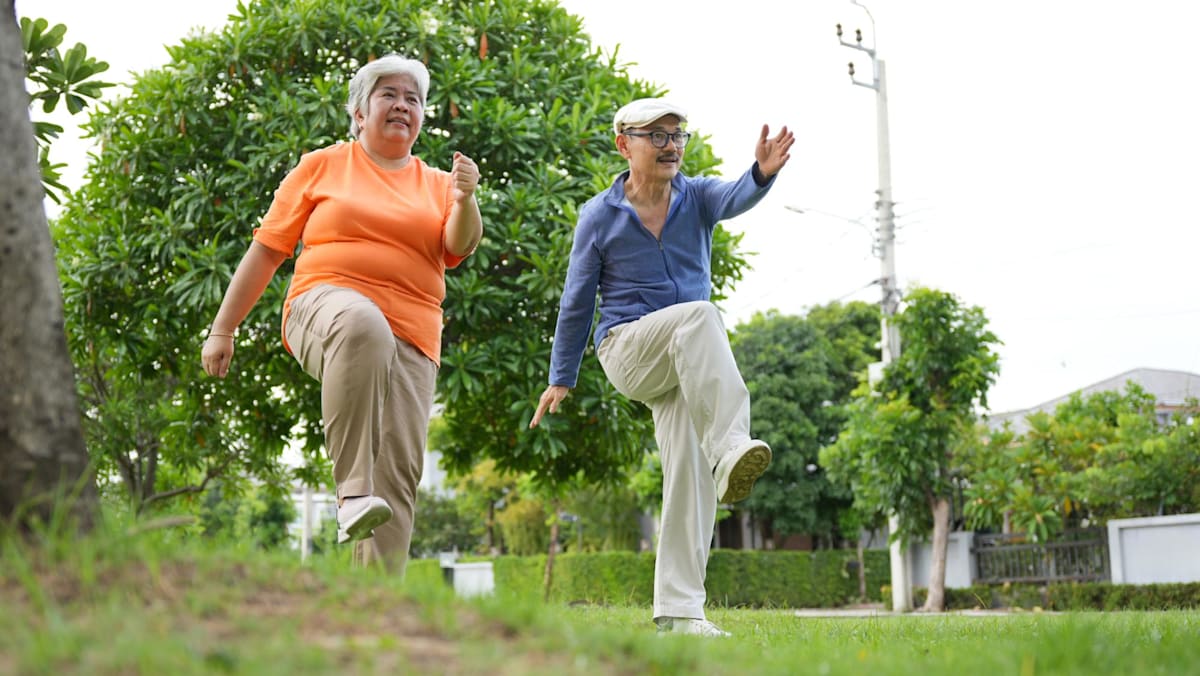
Plyometric exercises aren’t just box jumps and pogo hops. Experts explain how gentler versions can help older adults train their balance, reaction time, speed and bone strength – and how to get started safely.
(Photo: iStock/justocker)
This audio is generated by an AI tool.
You may be onboard when it comes to strength or resistance training for your 65-year-old (or maybe even older) parents. If you’re not, have a look at this article . But getting them to jump or hop? They're already starting to look frail and their movements can be unsteady at times. What if they fell and broke something?
Besides, you haven’t had much success getting your parents to do more than go to the market for groceries. For many seniors, “exercise” is just that – and maybe walking the grandchildren home from school. You might be able to convince them (if you’re lucky) to join a morning exercise group. And if you’re very, very convincing, they might agree to pick up a fitness band to try some stretching exercises.
But getting seniors to perform quick, explosive movements – or what is known as plyometric exercises – are essential to build agility, balance and speed, said Dr Chiam Tut Fu, a visiting sports medicine physician at Ascensus Health Specialist Centre. “There is a decline in speed, reaction time and body balance with age, and so plyometrics can help to improve these areas.”
Joshua Tan , 31, an independent personal trainer who has been in the fitness industry for 16 years, agreed. “Plyometrics trains your body to move and react faster, so when you start to fall, you have a real chance of catching yourself or pushing back up off the floor.”
There is a decline in speed, reaction time and body balance with age. (Photo: iStock/Chatchai Limjareon)
While strength training lets you carry your own weight, Tan is of the opinion that explosive actions are essential for balance, coordination and speed. “If you don’t train your joints and muscles to handle higher-intensity movements, they'll never be prepared for the moments when life demands it, like catching yourself from a fall.”
He added that the impact from plyometric exercises directly helps to build bone density when he noticed that many of his senior clients, especially the female ones, had osteoporosis. “I needed a way to help build their bone strength more directly, and the impact from plyometric movements does exactly that.”
And the research corroborates. A systematic review on the benefits of plyometrics in seniors found that explosive movements like jumping and hopping create forces that activate cells known as osteoblasts (bone-building cells) and osteocytes (cells that maintain the health of bone tissue) to form new bone tissue.
WHAT DO PLYOMETRIC EXERCISES LOOK LIKE FOR SENIORS?
Remember the standing broad jumps you did back in PE class? That’s an example of a plyometric exercise. Other exercises can include box jumps, where you jump from the ground onto a box. Or pogo hops, where you bounce rapidly on the balls of your feet. For the upper body, there are medicine ball slams, where you lift a medicine ball overhead and slam it down hard onto the floor.
Of course, plyometric exercises for seniors wouldn’t look like that – at least not initially. “There won’t be anything scary like a big jump,” said Tan. “It can be as simple as holding onto a rail and doing small hops or skips forward, backward or side to side.” At times, a thick, stretching mat can double as a small step, and the individual can repeatedly step up and down on it, he said.
Conventional plyometric exercises include box jumps, where you jump from the ground onto a box. (Photo: iStock/Ivant Weng Wai)
To add variation and increase intensity, the hopping can be performed on one leg, or while holding light weights. It can even just be stomping your feet hard on the ground before standing up. “It doesn't have to be a jump; any quick, explosive movement counts,” said Tan.
WHAT SHOULD SENIORS TAKE NOTE OF?
The exercises need to be carefully designed and executed for seniors, and there should be a gradual step-up in intensity, said Dr Chiam. “Plyometrics for seniors will be similar to those for the younger population but done with less speed, impact and with reduction in joint range of motion, especially at the start of the programme.”
Acknowledging the fear of pain as a big hurdle for seniors, Dr Chiam added that “they can still do plyometrics within the pain-free range of motion” and “depending on their specific joint conditions, suitable exercises and movements can be curated for them”.
Tan is also cognizant of the challenges that older individuals face in his ongoing work with seniors in their 60s and 70s. “Physically, they may have osteoporosis, sarcopenia, knee/back/hip/elbow pain, frozen shoulders, and/or difficulty getting up off the floor,” he observed. “The big non-physical fear is the fear of falling.”
To stay injury-free, engage a trainer who is conversant and trained to manage older people, advised Dr Chiam. “Seniors should also listen to their bodies for aches and pains from the exercise and inform the trainer.”
The good news is, “plyometrics can be done by people with no prior exercise experience”, said Dr Chiam. “As long as they are medically screened appropriately for participation in exercise, they can participate in a plyometrics programme.” Even better news, seniors can see improvements in their body balance, reaction time, speed and even muscle strength from as early as one month with twice-weekly training sessions, he added.
Seniors can see improvements in their body balance, reaction time, speed and even muscle strength from as early as one month with twice-weekly training sessions. (Photo: iStock/Edwin Tan)
The majority of Tan’s clients is aged 50 and above. Many are “working adults who have neglected their health for years, and they want to get back on track”. “Knowing that they can still jump and move explosively gives them more options in how they use their bodies in their day-to-day activities,” he said.
Tan listed the following lower-body exercises to help seniors build explosive strength, and train their muscles and limbs to move fast when needed. “The impact also signals to your bones and joints that they need to get stronger to handle that kind of load.”
Demonstrating the exercises is Tan’s mother and retired academic, Choo Bee Khim, 63. She found out she has osteopenia – a condition of reduced bone mineral density that is less severe than osteoporosis – when she broke her ankle while cycling two years ago. “I’d just put my foot down from the bicycle pedal and that was it,” she said. Choo used to swim thrice weekly but did not strength train.
Choo’s ankle has since healed but a persistent weakness has caused her steps to be wobbly. Three months ago, at her son’s insistence, she started doing plyometric exercises three times a week. “I feel more confident and have more energy now,” she said.
Personal trainer Joshua Tan. (Photo: Joshua Tan)
Tan’s recommendations may sound like a lot: perform each of the following six exercises for three to five sets. “Work up to 50 to 100 reps in total per exercise as your strength builds – very achievable since each rep is quick," he said.
“There's always a normal level of discomfort with exercise,” Tan continued. “I want people working just past ‘comfortable’ to where they start to sweat, but not to the point of panting hard, dizziness or sharp pain. Sharp, sudden pain is always a stop signal. Dull, lingering muscle aches or delayed onset muscle soreness (DOMS) that fades over a day or two is normal and okay.”
For Exercises 1 to 5, position the bar or any form of support about arm's length away from your body in front of you. Hold with one or two hands, whichever you prefer. Keep your elbows slightly bent, and tucked in against the sides of your body. When hopping, push off through the toes or balls of your feet.
For each session, spend about 10 minutes. Aim to do three sessions a week as consistency is key. " Training at least three or four times a week, m ost people will notice a difference within about two weeks," said Tan. "At two or three times a week, it can take closer to a month."
1. Hopping on the spot
Make sure to hop straight up and down in place.
2. Hopping forward and back
Cue: A line of tape or towel placed horizontally on the floor can give you a visual cue to jump over.
3. Hopping side to side
Cue: A line of tape placed vertically on the floor gives you a visual cue to jump to the left and right.
Squat your hips down as low as you can stay in control. Explode upwards, letting your feet leave the ground. Then, land with both feet firmly on the ground before repeating. Remove the support once you can do it unassisted.
Raise your knee high, at least up to waist height. Then, stomp your lifted leg down hard enough to make a sound on landing.
Cue: Imagine stomping on a bug. It’s not a soft foot placement, which would turn the stomping into marching instead.
Start seated. Stomp your feet as hard as you can, using that force to stand upright.
Cue: Let the stomp power your stand; it should not be a separate motion before it.
The exercises shown may not be suitable for everyone. Older adults should seek medical clearance before starting plyometric training and, where possible, learn the exercises under the supervision of a qualified trainer.
A single handpicked story that we think you shouldn't miss. Just one a day.
增强式训练不仅仅是跳箱和弹跳。专家解释了更温和的训练方式如何帮助老年人锻炼平衡能力、反应时间、速度和骨骼强度,以及如何安全地开始训练。
(图片:iStock/justocker)
这段音频由人工智能工具生成。
对于让65岁(甚至更年长)的父母进行力量或阻力训练,您可能表示赞同。如果您不赞同,请阅读这篇文章。但是让他们跳跃或单脚跳呢?他们看起来已经开始虚弱,动作有时也会不稳。万一他们摔倒骨折了怎么办?
此外,你也没能成功说服父母做除了去市场买菜以外的任何事。对很多老年人来说,“锻炼”也就仅限于此——或许就是送孙辈放学回家。如果你运气好的话,或许能说服他们参加晨练小组。如果你非常非常有说服力,他们或许会同意买个健身带试试拉伸运动。
亚盛健康专科中心客座运动医学医师詹德福医生表示,让老年人进行快速、爆发性的动作——也就是所谓的增强式训练——对于提升敏捷性、平衡性和速度至关重要。“随着年龄的增长,速度、反应时间和身体平衡能力都会下降,因此增强式训练有助于改善这些方面。”
31岁的独立私人教练Joshua Tan对此表示赞同,他从事健身行业已有16年。“增强式训练可以训练你的身体更快地移动和反应,这样当你开始摔倒时,你就有很大的机会抓住自己或从地上站起来。”
随着年龄增长,速度、反应时间和身体平衡能力都会下降。(图片:iStock/Chatchai Limjareon)
力量训练能让你承受自身体重,但谭认为爆发力训练对于保持平衡、协调和速度至关重要。“如果你不训练你的关节和肌肉来应对更高强度的运动,它们就永远无法在生活中真正需要的时候做好准备,比如从跌倒中稳住自己。”
他补充说,当他注意到许多老年客户,尤其是女性客户,都患有骨质疏松症时,增强式训练的直接作用有助于提高骨密度。“我需要一种方法来更直接地帮助他们增强骨骼强度,而增强式训练恰好能做到这一点。”
研究也证实了这一点。一项关于增强式训练对老年人益处的系统性综述发现,跳跃和单脚跳等爆发性运动产生的力量可以激活成骨细胞(骨骼构建细胞)和骨细胞(维持骨组织健康的细胞),从而形成新的骨组织。
老年人的增强式训练是什么样的?
还记得体育课上做的立定跳远吗?那就是增强式训练的一个例子。其他类似的训练还包括跳箱,也就是从地面跳到箱子上;或者弹跳,也就是用前脚掌快速弹跳。上肢训练方面,可以做药球砸地,也就是把药球举过头顶,然后用力砸向地面。
当然,老年人的增强式训练不会是这样的——至少一开始不会。“不会有任何吓人的动作,比如大幅度跳跃,”谭医生说。“它可以很简单,比如扶着栏杆,向前、向后或左右小跳。”他还说,有时候,厚厚的拉伸垫可以当作小台阶,练习者可以反复地在上面上下踩踏。
传统的增强式训练包括跳箱,即从地面跳到箱子上。(图片:iStock/Ivant Weng Wai)
为了增加变化和强度,可以单腿跳跃,或者手持轻重量的哑铃进行跳跃。甚至也可以只是在站起来之前用力跺脚。“不一定非得是跳跃;任何快速、爆发性的动作都算数,”谭说道。
老年人应该注意什么?
詹医生表示,老年人的锻炼需要精心设计和执行,强度也应该循序渐进。“老年人的增强式训练与年轻人的训练类似,但速度、冲击力和关节活动范围都会有所降低,尤其是在训练初期。”
詹医生承认疼痛是老年人的一大障碍,但他补充说,“他们仍然可以在无痛的活动范围内进行增强式训练”,并且“根据他们具体的关节状况,可以为他们制定合适的锻炼和动作”。
谭先生在与六七十岁老年人的长期合作中,也深知老年人面临的挑战。他指出:“在身体方面,他们可能患有骨质疏松症、肌肉减少症、膝盖/背部/髋部/肘部疼痛、肩周炎,以及/或者起身困难。他们最大的非身体方面的恐惧是害怕跌倒。”
为避免受伤,Chiam医生建议,老年人应聘请一位熟悉老年人情况并受过相关培训的教练。“老年人还应注意身体的感受,如果运动后出现任何疼痛或不适,都应及时告知教练。”
好消息是,“即使没有任何运动经验的人也可以进行增强式训练”,Chiam医生说。“只要经过适当的体检,确认适合运动,他们就可以参加增强式训练计划。” 他还补充道,更令人欣喜的是,老年人每周进行两次训练,最快一个月就能看到身体平衡、反应时间、速度甚至肌肉力量的改善。
老年人每周进行两次训练,最快一个月后就能看到身体平衡能力、反应速度、速度甚至肌肉力量的改善。(图片:iStock/Edwin Tan)
谭先生的大部分客户年龄都在50岁以上。他们当中许多人都是“多年来忽视自身健康的职场人士,现在他们想要重回正轨”。他表示:“知道自己仍然可以跳跃和爆发性地活动,让他们在日常活动中拥有更多运用身体的选择。”
谭医生列出了以下下肢锻炼方法,帮助老年人增强爆发力,并训练肌肉和四肢在需要时快速移动。“冲击力还能向你的骨骼和关节发出信号,表明它们需要变得更强壮才能承受这种负荷。”
示范这些动作的是谭的母亲,63岁的退休学者朱美琴(Choo Bee Khim)。两年前,她骑自行车摔断了脚踝,之后发现自己患有骨质减少症——一种骨矿物质密度降低的疾病,但比骨质疏松症的严重程度要轻。“我当时只是把脚从自行车踏板上放下来,就摔断了,”她说。朱美琴以前每周游泳三次,但并不进行力量训练。
秋的脚踝伤势已经痊愈,但持续的虚弱感让她走路有些不稳。三个月前,在儿子的坚持下,她开始每周进行三次增强式训练。“我现在感觉更有自信,也更有活力了,”她说。
私人教练 Joshua Tan。(照片:Joshua Tan)
谭的建议听起来可能很多:以下六个练习,每个练习做三到五组。“随着力量的增强,每个练习的总次数可以逐渐增加到50到100次——这很容易做到,因为每次重复都很快,”他说。
“运动时总会有一些不适感,这是正常的,”谭继续说道。“我希望大家运动到刚好超过‘舒适’程度,开始出汗,但不要气喘吁吁、头晕目眩或感到剧烈疼痛。剧烈、突如其来的疼痛绝对是停止运动的信号。持续的肌肉酸痛或延迟性肌肉酸痛(DOMS)会在一两天内消退,这是正常现象,无需担心。”
练习1至5时,将单杠或其他支撑物置于身体前方约一臂远的位置。可以用一只手或双手握住,随您喜好。保持肘部略微弯曲,并紧贴身体两侧。跳跃时,用脚趾或前脚掌蹬地。
每次训练大约10分钟。每周目标是进行三次训练,因为坚持是关键。谭说:“每周至少训练三到四次,大多数人大约两周内就能看到效果。如果每周只训练两到三次,可能需要将近一个月的时间。”
1. 原地跳跃
务必原地垂直上下跳跃。
2. 向前跳,向后跳
提示:在地板上水平放置一条胶带或毛巾,可以给你一个视觉提示,让你跳过它。
3. 左右跳跃
提示:地板上垂直贴着的一条胶带可以给你一个视觉提示,让你向左或向右跳跃。
尽可能深蹲,但要保持身体控制。然后爆发式向上跳起,双脚离地。接着,双脚稳稳落地,重复动作。一旦能够独立完成,就可以移除辅助工具。
抬起膝盖,至少抬到腰部高度。然后,用力跺脚,使落地时发出声音。
提示:想象一下踩死一只虫子。这不是轻柔的踩踏,轻柔的踩踏会变成行军。
先坐着。用力跺脚,利用这股力量站起来。
提示:让跺脚带动你的站姿;它不应该是跺脚之前的一个单独动作。
图中所示的练习可能并不适合所有人。老年人在开始进行增强式训练前应咨询医生,并尽可能在合格教练的指导下学习这些练习。
每天一篇,我们精心挑选一篇您不容错过的精彩故事。