Fewer Secondary 3 students taking eight or more subjects, more opting for just six选修八门或以上科目的中三学生人数减少,选择六门科目的学生人数增加。
Read more at straitstimes.com.
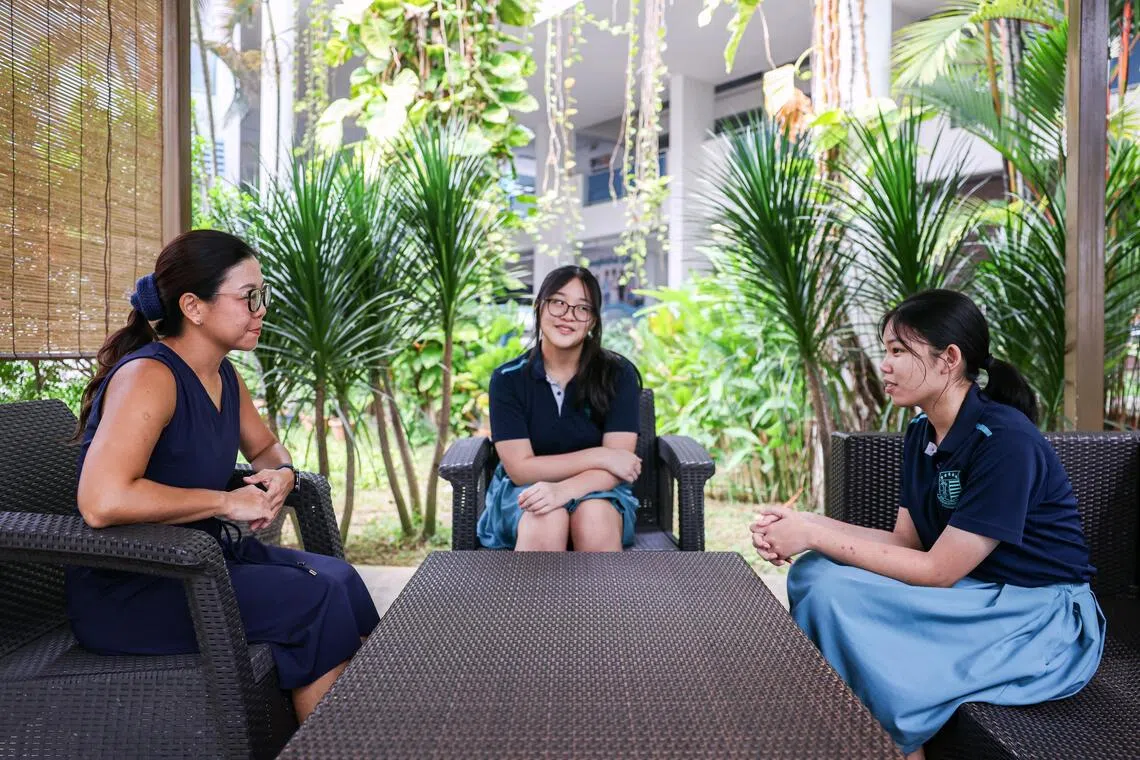
Swiss Cottage Secondary School principal Mandy Cheng (left) engaging Sec 3 students Andi’ Syakirah (right) and Natasha Ng at the school on Sept 18.
ST PHOTO: BRIAN TEO.
Published Sep 27, 2026, 12:00 PM
Updated Sep 27, 2026, 12:00 PM
Fewer Secondary 3 students in 2026 are taking eight or more subjects, dropping from 34% to 14%, due to revised junior college admission criteria requiring only five G3-level subjects.
Schools have adjusted subject combinations to support students' well-being and academic balance, encouraging sustainable workloads and allowing some to take fewer subjects or pursue interests.
Students appreciate reduced workloads, enabling focus on hobbies and leadership, while still keeping options open for JC admission with seven subjects as a safety net.
SINGAPORE - Secondary 3 students in 2026 are taking fewer subjects, after changes to junior college (JC) admission scoring.
From 2028, JC admission will be based on students’ performance in five G3-level subjects, instead of six. The current Secondary 3 cohort will be the first to enter JC under this new scoring criteria.
In response to queries from The Straits Times, the Education Ministry (MOE) said the share of Secondary 3 students taking eight or more G3-level subjects in 2026 has more than halved from 34 per cent in 2025 to 14 per cent currently.
Subjects can be taken at G1, G2 or G3 levels, which are broadly mapped from the Normal (Technical), Normal (Academic) and Express standards, respectively.
From 2025 to 2026, the proportion of students taking seven subjects rose slightly from 54 per cent to 57 per cent, while those offering six or fewer subjects more than doubled, from 12 per cent to 29 per cent.
Among students offering six or fewer G3-level subjects, one in five also offers at least one subject at a less demanding level - G2 or G1.
From 2028, JC admission will be computed using a new L1R4 aggregate score, capped at 16, instead of L1R5. This reduces the required number of G3-level subjects from six to five.
The change is intended to give students “more autonomy to recalibrate their curriculum load”, Education Minister Desmond Lee said in Parliament in August, in response to a question from Shawn Loh (Jalan Besar GRC).
Taking one fewer subject means that students can use the freed-up time for broader development, he said.
At the same time, students who aspire to enter JC are still required to take two languages and three subjects from mathematics or science, and the humanities subject groups to maintain a “broad-based” education, he added.
Under the new policy, fewer students in the first cohort are enrolling in geography, physics and Principles of Accounts.
MOE said students remain exposed to these disciplines elsewhere in the curriculum, such as through combined science for physics. And w hile enrolment for Principles of Accounts has dipped, the ministry said it remains a popular elective subject.
It added that the rise in students offering six or fewer subjects may also reflect revised polytechnic admission criteria for 2028, which will consider four G3-level subjects and one G2-level subject, instead of five G3 subjects.
Lighter curriculum load
Schools have revised their subject offerings, with some students opting for lighter workloads.
Students are also guided in choosing subjects through education and career guidance programmes, subject taster lessons in lower secondary and industry exposure.
About half of the Sec 3 students taking mostly G3 level subjects at Bedok South Secondary School now take six subjects, while the other half takes seven. It no longer offers eight-subject combinations.
The school’s principal, Daryl Koh, said the change was an opportunity to place greater emphasis on well-being alongside academic rigour. It encouraged students to select the right subjects and maintain a sustainable curriculum load, he said.
Swiss Cottage Secondary School in Bukit Batok used to offer only eight-subject combinations for its upper secondary students. This year, more than half of its Sec 3 students taking mostly G3 level subjects have opted for seven subjects.
Its principal Mandy Cheng said academically inclined students can still take nine subjects. Only a handful do so, typically to pursue interests in a third language or G3 computing offered at external venues.
Balancing aspirations
Students said the revised JC admission criteria allowed them to drop subjects they were not interested in . The reduced workload has also given them more time for hobbies and leadership roles, said Linus Fun and Alizee Lam from Bedok South Secondary.
Both 15-year-olds opted to do only seven subjects to better manage their time.
“I want to focus on my well-being and ensure I have time to indulge in my interests. If I had taken one more subject, I would have longer school days and a heavier workload,” said Linus, who holds a leadership position in the school’s National Cadet Corps.
An aspiring lawyer, he enjoys taking part in debate competitions organised by the school. He also spends two hours, twice a week, rock climbing at Lavender, a sport he has been doing since the age of four.
His schoolmate Alizee Lam, had planned to take one Science and two Humanities subjects as part of an eight-subject combination.
She changed her mind to take up Combined Science, which pairs two science subjects into one, and one Humanities subject instead.
“I decided to focus on subjects that I was more interested in, and which align with my goal of studying psychology or law in the future,” she said.
Bedok South Secondary students Linus Fun (right) and Alizee Lam opted to do only seven subjects to better manage their time. ST PHOTO: NG SOR LUAN
Bedok South Secondary students Linus Fun (right) and Alizee Lam opted to do only seven subjects to better manage their time.
ST PHOTO: NG SOR LUAN
At Swiss Cottage Secondary, Sec 3 students Andi’ Syakirah and Natasha Ng are pursuing starkly different subject combinations.
Syakirah is taking seven subjects, some of which are out of her own interests. For instance, she reads Higher Art, Higher Malay, and Malay literature - part of a humanities subject with social studies.
“I’m the kind of person who usually does well in a subject because I like it,” said the 15-year-old who hopes to become a mother tongue language teacher through the Malay Language Elective Programme in JC.
Her schoolmate, Natasha Ng, 15, chose an eight-subject combination. The aspiring anaesthesiologist is taking biology, chemistry, physics and additional mathematics .
Swiss Cottage Secondary School principal Mandy Cheng (centre) with students Natasha Ng (left) and Andi' Syakirah (right) on Sept 18. ST PHOTO: BRIAN TEO
Swiss Cottage Secondary School principal Mandy Cheng (centre) with students Natasha Ng (left) and Andi' Syakirah (right) on Sept 18.
“I know triple science is a lot of work, but my ECG counselor gave me the assurance that if I ever felt there was too much work and I couldn’t cope, I could just drop physics later on,” she said.
Natasha, a student councillor and head of photography in the school’s Media Club, said she would have taken nine subjects under the old system.
She said she was comfortable with the eight-subject load and preferred having more options now.
“It’s better to start with more and then drop one if you cannot cope. Because you cannot go from two sciences to three later on. At least you won’t live with the regret of not trying.”
Elisha Tushara is a correspondent at The Straits Times, specialising in Singapore’s education landscape.
Post-secondary education
9月18日,瑞士小屋中学校长Mandy Cheng(左)在学校与中三学生Andi' Syakirah(右)和Natasha Ng互动。
圣路易斯照片:BRIAN TEO。
发布于 2026 年 9 月 27 日下午 12:00
更新于2026年9月27日中午12:00
由于初级学院入学标准修订,仅要求修读五门 G3 水平科目,因此 2026 年修读八门或以上科目的中三学生比例将下降,从 34% 降至 14%。
学校调整了科目组合,以支持学生的身心健康和学业平衡,鼓励可持续的学习量,并允许一些学生减少选课科目或追求兴趣爱好。
学生们很欣赏减轻的课业负担,这使他们能够专注于兴趣爱好和领导力培养,同时七门科目仍然为他们进入大学预科班保留了选择余地。
新加坡——由于初级学院(JC)入学评分制度的改变,2026年中三学生将学习更少的科目。
自2028年起,初级学院的录取将基于学生五门G3水平科目的成绩,而非之前的六门。目前的初三学生将成为首批按照新评分标准进入初级学院的学生。
针对《海峡时报》的询问,教育部表示,到 2026 年,选修八门或以上 G3 水平科目的中三学生比例已从 2025 年的 34% 下降到目前的 14%,降幅超过一半。
学生可以选择 G1、G2 或 G3 级别学习科目,这些级别分别大致对应于普通(技术)、普通(学术)和快捷标准。
从 2025 年到 2026 年,选修七门课程的学生比例略有上升,从 54% 上升到 57%,而选修六门或更少课程的学生比例则增加了一倍多,从 12% 上升到 29%。
在选修六门或更少 G3 级课程的学生中,五分之一的学生还选修了至少一门难度较低的 G2 或 G1 级课程。
从 2028 年起,JC 录取将采用新的 L1R4 综合分数计算,上限为 16 分,而不是 L1R5。这将使 G3 级科目要求从六门减少到五门。
教育部长李智陞在8月份于国会回答惹兰勿刹集选区议员罗绍文的提问时表示,这项改变旨在让学生“拥有更大的自主权来调整他们的课程安排”。
他说,少修一门课意味着学生可以利用腾出的时间进行更广泛的发展。
他补充说,与此同时,有志进入初级学院的学生仍然需要学习两门语言和三门数学或科学科目以及人文科目,以保持“基础广泛”的教育。
在新政策下,第一批选修地理、物理和会计原理的学生人数减少。
教育部表示,学生仍然可以通过其他课程接触到这些学科,例如物理等综合科学课程。虽然会计原理课程的选修人数有所下降,但教育部表示,它仍然是一门很受欢迎的选修课。
报告还指出,选择六门或更少科目的学生人数增加,也可能反映了2028年理工学院入学标准的修订,该标准将考虑四门G3级科目和一门G2级科目,而不是五门G3级科目。
较轻的课程负担
学校调整了课程设置,一些学生选择减少学习负担。
通过教育和职业指导计划、初中阶段的科目体验课和行业接触,学生在选择科目方面也能得到指导。
勿洛南中学三年级学生中,约有一半选修G3水平的科目,现在选择六门科目,另一半选择七门。该校不再提供八门科目的组合。
该校校长达里尔·科赫表示,此次改革旨在更加重视学生身心健康,同时兼顾学术严谨性。他表示,改革鼓励学生选择合适的科目,并保持合理的课程负担。
位于武吉巴督的瑞士小屋中学过去只为高年级学生提供八门科目的组合。今年,该校超过一半的中三学生(主要选修G3水平的科目)选择了七门科目。
校长程曼迪表示,有学术倾向的学生仍然可以选修九门课程。不过,只有少数学生这样做,通常是为了学习第三门语言或参加校外开设的G3计算机课程。
平衡愿望
学生们表示,修订后的初级学院入学标准让他们可以放弃不感兴趣的科目。勿洛南中学的Linus Fun和Alizee Lam表示,课业负担的减轻也让他们有更多时间培养兴趣爱好和担任领导职务。
两位 15 岁的学生为了更好地管理时间,都选择只学习七门科目。
“我想专注于自身健康,确保有时间发展自己的兴趣爱好。如果我再选修一门课,我的上课时间就会更长,学习任务也会更重,”在学校国家少年军团担任领导职务的林纳斯说道。
他立志成为一名律师,喜欢参加学校组织的辩论比赛。此外,他每周还会抽出两个小时,去拉文德攀岩,这项运动他从四岁就开始练习了。
他的同学林丽姿计划选修一门理科科目和两门人文科目,作为八门科目组合的一部分。
她改变主意,选择综合科学专业,该专业将两门理科科目合并为一门,并选修一门人文科目。
“我决定专注于我更感兴趣的科目,这些科目也与我未来学习心理学或法律的目标相符,”她说。
勿洛南中学学生林纳斯·芬(右)和阿丽泽·林为了更好地管理时间,选择只修读七门科目。海峡时报摄影:吴淑銮
勿洛南中学学生 Linus Fun(右)和 Alizee Lam 为了更好地管理时间,选择只修读七门科目。
圣徒照片:吴索銮
在瑞士小屋中学,中三学生安迪·沙基拉和娜塔莎·吴选择了截然不同的科目组合。
Syakirah正在修读七门课程,其中一些是她出于自身兴趣而选择的。例如,她学习高等艺术、高等马来语和马来文学——这些都是人文学科的一部分,与社会研究是同一门学科。
“我属于那种因为喜欢某门科目而通常学得很好的人,”这位15岁的少年说道,他希望通过初级学院的马来语选修课程成为一名母语教师。
她的同学娜塔莎·吴(Natasha Ng),15岁,选择了八门科目的组合。这位立志成为麻醉师的女孩正在学习生物、化学、物理和高等数学。
9月18日,瑞士小屋中学(Swiss Cottage Secondary School)校长郑曼迪(Mandy Cheng,图中)与学生吴娜塔莎(Natasha Ng,左)和安迪·沙基拉(Andi' Syakirah,右)合影。(海峡时报摄影:张文杰)
9 月 18 日,瑞士小屋中学校长 Mandy Cheng(中)与学生 Natasha Ng(左)和 Andi' Syakirah(右)合影。
“我知道三门科学课的学习任务很重,但我的ECG辅导员向我保证,如果我感觉学习任务太重,无法应付,以后我可以随时放弃物理,”她说。
娜塔莎是学生会成员,也是学校媒体俱乐部的摄影负责人。她说,按照旧制度,她本应修读九门课程。
她说她对八门课程的学习量感到满意,并且更喜欢现在有更多选择。
“最好一开始多选几门,如果应付不过来再放弃一门。因为你不可能以后直接从两门科学增加到三门。至少你不会后悔当初没有尝试。”
Elisha Tushara 是《海峡时报》的记者,专门报道新加坡的教育领域。
高等教育