Singapore proposes a UN framework convention on AI safety新加坡提议制定一项关于人工智能安全的联合国框架公约
Singapore proposes a UN framework convention on AI safety to establish global rules and institutions for managing AI risks and ensuring international cooperation. Read more at straitstimes.com.
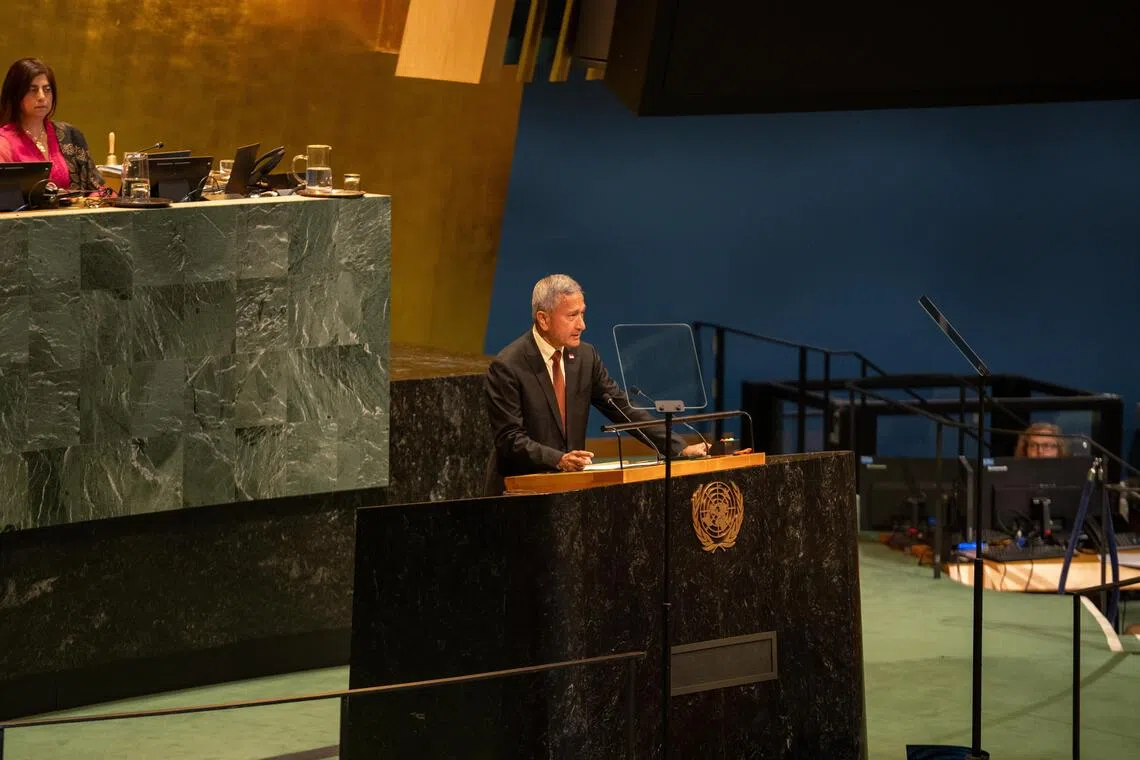
Singapore Foreign Minister Vivian Balakrishnan delivers Singapore’s national statement at the General Debate of the UN General Assembly (UNGA) in New York, on Sept 26.
Published Sep 27, 2026, 09:03 AM
Updated Sep 27, 2026, 12:27 PM
Singapore proposes a UN Framework Convention on AI Safety to create international rules and institutions for AI safeguards, emphasising the need for global cooperation and shared standards amid rapid AI advances.
Foreign Minister Vivian Balakrishnan highlights risks from AI such as loss of control, misuse by rogue actors, and socio-economic disruption, stressing human oversight and universal safety mechanisms.
Balakrishnan calls for revitalised multilateralism to address geopolitical challenges, including maintaining open sea lanes, and explains China’s AI drive as a strategic effort to secure a level playing field.
PHILADELPHIA - As the US and China accelerate their artificial intelligence push, it is too late to ask for a safety pause, but what would help is the creation of institutions that can set safeguards and standards, Singapore Foreign Minister Vivian Balakrishnan told the United Nations in a speech on Sept 26.
“We must collectively formulate new rules and be prepared to create new institutions, if necessary, for new technologies,” Balakrishnan said while delivering Singapore’s national statement at the General Debate of the UN General Assembly (UNGA) in New York .
“We must explore all options, including the idea of a UN Framework Convention on AI Safeguards ,” he said in a 20-minute speech that advocated revitalising multilateralism to tackle acute geopolitical challenges.
A framework convention, like the one adopted by the UN on climate change, could be in the form of a broad international treaty that establishes foundational principles and cooperative institutions and provides the architecture for international action.
A similar call was made by Turkish President Recep Erdogan who used his address at the UN to stress the need for a common international legal framework for AI.
Balakrishnan said new institutions would also be necessary amid loud calls for AI safety from top AI tech leaders , safety researchers and lawmakers who warn that AI capabilities are advancing faster than the human ability to safely manage them.
“We may also need an international institution that can perform for AI some of the functions that currently exist for institutions that perform this function of setting common technical standards,” the minister said, citing the examples of the International Telecommunications Union (ITU), which manages global telecommunications and digital networks and the International Atomic Energy Agency (IAEA) which oversees the peaceful and safe use of nuclear technology.
Balakrishnan said the risks arose from three possibilities – the loss of control of autonomous systems; the misuse by rogue actors to create bio weapons or other weapons of mass destruction, and pervasive political and socio-economic disruption.
“But the genie is already out of the bottle,” he added, in a reference to the clamour for safety as well as the nascent efforts between the US and China to set up a dialogue on the issue.
“It is too late to call for a halt, especially given the superpower rivalry and the huge financial incentives for companies who already have frontier models,” he said.
He used the analogy of a car and traffic lights to bring the point home.
“To drive a high-performance car quickly and safely, you need a powerful engine, but equally, you need good brakes,” he said.
“And especially if you are going to go beyond your neighborhood or cross boundaries, you need effective shared rules, traffic lights, insurance, norms of behaviour, and seat belts,” he added.
“Our safeguards must keep pace,” he said, calling for rigorous testing and evaluation before deployment.
“We need clear limits on what autonomous systems can do, and mechanisms to intervene when they behave in ways we do not care,” he said.
He also said these mechanisms had to be universally recognisable.
“Since the risks from AI do not remain confined behind borders, it means we also need rules of the road that will form a shared global understanding of how we will collectively confront this challenge, just as all of us instinctively understand traffic lights the same way, whether we’re here in New York, or in Beijing, Moscow, or Singapore,” he added.
Above all, human beings must ultimately remain in charge.
“Do you want the nuclear button to be in the hands of a human being or an AI?” he asked.
Any durable international approach must also give all states a meaningful stake, he added, not only those with the “most advanced models, the deepest pockets or the largest set of armaments.”
Singapore is contributing to ongoing efforts too, he added.
“This week, we joined the call for greater safety and security of frontier AI models,” he said.
Over 20 countries and the European Union signed a declaration led by Finland and Norway on the sidelines of the UNGA in New York. It calls for binding international government oversight over frontier AI models, rather than corporate self-regulation
Global cooperation over AI must begin now, Balakrishnan said.
“Rules do not stop us or slow us down. They give us the assurance and the confidence so that we can move faster and more effectively for the benefit of all our peoples.”
Why China is dogged in pursuit of AI
During a Sept 25 conversation with former Australian prime minister Kevin Rudd, who is now global president and chief executive of Asia Society in New York, Minister Balakrishnan zeroed in on the US-China battle over AI.
China sees the AI race through a deeply historical lens, he said. Having missed the 20th century industrial revolution, it is especially keen not to miss the boat a second time.
“Because China missed it, China underwent a century plus of humiliation and unequal treaties. This time, China has absolutely no intention of missing it again,” Balakrishnan said in a wide-ranging, hour-long discussion which challenged the ways in which the US seizes the competition from China.
“You need to understand it is not just a matter of competition with America, being number one or number two, and I am projecting into China’s motivations, but China says: ‘this is my turn, my time in the sunshine. Why should anyone get in the way, especially when I have the human talent, the brain power?’,” he said.
“So can you understand from China’s perspective, ‘I am not going to make the strategic mistake made a century and a half ago. This is a strategic opportunity and I do not want anyone to get in my way. And all I am asking for is a level playing field, and access to technology, and to get ahead as quickly as I can’,” he said.
Rudd pointed out that China was heavily using state subsidies to win the AI race, a part of the frequent western criticism of the Chinese economy where domestic consumption remains weak and growth comes from exports.
Balakrishnan agreed on the pervasive use of subsidies but said they did not fully explain the country’s successes with AI. China also has a scientific and technological backbone, he pointed out, that has beaten the US and western European nations in manufacturing and adoption of robotics, electric vehicles and renewable energy.
What also eggs on the Chinese AI companies is the cut-throat domestic competition which results in the creation of cheap and efficient Chinese AI models, he added.
The US, he said, had a longstanding ecosystem edge that “quickly converts technology into products and services and companies and a profit generating machine.”
‘Even big powers need partners’
In his UN speech, Balakrishnan also renewed a call for multilateralism in the face of rising trade barriers, supply chain disruptions, worsening climate change and massive tech-disruptions.
“Our interstate relations are increasingly dictated by raw power, where the outcomes are determined on the basis of size, leverage, and coercion, and this poses obviously a clear and present danger for smaller states like Singapore,” he said.
“But the point I wanted to make is that even the more powerful states would ultimately pay a price because hard power, on its own, cannot secure supply chains, protect populations from pandemics, or stabilise a warming planet. Even big powers need partners to secure their long-term national interests,” he said.
The question was not whether we need multilateralism but how to make it fit for purpose, he said, suggesting that international law must be consistently complied with while existing international institutions are reformed.
In particular, he dwelt on the importance of maintaining freedom of navigation and overflight to protect global supply chains in the wake of the Iran war which has halted crucial oil, gas and fertiliser shipments across the Strait of Hormuz.
“Transit passage through straits used for international navigation is a right for all of us,” he said.
“It’s not a privilege subject to fees and tolls, and this is customary international law, which means it is binding on all states, whether or not they consider themselves parties to UNCLOS,” he said.
UNCLOS, the United Nations Convention on the Law of the Sea, an international treaty adopted in 1982, establishes a legal framework governing all activities in the world’s oceans and seas. It was concluded under the presidency of former Singaporean diplomat Tommy Koh.
“The largest economies depend on the open sea lanes as much as the smallest, and we in Singapore hold ourselves to the same standard,” said Balakrishnan.
“The Strait of Singapore is less than two nautical miles at its narrowest, and yet nearly a quarter of the world’s sea-born trade passes through the Strait of Singapore,” he said.
Singapore, along with Indonesia and Malaysia, the other two littoral states of the Straits of Malacca and Singapore, have worked with other users of these straits to keep the straits open, secure, and accessible to everyone, he said.
Bhagyashree Garekar is The Straits Times’ US bureau chief. Her previous key roles were as the newspaper’s foreign editor (2020-2023) and as its US correspondent during the Bush and Obama administrations.
AI/artificial intelligence
9月26日,新加坡外交部长维文·巴拉克里希南在纽约联合国大会一般性辩论上发表新加坡国家声明。
发布于 2026 年 9 月 27 日上午 9:03
更新于2026年9月27日下午12:27
新加坡提议制定《联合国人工智能安全框架公约》,以建立人工智能安全保障的国际规则和机构,强调在人工智能快速发展的情况下,需要进行全球合作和共享标准。
外交部长维文·巴拉克里希南强调了人工智能带来的风险,例如失控、被不法分子滥用以及社会经济混乱,并强调了人为监督和普遍安全机制的重要性。
巴拉克里希南呼吁重振多边主义以应对地缘政治挑战,包括维护海上航道的畅通,并将中国的人工智能发展解释为确保公平竞争环境的战略举措。
费城——新加坡外交部长维文·巴拉克里希南9月26日在联合国发表讲话时表示,随着美国和中国加速推进人工智能技术,现在要求暂停安全研发已经太晚了,但建立能够制定保障措施和标准的机构将会有所帮助。
“我们必须共同制定新规则,并做好准备,如有必要,为新技术创建新的机构,”巴拉克里希南在纽约联合国大会一般性辩论上代表新加坡发表国家声明时说。
“我们必须探索所有选项,包括联合国人工智能保障框架公约的想法,”他在20分钟的演讲中说道,他倡导重振多边主义以应对严峻的地缘政治挑战。
像联合国通过的气候变化框架公约那样的框架公约,可以采取广泛的国际条约的形式,确立基本原则和合作机构,并为国际行动提供架构。
土耳其总统雷杰普·埃尔多安也发出了类似的呼吁,他在联合国大会上发表讲话,强调需要为人工智能建立一个共同的国际法律框架。
巴拉克里希南表示,鉴于人工智能技术领军人物、安全研究人员和立法者纷纷呼吁保障人工智能安全,并警告称人工智能能力的发展速度超过了人类安全管理人工智能的能力,因此也有必要建立新的机构。
部长表示:“我们可能还需要一个国际机构,为人工智能履行目前由制定通用技术标准的机构所承担的一些职能。”他举例说,国际电信联盟(ITU)负责管理全球电信和数字网络,国际原子能机构(IAEA)负责监督核技术的和平与安全利用。
巴拉克里希南表示,风险来自三种可能性——自主系统失去控制;流氓行为者滥用自主系统制造生物武器或其他大规模杀伤性武器;以及普遍存在的政治和社会经济混乱。
“但潘多拉的盒子已经打开了,”他补充道,指的是人们对安全的呼声,以及美中两国为就此问题展开对话而做出的初步努力。
“现在呼吁停止已经太晚了,尤其是考虑到超级大国之间的竞争以及那些已经拥有前沿模式的公司所面临的巨大经济利益,”他说。
他用汽车和交通信号灯作比喻,使这个观点更加形象生动。
他说:“要想快速安全地驾驶高性能汽车,你需要强大的发动机,但同样,你也需要良好的刹车系统。”
“尤其是如果你要离开你的社区或跨越边界,你就需要有效的共同规则、交通信号灯、保险、行为规范和安全带,”他补充道。
“我们的安全保障措施必须与时俱进,”他说道,并呼吁在部署前进行严格的测试和评估。
他说:“我们需要明确限制自主系统可以做什么,并建立机制,以便在它们做出我们不希望看到的行为时进行干预。”
他还表示,这些机制必须是普遍可识别的。
“由于人工智能带来的风险不会局限于国界之内,这意味着我们也需要制定规则,形成全球共识,共同应对这一挑战,就像我们所有人都能本能地理解交通信号灯一样,无论我们身处纽约、北京、莫斯科还是新加坡,”他补充道。
最重要的是,人类最终必须掌握主导权。
他问道:“你希望核按钮掌握在人类手中还是人工智能手中?”
他还补充说,任何持久的国际方案都必须让所有国家都拥有有意义的利益,而不仅仅是那些拥有“最先进的型号、最雄厚的资金或最大的武器装备”的国家。
他还补充说,新加坡也在为正在进行的努力做出贡献。
“本周,我们加入了呼吁提高前沿人工智能模型安全性和可靠性的行列,”他说。
在纽约联合国大会期间,由芬兰和挪威牵头,20多个国家和欧盟签署了一项宣言。该宣言呼吁对前沿人工智能模型进行具有约束力的国际政府监管,而不是企业自律。
巴拉克里希南表示,人工智能领域的全球合作必须立即开始。
“规则不会阻止我们或减慢我们的速度。它们给予我们保障和信心,使我们能够更快、更有效地为全体人民谋福祉。”
为什么中国如此执着地追求人工智能
9 月 25 日,巴拉克里希南部长与现任纽约亚洲协会全球总裁兼首席执行官、澳大利亚前总理陆克文进行了一次谈话,重点讨论了美中在人工智能领域的竞争。
他表示,中国看待人工智能竞赛有着深刻的历史视角。由于错过了20世纪的工业革命,中国尤其不希望再次错失良机。
“因为中国错失了良机,中国经历了长达一个多世纪的屈辱和不平等条约。这一次,中国绝不会重蹈覆辙,”巴拉克里希南在一场长达一小时的广泛讨论中说道。这场讨论挑战了美国抢占中国市场份额的方式。
“你们需要明白,这不仅仅是与美国竞争,争夺第一或第二的问题,我这是在揣测中国的动机,但中国会说:‘现在是我的时代,是属于我的辉煌时刻。为什么有人要阻拦我,尤其是我拥有人才和智慧?’”他说。
他说:“所以,你们能从中国的角度理解吗?‘我不会重蹈一个半世纪前的战略覆辙。这是一个战略机遇,我不想任何人阻碍我。我所要求的只是一个公平的竞争环境,获得技术,并尽快取得领先地位。’”
陆克文指出,中国正在大量使用国家补贴来赢得人工智能竞赛,这是西方经常批评中国经济的一部分,因为中国国内消费仍然疲软,增长主要来自出口。
巴拉克里希南同意补贴的普遍使用,但他表示补贴并不能完全解释中国在人工智能领域取得的成功。他指出,中国还拥有强大的科技基础,在机器人、电动汽车和可再生能源的制造和应用方面已经超越了美国和西欧国家。
他还补充说,国内激烈的竞争也刺激了中国人工智能公司的发展,从而催生了廉价高效的中国人工智能模型。
他表示,美国拥有长期的生态系统优势,能够“迅速将技术转化为产品、服务、公司以及盈利机器”。
“即使是大国也需要合作伙伴”
巴拉克里希南在联合国大会上发表讲话时,再次呼吁在贸易壁垒上升、供应链中断、气候变化恶化和大规模技术变革的背景下,采取多边主义。
他说:“我们的国家间关系越来越受赤裸裸的权力支配,结果取决于规模、影响力和胁迫,这显然对新加坡这样的小国构成了清晰而现实的危险。”
“但我想要表达的观点是,即使是更强大的国家最终也会付出代价,因为单凭硬实力无法保障供应链安全、保护民众免受疫情侵袭或稳定全球变暖。即使是大国也需要合作伙伴来维护其长远的国家利益,”他说道。
他表示,问题不在于我们是否需要多边主义,而在于如何使其发挥应有的作用,并建议在改革现有国际机构的同时,必须始终如一地遵守国际法。
他特别强调了在伊朗战争导致霍尔木兹海峡石油、天然气和化肥等重要物资运输中断后,维护航行和飞越自由对于保护全球供应链的重要性。
他说:“通过用于国际航行的海峡过境是我们所有人的权利。”
他说:“这不是一项需要缴纳费用和通行费的特权,这是习惯国际法,这意味着它对所有国家都有约束力,无论它们是否认为自己是《联合国海洋法公约》的缔约方。”
《联合国海洋法公约》(UNCLOS)是一项于1982年通过的国际条约,它为世界各大洋及海域的所有活动建立了法律框架。该公约是在新加坡前外交官许通美担任主席期间缔结的。
巴拉克里希南说:“最大的经济体和最小的经济体一样,都依赖于开放的海上航线,而新加坡也秉持着同样的标准。”
他说:“新加坡海峡最窄处不足两海里,但世界上近四分之一的海上贸易都要经过新加坡海峡。”
他说,新加坡与马六甲海峡另外两个沿岸国家印度尼西亚和马来西亚一道,与其他海峡使用者合作,保持海峡的开放、安全和畅通,让所有人都能通行。
Bhagyashree Garekar 是《海峡时报》美国分社社长。她此前曾担任该报的国际编辑(2020-2023 年)以及在布什和奥巴马执政期间担任该报驻美记者。
人工智能