The Tale Of A World War II British Submarine That Shot Down An Enemy Plane With A Torpedo二战时期英国潜艇用鱼雷击落敌机的故事
History has almost forgotten the World War II submarine crew that claimed a unique “kill” of an enemy aircraft in the Mediterranean.
Updated Dec 29, 2020 2:35 PM EST
Without a doubt, one of the most unusual aircraft “kill” claims of all time is one attributed to the British submarine HMS Umbra , which is said to have brought down an enemy aircraft, using torpedoes, during World War II. The incident occurred in the Mediterranean, while the submarine, under the command of then-Lieutenant Lynch Maydon , was engaging an enemy ship. Such was the ferocity of the resulting explosion after the torpedoes hit that vessel, that Maydon reported that one of the aircraft escorting it was engulfed in a column of fire that leaped 1,000 feet into the air.
Were such a scenario to be considered for a fictional account of naval warfare, it would likely be rejected as too far-fetched. However, the submarine’s commander described the action in some detail and it was widely reported in newspapers at the time. When it returned from its patrol, HMS Umbra was flying the Jolly Roger to signify its successful hunting and the flag included a symbol of the aircraft claimed destroyed. The significance of this type of flag, and its symbols, is something The War Zone discussed in this past article .
Officers and crew of HMS Umbra , together with their Jolly Roger success flag, at Devonport in February 1943., Crown Copyright/Wikimedia Commons
As of December 1942, HMS Umbra , a Royal Navy U-class submarine built by Vickers-Armstrong, was on patrol off the coast of Tunisia, where Allied and Axis forces were locked in desert warfare after the Allied Operation Torch landings in North Africa the previous month. Meanwhile, the last major naval battles of the Mediterranean campaign were being fought between the United Kingdom and the Axis forces of Germany and Italy, with the British submarines exacting a steady toll on enemy shipping.
On December 9, HMS Umbra sighted the German merchant vessel Süllberg , south of the Tunisian coastal town of Hammamet. The 1,699-ton steamer Süllberg had been built in 1912 and was now carrying 645 tons of ammunition, 62 tons of other stores, four artillery pieces, and 23 vehicles. These were being transported from Trapani in Sicily to Sousse in Tunisia, to help the Axis forces repel the growing Allied advance into that country.
The following official account of what happened, compiled from details in patrol reports and logbooks, is available online at uboat.net , with HMS Umbra indicated by its pennant number, P35. Note that the submarine was armed with four tubes in the bow for 21-inch torpedoes , plus another four reloads, as well as a 3-inch gun:
(All times are zone -1) 0930 hours — Sighted a small merchant vessel, estimated to be 2,000 to 3,000 tons, bearing 342°. She was proceeding close inshore south of Hammamet. Estimated enemy course was 250°. Altered course and went to full submerged speed to intercept further South on the coast. 0945 hours — Enemy course was now seen to be 235°, speed was 9 knots. The target was keeping very close inshore. P35 proceeded to the South-West at full speed. 1057 hours — Turned to a firing course. 1100 hours — In position 36°14’N, 10°32’E fired three torpedoes from 4,500 yards. A very heavy explosion followed after about four minutes. Another very slight explosion followed about 15 seconds after the heavy explosion. 1109 hours — Returned to periscope depth. All that was left of the target was a magnificent column of orange and white smoke rising to about 1,000 feet in the air.
(All times are zone -1)
0930 hours — Sighted a small merchant vessel, estimated to be 2,000 to 3,000 tons, bearing 342°. She was proceeding close inshore south of Hammamet. Estimated enemy course was 250°. Altered course and went to full submerged speed to intercept further South on the coast.
0945 hours — Enemy course was now seen to be 235°, speed was 9 knots. The target was keeping very close inshore. P35 proceeded to the South-West at full speed.
1057 hours — Turned to a firing course.
1100 hours — In position 36°14’N, 10°32’E fired three torpedoes from 4,500 yards. A very heavy explosion followed after about four minutes. Another very slight explosion followed about 15 seconds after the heavy explosion.
1109 hours — Returned to periscope depth. All that was left of the target was a magnificent column of orange and white smoke rising to about 1,000 feet in the air.
It’s important to note that this description doesn’t mention the possibility that the explosion aboard the Süllberg had not only sent that vessel to the bottom of the Mediterranean, but had also brought down one of the aircraft that was escorting it.
Crew transfer personal items between HMS Umbra and a supply ship, with the submarine’s 3-inch gun in the foreground., Crown Copyright/Wikimedia Commons
It’s also worth noting that in World War II, low-flying aircraft faced a genuine threat of damage or destruction from detonations on the ground, or water, below. It was by no means unusual for bombers or attack aircraft to be hit by debris thrown up from the targets they were supposed to be attacking, with potentially disastrous results. At times, such incidents even stretched the boundaries of credibility. On one occasion, for example, a German Luftwaffe fighter strafing a British train was brought down by debris that flew out of the locomotive’s exploding boiler. Even today, the pilot of an aircraft attacking objectives while flying at low-level must be alert to debris from exploding targets, as well as terrain and air defense threats.
Italian Fiat G.50 and German Messerschmitt Bf 110 fighters over the Mediterranean. While there is no available record of whether the escorts for the Süllberg were German or Italian, if they were indeed twin-engined, then they may well have been Luftwaffe Bf 110s. , German Federal Archives/Wikimedia Commons
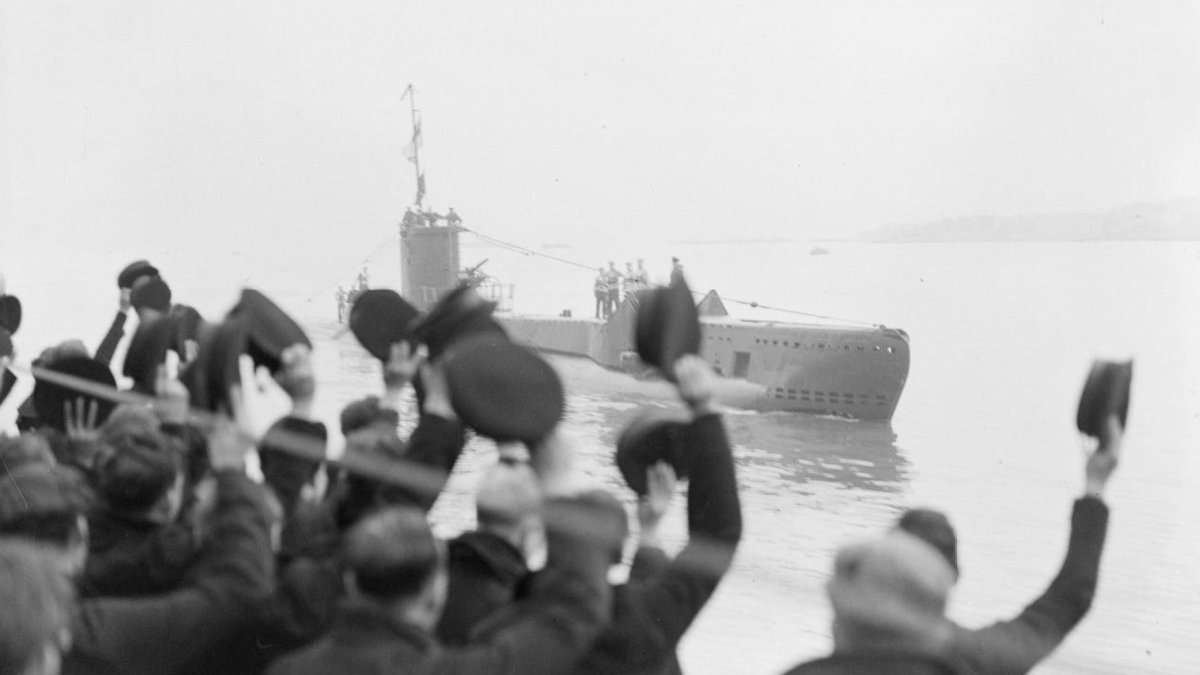
HMS Umbra enters Devonport naval base, flying the Jolly Roger and with a reduced-size pennant number., Crown Copyright/Wikimedia Commons
Oddly, for such a unique claim, the incident is absent from many of the histories of the campaign in the Mediterranean, suggesting that, after an initial flurry of media attention, the British Royal Navy may have considered that evidence was inadequate for it to be made official. The few published accounts available even describe the event happening in different years — 1942 or 1943 — but it’s still possible to piece together a more complete story, at least from the submarine crew’s point of view.
By the time that HMS Umbra returned to its Devonport base after its patrol, in February 1943, the official narrative as distributed by the Associated Press ran as follows:
HM Submarine Umbra home from the Mediterranean — she “torpedoed” an enemy plane. HMS Umbra has returned home after more than 12 months in service in Mediterranean waters. Under the command of Lieutenant S L C Maydon, DSO, RN, one of the Navy’s most successful submarine skippers, the Umbra fought many daring actions and wrought much destruction among enemy shipping. Her strangest adventure occurred early this year [sic] when she torpedoed an enemy aircraft in mid-air. Lieutenant Maydon sighted an enemy supply ship being escorted by three aircraft. He fired a torpedo and “all that was left of the target was a magnificent column of orange and white smoke rising to quite a thousand feet.” He noticed that only two of the three enemy aircraft were in sight. “It was hoped,” reported Lieutenant Maydon, “that the third may have gone to great heights when the target blew up.”
South African-born Lieutenant S L C Maydon, DSO, RN., Crown Copyright/Wikimedia Commons
Together with that report, a series of photos were taken by the Admiralty showing the victorious crew of the HMS Umbra as they returned. The photo of the crew surrounding the conning tower reveals details of the Jolly Roger flag , which bears the silhouette of an apparent twin-engine aircraft directly above the skull and crossbones. The addition of a victory marking representing an aircraft was not uncommon, with wartime submarines being routinely equipped with anti-aircraft guns for defending against air attack when operating on the surface. Meanwhile, at the bottom of the flag is a life raft symbol denoting the rescue of two airmen from another downed German aircraft, a Junkers Ju 88 , which happened two days after the torpedo “kill.”
Another of several different Jolly Rogers flown by HMS Umbra , with the downed aircraft emblem now to the right of the skull., Wikimedia Commons
Some of the symbols that can be found on a submarine’s Jolly Roger flag, and what they mean., NAVYNEWS.CO.UK
News of the — possible — unique victory then spread fast, although reports still noted that there was no official confirmation of the enemy aircraft having been destroyed. “Circumstantial evidence,” explained the San Bernardino Sun , of March 9, 1943, “has led the crewmen of a British submarine to conclude that they ‘torpedoed’ an enemy aircraft.” Again, the same source incorrectly cites the date as early 1943, based on when HMS Umbra had actually returned to port.
One of the members of the crew of HMS Umbra poses with a bunch of bananas on returning to the United Kingdom., Crown Copyright/Wikimedia Commons
Other accounts were more circumspect. Captain George Simpson was the commander of the Royal Navy’s Tenth Submarine Flotilla, headquartered in Malta, at the time of the sinking of the Süllberg . In The History of the British ‘U’ Class Submarine , Simpson is quoted as having said of the incident:
P35 is inclined to claim one aircraft from the explosion though the torpedoing of an aircraft at 1,000 feet seems more like the story of a rear gunner .
While Captain Simpson sounds less than convinced by the explanation provided by Maydon and his crew, that’s not to say that it didn’t happen.
Lieutenant Maydon and another crewman in the cramped interior of HMS Umbra. , Crown Copyright/Wikimedia Commons
Regardless of whether or not HMS Umbra had genuinely brought down an enemy aircraft with one or more torpedoes, Maydon was decorated for his actions, receiving a second Distinguished Service Order (DSO) in recognition of his submarine having sunk seven merchant ships — the same sub and captain had also destroyed the Italian heavy cruiser Trento . Before the end of the war, the latter part of which saw him commanding a submarine in the Pacific, Maydon would also receive the Distinguished Service Cross (DSC), for which the citation read: “For outstanding courage, skill and undaunted devotion to duty in successful patrols in one of HM Submarines.”
It is not surprising that the supposed aircraft kill, being unsupported by evidence other than the crew’s own conclusions, would not have been mentioned in relation to Maydon’s various honors. It is for this reason, perhaps, that it appears to have quickly begun to be neglected by official histories, too. As for Maydon himself, he entered politics soon after the war and doesn’t seem to have spoken about the incident at any length before his death in 1970, at the age of 57.
Lieutenant Maydon and other crewmen in the conning tower after the return of HMS Umbra to Devonport . , Crown Copyright/Wikimedia Commons
While it is likely we will never know conclusively whether HMS Umbra was successful in downing an enemy aircraft on December 9, 1942, the supposed remarkable event, and the media’s reaction to it, certainly deserves to be remembered as more than just a footnote in military history.
Hat tip to the U.S. Naval Institute , whose Twitter account brought this story to our attention.
Contact the author: thomas@thedrive.com
Comments couldn’t be loaded. Please refresh the page.
更新于美国东部时间2020年12月29日下午2:35。
毫无疑问,历史上最不寻常的飞机“击落”战绩之一,要数英国潜艇“安布拉”号(HMS Umbra)在二战期间用鱼雷击落一架敌机的壮举了。事件发生在地中海,当时这艘由林奇·梅顿中尉指挥的潜艇正在与一艘敌舰交战。鱼雷击中敌舰后引发的爆炸威力巨大,梅顿报告说,护航的一架飞机被一股高达1000英尺的火柱吞噬。
如果将这样的场景纳入虚构的海战故事中,很可能会因为过于离奇而被否决。然而,潜艇指挥官对当时的行动进行了详细描述,并且当时的报纸也对此进行了广泛报道。当“安布拉”号潜艇巡逻归来时,它升起了海盗旗,以示狩猎成功,旗帜上还包含了被击落飞机的图案。这种旗帜及其图案的意义,《战区》杂志曾在之前的文章中讨论过。
1943年2月,英国皇家海军“安布拉”号军舰的官兵和船员,以及他们的“海盗旗”(Jolly Roger)胜利旗帜,在德文波特港合影。(图片版权归英国皇家所有/维基共享资源所有)
1942年12月,由维克斯-阿姆斯特朗公司建造的英国皇家海军U级潜艇“安布拉”号正在突尼斯沿海巡逻。此前一个月,盟军在北非发动了“火炬行动”,盟军和轴心国军队在突尼斯沙漠展开激战。与此同时,地中海战役的最后几场大规模海战也在英国与德国和意大利组成的轴心国军队之间展开,英国潜艇不断给敌方船只造成损失。
12月9日,英国皇家海军“安布拉”号巡洋舰在突尼斯沿海城镇哈马马特以南发现了德国商船“苏尔贝格”号。这艘排水量1699吨的蒸汽船“苏尔贝格”号建于1912年,当时船上载有645吨弹药、62吨其他物资、四门火炮和23辆车辆。这些物资正从西西里岛的特拉帕尼运往突尼斯的苏塞,以协助轴心国军队抵御盟军在突尼斯境内的推进。
以下根据巡逻报告和航海日志的详细内容整理的官方事件记述可在 uboat.net 网站上查阅,其中“暗影号”(HMS Umbra)以其舷号 P35 标示。请注意,该潜艇艇艏装有四具 21 英寸鱼雷发射管,另有四具备用鱼雷,以及一门 3 英寸舰炮:
(所有时间均为-1时区)09:30 — 发现一艘小型商船,估计吨位2000至3000吨,方位角342°。该船在哈马迈特以南近岸航行。估计敌船航向为250°。改变航向并全速潜航,准备在更南的海岸拦截该目标。09:45 — 敌船航向现为235°,航速9节。目标船保持非常近的近岸航行。P35全速向西南方向航行。10:57 — 转向射击航向。11:00 — 在北纬36°14′,东经10°32′处,从4500码(约4000米)处发射三枚鱼雷。约四分钟后发生剧烈爆炸。剧烈爆炸约15秒后发生另一次轻微爆炸。11:09 — 返回潜望镜深度。目标只剩下一股壮观的橙白色烟柱,直冲云霄约 1000 英尺。
(所有时间均为-1时区)
0930时——发现一艘小型商船,估计吨位2000至3000吨,方位角342°。该船在哈马迈特以南近岸航行。估计敌船方位角为250°。改变航向,全速潜航,准备在更南的海岸拦截该船。
0945时——敌舰航向现为235°,航速9节。目标舰艇紧贴近岸航行。P35号全速向西南方向驶去。
10:57 — 转入射击训练场。
11时——在北纬36°14′、东经10°32′处,从4500码(约4000米)外发射了三枚鱼雷。约四分钟后发生剧烈爆炸。剧烈爆炸后约15秒,又发生一次轻微爆炸。
11时09分——返回潜望镜深度。目标只剩下一股壮观的橙白色烟柱,升腾至约1000英尺的高空。
值得注意的是,这段描述并没有提到苏尔贝格号上的爆炸不仅将该船炸沉到地中海底部,而且还导致为其护航的一架飞机坠毁的可能性。
船员们在“暗影号”潜艇和一艘补给舰之间转移个人物品,前景中可以看到潜艇的3英寸舰炮。(图片版权归英国皇家所有/维基共享资源所有)
值得注意的是,在二战期间,低空飞行的飞机确实面临着地面或水面爆炸造成的损害或摧毁的威胁。轰炸机或攻击机被目标爆炸产生的碎片击中并非罕见,而且后果可能不堪设想。有时,这类事件甚至令人难以置信。例如,曾有一架德国空军战斗机在扫射一列英国火车时,被火车爆炸锅炉飞溅的碎片击落。即使在今天,低空飞行攻击目标的飞行员也必须时刻警惕爆炸目标产生的碎片,以及地形和防空威胁。
意大利菲亚特G.50和德国梅塞施密特Bf 110战斗机在地中海上空飞行。虽然目前尚无记录表明“苏尔贝格”号的护航飞机是德国的还是意大利的,但如果它们确实是双引擎飞机,那么很可能是德国空军的Bf 110。(图片来源:德国联邦档案馆/维基共享资源)
“安布拉”号军舰驶入德文波特海军基地,舰上悬挂着海盗旗,舷号也缩小了。(图片版权归英国皇家所有/维基共享资源所有)
奇怪的是,如此独特的事件却在许多地中海战役史中不见踪影,这表明,在最初媒体的广泛关注之后,英国皇家海军可能认为证据不足以将其正式记录下来。少数已出版的记载甚至将事件发生的时间描述为不同的年份——1942年或1943年——但至少从潜艇艇员的角度来看,我们仍然可以拼凑出一个更完整的故事。
1943年2月,当“安布拉”号巡逻舰结束任务返回德文波特基地时,美联社发布的官方报道如下:
英国皇家海军“安布拉”号潜艇从地中海凯旋——她用鱼雷击落了一架敌机。“安布拉”号在地中海海域服役超过12个月后返回母港。在海军最成功的潜艇艇长之一、海军少尉SLC Maydon(荣获杰出服务勋章)的指挥下,“安布拉”号参与了多次英勇作战,对敌方船只造成了巨大破坏。她最奇特的经历发生在今年年初,当时她用鱼雷击落了一架敌机。Maydon少尉发现一艘敌方补给舰由三架飞机护航。他发射了一枚鱼雷,“目标只剩下一股壮观的橙白色烟柱,直冲千尺高空。”他注意到,三架敌机中只有两架还在视野范围内。“我们当时希望,”Maydon少尉报告说,“第三架飞机可能在目标爆炸时升到了很高的高度。”
南非出生的海军中尉SLC Maydon,DSO,RN。版权所有/维基共享资源
与这份报告一同发布的还有海军部拍摄的一系列照片,展现了“安布拉”号潜艇凯旋归来的场景。其中一张艇员们围在指挥塔旁的照片清晰地展现了骷髅旗的细节:骷髅旗上,骷髅和交叉骨图案的正上方,似乎是一个双引擎飞机的轮廓。在旗帜上添加代表飞机的胜利标志并不罕见,因为战时潜艇通常都会配备防空炮,以便在水面航行时防御空袭。此外,旗帜底部还有一个救生筏图案,象征着在鱼雷击沉德军飞机两天后,潜艇从另一架被击落的容克Ju 88轰炸机上救起了两名飞行员。
这是英国皇家海军“安布拉”号航空母舰上悬挂的几面不同的“海盗旗”之一,被击落飞机的标志现在位于骷髅头的右侧。(图片来自维基共享资源)
潜艇上的海盗旗(Jolly Roger)上的一些符号及其含义,NAVYNEWS.CO.UK
随后,这场——或许是——史无前例的胜利的消息迅速传播开来,尽管报道仍然指出,敌机被击落一事尚未得到官方证实。1943年3月9日的《圣贝纳迪诺太阳报》解释说:“间接证据让一艘英国潜艇的艇员得出结论,他们用鱼雷击落了一架敌机。” 然而,同一消息来源再次错误地将日期记为1943年初,而当时英国皇家海军“安布拉”号潜艇实际上已经返回港口。
“安布拉”号军舰的一名船员返回英国时,手捧一串香蕉合影。(图片版权归英国皇家所有/维基共享资源所有)
其他说法则更为谨慎。乔治·辛普森上校是皇家海军第十潜艇支队的指挥官,该支队总部设在马耳他,当时“苏尔贝格”号潜艇沉没。在《英国“U”级潜艇史》一书中,辛普森被引述曾就此事说过:
P35倾向于声称爆炸中有一架飞机被击落,尽管在1000英尺高空用鱼雷击落飞机似乎更像是后座机枪手的故事。
虽然辛普森船长对梅顿及其船员提供的解释似乎不太信服,但这并不意味着这件事没有发生过。
梅顿中尉和另一名船员在“安布拉”号巡洋舰狭小的内部空间里。(图片版权归英国皇家所有/维基共享资源所有)
无论“安布拉”号潜艇是否真的用一枚或多枚鱼雷击落了敌机,梅登都因其英勇行为而获得嘉奖,并因其潜艇击沉七艘商船而荣获第二枚杰出服务勋章(DSO)——这艘潜艇及其艇长还曾击沉意大利重巡洋舰“特伦托”号。在战争结束前,梅登在太平洋指挥一艘潜艇作战,并荣获杰出服务十字勋章(DSC),其嘉奖词写道:“因在英国皇家海军潜艇的一次成功巡逻中展现出杰出的勇气、技能和对职责的坚定奉献而获此殊荣。”
由于除了机组人员的结论外,没有其他证据支持所谓的击落敌机事件,因此,梅顿所获得的诸多荣誉中没有提及此事也就不足为奇了。或许正因如此,官方历史似乎也很快开始忽略此事。至于梅顿本人,他在战后不久便投身政界,而且似乎在1970年去世(享年57岁)之前,从未详细谈及过这起事件。
“安布拉”号军舰返回德文波特港后,梅顿中尉和其他船员在指挥塔内。(图片版权归英国皇家所有/维基共享资源所有)
虽然我们可能永远无法确切知道“安布拉”号军舰是否在 1942 年 12 月 9 日成功击落了一架敌机,但这一所谓的非凡事件以及媒体对此的反应,无疑值得被铭记,而不仅仅是军事史上的一个脚注。
感谢美国海军学会,他们的推特账号让我们注意到了这条新闻。
联系作者:thomas@thedrive.com
评论加载失败,请刷新页面。