The Day The Royal Air Force Lost Six Jet Fighters In Just 45 Minutes英国皇家空军在短短45分钟内损失六架喷气式战斗机的那一天
As bad weather closed in on their base, eight Hawker Hunters diverted to an alternate location. It didn’t end well.
新闻视频
Updated Nov 27, 2020 6:23 PM EST
The early days of jet fighter operations were notoriously hazardous, especially when the rate of non-combat losses is compared with today’s accident rates. But even by the standards of the 1950s, the loss of six aircraft in a single peacetime mission was highly unusual.
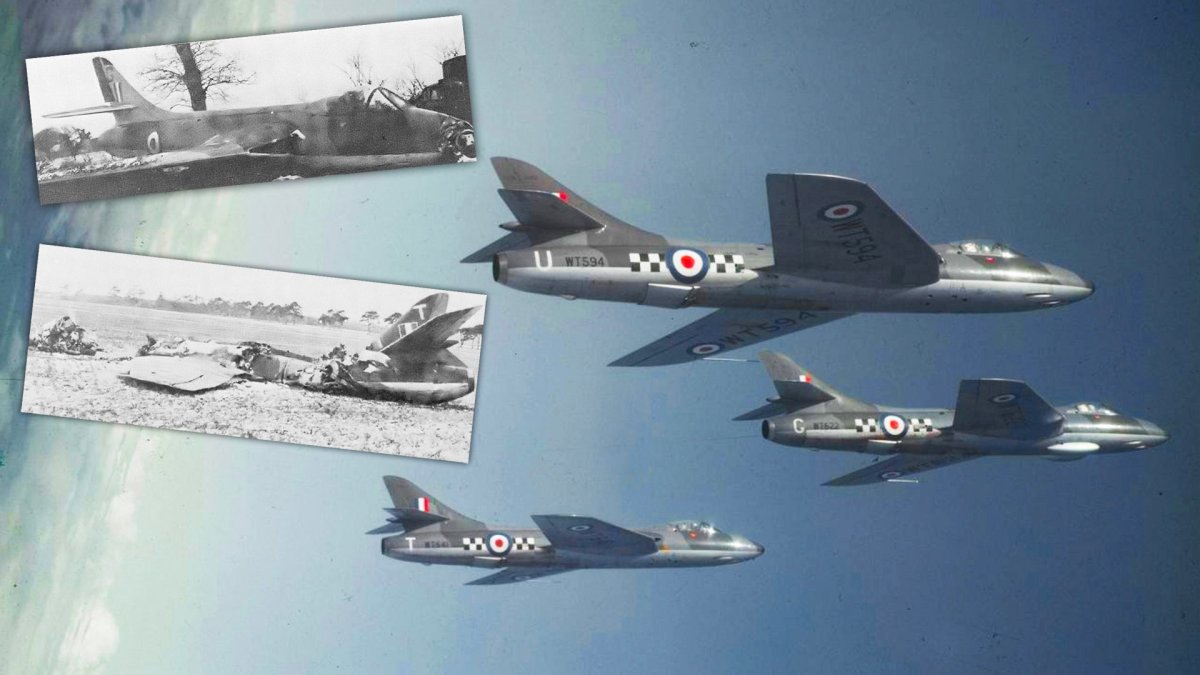
At 1050 hours on the morning of February 8, 1956, eight Royal Air Force Hawker Hunter F1 jet fighters began taking off from their base at West Raynham, Norfolk, for a routine four-versus-four aerial combat exercise that would be conducted at around 45,000 feet over the airfield. The jets belonged to the Day Fighter Leader School, part of the Central Fighter Establishment, the RAF unit responsible for the development of fighter aircraft tactics. Two of the jets were flown by instructor pilots, while the other six had student pilots at their controls.
The eight Day Fighter Leader Squadron Hunter F1s lined up at RAF West Raynham before their fateful flight., TERRY FLEMING
After around 20 minutes’ flying, the pilots had completed their maneuvers and, with the Hunters starting to run low on fuel, it was time for them to return to base. However, the weather over West Raynham had now deteriorated, and they were instead diverted to RAF Marham , approximately 20 miles south. At this point, the jets had sufficient fuel left for around 20 minutes of flying.
Once at Marham, the Hunters were running critically low on fuel. Compounding matters, the weather at Marham had now worsened, too, with cloud and fog sweeping in from the North Sea, meaning visibility was reduced “alarmingly quickly,” and the base’s air traffic controllers were unfamiliar with the Hunter.
The fighters now dropped down to around 2,000 feet and formed up in pairs separated by 30-second intervals.
The first pair of Hunters emerged from the cloud to find fog and quickly lost sight of each other. The lead jet overshot the runway while his wingman touched down safely at Marham — total flying time, 42 minutes. The lead also got down safely, but it required three more circuits and the jet’s fuel tanks were empty by the time it rolled off the runway.
The next pair was less lucky. The pilot of one Hunter struggled to find the runway through the fog, before making the decision to climb to altitude and then eject. The pilot of the fourth jet elected to continue his approach to the runway, but his jet crashed in a field a couple of miles from the airstrip, and he was tragically killed.
Of the next two fighters, one was down to the last few gallons of fuel in its tanks and, after an aborted approach, the pilot also made the call to eject. His wingman, meanwhile, made a low approach before spotting trees in his path, forcing him to pull up. He made another circuit around the airfield at 150 feet and was on approach before the Hunter’s engine flamed out. The fighter overshot the runway and then belly-landed beyond it.
The Ground Control Approach caravan at RAF West Raynham at the time of the incident. , TERRY FLEMING
In the chaos that ensued, the pilots of the two remaining fuel-starved aircraft abandoned their approaches and then ejected in quick succession — from 4,000 feet and 2,500 feet. Their aircraft came down in open country, around the area of Swaffham, where local firefighters dealt with the flames.
The four pilots who had ejected didn’t suffer any serious injuries and there were no civilian casualties.
Questions were soon asked in parliament as to what exactly had gone wrong. Of particular concern was the fact that limited fuel loads had also been a factor in an accident the previous November, when three out of five jets, two of them Hunters, crashed in southeast England. In this incident, too, the jets had run out of fuel after poor weather forced them to divert to another airfield.
A pre-delivery photo of RAF Hunter F1 WT594., THE AVIATION HISTORIAN
The day after the accident, a Labour member of parliament, George Wigg, noted in the Commons that “there has always been a suspicion that [the Hunter] Marks I and II are liable to be deficient in fuel if a crisis arises” and then questioned whether the Ground Control Approach (GCA) system used to aid landings in poor weather at the two bases had broken down.
The Secretary of State for Air, Nigel Birch, confirmed that it was indeed the problematic Rolls-Royce Avon -engined Hunter F1 that had been involved. “I would point out that all modern fighter aircraft have quite short flying duration, and the difficulty is that the lower they get the higher is their fuel consumption,” he noted and confirmed that all aircraft had taken off with full fuel loads. A member of parliament (MP) from the Labour Party, John Strachey, commented that “There is increasing anxiety in the House at the apparent fact that the modifications which have taken place in the Hunter aircraft have not made it capable of flying effectively in the conditions of service life.”
Hunter WT680 is one of a handful of surviving F1 variants, now preserved outside a motel in Lincolnshire, England., ALAN WILSON/CREATIVE COMMONS
In April 1956, the results of the inquiry into the accident were made public. It became clear that the decision to take off that morning from West Raynham, despite poor weather, was based on a forecast suggesting that “an improvement was likely.” This prognosis had been confirmed by a weather reconnaissance flight by a Hunter from West Raynham at 0930 hours. However, the co-located Air Fighting Development School had canceled its flying operations for the day.
It was found that while West Raynham’s GCA was unserviceable, that at Marham was working normally. The Secretary of State for Air then recounted what happened next:
“Bad weather procedure was in force from the commencement of the exercise and pilots had been briefed before the flight to return overhead West Raynham at 20,000 feet by 1115 hours. This timing took into account the endurance of the aircraft. Sufficient time was allowed for controlled descents to be completed by 1130 at the diversion airfields. By 1100 hours the weather at West Raynham had deteriorated, and it was therefore decided by West Raynham that, at the end of the exercise, the aircraft should be diverted to Marham, where visual landings were then practicable. The aircraft returned overhead 20,000 feet [at] West Raynham in accordance with their flight instructions just after 1110 hours. When they started to descend from this altitude under the control of West Raynham the weather was, in fact, still suitable for visual circuits and landings at Marham. Visibility deteriorated very suddenly during the few critical minutes when the descent and handover of ground control from West Raynham to Marham were in progress. This rapid change in the weather made Ground Control Approach landings imperative, but insufficient time was available to make the necessary change in procedure. The pilots were already approaching Marham prepared for, and committed to, visual landings, and were consequently so closely spaced that it was impossible to effect individual identification and to establish effective Ground Control Approach control. At this stage there was no time or fuel left to bring the aircraft under Ground Control Approach control in order to carry out the landings. At the time of the accidents the weather conditions at Marham were cloud base 600 feet with visibility 800 to 1,000 yards in slight rain and drizzle with fog, and deteriorating. As far as it is possible to tell, the sudden deterioration was due to the presence of an extensive sheet of stratus cloud which spread into Norfolk unexpectedly from the sea during the late morning. The evidence taken at the Court of Inquiry indicates that the accidents were primarily caused by the sudden and unexpected deterioration in the weather. The question then arises whether, notwithstanding the deterioration that had taken place at West Raynham, the decision taken to divert the aircraft to Marham, spaced for visual landings, was correct. This diversion was ordered on the assumption that visual landings would be possible. The Court of Inquiry came to the conclusion that this assumption constituted an error of judgment on the part of the Control staff at West Raynham who failed to appreciate that, because of the relative positions of the two airfields, it was probable that any deterioration in the weather at West Raynham would affect Marham shortly afterwards, thus necessitating Ground Control Approach landings there.”
“Bad weather procedure was in force from the commencement of the exercise and pilots had been briefed before the flight to return overhead West Raynham at 20,000 feet by 1115 hours. This timing took into account the endurance of the aircraft. Sufficient time was allowed for controlled descents to be completed by 1130 at the diversion airfields. By 1100 hours the weather at West Raynham had deteriorated, and it was therefore decided by West Raynham that, at the end of the exercise, the aircraft should be diverted to Marham, where visual landings were then practicable. The aircraft returned overhead 20,000 feet [at] West Raynham in accordance with their flight instructions just after 1110 hours. When they started to descend from this altitude under the control of West Raynham the weather was, in fact, still suitable for visual circuits and landings at Marham.
Visibility deteriorated very suddenly during the few critical minutes when the descent and handover of ground control from West Raynham to Marham were in progress. This rapid change in the weather made Ground Control Approach landings imperative, but insufficient time was available to make the necessary change in procedure. The pilots were already approaching Marham prepared for, and committed to, visual landings, and were consequently so closely spaced that it was impossible to effect individual identification and to establish effective Ground Control Approach control. At this stage there was no time or fuel left to bring the aircraft under Ground Control Approach control in order to carry out the landings.
At the time of the accidents the weather conditions at Marham were cloud base 600 feet with visibility 800 to 1,000 yards in slight rain and drizzle with fog, and deteriorating. As far as it is possible to tell, the sudden deterioration was due to the presence of an extensive sheet of stratus cloud which spread into Norfolk unexpectedly from the sea during the late morning. The evidence taken at the Court of Inquiry indicates that the accidents were primarily caused by the sudden and unexpected deterioration in the weather. The question then arises whether, notwithstanding the deterioration that had taken place at West Raynham, the decision taken to divert the aircraft to Marham, spaced for visual landings, was correct. This diversion was ordered on the assumption that visual landings would be possible. The Court of Inquiry came to the conclusion that this assumption constituted an error of judgment on the part of the Control staff at West Raynham who failed to appreciate that, because of the relative positions of the two airfields, it was probable that any deterioration in the weather at West Raynham would affect Marham shortly afterwards, thus necessitating Ground Control Approach landings there.”
After a review of all the facts, the Air Officer Commanding-in-Chief, RAF Fighter Command, decided to take disciplinary action against the officers responsible for flying operations at West Raynham at the time. One officer was removed from his position and three others disciplined.
“I am satisfied that, having regard to the meteorological forecast, confirmed by a special weather reconnaissance flight, it was a proper and reasonable decision for the exercise to take place. I am also satisfied that the pilots were competent to undertake the flights; that the aircraft were serviceable and had adequate fuel for the exercise, and that the endurance of the aircraft had no direct bearing on the accidents — this factor having been provided for in the flight arrangements,” the Air Officer Commanding-in-Chief concluded.
The loss of six jet fighters in a single day, let alone in the space of 45 minutes, seems incredible now, even more so the fact that these Hunters were among the latest and most sophisticated equipment to have been delivered to the RAF. The reason for their loss — simply running out of fuel — makes the event all the more extraordinary. It’s a reminder, however, of a very different time in military aviation, in which the loss of aircraft — and the loss of human life — was a sadly regular occurrence.
Thanks to West Raynham Control Tower .
Contact the author: thomas@thedrive.com
Comments couldn’t be loaded. Please refresh the page.
更新于美国东部时间2020年11月27日下午6:23。
喷气式战斗机作战初期危险性极高,尤其与今天的事故率相比,非战斗损失率更是惊人。但即使以20世纪50年代的标准来看,在一次和平时期任务中损失六架飞机也是极其罕见的。
1956年2月8日上午10点50分,八架英国皇家空军霍克猎人F1喷气式战斗机从位于诺福克郡西雷纳姆的基地起飞,进行例行的四对四空中格斗演习,演习高度约为45000英尺。这些战斗机隶属于中央战斗机训练局下属的昼间战斗机指挥官学校,该机构负责英国皇家空军战斗机战术的研发。其中两架由教官飞行员驾驶,其余六架则由学员飞行员驾驶。
八架隶属于昼间战斗机领队中队的“猎人”F1战斗机在西雷纳姆皇家空军基地列队,准备执行那次致命的飞行任务。——特里·弗莱明
飞行约20分钟后,飞行员完成了机动飞行,由于“猎人”战斗机的燃料开始告急,他们本应返回基地。然而,西雷纳姆上空的天气此时恶化,他们被迫改道飞往约20英里以南的马勒姆皇家空军基地。此时,战斗机剩余的燃料足够再飞行约20分钟。
到达马勒姆后,猎人战斗机的燃料已经严重不足。更糟糕的是,马勒姆的天气也恶化了,北海上空的云雾滚滚而来,导致能见度“迅速”下降,而且基地的空中交通管制员对猎人战斗机也不熟悉。
战斗机下降到大约 2000 英尺的高度,两两一组,间隔 30 秒。
第一架猎人式战斗机从云层中出现,却发现周围有浓雾,很快就失去了彼此的踪迹。领头的飞机冲出跑道,而它的僚机则安全降落在马勒姆机场——总飞行时间为42分钟。领头的飞机也安全着陆,但需要绕跑道飞行三圈,而且当它滑出跑道时,油箱已经空了。
接下来的两架飞机就没那么幸运了。一架“猎人”战斗机的飞行员在浓雾中艰难地寻找跑道,最终决定爬升到一定高度后弹射逃生。第四架飞机的飞行员则选择继续进近跑道,但他的飞机在距离跑道几英里外的田野里坠毁,飞行员不幸遇难。
接下来的两架战斗机中,一架油箱里只剩下最后几加仑燃油,进近失败后,飞行员也决定弹射逃生。与此同时,他的僚机低空进近,但发现前方有树木,被迫拉升。他绕着机场以150英尺的高度盘旋了一圈,正准备进近时,猎人战斗机的发动机突然熄火。这架战斗机冲出跑道,最终迫降在跑道外。
事发时位于英国皇家空军西雷纳姆基地的地面控制进近房车。,特里·弗莱明
在随后的混乱中,剩下的两架燃油耗尽的飞机的飞行员放弃了进近,然后分别从4000英尺和2500英尺的高度迅速弹射逃生。他们的飞机坠落在斯瓦夫汉姆附近的开阔地带,当地消防员扑灭了大火。
四名弹射逃生的飞行员没有受重伤,也没有造成平民伤亡。
议会很快就提出了质询,询问究竟出了什么问题。尤其令人担忧的是,燃油不足也是去年11月一起事故的诱因之一。当时,五架喷气式飞机中有三架坠毁在英格兰东南部,其中两架是“猎人”战斗机。在那起事故中,由于恶劣天气迫使飞机改道飞往另一个机场,最终导致燃油耗尽。
皇家空军猎人F1战斗机WT594交付前的照片。《航空史学家》
事故发生后的第二天,工党议员乔治·威格在下议院指出,“一直有人怀疑,如果发生危机,[猎人]Mark I 和 Mark II 可能会出现燃料不足的情况”,然后质疑这两个基地用于在恶劣天气下辅助着陆的地面控制进近 (GCA) 系统是否发生故障。
空军大臣奈杰尔·伯奇证实,涉事飞机确实是问题重重的劳斯莱斯“埃文”发动机的“猎人”F1战斗机。他指出:“我要强调的是,所有现代战斗机的续航时间都很短,而问题在于,续航时间越短,油耗就越高。”他还确认,所有飞机起飞时都满载燃油。工党议员约翰·斯特雷奇评论道:“议会中越来越担忧,‘猎人’战斗机的改装似乎并没有使其能够在服役期间有效飞行。”
Hunter WT680是少数幸存的F1型战斗机之一,目前保存在英国林肯郡一家汽车旅馆外。(图片来源:ALAN WILSON/CREATIVE COMMONS)
1956年4月,事故调查结果公布。调查结果显示,尽管天气恶劣,但当天早上仍决定从西雷纳姆起飞,是基于“天气可能好转”的天气预报。这一预报已由一架猎人战斗机于上午9点30分从西雷纳姆起飞的气象侦察飞行证实。然而,位于同一地点的空战发展学校当天取消了所有飞行训练。
经查明,西雷纳姆机场的地面控制中心(GCA)无法使用,而马勒姆机场的GCA运行正常。随后,航空大臣叙述了接下来发生的事情:
“恶劣天气应急程序自演习开始生效,飞行员在飞行前已接到简报,要求于11:15前返回西雷纳姆上空20,000英尺高度。这一时间安排已考虑了飞机的续航能力。预留了足够的时间,以便在备降机场于11:30前完成受控下降。到11:00时,西雷纳姆的天气状况恶化,因此西雷纳姆方面决定,演习结束后,飞机应备降马勒姆,届时该机场可以进行目视着陆。飞机按照飞行指令,于11:10刚过返回西雷纳姆上空20,000英尺高度。当飞机在西雷纳姆的控制下开始从该高度下降时,天气实际上仍然适合在马勒姆进行目视起降。但在下降和地面控制权移交的几分钟关键时间内,能见度突然恶化。”从西雷纳姆飞往马勒姆的航班正在进行中。天气的急剧变化使得地面管制进近着陆成为当务之急,但没有足够的时间进行必要的程序变更。飞行员们已经做好目视着陆的准备,并已决定在接近马勒姆时进行目视着陆,因此彼此间距过近,无法进行个体识别,也无法建立有效的地面管制进近控制。此时,已没有足够的时间或燃料将飞机置于地面管制进近控制之下以完成着陆。事故发生时,马勒姆的天气状况为:云底高度600英尺,能见度800至1000码,伴有小雨和毛毛雨,并伴有雾,且天气状况正在恶化。据推测,天气的突然恶化是由于一大片层云在上午晚些时候从海上意外扩散到诺福克郡造成的。调查法庭收集的证据表明,事故的主要原因是天气的突然恶化。那么,问题来了……尽管西雷纳姆机场天气状况恶化,但将飞机改道至马勒姆机场(该机场预留了目视着陆的间隔)的决定是否正确,仍需进一步审查。此次改道是基于目视着陆可行的假设而下达的。调查法庭最终认定,这一假设是西雷纳姆机场管制人员的判断失误,他们未能意识到,由于两座机场的相对位置,西雷纳姆机场天气的任何恶化都可能很快影响到马勒姆机场,从而需要进行地面管制进近着陆。
“恶劣天气应对程序自演习开始生效,飞行员在飞行前已接到简报,要求于11:15前返回西雷纳姆上空20,000英尺高度。这一时间安排已考虑了飞机的续航能力。预留了足够的时间,以便在备降机场于11:30前完成受控下降。到11:00时,西雷纳姆的天气状况恶化,因此西雷纳姆方面决定,演习结束后,飞机应备降马勒姆机场,届时该机场可以进行目视着陆。飞机于11:10刚过,按照飞行指令返回西雷纳姆上空20,000英尺高度。当飞机在西雷纳姆的管制下开始从该高度下降时,天气实际上仍然适合在马勒姆进行目视起降。”
在飞机从西雷纳姆机场下降并将地面控制权移交给马勒姆机场的几分钟关键时间内,能见度骤然恶化。天气的快速变化使得地面控制进近着陆势在必行,但时间不足以完成必要的程序变更。飞行员们已经做好目视着陆的准备并已决定执行目视着陆,因此彼此间距过近,无法进行个体识别,也无法建立有效的地面控制进近管制。此时,已没有足够的时间和燃料将飞机置于地面控制进近管制之下以完成着陆。
事故发生时,马勒姆机场的天气状况为云底高度600英尺,能见度800至1000码,伴有小雨和毛毛雨,并伴有雾,且天气状况正在恶化。据目前所知,天气状况的突然恶化是由于上午晚些时候,一大片层状云从海上意外地蔓延至诺福克郡所致。调查法庭收集的证据表明,事故的主要原因是天气的突然恶化。由此产生的问题是,尽管西雷纳姆机场的天气状况已经恶化,但将飞机改道至马勒姆机场并预留目视着陆间距的决定是否正确。此次改道是基于目视着陆可行的假设而下达的。调查法庭得出结论,这一假设是西雷纳姆机场管制人员的判断失误,他们未能意识到,由于两个机场的相对位置,西雷纳姆机场天气的任何恶化都可能很快影响到马勒姆机场,因此需要在那里进行地面管制进近着陆。
在审查了所有事实后,英国皇家空军战斗机司令部总司令决定对当时负责西雷纳姆飞行行动的军官采取纪律处分。一名军官被撤职,另有三名军官受到纪律处分。
“鉴于气象预报,并经专门的气象侦察飞行确认,我认为进行此次演习的决定是恰当合理的。我也确信飞行员具备执行飞行任务的能力;飞机状况良好,燃油充足;而且飞机的续航能力与事故没有直接关系——飞行安排中已考虑到了这一点,”空军总司令总结道。
一天之内,更何况是在短短45分钟内,就损失了六架喷气式战斗机,这在今天看来简直难以置信,尤其考虑到这些“猎人”战斗机是当时英国皇家空军接收的最新、最先进的装备之一。它们的坠毁原因——仅仅是燃料耗尽——更使这起事件显得非同寻常。然而,这也提醒我们,在军事航空史上,曾经有一个截然不同的时代,飞机损失——以及人员伤亡——是令人痛心的常态。
感谢西雷纳姆控制塔。
联系作者:thomas@thedrive.com
评论加载失败,请刷新页面。