PacificLight Power begins work on S’pore’s first gas power plant that comes with battery storagePacificLight Power公司开始建设新加坡首座配备电池储能系统的燃气发电厂。
The $1.2 billion plant is set to begin operations in 2029. Read more at straitstimes.com.
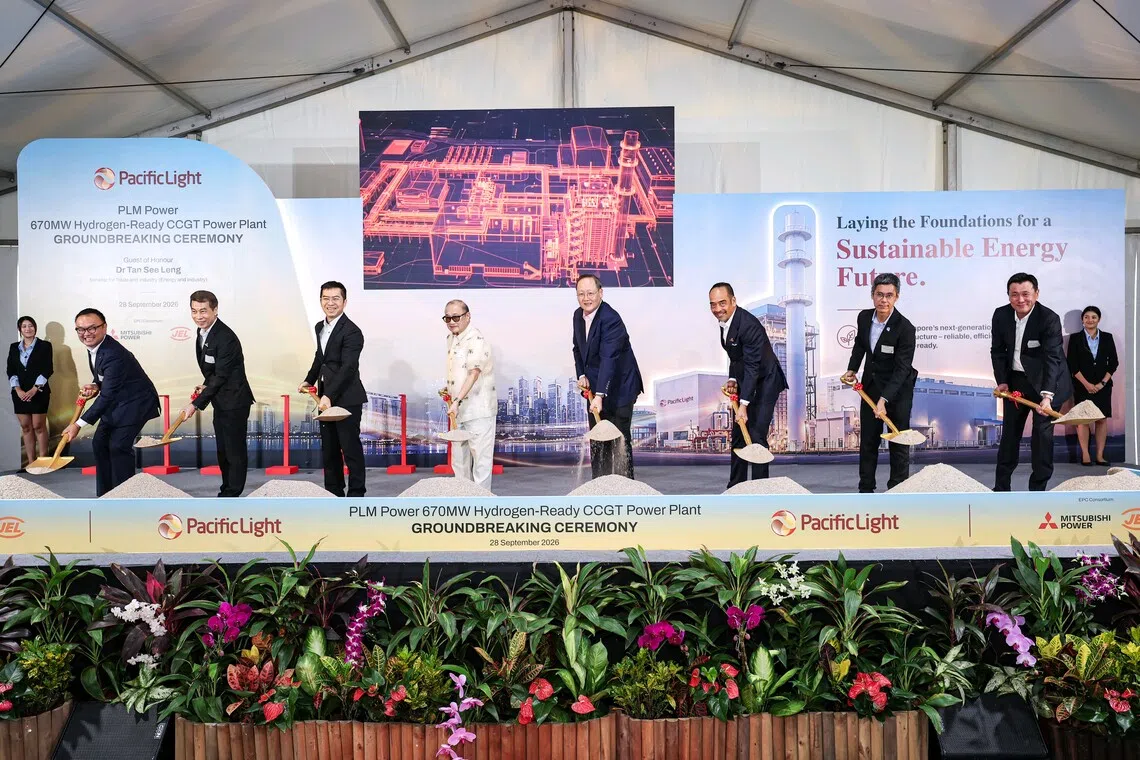
Minister for Trade and Industry Tan See Leng (fourth from right) said the plant will also increase PacificLight Power’s total generation capacity by 70%.
Published Sep 28, 2026, 01:30 PM
Updated Sep 28, 2026, 01:31 PM
SINGAPORE – Local electricity generator PacificLight Power on Sept 28 began constructing on Jurong Island a new gas-fired power generation facility , which it said will also be the country’s firs t such plant to be paired with a battery storage system.
Battery storage systems are usually paired with renewable energy systems, such as a solar plant. This is because renewable energy sources like solar and wind are intermittent and batteries can help to store power when the output is high and release it back into the electricity grid when needed.
But PacificLight Power said incorporating a battery storage system into its new plant will allow it to install a larger gas turbine without compromising the stability of the system. Such a storage system will also allow the plant to serve as a buffer as Singapore continues to increase solar deployment.
There are currently more than 20 gas-fired power plants generating electricity for Singapore.
When it begins operations in 2029, PacificLight’s plant will be the largest one fired by a single power generation unit. The 670 megawatt (MW) combined cycle gas turbine (CCGT) facility will generate enough electricity to power up to 1.2 million four-room flats for a year.
The power plant – which costs $1.2 billion — will be the largest single and most efficient CCGT facility in Singapore, said the company. It is being built by Mitsubishi Power and Jurong Engineering Limited.
The plant will also increase PacificLight Power’s total generation capacity by 70%, said Minister for Trade and Industry (Energy and Industry) Tan See Leng, who was the guest of honour at the groundbreaking event.
PacificLight Power currently generates close to 10% of Singapore’s annual electricity demand.
Singapore’s peak demand in 2025 was around 8GW. Peak demand refers to the highest amount of electricity used in a specific period, much like the “rush hour” of power used.
The Republic’s existing power facilities can generate about 13 GW of energy. But by 2031, the peak demand is projected to reach between 9.9 GW and 13 GW, according to the Energy Market Authority (EMA), Singapore’s energy regulator.
Tan said that Singapore’s peak electricity demand is projected to grow at a faster pace in the coming years, driven by advanced manufacturing, the digital economy, rapid rise in AI and transport electrification.
“This is not unique to Singapore. Around the world, countries are racing to secure the energy capacity needed to power this next wave of economic growth,” he said. “As energy increasingly shapes important investment decisions, it will be important to provide the power at the scale and the speed that are needed to meet our business needs.”
EMA forecasts that Singapore’s peak electricity demand is expected to grow by between 2.4% and 6.5% annually over the next 10 years.
Tan also noted the need to to strength the operational resilience of power infrastrastruture here.
Pairing a battery storage system with the gas turbine strengthens the facility’s “ability to respond to contingencies and support system recovery when needed” , he added.
The 80MW battery storage system can store electricity during periods of low demand and release it whenever needed, allowing the facility to better match power demand and supply and keep operations more stable.
PacificLight Power said the battery storage system will be capable of responding within two seconds.
Other than building new fossil fuel-powered generation facilities to meet rising electricity demand, Singapore is also looking to tap alternative sources of energy with a lower carbon footprint.
This includes tapping hydrogen, which is considered a clean fuel as it does not produced any planet-warming carbon dioxide when burned.
PacificLight said its upcoming plant will also be hydrogen-compatible.
This means the facility can burn a mixed fuel composition comprising up to 30% hydrogen with natural gas making up the rest, to generate electricity.
The company is working toward having the plant burn 100% hydrogen in the future, as the power sector works towards net-zero carbon emissions. This sector currently generates 40% of Singapore’s total emissions.
Hydrogen as a fuel can be generated by different means. The fuel is considered green only if renewable energy is used to split water (H2O) into oxygen and hydrogen.
PacificLight Power’s chief executive Yu Tat Ming said that the current costs of producing green hydrogen remain high and the necessary infrastructure to support large-scale adoption still needs to be developed.
“As and when these commercial and logistical matters are resolved we will be able to implement the transition to hydrogen or other alternative green fuels,” he said.
Speaking at the groundbreaking ceremony, Tan also noted that the Ministry of Trade and Industry will become the Ministry of Energy, Trade and Industry (METI) on Oct 1.
The change was announced on July 22 by Prime Minister Lawrence Wong who had said that energy is becoming increasingly central to Singapore’s economic competitiveness, industrial transformation and long-term resilience.
“This change reflects the greater focus we are placing on energy, given its vital role in our economic growth, climate goals and national resilience,” said Tan.
Chin Hui Shan is a journalist covering the environment beat at The Straits Times.
Electricity and power
贸工部长陈诗龙(右四)表示,该电厂还将使太平洋电力公司的总发电能力提高 70%。
发布于2026年9月28日下午1:30
更新于2026年9月28日下午1:31
新加坡——本地电力生产商 PacificLight Power 于 9 月 28 日在裕廊岛开始建设一座新的燃气发电厂,该公司表示,该发电厂也将是该国首个配备电池储能系统的此类电厂。
电池储能系统通常与可再生能源系统(例如太阳能电站)配套使用。这是因为太阳能和风能等可再生能源具有间歇性,而电池可以在发电量高时储存电能,并在需要时将其释放回电网。
但太平洋电力公司表示,在其新电厂中集成电池储能系统,将使其能够在不影响系统稳定性的前提下安装更大的燃气轮机。随着新加坡太阳能发电部署的持续增长,该储能系统还能使电厂发挥缓冲作用。
目前新加坡有超过20座燃气发电厂为新加坡供电。
PacificLight的电厂将于2029年投入运营,届时它将成为由单个发电单元燃烧的最大电厂。这座670兆瓦(MW)的联合循环燃气轮机(CCGT)电厂将产生足够的电力,可供多达120万套四房式组屋使用一年。
该公司表示,这座耗资12亿美元的发电厂将成为新加坡规模最大、效率最高的单体燃气轮机联合循环发电厂。该电厂由三菱电力公司和裕廊工程有限公司联合承建。
贸易及工业部(能源及工业)部长陈诗玲在奠基仪式上表示,该电厂还将使太平洋电力公司的总发电能力提高 70%。陈诗玲部长是奠基仪式的荣誉嘉宾。
PacificLight Power 目前满足新加坡近 10% 的年度电力需求。
新加坡2025年的用电高峰约为8吉瓦。用电高峰是指在特定时期内使用的最高电量,类似于用电的“高峰时段”。
新加坡现有的电力设施可以发电约13吉瓦。但据新加坡能源市场管理局(EMA,新加坡的能源监管机构)预测,到2031年,峰值需求预计将达到9.9吉瓦至13吉瓦之间。
陈先生表示,受先进制造业、数字经济、人工智能快速发展和交通电气化等因素的推动,新加坡未来几年的电力需求峰值预计将以更快的速度增长。
“这并非新加坡独有的现象。世界各国都在竞相确保能源供应,以支撑下一波经济增长,”他说道。“随着能源在重要的投资决策中扮演越来越重要的角色,以足够的规模和速度提供电力,满足我们的业务需求至关重要。”
EMA预测,未来10年新加坡的用电高峰需求预计将以每年2.4%至6.5%的速度增长。
谭先生还指出,需要加强这里电力基础设施的运行韧性。
他补充说,将电池储能系统与燃气轮机相结合,可以增强该设施“应对突发事件和在需要时支持系统恢复的能力”。
80MW电池储能系统可在用电低谷期储存电力,并在需要时释放电力,使该设施能够更好地匹配电力需求和供应,并保持运行更加稳定。
PacificLight Power公司表示,该电池储能系统能够在两秒内做出响应。
除了建造新的化石燃料发电设施以满足不断增长的电力需求外,新加坡还在寻求开发碳足迹更低的替代能源。
这包括利用氢气,氢气被认为是一种清洁燃料,因为它燃烧时不会产生任何导致全球变暖的二氧化碳。
PacificLight表示,其即将投产的工厂也将与氢能兼容。
这意味着该设施可以燃烧由高达 30% 的氢气和其余部分的天然气组成的混合燃料来发电。
随着电力行业朝着净零碳排放的目标迈进,该公司正致力于使该电厂未来100%燃烧氢气。目前,电力行业占新加坡总排放量的40%。
氢气作为一种燃料,可以通过多种方式制取。只有当使用可再生能源将水(H₂O)分解成氧气和氢气时,这种燃料才被认为是绿色燃料。
PacificLight Power首席执行官余达明表示,目前生产绿色氢气的成本仍然很高,支持大规模应用所需的必要基础设施仍需开发。
他说:“一旦这些商业和物流问题得到解决,我们将能够实施向氢能或其他替代绿色燃料的过渡。”
在奠基仪式上,陈先生还指出,贸易和工业部将于10月1日更名为能源、贸易和工业部(METI)。
7月22日,新加坡总理黄循财宣布了这一变化,他表示能源对新加坡的经济竞争力、产业转型和长期韧性正变得越来越重要。
“这一变化反映了我们对能源的日益重视,因为能源在我们的经济增长、气候目标和国家韧性方面发挥着至关重要的作用,”谭说道。
Chin Hui Shan是《海峡时报》负责环境报道的记者。
电力