Emergency visits for asthma, chronic respiratory disease rise with higher PM2.5 levels: S’pore study新加坡研究显示,随着PM2.5浓度升高,哮喘和慢性呼吸系统疾病的急诊就诊量增加。
PM2.5 is one of six pollutants measured in Singapore’s Pollutant Standards Index . Read more at straitstimes.com.
新闻视频
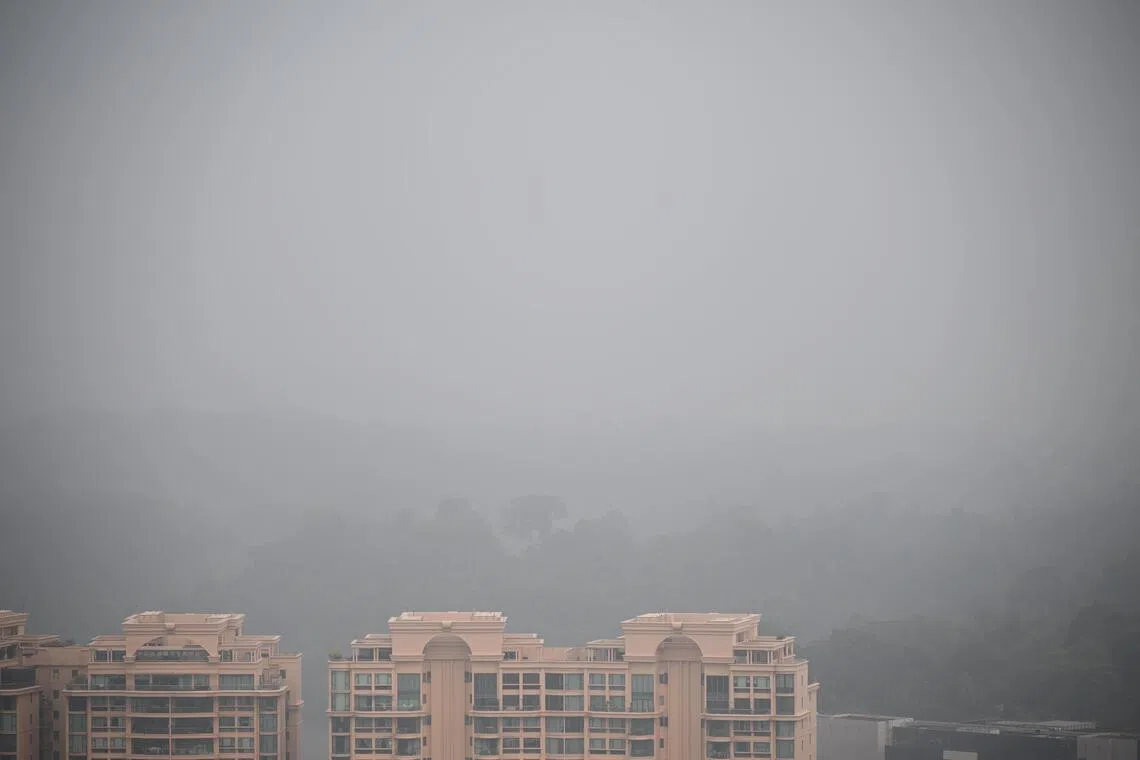
The haze in Toa Payoh at 8am on Sept 29.
ST PHOTO: KUA CHEE SIONG
Published Sep 29, 2026, 02:50 PM
Updated Sep 29, 2026, 02:50 PM
Small increases in PM2.5 air pollution were followed by a 3.2% rise in emergency visits for asthma and chronic respiratory diseases within two days, with asthma visits rising by 4.4%.
The study analysed 74,839 emergency visits for such conditions from 2016 to 2022, showing pollution impacts on respiratory health regardless of sex, age, or income.
Researchers recommend using real-time air quality data for health alerts and planning emergency care.
SINGAPORE - Increased emergency department visits in Singapore for asthma and chronic respiratory disease have been linked to small spikes in fine-particle air pollution , according to a Sept 28 study led by local researchers.
This finding shows that people should monitor air quality advisories, and take precautions early rather than waiting until symptoms worsen, said the study’s co-author Yohei Okada, a Duke-NUS Medical School assistant professor in prehospital and emergency research.
This is especially since the impact of a small increase in PM2.5 concentrations c an only become apparent a couple of days after the spike i n the haze pollutants , he added.
PM2.5 – particulate matter no bigger than 2.5 microns in diameter, smaller than the width of a strand of hair – is an ultra-fine pollutant that can penetrate deep into human lungs.
It is one of the six pollutants measured in Singapore’s Pollutant Standards Index (PSI), and is the dominant toxin during periods of transboundary h a ze.
On Sept 29, the 24-hour PSI reading hit a new peak for the current haze season , as air quality across Singapore’s five regions entered the unhealthy range for the first time in two weeks.
Past studies have shown that long-term exposure to PM2.5 on a regular basis has been linked to increased risk of death from heart and lung complications such as lung cancer or heart disease.
But the new study, published on Sept 28 in the medical journal JAMA Network Open, indicates that even shorter-term exposure could also be linked to more emergency room visits.
It was conducted by researchers from Duke-NUS Medical School, Singapore General Hospital, the University of Miami, and Duke University.
Said the Duke-NUS Medical School in a statement: “The findings provide new insights into the health effects of short-term air pollution in a tropical South-east Asian setting with relatively low background pollution, a context that remains understudied compared with other regions of the world.”
What the study found
Healthy air quality, according to the World Health Organisation, should not have PM2.5 concentrations exceeding 15 micrograms (mcg) per cubic m. The researchers used this figure as a reference level for their study.
But during periods of haze such as that experienced in Singapore from September , PM2.5 readings have reached over 100. On Sept 29, PM2.5 concentrations in eastern Singapore was 70 mcg per cubic m as at 1pm.
Researchers found that for each 10 mcg per cubic m increase in PM2.5 above the 15 mcg per cubic m reference level, emergency department visits for asthma and chronic obstructive pulmonary disease increased by 3.2 per cent over the following two days.
For the study, the researchers compiled the asthma and chronic obstructive pulmonary disease-related emergency department visits from February 2016 to December 2022.
A total of 74,839 visits were analysed, of which 43,446 resulted in hospital admissions, and 1,369 patients died within 30 days.
The data was extracted from all public hospitals via a government administrative and health data platform.
They also retrieved data on PM2.5 levels and other environmental parameters, such as temperature, humidity and rainfall, from the website of the National Environment Agency.
Statistical analyses were performed to see if there was any correlation in the data.
They found that asthma-related emergency department visits specifically rose by 4.4 per cent over the two-da y window between an increase in PM2.5 concentration and emergency room visits.
Chronic obstructive pulmonary disease-related visits also tended to increase, though the association was less clear at these lower PM2.5 concentrations.
The researchers observed stronger evidence of an increase in such visits at higher pollution levels, which suggested that the respiratory effects of PM2.5 could become more apparent with increased exposure.
While the researchers also analysed subsequent hospital admissions and 30-day mortality, they observed no statistically significant associations with the pollution spikes.
Of the data collected, nearly 60 per cent of these patients were male and more than 75 per cent had a monthly household income of less than $2,000.
However, the study found no evidence that the pollution-related risk differed significantly based on sex, age, income, or other existing diseases.
The researchers noted several limitations. While the data had captured most of Singapore’s emergency care, it excluded visits to clinics, polyclinics and urgent care centres.
They also acknowledged that their analysis of only one pollutant, consistent with standard practice, meant that the effects of other ambient pollutants cannot be ruled out.
They noted that lingering effects of the Covid-19 pandemic could have affected the study as they had only adjusted the data for the period of 2020 to 2021.
The authors concluded that the findings support integrating real-time air quality data into alerts for patients and using the information to plan for respiratory case surges in emergency departments.
Said Professor Marcus Ong, Director of the Health Services Research and Population Health programme at Duke-NUS Medical School, said: “Haze is not only an environmental issue; poorer air quality can translate into additional demand on emergency healthcare within days.”
The NEA provides one-hour PM2.5 reading on its website, which shows the average concentration of such particles measured in the air over the past hour.
Readings are considered high when they reach between 151 mcg and 250 mcg. When readings are high, people are advised to avoid strenuous outdoor activity for the next hour.
Respiratory illnesses
9月29日上午8点,大巴窑的雾霾。
《海峡时报》摄影:郭志雄
发布于2026年9月29日下午2:50
更新于2026年9月29日下午2:50
PM2.5 空气污染小幅增加后,两天内哮喘和慢性呼吸系统疾病的急诊就诊量增加了 3.2%,其中哮喘就诊量增加了 4.4%。
该研究分析了 2016 年至 2022 年间 74,839 例此类疾病的急诊就诊记录,结果表明,无论性别、年龄或收入如何,污染都会对呼吸系统健康产生影响。
研究人员建议使用实时空气质量数据进行健康警报和应急护理计划。
新加坡——根据当地研究人员于 9 月 28 日进行的一项研究,新加坡因哮喘和慢性呼吸系统疾病而前往急诊室就诊的人数增加与细颗粒物空气污染的小幅激增有关。
该研究的共同作者、杜克-新加坡国立大学医学院院前和急诊研究助理教授冈田洋平表示,这一发现表明人们应该关注空气质量警报,并及早采取预防措施,而不是等到症状恶化才采取行动。
他补充说,尤其值得注意的是,PM2.5 浓度的小幅上升的影响可能要到雾霾污染物激增后的几天才会显现出来。
PM2.5——直径不超过2.5微米的颗粒物,比一根头发丝的宽度还要小——是一种超细污染物,可以深入人体肺部。
它是新加坡污染物标准指数 (PSI) 中测量的六种污染物之一,也是跨境雾霾期间的主要毒素。
9 月 29 日,新加坡五大区域的空气质量两周来首次进入不健康范围,24 小时 PSI 读数达到本雾霾季的新高峰。
过去的研究表明,长期定期接触 PM2.5 与死于心肺并发症(如肺癌或心脏病)的风险增加有关。
但这项于 9 月 28 日发表在医学期刊《JAMA Network Open》上的新研究表明,即使是短期接触也可能导致急诊室就诊次数增加。
该研究由杜克-新加坡国立大学医学院、新加坡中央医院、迈阿密大学和杜克大学的研究人员共同完成。
杜克-新加坡国立大学医学院在一份声明中表示:“研究结果为热带东南亚地区短期空气污染对健康的影响提供了新的见解,该地区的背景污染相对较低,与世界其他地区相比,这一背景的研究仍然不足。”
研究结果
根据世界卫生组织的定义,健康的空气质量是指PM2.5浓度不应超过每立方米15微克(mcg)。研究人员将此数值作为他们研究的参考水平。
但在像新加坡从 9 月开始经历的那种雾霾期间,PM2.5 读数已超过 100。9 月 29 日下午 1 点,新加坡东部的 PM2.5 浓度为每立方米 70 微克。
研究人员发现,PM2.5 每增加 10 微克/立方米(高于 15 微克/立方米的参考水平),接下来的两天内,因哮喘和慢性阻塞性肺病而前往急诊室就诊的人数就会增加 3.2%。
在这项研究中,研究人员收集了 2016 年 2 月至 2022 年 12 月期间与哮喘和慢性阻塞性肺病相关的急诊就诊记录。
共分析了 74,839 次就诊,其中 43,446 次导致住院,1,369 名患者在 30 天内死亡。
数据是通过政府行政和卫生数据平台从所有公立医院提取的。
他们还从国家环境局网站获取了 PM2.5 水平和其他环境参数(如温度、湿度和降雨量)的数据。
我们进行了统计分析,以查看数据中是否存在任何相关性。
他们发现,在 PM2.5 浓度升高到急诊室就诊的两天窗口期内,与哮喘相关的急诊就诊量专门上升了 4.4%。
慢性阻塞性肺病相关就诊次数也有所增加,尽管在较低的 PM2.5 浓度下,这种关联不太明显。
研究人员观察到,污染水平越高,此类就诊次数就越多,这表明随着接触 PM2.5 的增加,PM2.5 对呼吸系统的影响可能会变得更加明显。
虽然研究人员还分析了后续的住院情况和 30 天死亡率,但他们没有观察到与污染高峰之间存在统计学上的显著关联。
在收集到的数据中,近 60% 的患者为男性,超过 75% 的患者家庭月收入低于 2000 美元。
然而,该研究并未发现污染相关风险因性别、年龄、收入或其他现有疾病而存在显著差异的证据。
研究人员指出了一些局限性。虽然数据涵盖了新加坡大部分的急诊护理,但它不包括诊所、综合诊所和紧急护理中心的就诊记录。
他们也承认,按照标准做法,他们只分析了一种污染物,这意味着不能排除其他环境污染物的影响。
他们指出,新冠肺炎疫情的持续影响可能对研究结果产生了影响,因为他们只调整了 2020 年至 2021 年期间的数据。
作者们得出结论,研究结果支持将实时空气质量数据整合到患者警报中,并利用这些信息来规划急诊科呼吸道疾病病例激增的情况。
杜克-新加坡国立大学医学院卫生服务研究和人口健康项目主任马库斯·翁教授表示:“雾霾不仅是一个环境问题;空气质量恶化会在几天内转化为对紧急医疗保健的额外需求。”
新加坡国家环境局在其网站上提供一小时 PM2.5 读数,显示过去一小时内空气中此类颗粒物的平均浓度。
当读数达到 151 微克至 250 微克之间时,即被认为是高读数。当读数偏高时,建议人们在接下来的一个小时内避免剧烈的户外活动。
呼吸系统疾病