Public transport fares to rise by 12 to 13 cents per ride for adult card users from Dec 26自12月26日起,成人乘车卡用户每次乘车票价将上涨12至13美分。
The record increase in cash terms for public transport fares was driven mainly by a substantial increase in energy prices between July 2025 and June 2026 due to the Middle East conflict, said the Public Transport Council.
新闻视频
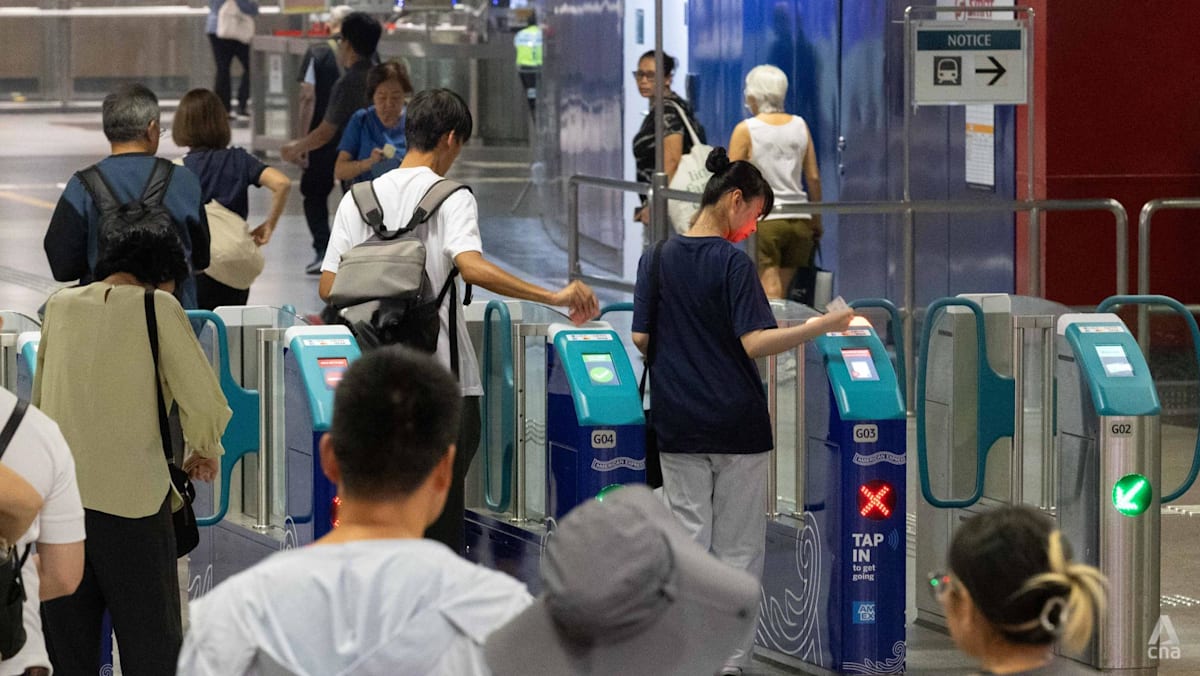
The record increase in cash terms for public transport fares was driven mainly by a substantial increase in energy prices between July 2025 and June 2026 due to the Middle East conflict, said the Public Transport Council.
Commuters at Harbourfront station on Sep 29, 2026. (Photo: CNA/Ili Mansor)
This audio is generated by an AI tool.
SINGAPORE: Public transport fares will rise by 12 to 13 cents per journey for adult card users from Dec 26, a record increase in cash terms, the Public Transport Council (PTC) announced on Tuesday (Sep 29).
Adult commuters travelling up to 3.2km will pay 12 cents more per journey, while those travelling farther will pay 13 cents more per journey.
Overall, public transport fares will increase by 7 per cent, higher than last year's 5 per cent increase.
The PTC said the higher fare formula output was driven by a "substantial increase" in energy prices between July 2025 and June 2026 due to the Middle East conflict.
CNA Games Guess Word Crack the word, one row at a time Buzzword Create words using the given letters Mini Sudoku Tiny puzzle, mighty brain teaser Mini Crossword Small grid, big challenge Word Search Spot as many words as you can Show More Show Less In the last five review exercises from 2022 to 2026, fare adjustments ranged between 2.9 per cent and 7 per cent. This year’s cent increase surpasses the hike in 2023, when adult card fares rose by 10 to 11 cents .
In the last five review exercises from 2022 to 2026, fare adjustments ranged between 2.9 per cent and 7 per cent. This year’s cent increase surpasses the hike in 2023, when adult card fares rose by 10 to 11 cents .
For concession cardholders, including students, seniors and people with disabilities, card fares will rise by 5 cents per journey.
Card fares for lower-wage workers under the Workfare Transport Concession Scheme (WTCS) will remain unchanged, with the government absorbing the increase for about 190,000 cardholders.
Cash fares will increase by 20 cents per journey for adults and 10 cents per journey for students, seniors and people with disabilities. Less than 1 per cent of public transport journeys are paid for in cash, according to PTC.
Prices of all monthly passes will remain unchanged. There are currently about 126,000 monthly pass users, and the PTC estimates that another 110,000 card commuters could potentially save money by switching to a monthly hybrid pass following the fare increase.
The hybrid monthly pass provides unlimited travel on both basic bus and train services over a one-month period.
PTC said it encourages commuters who travel frequently to consider buying monthly passes to help manage public transport expenses.
Over the past three years, the number of monthly passes sold has more than doubled from 56,000 in 2023 to 126,000 this year.
The average monthly savings of a pass user, as compared to paying card fares, has also increased from S$11 to S$26 over the same period, it added.
The council said commuters can use the transit expense summary feature in the SimplyGo app to track their expenditure on public transport, in order to decide whether a monthly pass represents better value over paying card fares.
Public transport vouchers for eligible lower-income households will increase from S$60 (US$ 47) to S$80 per household this year.
Under the fare adjustment formula, which applies from 2023 to 2027, the 2026 fare adjustment quantum generated by the formula was 5.3 per cent.
The formula takes into account changes in the core consumer price index, wages and energy costs, as well as productivity and public transport capacity.
Taking into account the 9.4 percentage-point adjustment carried over from previous fare review exercises, the maximum allowable fare adjustment quantum was 14.7 per cent.
The PTC decided to grant a fare adjustment quantum of 7 per cent and defer the remaining 7.7 percentage points to future fare review exercises.
"Over the past five years, the Public Transport Council has moderated fare increases to strike a balance between keeping public transport fares affordable for commuters and ensuring the financial sustainability of Singapore's public transport system amid rising operating and energy costs," the council said.
"Commuters have been shielded from the full increase in costs, whenever fares were not fully adjusted by the quantum determined by the fare formula."
The fare adjustment formula protects the interests of commuters by capping the adjustment, rather than leaving it to the operators to pass through all cost increases to commuters to bear.
During a press conference on Tuesday, PTC chairperson Janet Ang said in the past year, energy prices rose sharply by 21 per cent due to the Middle East conflict, contributing significantly to the increased cost of operating and maintaining Singapore’s public transport system.
“Now the council is mindful, of course, of how rising costs affect commuters. So over the past three years, as you know, the council has consistently moderated fare adjustments to keep increases manageable for commuters,” she said.
According to the PTC, SBS Transit Rail and SMRT Trains had applied for the maximum fare adjustment of 14.7 per cent, citing cost pressures including rising energy costs and a competitive labour market.
Both operators recorded “relatively thin” EBIT (earnings before interest and taxes) margins in their latest financial year even after taking into account government support, the PTC added.
The 7 per cent adjustment will translate into about S$176.9 million more in fare revenue a year.
The increase in annual revenue for SBS Transit Rail and SMRT Trains is S$26.9 million and S$52.9 million respectively, while fare revenue for bus services and the Thomson-East Coast Line collected by the Land Transport Authority will rise by S$97.1 million to sustain the cost of operations.
"These revenues are not sufficient to cover the costs of providing high-quality public transport services," said the PTC.
To cover the deferred 7.7 percentage point fare adjustment, the government will provide a further additional subsidy of close to S$200 million for 2027.
This is on top of the more than S$2 billion in annual operating subsidies for public transport, as well as capital expenditures averaging S$5 billion annually over the next five years.
In a separate release on Tuesday, the Ministry of Transport (MOT) said the additional support would help commuters and operators by covering the cost of deferring the full allowable fare increase.
"Sustaining a reliable and efficient public transport system requires shared contribution from commuters, the government and public transport operators," said MOT.
"Raising fares is also necessary to ensure that our public transport workforce continues to receive fair wages and salary increments annually."
(From left) PTC’s council member, Dr Timothy Wong and Mr Lim Boon Wee, chairperson, Ms Janet Wong, chief executive, Mr Leow Yew Chin, council member, Dr Vincent Chua Cheng Huat and Mr Naseer Bin Ghani, at the 2026 Fare Review Exercise (FRE) on Sep 29, 2026. (Photo: CNA/Ili Mansor)
The PTC said the proportion of household income spent on public transport has remained at 2.4 per cent for lower-income households and 1.7 per cent for average-income households over the past decade. It added that it would continue to monitor fare affordability.
The government will set aside an additional S$15 million for public transport vouchers this year compared to last year, with each eligible household receiving S$80 in vouchers, up from S$60 last year.
The income eligibility ceiling for public transport vouchers will also be raised from a monthly household income per person of S$1,800 to S$2,100.
About four in 10 households will qualify for the vouchers as a result, including about 60,000 additional households, according to a joint release by MOT and the People's Association on Tuesday.
Households can use the vouchers to top up fare cards or buy monthly passes.
The distribution of the vouchers will take place in two stages. In the first stage, households that received a voucher in the 2025 exercise and continue to meet the income criterion will automatically receive another voucher.
Notification letters will be sent by post or SMS from the end of December, based on the contact preference indicated in the previous exercise.
In the second stage, from early 2027, eligible households that did not receive a voucher in the first stage can apply online or in person at their local community centres or clubs. The vouchers will be valid until Mar 31, 2028.
Public transport operators will also contribute to the support measures. SBS Transit Rail and SMRT Trains are required to contribute 30 per cent of their expected increase in fare revenue to the Public Transport Fund, amounting to S$23.94 million in total.
The PTC recommended that the government draw on the public transport fund to provide additional support to cushion the impact of the fare increase for lower-income households.
Get our pick of top stories and thought-provoking articles in your inbox
Stay updated with notifications for breaking news and our best stories
Join our channel for the top reads for the day on your preferred chat app
公共交通委员会表示,公共交通票价现金价格创纪录上涨的主要原因是,由于中东冲突,2025 年 7 月至 2026 年 6 月期间能源价格大幅上涨。
2026年9月29日,港湾站的通勤者。(图片:CNA/Ili Mansor)
这段音频是由人工智能工具生成的。
新加坡:公共交通理事会(PTC)周二(9月29日)宣布,从12月26日起,成人乘车卡用户的公共交通票价将上涨12至13分,这将是现金价格的最高涨幅。
成年通勤者,出行距离不超过 3.2 公里,每次行程将多付 12 分钱;出行距离超过 3.2 公里,每次行程将多付 13 分钱。
总体而言,公共交通票价将上涨 7%,高于去年 5% 的涨幅。
PTC表示,由于中东冲突,2025年7月至2026年6月期间能源价格“大幅上涨”,导致票价公式计算结果上涨。
CNA游戏 猜词游戏 逐行破解单词 流行词游戏 用给定的字母组成单词 迷你数独 小谜题,脑力挑战 迷你填字游戏 小方格,大挑战 单词搜索 尽可能多地找出单词 显示更多 显示更少 在2022年至2026年的最后五次审查练习中,票价调整幅度在2.9%至7%之间。今年的涨幅超过了2023年的涨幅,当时成人卡票价上涨了10至11美分。
从2022年到2026年的最近五次票价调整中,票价调整幅度在2.9%到7%之间。今年的涨幅为1美分,超过了2023年的涨幅,当时成人卡票价上涨了10到11美分。
对于包括学生、老年人和残疾人在内的优惠卡持有者,每次乘车的票价将上涨 5 分。
根据“工作补贴交通优惠计划”(WTCS),低收入工人的交通卡票价将保持不变,政府将承担约 19 万持卡人的票价上涨部分。
成人现金票价将上涨20美分/次,学生、老年人和残疾人现金票价将上涨10美分/次。据公共交通委员会(PTC)统计,只有不到1%的公共交通行程使用现金支付。
所有月票价格将保持不变。目前约有12.6万月票用户,公共交通委员会(PTC)估计,票价上涨后,另有11万持卡通勤者可以通过转用混合型月票来节省费用。
这种混合型月票可在一个月内无限次乘坐基本公交和火车服务。
PTC表示,鼓励经常通勤的乘客考虑购买月票,以帮助控制公共交通费用。
过去三年,月票销量翻了一番还多,从 2023 年的 56,000 张增加到今年的 126,000 张。
报告还指出,与使用公交卡购票相比,同期公交卡用户的平均每月节省金额也从 11 新元增加到 26 新元。
市议会表示,通勤者可以使用 SimplyGo 应用程序的交通费用汇总功能来跟踪他们在公共交通上的支出,以便决定月票是否比单次购票更划算。
今年,符合条件的低收入家庭的公共交通补贴将从每户 60 新元(47 美元)增加到 80 新元。
根据 2023 年至 2027 年适用的票价调整公式,该公式计算出的 2026 年票价调整幅度为 5.3%。
该公式考虑了核心消费者价格指数、工资和能源成本的变化,以及生产率和公共交通能力的变化。
考虑到从之前的票价审查工作中结转的 9.4 个百分点的调整,最高允许的票价调整幅度为 14.7%。
PTC决定批准7%的票价调整幅度,并将剩余的7.7个百分点推迟到未来的票价审查工作中进行。
“过去五年,公共交通理事会一直控制票价上涨幅度,力求在保持公共交通票价对通勤者来说负担得起和确保新加坡公共交通系统在运营和能源成本不断上涨的情况下实现财务可持续性之间取得平衡。”该理事会表示。
“只要票价没有按照票价公式确定的幅度进行完全调整,通勤者就不会承担全部成本上涨的影响。”
票价调整公式通过限制调整幅度来保护通勤者的利益,而不是让运营商将所有成本增加转嫁给通勤者来承担。
周二的新闻发布会上,公共交通委员会主席Janet Ang表示,由于中东冲突,过去一年能源价格大幅上涨了21%,这大大增加了新加坡公共交通系统的运营和维护成本。
“当然,市议会也意识到不断上涨的成本会对通勤者造成影响。因此,正如你们所知,在过去三年里,市议会一直在稳步调整票价,以确保涨幅在通勤者能够承受的范围内,”她说道。
根据公共交通委员会 (PTC) 的说法,新捷运铁路和SMRT地铁已申请最高14.7%的票价调整,理由是能源成本上涨和劳动力市场竞争激烈等成本压力。
PTC补充说,即使考虑到政府的支持,这两家运营商在最近一个财政年度的息税前利润率也“相对较低”。
7% 的调整将使票价收入每年增加约 1.769 亿新元。
新捷运铁路和SMRT地铁的年度收入分别增加2690万新元和5290万新元,而陆路交通管理局收取的巴士服务和汤申-东海岸线的票价收入将增加9710万新元,以维持运营成本。
“这些收入不足以支付提供高质量公共交通服务的成本,”公共交通委员会表示。
为了弥补推迟的 7.7 个百分点的票价调整,政府将在 2027 年提供近 2 亿新元的额外补贴。
除了每年超过 20 亿新元的公共交通运营补贴外,未来五年每年平均还将投入 50 亿新元用于资本支出。
交通部周二在另一份声明中表示,这项额外支持将帮助通勤者和运营商支付推迟全部允许票价上涨的成本。
“维持可靠高效的公共交通系统需要通勤者、政府和公共交通运营商的共同努力,”交通部表示。
“提高票价也是必要的,这样才能确保我们的公共交通从业人员继续获得公平的工资和每年的薪资增长。”
(从左至右)公共交通委员会(PTC)理事会成员黄添福博士、主席林文伟先生、首席执行官黄慧敏女士、理事会成员廖耀进先生、蔡成发博士和纳西尔·本·加尼先生于2026年9月29日出席2026年票价检讨活动(FRE)。(图片:CNA/Ili Mansor)
公共交通委员会(PTC)表示,过去十年间,低收入家庭用于公共交通的家庭收入比例一直维持在2.4%,中等收入家庭的比例一直维持在1.7%。PTC还表示,将继续监测票价的可负担性。
今年政府将比去年额外拨出 1500 万新元用于公共交通代金券,每个符合条件的家庭将获得 80 新元的代金券,高于去年的 60 新元。
公共交通券的收入资格上限也将从每人每月家庭收入 1800 新元提高到 2100 新元。
据交通部和人民协会周二联合发布的消息,此举将使约十分之四的家庭有资格获得补贴券,其中包括约 6 万个新增家庭。
家庭可以使用这些代金券为车票充值或购买月票。
代金券的发放将分两个阶段进行。第一阶段,在2025年发放过代金券且继续符合收入标准的家庭将自动获得另一张代金券。
从 12 月底开始,我们将根据上次调查中选定的联系方式,通过邮寄或短信方式发送通知信。
第二阶段从2027年初开始,符合条件但未在第一阶段获得代金券的家庭可以通过网络或亲自前往当地社区中心或俱乐部申请。代金券有效期至2028年3月31日。
公共交通运营商也将为这些支持措施做出贡献。新捷运铁路和SMRT地铁公司须将其预期票价收入增长的30%捐献给公共交通基金,总计2394万新元。
公共交通委员会建议政府动用公共交通基金,为低收入家庭提供额外支持,以缓解票价上涨带来的影响。
订阅我们的邮件,即可获取精选热点新闻和引人深思的文章。
订阅通知,第一时间获取突发新闻和精彩报道。
加入我们的频道,即可在您常用的聊天应用上获取当日热门文章。