How The Air Force Fires Live Missiles To Make Sure Pilots And Weapons Function In Actual Combat空军如何发射实弹导弹以确保飞行员和武器在实战中发挥作用
Live-fire training is about giving aircrews vital experience outside of the heat of combat and making sure the weapons they would use actually work.
新闻视频
Updated May 18, 2021 6:39 PM EDT
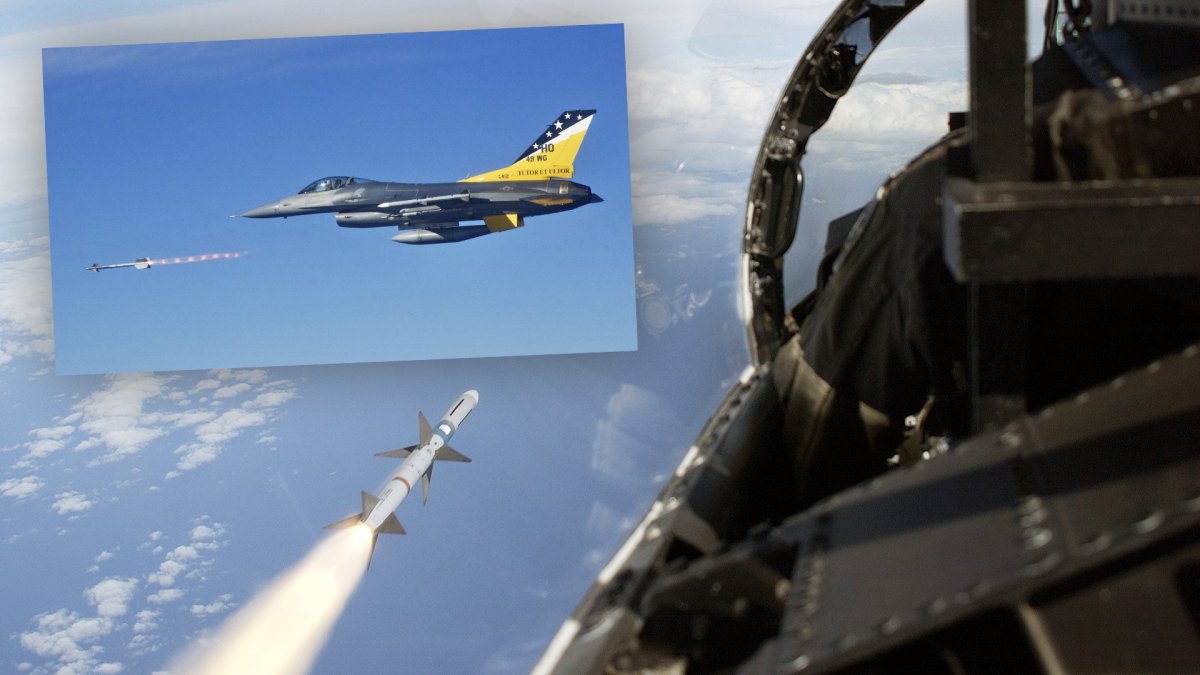
“Fox 3!” a pilot exclaims as a radar-guided missile streaks off the wing of a fighter jet. In seconds the weapon is traveling at supersonic speed, hurtling to deliver a lethal blow to its intended target. However, this isn’t actual real-world combat, this is training for a fledgling aviator gaining vital experience, or testing a new piece of equipment or software, ensuring an air-to-air missile will work exactly as planned not during a canned training event, but in the heat of combat.
The world of advanced air-to-air combat is a notoriously complex affair. The missile technology that underpins it, from short-range heat-seeking AIM-9 Sidewinders to long-range, radar-guided, AIM-120 Advanced Medium-Range Air-to-Air Missiles (AMRAAMs), represents the tip of the aerial combat spear. Harnessing that edge is a critical part of maintaining air supremacy, and it’s something the U.S. military takes very seriously.
An F-15E of the 40th Flight Test Squadron fires an AIM-120 AMRAAM., USAF/SSgt John McRell
Therefore, the end-to-end testing of the entire system, from pulling a weapon from its transportation container, loading it on the aircraft, flying it, engaging a target, and ultimately firing the weapon, making sure it is guiding to the target, and ultimately destroying its victim, is important in many ways. It proves the system works, plus it gives new aviators experience of the rush of using live weapons in a far better situation than the heat of combat.
The U.S. Air Force has recently transformed its premier live-fire weapons events as part of an effort to better combine cutting-edge squadron training with the latest operational testing. These types of mass live-fire drills started out as the famous William Tell missile-firing exercises that commenced in the 1950s, which saw rows of Century Series fighters congregating at Tyndall Air Force Base, Florida. Today’s Weapons System Evaluation Program , or WSEP, is still staged primarily out of the same Florida airbase, and it has cemented its position as the premier event for live-fire weapons employment for combat aviators across the U.S. military.
WSEP was established as a feedback mechanism to improve upon identified deficiencies in the Department of Defense’s air-to-air combat enterprise. It also serves to build confidence for young aviators by providing the experience of actually employing air-to-air weapons — imparting a better understanding of what their weapons are capable of, as well as learning first hand about a weapon’s behavior and performance.
“I’ve seen several young pilots assess their shots as “guiding” towards the target, when in reality — as a chase pilot — I watched their missile leave their aircraft and not guide towards the target at all,” Lieutenant Colonel Orion “Rhino” Vail, commander of Tyndall’s 83rd Fighter Weapons Squadron (FWS), told The War Zone in an exclusive interview. “These are fantastic learning opportunities for young pilots in the debrief, now that they have seen what the missile was not supposed to do, they will be better prepared to recognize that and take a follow-up shot if they see something like that in actual combat.”
“Our mission is to conduct air-to-air and air-to-surface weapons evaluation for Combat Air Force [CAF] fleet aircrews, platforms, and weapons. We prioritize the first-time shooter experience and evaluation of aircrews, while also integrating with the operational test community to inform strategic weapons decisions,” says Vail, an F-22 Raptor pilot and Weapons School graduate, whose squadron is now mandated with overseeing WSEP East at Tyndall .
In the past, the USAF ran separate Combat Archer air-to-air and Combat Hammer air-to-ground WSEPs. Now, these have been incorporated into WSEP East, which is overseen by Vail’s squadron, and WSEP West at Hill Air Force Base, Utah, overseen by sister unit the 86th FWS. Both locations can include a mix of these mission sets, but with a bias toward air-to-air at Tyndall and air-to-ground at Hill.
An F-15E drops a GBU-31 JDAM on the Utah Test and Training Range., Jamie Hunter
“CAF Plan 53 is the new guidance that came out in May 2020. This supersedes and replaces COMACC [Commander Air Combat Command] Plan 85, which was the Combat Archer guidance, and Plan 90 which related to Combat Hammer. This has resulted in the shift to the WSEP East and WSEP West construct,” explains Vail. CAF Plan 53 has brought about a dramatic change from the traditionally separate Archer and Hammer events, with as many as 10 WSEPs per year now held at each location as dynamic, integrated events that include live air-to-air and air-to-ground weapons employment, as well as aerial gunnery.
The Tyndall event is run over the nearby Gulf of Mexico range complex, with the Hill WSEP making use of the expansive Utah Test and Training Range (UTTR). Both of these now include close cooperation with the 53rd Wing , the USAF’s primary Operational Test and Evaluation (OT&E) organization.
“There wasn’t a lot of crossing of the lines with regard to the operational test and the evaluation piece,” Vail adds, “[But] we now act more as the “E” in OT&E, as part of the fantastic vision from the USAF Warfare Center about accelerating the ability to field weapons systems faster.”
An F-35A fires an AIM-120 at a QF-16 target during a live-fire test over the Gulf of Mexico., USAF/MSgt Michael Jackson
Illustrating the new mandate, between March 8-19, 2021, the 53rd Wing’s Weapons Evaluation Group (WEG) hosted simultaneous air-to-air and air-to-ground WSEPs at Tyndall and Hill. The Florida base hosted F-16C/Ds from Holloman Air Force Base, New Mexico, along with F/A-18E/F Super Hornets from the U.S. Navy and F/A-18 “legacy” Hornets and F-35B Lightning IIs from the Marine Corps. F-22A Raptors and F-15C Eagles from the 422nd TES and 433rd Weapons Squadron (WPS) also participated in WSEP East to accomplish operational test and Weapons School objectives.
The March event included some notable weapons evaluations including an extremely long-range AIM-120 AMRAAM shot from an F-15C Eagle and the first-ever employment of the F-35B gun pod in aerial gunnery, both of which took place over the Gulf of Mexico. You can read more about the F-15’s unprecedented AMRAAM shot here . Meanwhile, WSEP West at Hill included air-to-ground work with the first live operational test drop of a GBU-53/B Stormbreaker Small Diameter Bomb (SDB) II from an F-15E Strike Eagle during the exercise.
“We dropped six total SDB IIs against both moving and static targets ,” said Major Derek Anderson, F-15E pilot, and director of operations at the 706th Fighter Squadron. “The SDB II performed as expected and on target using the normal mode and net-enabled features.” The GBU-53/B incorporates advanced smart weapon logic and networking, allowing the weapon to be re-targeted in flight and also provide status feedback to those on the network. At Hill, the 86th FWS also hosted A-10s, B-52Hs, and MQ-9s which dropped munitions to train and evaluate air-to-ground weapons employment.
An F-15E from the 422nd TES carrying a GBU-53/B Stormbreaker weapon., USAF
WSEP East included F-16 instructor pilots and 16 first-time missile shooters from the 314th Fighter Squadron, the Viper training unit at Holloman, as well as F-16 student pilots who flew in the sorties as a learning opportunity. The Super Hornets, Hornets, and F-35Bs fired a mixture of AIM-9 Sidewinder and AIM-120 missiles, along with the aforementioned debut use of the F-35B’s four-barrel 25mm GAU-22/A gun pod in air-to-air gunnery in an operational setting.
The 83rd FWS developed various profiles, to include what it calls high-G “combat-free” mission sets, against QF-16 full-scale aerial targets, as well as sub-scale drones, that were provided by the 82nd Aerial Targets Squadron (ATRS) to furnish scenarios to accomplish the various objectives. Combat Free is when an aircraft fires a missile while pulling Gs, instead of flying straight and level. It’s designed to simulate a dynamic air-to-air situation.
In total, the combined units flew 295 sorties, firing 37 missiles and conducting 27 aerial gunnery missions.
An event such as WSEP, with multiple aircraft, live weapons firing, deconfliction, and many other variables, is clearly a complex affair. Mission execution is led by a qualified “Aces Chase” — an 83rd FWS pilot who is an airborne safety observer. The 81st Air Control Squadron, from the 53rd Weapons Evaluation Group (WEG), has a team monitoring and providing air control for the mission. Embedded safety observers ensure safe profile execution and can terminate the flight of any errant missiles after separation from the shooter aircraft. The “Lucky Ace” ground team, also members of the 83rd FWS, monitor the mission from the ground on the ops floor that is specifically designed for data collection and storage of missile data.
“The 83rd FWS analysts and telemetry team monitor missile status and performance in real-time,” Vail adds. “Once the Aces Chase pairs the shooter to the target, the shooter begins execution of the briefed profile that the 83rd FWS program managers have developed, and the shooter has practiced for by both “chair-flying” and in the simulator [if available]. The shooter, or shooters in some cases, will use available sensors to detect, target, and identify the target. Once this sequence has occurred, and safety criteria are met, the Aces Chase will clear the shooter[s] to fire their weapon[s].
“The shooters will then hit the weapons release button in their platforms and, hopefully, the missile will successfully leave their aircraft and guide on the intended target. That doesn’t always happen though and that is exactly why we do this — to reaffirm what works — but more importantly, to identify what doesn’t work, what went wrong, and implement necessary corrections.”
F-15Cs fire AIM-7 Sparrow medium-range air-to-air missiles over the Gulf of Mexico in 2005 during WSEP., MSgt Michael Ammons
“Over the years, air-to-air missile shot evaluation has evolved considerably, stemming from the results of our weapons employment in Vietnam with a 10-1 kill ratio, through to a 39-1 ratio in Operation Desert Storm . WSEP has been integral to achieving those results,” explains Vail, adding that WSEP is the Department of Defense’s only weapons evaluation program.
“WSEP is an incredible opportunity for our pilots, maintainers, and ammo personnel to get real-world experience loading and employing live air-to-air weapons, allowing us to validate our processes while gaining valuable experience that simply cannot be replicated in a simulated environment,” commented Capt Zachary Helton, from the 27th Fighter Squadron, during the February 2021 WSEP. “The data gained from each of these shots further benefit the Combat Air Forces as a whole, as we are able to train within the observed capabilities of each missile.”
Informing the tactics
What is known as the “3-dash-1 shot kill” is a manual that explains the tactics for firing missiles and data from WSEPs informs these tactics. “This manual provides aircrews in the Combat Air Forces — and the Navy fleet in F-35 specifically — with the ability to have a better understanding — that’s data-informed — with regard to their weapons employment,” explains Vail. “When they train they can reference the “3-dash-1 shot kill” to gain a better understanding in live-fly execution, but more importantly for debrief, to fully understand how their weapons performed.”
While Vail’s squadron has no actual aircraft, the unit’s Program Managers are assigned from the full range of fighter aircraft types, including one Navy Super Hornet pilot . They provide a critical conduit between the WSEP team and the end-user. They are the experts that coach the visiting units through the event, making sure they gain maximum learning. “Any time units are preparing to deploy to Tyndall for air-to-air WSEP, my program managers will travel out to that unit for about a week for pre-deployment briefings. They will fly with them as part of the evaluation process to assess them during normal operations and ensure they are briefed on profiles and prepped, ready to come to Tyndall to shoot weapons.”
The USAF uses the QF-16 for manned and unmanned Full-Scale Aerial Target missions., USAF
Visiting units, and the nearby OT&E squadrons from Eglin Air Force Base can draw upon the wealth of resources that are available at Tyndall under the 53rd WEG. This includes the QF-16 that can be flown by a pilot, or unmanned from a ground control station, and BQM-167 sub-scale drones of the 82nd ATRS.
Having been devastated by Hurricane Michael in October 2018, Tyndall’s 325th FW is spinning up to become a unit with three F-35A squadrons . Alongside, the 82nd ATRS is fully back in action, supporting the resident WEG. “The drone set-up and telemetry here is incredible,” enthuses Vail.
When it comes to the flying targets that will have missiles fired at them, both the QF-16 and the BQM-167 are capable of being configured with varying countermeasures in the Electromagnetic Spectrum (EMS). These countermeasures range in frequency within the EMS from infrared through various Radio Frequency (RF) spectrums. The RF spectrums are used to simulate electronic warfare from adversary aircraft. Adversary infrared capabilities and countermeasures are also incorporated — with simulated Directional Infrared Counter Measures (DIRCM) anti-missile systems and real chaff and flares — with the intent being to employ and evaluate weapons against these realistic adversary threats.
A BQM-167 is launched as the intended target for a missile shot., USAF
“We shoot live missiles at the drones, and we can evaluate the weapon’s performance against a range of countermeasures,” Vail continues, adding that heat-seeking AIM-9 Sidewinder shots could previously be conducted against glowing-hot flares, but with only the F/A-18C, which is diminishing in numbers , cleared to carry the LUU-2 parachute flares, all WSEP shots are now conducted against drones.
“For the more experienced aircrews or for testing we must make sure we get good data from the telemetry. To gather weapons performance data we let them ride as much as we can,” says Vail of the WSEP missile shots. “For the first-time shooter experience, the younger guys, we have them fly a profile and the drone executing some sort of defeat maneuver, so we know the weapon won’t hit the drone, but it provides sufficient experience.”
Maintainers load a live AIM-120 AMRAAM., USAF
Vail explains that the WSEP live shots do not just include high-time missiles that are close to being life-expired. Part of the mandate is to prove out the end-to-end build, load, engage and fire process of a weapon. So, they are typically drawn from the regular combat stockpile and then subjected to that end-to-end evaluation to ensure the whole weapon system is working as advertised.
“The weapons are sent here, our team retrofits the telemetry kit [TM] in place of the warhead, and adds a flight termination system,” which means the WEG operators can disable the weapon if necessary, Vail explains. “We shoot some weapons with telemetry kits and some without. The TM kits provide the ability to provide real-time monitoring of missile performance. We monitor, and collect that data for evaluation and assessment. The weapons that we don’t retrofit with TM are primarily used for younger shooters who have not shot a live air-to-air missile previously.”
Removing the warhead means that the missiles don’t detonate, and the “kill” can be scored due to its proximity to the target. This means that, in some cases, the target can live to fly another day, while the front line crews gain the all-important experience that they require. This is all about them experiencing what it is like for the missile to whoosh off the rail and guide onto a target, and under some circumstances detonate and destroy it, and not experiencing that for the first time in real combat.
An F-16 fires an AIM-7 Sparrow with a inert warhead during a live fire exercise. , USAF
For aerial gunnery, WSEP uses an aerial banner that is towed by either a contract Learjet or by a Hornet, or they use the Aerial Gunnery Targeting System (AGTS) towed by a QF-16. “That’s an organic capability in the WEG,” says Vail, who adds: “There had been a bit of atrophy with aerial gunnery in recent years, but it’s something we have re-invigorated with a full evaluation,” possibly reflecting a new emphasis on the full range of air-to-air capabilities for fighters.
“AGTS is a cylindrical object that has a Visual Augmenter strung aft of it. It’s used as a lower-cost method of providing aerial gunnery experience for combat and fleet aircrews. There is a scoring version of the AGTS which provides feedback on the number of rounds that pass within the measuring capabilities of the system.”
Part of the WSEP charter is geared toward a cycle of pre-deployment training for units, giving them the opportunity to employ the full range of weapons that they might use should they go into combat during their time downrange. Recent difficulties for units to deploy into bases like Tyndall from outside the Continental U.S. — such as those caused by COVID-19 — have seen some units conducting weapons evaluations from home stations. A recent example of this was the 493rd Fighter Squadron, which conducted live missile firings from its home base at RAF Lakenheath, England, in December 2020. “They were supposed to come here, but the whole thing pivoted due to COVID. We sent them AIM-9s and AIM-120s and helped set them up for success,” says Vail.
“There are efforts in play right now regarding deployment preparation and spin up,” Vail adds. “Checkered Flag is an event twice a year by Team Tyndall, and the resident 325th Fighter Wing and the 53rd WEG host the participants. We run this coincident with WSEP East and it’s mainly aimed at the Immediate Response Force [IRF]. These are the three squadrons that are on the hook to deploy at short notice to go and handle any tasking that may arise.”
“The intent of Checkered Flag is to get those three units operating together in extremely large Defensive Counter Air [DCA] missions over the Gulf of Mexico. Those VULs [Vulnerability Periods] are deconflicted from the live-fly weapons events. The U.S. Navy and Marine Corps have their own programs that are dovetailed into CAF Plan 53, they both come here to shoot, and we are seeing the Navy now have more emphasis on readiness and preparing their Carrier Air Wings [CVW] for deployment, so that sees less emphasis on individual units and more on the entire CVW showing up.”
As well as being an environment in which to safely execute live-fire air-to-air missile profiles, WSEP now has an added element of combat tactical execution built-in, such as a realistic threat or “red air” environment, which is achieved through the use of the drones in the airspace, which can perform high-G and tactical maneuvers. “It is a substantial challenge for our team to fit wartime-like execution into the reality and necessity for safe execution,” says Vail. “We do the best we can to build scenarios that are combat representative given the constraints we operate within. WSEP is designed to evaluate effective missile shots at a fundamental level. There is not an increased tactical environment outside of flying the various profiles and firing at the full- and/or sub-scale drones.”
With multiple aircraft and types completing live-fire sorties in the airspace at the same time, this requires a significant level of planning and deconfliction, with multiple agencies confirming the shot is safe to take prior to the actual firing.
The USAF and U.S. Navy also conduct missile tests over the Point Mugu Sea Test Range in California, as illustrated here by the second firing of the new AIM‑120D-3 on May 12., NAVAIR
Alongside the training part of WSEP, the desire to accelerate the introduction of new technology is a major focus for Lt Col Vail in support of operational testing. “We are trying to do all we can in accelerating the future faster,” he says. Commenting on new weapons such as the secretive AIM-260 Joint Advanced Tactical Missile (JATM), which is now in development and due to be fielded in the next couple of years, Vail says: “I’ve been involved in discussions about that weapon.”
“Prior to this role I was with the 422nd Test and Evaluation Squadron [TES] at Nellis AFB, so I know the guys out there. Having an operating location at Eglin means the 83rd FWS has a good working relationship with the 85th TES. That human interaction, the face-to-face conversations, mean that a lot of things come together as a result of personal relationships.” Vail acknowledges that a lot of developmental test work, such as new missile testing, is conducted out of Edwards AFB, California . “The furthest left we go is a discussion with the development test guys, most of our chat is with the operational test community.”
Vail says WSEP is a far cry from just pitching up and firing missiles. The roughly two-week WSEP window involves a series of flights in carefully constructed scenarios, which add an element of real-world complexity. “We certainly have tried to include more of a “night one” battle focus,” he acknowledges. It means that WSEP is not just about shooting missiles at targets, but it blends in some of the large force exercise-type scenarios that have developed in other major training events.
90th Fighter Squadron F-22 Raptors at Tyndall in October 2020 for Exercise Checkered Flag 21-1., USAF/Amn Anabel Del Valle
“I like the direction WSEP East has taken — trying to focus on air-to-air weapons evaluation against what we think the highest threat is.” It’s part of what Lt Col Vail calls “making this more missionized,” and clearly, more valuable across the range of participants that come to Tyndall to fire off the latest and greatest missiles.
Despite the cost of modern weaponry, the USAF places a high value on operators and testers gaining vital experience of employing these sophisticated and lethal systems for real. When fighters head out over the ranges of the Gulf of Mexico, they aren’t simply firing off old, time-expired weapons. They are adding a critical piece to the complex puzzle of keeping fighter squadrons and their crews at the top of their game.
WSEP blends advanced drone technology with emerging test requirements and essential frontline aircrew training so that when the radio call of “Fox” comes over the airwaves, the missile will be in the air and ready to deliver its killer blow.
Contact the editor: Tyler@thedrive.com
Comments couldn’t be loaded. Please refresh the page.
更新于美国东部时间2021年5月18日下午6:39
“狐狸3号!”一名飞行员喊道,一枚雷达制导导弹从战斗机的机翼上疾驰而出。几秒钟之内,这枚导弹便以超音速飞行,直奔目标,准备给予致命一击。然而,这并非真正的实战演练,而是一名初出茅庐的飞行员在训练中积累宝贵经验,或是在测试新的设备或软件,以确保空空导弹能够在实战中而非预设的训练场景中精准命中目标。
先进空战领域向来错综复杂。支撑空战的导弹技术,从短程红外制导的AIM-9“响尾蛇”导弹到远程雷达制导的AIM-120先进中程空空导弹(AMRAAM),代表着空战的尖端技术。驾驭这一优势是保持制空权的关键,也是美军高度重视的方面。
美国空军第40飞行测试中队的一架F-15E战斗机发射了一枚AIM-120 AMRAAM导弹。(美国空军/中士约翰·麦克雷尔摄)
因此,对整个系统进行端到端的测试至关重要,这包括从运输容器中取出武器、将其装载到飞机上、飞行、锁定目标、最终开火、确保武器制导命中目标并最终摧毁目标。这不仅能验证系统的有效性,还能让新飞行员在远比实战环境更优越的条件下体验使用实弹武器的刺激感。
美国空军近期对其最重要的实弹武器演习进行了改革,旨在更好地将尖端中队训练与最新的作战测试相结合。这类大规模实弹演习起源于20世纪50年代著名的“威廉·泰尔”导弹发射演习,当时成排的世纪系列战斗机聚集在佛罗里达州廷德尔空军基地。如今的武器系统评估计划(WSEP)仍然主要在同一佛罗里达空军基地进行,并已巩固其作为美国军方作战飞行员实弹武器运用首要演习的地位。
WSEP的设立旨在建立一种反馈机制,以改进国防部空对空作战体系中已发现的不足之处。它还通过提供实际使用空对空武器的经验,增强年轻飞行员的信心——使他们更好地了解武器的性能,并亲身学习武器的特性和性能。
“我见过一些年轻飞行员把他们的导弹发射描述为‘引导’目标,但实际上——作为一名伴飞飞行员——我亲眼看到他们的导弹脱离飞机后根本没有引导目标,”廷德尔空军基地第83战斗机武器中队(FWS)指挥官奥赖恩·“犀牛”·韦尔中校在接受《战区》独家采访时表示。“这对年轻飞行员来说是绝佳的学习机会,在战后总结中,他们已经看到了导弹的异常行为,如果在实战中遇到类似情况,他们就能更好地识别并进行后续射击。”
“我们的任务是为美国空军作战部队(CAF)的机队飞行员、平台和武器进行空对空和空对地武器评估。我们优先考虑飞行员的首次射击体验和评估,同时也与作战测试界合作,为战略武器决策提供信息,”韦尔说道。他是一名F-22猛禽战斗机飞行员,也是武器学校的毕业生,他的中队现在负责监督廷德尔空军基地的东部武器安全评估项目(WSEP East)。
过去,美国空军分别开展“战斗射手”(Combat Archer)空对空作战训练计划和“战斗铁锤”(Combat Hammer)空对地作战训练计划。现在,这些计划已合并为东部作战训练计划(WSEP East),由韦尔空军基地的飞行中队负责;以及位于犹他州希尔空军基地的西部作战训练计划(WSEP West),由其姊妹单位第86战斗机联队负责。两个基地都可能包含多种任务类型,但廷德尔空军基地侧重于空对空作战,而希尔空军基地则侧重于空对地作战。
一架F-15E战斗机在犹他州试验训练靶场投掷了一枚GBU-31联合直接攻击弹药。——杰米·亨特
“CAF 53号计划是2020年5月发布的新指导方针。它取代了COMACC(空战司令部)85号计划(即‘战斗射手’演习指导方针)和90号计划(即‘战斗铁锤’演习指导方针)。这导致了WSEP东部和WSEP西部演习模式的转变,”韦尔解释道。CAF 53号计划彻底改变了以往“战斗射手”和“战斗铁锤”演习各自独立的模式,现在每个地点每年举办多达10场WSEP演习,这些演习形式多样、内容丰富,包括实弹空对空和空对地武器运用以及空中射击。
廷德尔演习在附近的墨西哥湾靶场综合体进行,而希尔WSEP演习则利用了广阔的犹他州试验训练靶场(UTTR)。这两项演习目前都与美国空军第53联队——美国空军的主要作战测试与评估(OT&E)机构——开展了密切合作。
“在作战测试和评估方面,并没有太多越界行为,”韦尔补充道,“[但是]我们现在更多地扮演作战测试与评估中的‘评估’角色,这是美国空军作战中心关于加快武器系统部署能力的宏伟愿景的一部分。”
在墨西哥湾上空的一次实弹射击测试中,一架F-35A战斗机向一架QF-16目标发射了一枚AIM-120导弹。(美国空军/中士迈克尔·杰克逊摄)
为了体现新的任务目标,2021年3月8日至19日,第53联队武器评估大队(WEG)在廷德尔空军基地和希尔空军基地同时举办了空对空和空对地武器安全评估演习(WSEP)。来自新墨西哥州霍洛曼空军基地的F-16C/D战斗机、美国海军的F/A-18E/F超级大黄蜂战斗机以及海军陆战队的F/A-18“老款”大黄蜂战斗机和F-35B闪电II战斗机参与了此次演习。来自第422测试评估中队(TES)和第433武器中队(WPS)的F-22A猛禽战斗机和F-15C鹰式战斗机也参加了此次东部武器安全评估演习,以完成作战测试和武器学校的各项目标。
三月份的活动包括一些引人注目的武器评估,例如F-15C“鹰”式战斗机发射超远程AIM-120 AMRAAM导弹,以及F-35B机炮吊舱首次用于空中射击,这两项测试均在墨西哥湾上空进行。您可以在这里阅读更多关于F-15史无前例的AMRAAM导弹发射的信息。与此同时,在希尔空军基地举行的西部武器安全评估计划(WSEP West)演习中,F-15E“攻击鹰”战斗机首次进行了GBU-53/B“风暴破坏者”小直径炸弹(SDB)II的实战投放,其中包括空对地作战演练。
“我们总共投掷了六枚SDB II型炸弹,目标包括移动目标和静止目标,”F-15E战斗机飞行员、第706战斗机中队作战主任德里克·安德森少校说道。“SDB II型炸弹性能符合预期,在正常模式和联网模式下均能精准命中目标。” GBU-53/B炸弹采用了先进的智能武器逻辑和网络技术,使其能够在飞行中重新锁定目标,并向网络上的其他用户提供状态反馈。在希尔空军基地,第86战斗机联队还派出A-10攻击机、B-52H轰炸机和MQ-9无人机投放弹药,以训练和评估空对地武器的使用。
美国空军第422测试中队的一架F-15E战斗机,携带一枚GBU-53/B“风暴破坏者”炸弹。
WSEP East演习包括来自霍洛曼空军基地第314战斗机中队(蝰蛇训练部队)的F-16教官飞行员和16名首次进行导弹射击的飞行员,以及作为学习机会参与飞行任务的F-16学员飞行员。超级大黄蜂、大黄蜂和F-35B战斗机发射了AIM-9响尾蛇和AIM-120导弹,此外,F-35B还首次在实战环境下使用其四管25毫米GAU-22/A机炮吊舱进行空对空射击。
第83战斗机中队开发了多种训练方案,其中包括其所谓的“高过载非战斗”任务,目标包括QF-16全尺寸空中目标以及由第82空中目标中队(ATRS)提供的亚尺寸无人机。这些无人机用于模拟各种场景,以达成不同的训练目标。“非战斗”是指飞机在承受过载的情况下发射导弹,而不是平飞。其目的是模拟动态的空对空作战环境。
联合部队总共执行了 295 架次飞行任务,发射了 37 枚导弹,并进行了 27 次空中射击任务。
像WSEP这样的演习,涉及多架飞机、实弹射击、冲突消解以及诸多其他因素,显然是一项复杂的任务。任务执行由一名合格的“王牌飞行员”(Aces Chase)负责——他是第83飞行训练中队的一名飞行员,同时也是一名空中安全观察员。第53武器评估大队(WEG)的第81空中管制中队派出一个团队负责监控和提供空中管制服务。嵌入式安全观察员确保任务安全执行,并在导弹与发射机分离后终止任何偏离航线的导弹的飞行。“幸运王牌”(Lucky Ace)地面小组也是第83飞行训练中队的成员,他们在专门用于导弹数据收集和存储的作战指挥中心监控任务。
“第83战斗机中队的分析员和遥测团队会实时监控导弹的状态和性能,”韦尔补充道。“一旦‘王牌追踪’系统将射手与目标匹配,射手便开始执行第83战斗机中队项目经理制定的简报流程,射手此前已通过模拟飞行和模拟器(如有)进行过练习。射手(在某些情况下可能是多名射手)将使用可用的传感器来探测、瞄准和识别目标。一旦完成上述步骤并满足安全标准,‘王牌追踪’系统将允许射手开火。”
“然后,射手们会按下平台上的武器发射按钮,希望导弹能够成功脱离飞机并击中预定目标。但这并非总是如此,而这正是我们进行这项工作的原因——为了再次确认哪些方法有效——但更重要的是,为了找出哪些方法无效,哪里出了问题,并实施必要的纠正措施。”
2005年WSEP演习期间,F-15C战斗机在墨西哥湾上空发射AIM-7“麻雀”中程空空导弹。(图片:中士迈克尔·阿蒙斯)
“多年来,空空导弹射击评估技术取得了长足发展,从我们在越南战争中10比1的击杀比,到沙漠风暴行动中39比1的击杀比,都取得了显著进步。武器系统评估项目(WSEP)在取得这些成果中发挥了至关重要的作用,”韦尔解释道,并补充说,WSEP是国防部唯一的武器评估项目。
“WSEP(实弹武器实战演习)为我们的飞行员、维护人员和弹药人员提供了一个绝佳的机会,让他们能够获得装填和使用实弹空空武器的实战经验,这使我们能够验证现有流程,同时积累在模拟环境中无法复制的宝贵经验,”第27战斗机中队的扎卡里·赫尔顿上尉在2021年2月的WSEP演习期间评论道。“每次射击所获得的数据都将进一步惠及整个作战空军,因为我们能够根据每枚导弹的实际性能进行训练。”
为战术提供信息
所谓的“三步一击毙命”手册解释了导弹发射战术,而武器系统评估程序(WSEP)的数据则为这些战术提供了依据。“这本手册使作战空军的机组人员——特别是海军F-35战斗机的机组人员——能够更好地理解武器的使用,这种理解是基于数据的,”韦尔解释说。“在训练中,他们可以参考‘三步一击毙命’手册来更好地理解实战操作,但更重要的是,在任务汇报中,他们可以全面了解武器的性能。”
虽然韦尔的飞行中队没有自己的飞机,但该单位的项目经理来自各种战斗机机型,其中一位还是海军的超级大黄蜂飞行员。他们是武器系统评估项目(WSEP)团队和最终用户之间的重要桥梁。他们是指导来访单位完成活动的专家,确保他们获得最大的学习收益。“每当有单位准备部署到廷德尔空军基地参加空对空武器系统评估项目时,我的项目经理都会前往该单位进行大约一周的部署前简报。他们将与这些单位一起飞行,作为评估过程的一部分,以评估他们在正常作战中的表现,并确保他们了解相关情况并做好准备,随时前往廷德尔进行武器射击。”
美国空军使用QF-16执行有人和无人全尺寸空中靶机任务。
来访部队以及来自埃格林空军基地的附近作战测试与评估中队可以利用廷德尔空军基地第53武器大队提供的丰富资源。这包括可由飞行员驾驶或从地面控制站无人驾驶的QF-16战斗机,以及第82空中战术侦察中队的BQM-167小型无人机。
廷德尔空军基地第325战斗机联队在2018年10月遭受飓风“迈克尔”重创后,正在迅速恢复,即将扩充为拥有三个F-35A战斗机中队的部队。与此同时,第82空中战术侦察中队也已全面恢复作战,为驻扎在该基地的无人机专家组(WEG)提供支持。“这里的无人机系统和遥测技术令人惊叹,”韦尔兴奋地说道。
对于将要遭受导弹攻击的飞行目标,QF-16 和 BQM-167 均可配置多种电磁频谱 (EMS) 对抗措施。这些对抗措施涵盖电磁频谱内从红外线到各种射频 (RF) 频谱的频率范围。射频频谱用于模拟敌方飞机的电子战。此外,还模拟了敌方的红外能力和对抗措施——包括模拟定向红外对抗 (DIRCM) 反导系统以及真实的箔条和干扰弹——旨在运用和评估武器对抗这些真实敌方威胁的能力。
美国空军发射了一枚BQM-167导弹,作为预定目标。
“我们用实弹导弹攻击无人机,并评估该武器在各种对抗措施下的性能,”韦尔继续说道,并补充说,以前可以用热寻的AIM-9“响尾蛇”导弹攻击炽热的照明弹,但由于只有数量正在减少的F/A-18C战斗机获准携带LUU-2降落伞照明弹,现在所有WSEP的射击都是针对无人机进行的。
“对于经验丰富的机组人员或测试人员,我们必须确保从遥测数据中获得可靠的信息。为了收集武器性能数据,我们会让他们尽可能多地进行飞行,”韦尔在谈到WSEP导弹发射时说道。“对于初次试射的年轻飞行员,我们会让他们按照预设航线飞行,并让无人机执行某种规避机动,这样我们就能确保武器不会击中无人机,但也能提供足够的经验。”
维护人员正在装载一枚实弹AIM-120 AMRAAM导弹。(美国空军)
韦尔解释说,武器安全评估计划(WSEP)的实弹射击并非仅包括那些接近失效寿命的高龄导弹。该计划的部分任务是验证武器从组装、装填、交战到发射的整个流程。因此,这些导弹通常来自常规作战库存,然后接受端到端的评估,以确保整个武器系统能够按预期运行。
“武器运到这里后,我们的团队会用遥测套件(TM)替换弹头,并加装飞行终止系统,”韦尔解释说,这意味着武器专家组(WEG)的操作员可以在必要时使武器失效。“我们有些武器装有遥测套件,有些则没有。遥测套件能够实时监测导弹的性能。我们会监测并收集这些数据,用于评估和评价。那些没有改装遥测套件的武器主要用于那些以前从未射击过实弹空空导弹的年轻射手。”
移除弹头意味着导弹不会引爆,但由于导弹距离目标很近,因此可以判定为“击杀”。这意味着,在某些情况下,目标可以继续飞行,而一线机组人员则可以获得至关重要的经验。这样做的目的是让他们体验导弹从导轨上飞出、瞄准目标,并在某些情况下引爆摧毁目标的过程,而不是在实战中首次经历这些。
一架F-16战斗机在实弹演习中发射了一枚装有惰性弹头的AIM-7“麻雀”导弹。(美国空军)
在空中射击方面,WSEP使用由合同里尔喷气机或大黄蜂战斗机牵引的空中标靶,或者使用由QF-16战斗机牵引的空中射击目标指示系统(AGTS)。“这是WEG的固有能力,”韦尔说道,并补充道:“近年来空中射击能力有所衰退,但我们通过全面评估重新振兴了这项能力。”这可能反映出对战斗机全方位空对空作战能力的重视程度有所提高。
“AGTS是一个圆柱形物体,其后方悬挂着一个视觉增强器。它是一种成本较低的空中射击训练方法,适用于作战和舰队飞行员。AGTS还有一个评分版本,可以反馈在系统测量范围内命中目标的炮弹数量。”
武器安全评估计划(WSEP)的部分宗旨是为部队提供部署前训练,使他们有机会使用在战区部署期间可能使用的所有武器。近期,由于新冠疫情等原因,部队从美国本土以外地区部署到廷德尔空军基地等地面临诸多困难,一些部队不得不从其驻地进行武器评估。例如,2020年12月,第493战斗机中队在其位于英国莱肯希思皇家空军基地的驻地进行了实弹导弹发射演练。“他们原本应该来这里,但由于新冠疫情,整个计划都改变了。我们向他们运送了AIM-9和AIM-120导弹,并帮助他们做好了充分的准备工作,”韦尔说道。
“目前正在进行部署准备和启动方面的工作,”韦尔补充道。“‘方格旗’是廷德尔空军基地团队每年举办两次的活动,驻扎在那里的第325战斗机联队和第53武器大队负责接待参赛人员。我们与东部战区紧急行动计划(WSEP East)同期举办这项活动,主要面向快速反应部队(IRF)。这三个中队随时准备在接到通知后迅速部署,以应对可能出现的任何任务。”
“‘方格旗’演习的目的是让这三个单位在墨西哥湾上空进行大规模的防御性反空袭(DCA)任务,并协同作战。这些脆弱期(VUL)与实弹武器演练活动错开时间。美国海军和海军陆战队都有各自的演习计划,这些计划与CAF 53计划相衔接。他们都会来这里进行实弹射击演练。我们看到,海军现在更加重视战备,并致力于提升其航母舰载航空联队(CVW)的部署能力,因此,演习的重点不再是单个单位,而是整个航母舰载航空联队的参与。”
除了提供一个可以安全执行实弹空空导弹射击训练的环境外,WSEP 现在还内置了额外的战术执行要素,例如逼真的威胁或“红空”环境。这是通过在空域中使用能够执行高过载和战术机动的无人机来实现的。“对于我们的团队来说,如何在确保安全的前提下,将类似战时的执行方式融入其中,是一项巨大的挑战,”Vail 说。“在既定的限制条件下,我们尽最大努力构建具有实战代表性的场景。WSEP 旨在从根本上评估导弹的有效发射。除了飞行各种训练模式并向全尺寸和/或缩小尺寸的无人机发射导弹之外,并没有增加额外的战术环境。”
由于多架不同型号的飞机同时在空域内进行实弹射击训练,这需要大量的计划和冲突消除工作,多个机构需要在实际射击前确认射击是安全的。
美国空军和美国海军还在加利福尼亚州穆古角海上试验场进行导弹试验,如图所示,5月12日进行了新型AIM-120D-3导弹的第二次试射。(图片来源:NAVAIR)
除了WSEP的训练部分,加快新技术引进也是韦尔中校支持作战测试的一项重要工作。“我们正竭尽所能,加速迈向未来,”他说道。谈到目前正在研发并将于未来几年内部署的神秘新型武器,例如AIM-260联合先进战术导弹(JATM),韦尔表示:“我参与了关于这种武器的讨论。”
“在此之前,我曾在内利斯空军基地的第422测试评估中队(TES)工作,所以我认识那里的同事。第83战斗机联队(FWS)在埃格林空军基地设有作战基地,这意味着我们与第85测试评估中队(TES)保持着良好的工作关系。这种人际互动,这种面对面的交流,使得很多事情能够通过人际关系得以顺利开展。” 韦尔承认,许多研发测试工作,例如新型导弹测试,都是在加利福尼亚州的爱德华兹空军基地进行的。“我们最多也就是和研发测试人员进行一些讨论,我们的大部分交流都是与作战测试人员进行的。”
韦尔表示,WSEP远非简单的导弹发射演习。为期两周左右的WSEP演习包含一系列精心设计的飞行场景,增加了实战的复杂性。“我们确实努力融入了更多‘第一夜’战斗的元素,”他承认道。这意味着WSEP不仅仅是向目标发射导弹,它还融合了其他大型训练活动中已发展出的大规模兵力演习场景。
2020年10月,美国空军第90战斗机中队的F-22“猛禽”战斗机在廷德尔空军基地参加“方格旗21-1”演习。(美国空军/阿纳贝尔·德尔·瓦列摄)
“我喜欢WSEP东部演习的方向——专注于针对我们认为威胁最大的目标进行空对空武器评估。” 这正是韦尔中校所说的“使其更具任务性”的一部分,而且显然,对于前来廷德尔空军基地试射最新最先进导弹的各方参与者来说,这也更有价值。
尽管现代武器造价昂贵,但美国空军高度重视操作人员和测试人员在实战中积累使用这些精密致命武器系统的关键经验。当战斗机飞越墨西哥湾靶场时,它们并非只是发射老旧过时的武器。它们是在为保持战斗机中队及其机组人员的最佳状态这一复杂难题增添关键的一环。
WSEP 将先进的无人机技术与新兴的测试要求和必要的一线机组人员训练相结合,以便当“狐狸”的无线电呼叫通过电波传来时,导弹将升空并准备好进行致命一击。
联系编辑:Tyler@thedrive.com
评论加载失败,请刷新页面。