Full F-47 Production Line “Not Too Far Away”: USAF General美国空军将军:F-47全线生产线“指日可待”。
Boeing has been proceeding with a multi-billion-dollar expansion of its facilities in St. Louis as the F-47 program continues to ramp up.
By Joseph Trevithick
Published Sep 29, 2026 12:53 PM EDT
A top U.S. Air Force acquisition officer says work to set up a full production line for the F-47 sixth-generation fighter is getting closer and closer on the horizon. Prime contractor Boeing is in the midst of a nearly $2 billion expansion to its facilities in St. Louis, Missouri. The F-47 program otherwise continues to progress along an aggressive schedule, with a first flight still being targeted for 2028 and the goal of production jets entering operational service in the early 2030s.
Air Force Brig. Gen. Timothy Helfrich, the service’s Portfolio Acquisition Executive for Fighters and Advanced Aircraft, provided an update on the F-47 program during a virtual talk hosted by the Air & Space Forces Association’s Mitchell Institute for Aerospace Studies yesterday. Boeing won the Air Force competition to produce the F-47 in March 2023 , and at least one pre-production example is being built now . The Air Force’s stated plan now is to acquire at least 185 of these jets.
“We have an imperative, I would call it a strategic asset, which is fighter production capacity,” Helfrich said during his opening remarks. “We only have so many production lines, and so we have to get the very most out of those that we can while planning for CCA [ Collaborative Combat Aircraft drone ] production, and pretty soon F-47 production.”
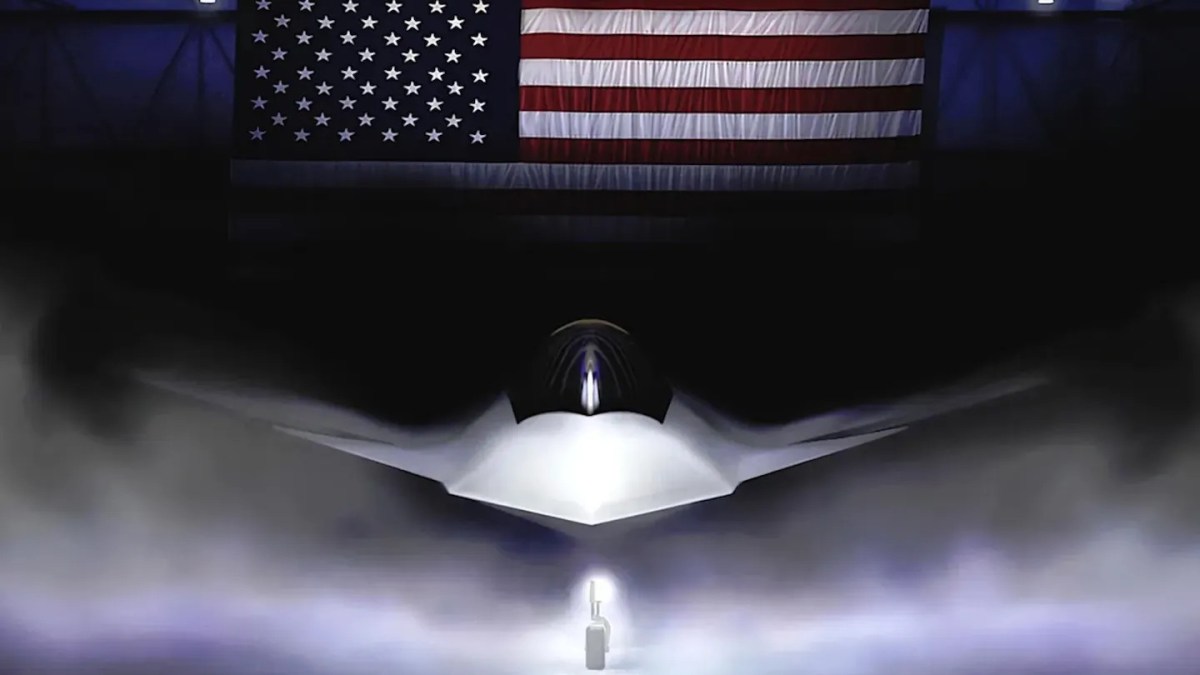
A rendering of the F-47 sixth-generation fighter. USAF
“There are only three active fighter production lines, right? We got F-35 down in Fort Worth, the F-15EX in St. Louis, and F-16 in Greenville,” Helfrich elaborated later on in the discussion in response to a question about steps the Air Force is taking to maintain sufficient operational capacity across its fighter fleets, in general. “So we need to grow the existing production lines, and we need to – or at least maximize what we can get out of those existing production lines, and we need to add production lines.”
“We’re not too far away from an F-47 production line, which will be additive to the production capacity,” he added.
Since 2023, Boeing has been working to substantially expand its production and other facilities in St. Louis by more than one million square feet. The company has repeatedly shied away from explicitly linking the $1.8 billion construction project to the F-47 program, but there have been clear signs of a connection for years now.
An undated aerial view of work to expand Boeing’s facilities in St. Louis. PARIC Corporation
“The project’s first phase includes plans to erect and renovate 1.1 million ft.2 of facilities on the 110-acre Brownleigh and 75-acre Northern tracts adjacent to St. Louis Lambert International Airport, according to planning documents released by the airport authority in 2023,” Aviation Week reported in 2025 . “Phase 1 includes the construction of a 880,000-ft.2 aircraft assembly building on the Brownleigh [site], plus a 185,000-ft.2 hangar, 80,000-ft.2 radar cross-section test facility, open aircraft shelters, hush house, maintenance building, fuel calibration building and fire house totaling 90,000 ft.2 on the Northern tract.”
At that time, parts of the new facility were reportedly expected to open in 2026 ahead of the completion of the full project in 2030.
A post across Boeing’s social media accounts in July highlighted continued progress with this construction. This included the completion of roof and exterior panels and the installation of hangar doors at a section of the site dedicated to “Advanced Combat Aircraft Assembly,” as well as the “first steel column installed for the Central Utility Plan” in the North Tract area.
Progress you can see. Built for what's next. Momentum continues on our St. Louis expansion: ✅ Advanced Combat Aircraft Assembly: roof and exterior panels complete, hangar doors installed ✅ North Tract: first steel column installed for the Central Utility Plant Fueling future… pic.twitter.com/281prUMMCV — Boeing Defense (@BoeingDefense) July 6, 2026
Progress you can see. Built for what's next. Momentum continues on our St. Louis expansion: ✅ Advanced Combat Aircraft Assembly: roof and exterior panels complete, hangar doors installed ✅ North Tract: first steel column installed for the Central Utility Plant Fueling future… pic.twitter.com/281prUMMCV
“Momentum continues on our St. Louis expansion,” Dan Gillian, Vice President and General Manager of Air Dominance at Boeing, also said in July, according to Flight Global . “We are expanding our defence footprint while supporting next-generation capabilities.”
All of this is in line with Brig. Gen. Helfrich’s comments yesterday about a full production line for the F-47 steadily taking shape now. This, in turn, fits squarely with the aforementioned aggressive timeline the Air Force is pursuing for the program overall. Accelerated work on the F-47 has been aided by years of flight testing in secret of advanced demonstrator aircraft .
There is also a question of whether Boeing’s expansion of its production capacity in St. Louis could also be tied to the Navy’s F/A-XX next-generation carrier-based fighter program. Boeing has been facing off against Northrop Grumman in the F/A-XX competition with a design that looks related, at least to some degree , to the F-47.
A rendering of Boeing’s proposed F/A-XX design. Boeing
The F-47 and F/A-XX programs have become very closely intertwined in other ways. In 2025, the Pentagon moved to freeze F/A-XX, explicitly over concerns about competition for industrial base resources with F-47. This would include production line capacity. Congress subsequently intervened to keep the Navy effort going, but a final winner still has yet to be announced.
Just earlier this month, Air Force Gen. Dale White, the service’s Direct Reporting Portfolio Manager for Critical Major Weapon Systems, reiterated concerns about industrial capacity . White’s comments came in response to a question about potential challenges in building F/A-XXs at the same time as F-47s at a media roundtable at the Air & Space Forces’ Air, Space and Cyber Conference at which TWZ was in attendance. The general also acknowledged that these concerns were “not unique” to F/A-XX and F-47.
During the virtual talk yesterday, Brig. Gen. Timothy otherwise touted continued progress on the F-47 program.
“The F-47 is going to be the world’s first sixth-generation fighter, and I can’t wait to fly it [sic; see it fly] this administration,” he said. “That’s a commitment that I made, that we are on track to do.”
The “administration” referred to here is President Donald Trump’s second term in office, which will come to a close in January 2029. With this deadline in mind, the Air Force has openly said in the past that it is aiming for a first flight of the F-47 in 2028. Beyond that, the stated goal is to be operating the jets operationally sometime in the early 2030s.
As noted, the Air Force has said previously that it is planning to acquire a fleet of at least 185 F-47s , which is in line with the original vision of the aircraft as a direct successor to the F-22 Raptor. However, there have already been signs that the final F-47 fleet figure could grow amid an evolving view of the F-22’s continued role in the near-term . A huge, multi-faceted modernization effort for the F-22 fleet is now underway, as you can read more about here .
A stock picture of a US Air Force F-22 Raptor. USAF
When the jets do enter service, “one of the things that we know F-47 is going to bring is more survivability and lethality than anything that’s ever been delivered before. And going into that highly contested environment, you have to meet certain levels of survivability if you want to execute there,” Helfrich noted yesterday. “Beyond just the survivability and lethality that we know is going to come, there’s also an adaptability that the F-47 will bring.”
“The F-47 will come out of the box with full open architecture,” he continued. “Amongst other great things, it brings the ability to upgrade rapidly, faster than the threat if needed. That is what is going to be required in that kind of environment. Other things it’s going to bring, it’s going to be much more survivable than our fifth-gen platforms, as well as have a combat radius of over 1,000 nautical miles, which you’re familiar with . That’s a long way, which is needed for that kind of environment. You need to be able to execute and persist there.”
“Especially in these highly contested environments, no one’s going to be fighting alone. So we need to make sure that we are integrating,” he added. “There’s some ability to get lift from one platform to another, right? Whether it’s a mission system, it’s communications, it’s open architectures, we’re seeing that integration pay dividends, so that we are integrated from day one.”
This kind of integration and cross-platform commonality in mission systems will be particularly relevant for F-47s acting as airborne controllers for CCA drones. Brig. Gen. Helfrich’s comments above also came in the midst of a discussion about future operations involving both F-47s and B-21 Raider bombers .
Many questions do still remain about plans for the F-47 and its design, including what engines will power the aircraft when it first enters service. In July, TWZ published a deep-dive feature about what is known about the aircraft to date, which you can find here .
In the meantime, the Air Force and Boeing are continuing to push ahead with laying the groundwork for full production of the F-47 as the jet gets closer to its first flight in the coming years.
Contact the author: joe@twz.com
Comments couldn’t be loaded. Please refresh the page.
作者:约瑟夫·特雷维西克
发布于美国东部时间2026年9月29日下午12:53
美国空军一位高级采购官员表示,F-47第六代战斗机的完整生产线建设工作正日益接近尾声。主承包商波音公司正在对其位于密苏里州圣路易斯的工厂进行近20亿美元的扩建。F-47项目仍在按计划稳步推进,首飞仍定于2028年,量产型战机的目标是在2030年代初投入使用。
美国空军准将、战斗机和先进飞机项目采购主管蒂莫西·赫尔弗里奇(Timothy Helfrich)昨日在空军与太空部队协会米切尔航空航天研究所主办的线上研讨会上,介绍了F-47项目的最新进展。波音公司于2023年3月赢得了美国空军的F-47项目竞标,目前至少有一架预生产型正在建造中。美国空军目前的计划是采购至少185架F-47战机。
“我们面临着一项迫切需要的,我称之为战略资产的,那就是战斗机生产能力,”赫尔弗里希在开幕致辞中说道。“我们的生产线数量有限,因此我们必须最大限度地利用现有生产线,同时还要规划协同作战无人机(CCA)的生产,以及很快也将开始的F-47生产。”
美国空军F-47第六代战斗机的效果图。
“目前只有三条现役战斗机生产线,对吧?F-35在沃斯堡,F-15EX在圣路易斯,F-16在格林维尔,”赫尔弗里奇在随后的讨论中详细解释道,当时有人问及空军正在采取哪些措施来维持其战斗机机队的作战能力。“所以我们需要扩大现有生产线的规模,我们需要——或者至少要最大限度地利用现有生产线,而且我们还需要增加新的生产线。”
“我们离F-47生产线不远了,这将提升我们的产能,”他补充道。
自2023年以来,波音公司一直在努力大幅扩建其位于圣路易斯的生产设施和其他相关设施,扩建面积超过100万平方英尺。该公司一直避免明确将这项耗资18亿美元的建设项目与F-47项目联系起来,但多年来种种迹象表明,两者之间存在着明显的关联。
一张未注明日期的航拍照片,展示了波音公司在圣路易斯扩建工厂的工程。PARIC公司
据《航空周刊》2025年报道,“根据机场管理局2023年发布的规划文件,该项目的第一阶段计划在毗邻圣路易斯兰伯特国际机场的110英亩布朗利地块和75英亩北部地块上建造和翻新110万平方英尺的设施。第一阶段包括在布朗利地块上建造一座88万平方英尺的飞机组装大楼,以及在北部地块上建造一座18.5万平方英尺的机库、一座8万平方英尺的雷达横截面测试设施、开放式飞机掩体、消音室、维修大楼、燃油校准大楼和消防站,总面积达9万平方英尺。”
当时有报道称,新设施的部分设施预计将于 2026 年开放,整个项目将于 2030 年竣工。
波音公司7月份在其社交媒体账号上发布的一则消息重点介绍了该项目建设的持续进展。其中包括“先进战斗机组装”区域的屋顶和外墙板已完工,机库门已安装完毕,以及北区“中央公用设施规划的首根钢柱已安装完毕”。
看得见的进展。面向未来而建。我们在圣路易斯的扩建工程持续推进:✅ 先进战斗机组装:屋顶和外墙板已完工,机库门已安装 ✅ 北区:中央公用设施厂首根钢柱已安装 为未来提供动力…… pic.twitter.com/281prUMMCV — 波音防务 (@BoeingDefense) 2026年7月6日
看得见的进展。面向未来而建。我们在圣路易斯的扩建工程持续推进:✅ 先进战斗机组装:屋顶和外墙板已完工,机库门已安装 ✅ 北区:中央公用设施厂首根钢柱已安装 为未来提供燃料…… pic.twitter.com/281prUMMCV
据《飞行全球》报道,波音公司空中优势副总裁兼总经理丹·吉利安7月份也表示:“我们在圣路易斯的扩张势头持续强劲。我们正在扩大国防布局,同时支持下一代能力的发展。”
这一切都与赫尔弗里奇准将昨天关于F-47完整生产线正在稳步成型的评论相符。而这又与空军为该项目制定的雄心勃勃的总体时间表完全吻合。多年来,先进验证机的秘密飞行测试也为F-47的加速研发提供了助力。
还有一个问题是,波音公司在圣路易斯扩大产能是否也与海军的F/A-XX下一代舰载战斗机项目有关。波音公司一直在与诺斯罗普·格鲁曼公司竞争F/A-XX项目,其设计看起来至少在某种程度上与F-47战斗机相关。
波音公司提出的F/A-XX设计方案效果图。
F-47 和 F/A-XX 项目在其他方面也紧密交织在一起。2025 年,五角大楼曾试图冻结 F/A-XX 项目,其明确理由是担心该项目会与 F-47 争夺工业基础资源,包括生产线产能。国会随后介入,维持海军的研发工作,但最终的中标者至今尚未公布。
就在本月初,空军关键大型武器系统项目直接汇报负责人戴尔·怀特上将重申了对工业产能的担忧。怀特上将在空军与太空部队联合举办的“空天网络会议”媒体圆桌会议上,回答了关于同时生产F/A-XX和F-47战斗机可能面临的挑战的问题。TWZ也出席了此次会议。怀特上将还承认,这些担忧并非F/A-XX和F-47独有。
在昨天的线上谈话中,蒂莫西准将还大力宣传了 F-47 项目取得的持续进展。
“F-47将成为世界上第一款第六代战斗机,我迫不及待地想在本届政府任期内驾驶它,”他说。“这是我做出的承诺,我们正在按计划实现。”
这里提到的“本届政府”指的是唐纳德·特朗普总统的第二个任期,将于2029年1月结束。考虑到这一期限,空军过去曾公开表示,其目标是在2028年实现F-47的首飞。除此之外,其既定目标是在2030年代初期投入作战使用。
如前所述,美国空军此前曾表示计划采购至少185架F-47战斗机,这与最初将该机型定位为F-22“猛禽”战斗机直接后继机型的设想相符。然而,已有迹象表明,随着人们对F-22在近期内继续发挥作用的看法不断变化,最终的F-47机队规模可能会增加。目前,F-22机队的大规模、多方面的现代化升级工作正在进行中,您可以在这里了解更多信息。
一张美国空军F-22猛禽战斗机的库存照片。美国空军
赫尔弗里希昨天指出,当这些战机投入使用时,“我们知道F-47将带来的一大优势是其生存能力和杀伤力将超越以往任何战机。在高度对抗的环境中,要想有效作战,就必须达到一定的生存能力水平。”他还表示,“除了我们已知的生存能力和杀伤力之外,F-47还将带来出色的适应性。”
“F-47将采用完全开放式架构,”他继续说道。“它具备诸多优势,其中之一就是能够快速升级,必要时甚至比威胁出现得更快。这正是那种环境下所需要的。此外,它的生存能力将远超我们的第五代战机,作战半径也将超过1000海里,这一点你们应该很熟悉。这相当远的距离对于那种环境至关重要。你必须能够在那种环境下执行任务并持续作战。”
“尤其是在这种竞争激烈的环境中,没有人会孤军奋战。所以我们需要确保彼此融合,”他补充道。“不同平台之间可以互相借鉴,对吧?无论是任务系统、通信系统还是开放式架构,我们都看到融合带来了丰厚的回报,因此我们从一开始就实现了融合。”
这种任务系统的集成和跨平台通用性对于担任CCA无人机空中管制员的F-47战机尤为重要。赫尔弗里希准将上述评论也是在讨论未来F-47战机和B-21“突袭者”轰炸机联合作战行动时发表的。
关于F-47的计划和设计,仍然存在许多疑问,包括该机首次服役时将使用何种发动机。今年7月,TWZ发表了一篇深度报道,介绍了目前已知的关于该机的信息,您可以在这里找到这篇文章。
与此同时,随着F-47战机在未来几年内接近首飞,美国空军和波音公司正继续推进F-47全面生产的基础工作。
联系作者:joe@twz.com
评论加载失败,请刷新页面。