Roll-out of latest MRT fleet on North-South, East-West lines complete最新款地铁列车已在南北线和东西线上全面投入使用
The roll-out of the new R151 trains on Singapore’s NSEWL is complete, boosting reliability and capacity with advanced monitoring and upgraded features. Read more at straitstimes.com.
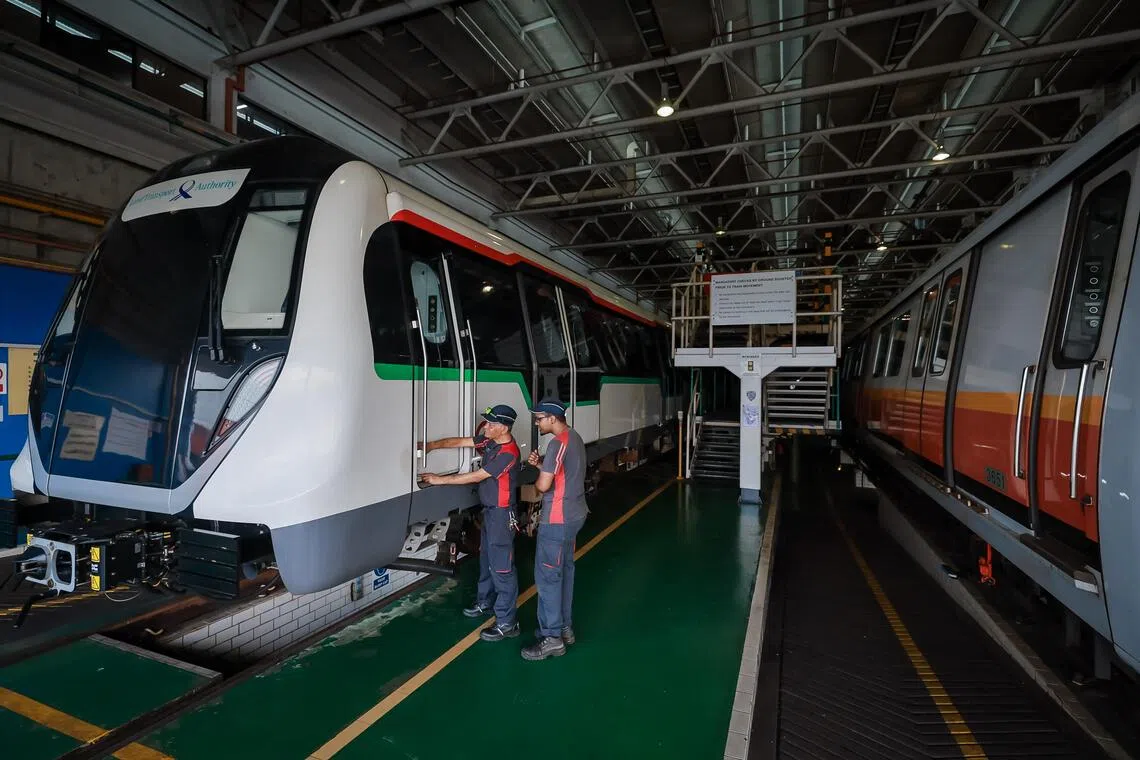
The first R151 trains entered service in June 2023.
Published Sep 30, 2026, 01:19 PM
Updated Sep 30, 2026, 01:19 PM
The roll-out of the seventh-generation Alstom Movia R151 trains on Singapore's North-South and East-West MRT lines is complete.
The new R151 trains feature advanced condition monitoring, larger open spaces, wider windows, and improved passenger capacity, enhancing service quality and commuter experience.
Upgrades since 2012, including new trains and signalling systems, have tripled the MRT's reliability, achieving 2.88 million MKBF, far exceeding the 1 million MKBF target for the network.
SINGAPORE – The roll-out of the newest trains on the North-South and East-West MRT lines (NSEWL) is now complete, with the last of the seventh-generation fleet entering service from Sept 30.
The Land Transport Authority (LTA) said in a Facebook post on Sept 30 that it has handed over the 106th train from the Alstom Movia R151 fleet to SMRT, which operates NSEWL, Singapore’s oldest and most heavily used rail lines.
LTA purchased 66 of the 106 R151 trains in a $1.2 billion deal in 2018 to replace the first-generation NSEWL Kawasaki Heavy Industry trains, which had been operating since the two MRT lines opened in 1987.
These have been phased out of service, with the last of the 66 first-generation trains plying the NSEWL for a final time on Sept 26, 2025 .
Another 40 trains, costing $337.8 million, were bought in 2020 to replace now-retired second-generation Siemens and third-generation Kawasaki-Nippon Sharyo trains.
The first R151 trains entered service in June 2023 .
As at June 2025, more than half of the R151 trains had entered service , a spokesperson for LTA told The Straits Times at the time.
Designed in Germany, the new R151 trains were assembled in Changchun, China.
They have built-in condition monitoring capabilities and diagnostic systems that can pick up faults early and track the performance of various systems in real time.
The cars have bigger open spaces to increase passenger capacity while maintaining the number of seats. Other upgrades on board include wider windows and perch seats for passengers.
Alongside the R151, three other generations of trains, added between 2011 and 2018, are also operating on the NSEWL. These were manufactured by Kawasaki Heavy Industries and CSR Qingdao Sifang.
Work to renew the NSEWL started in 2012. Valued at $2.6 billion, the refurbishment included new trains, a new signalling system that allows trains to run at shorter intervals, upgraded power rails that supply electricity to the trains, and a track circuit system capable of detecting rail defects.
LTA said in 2025 that the improvements have boosted the NSEWL’s reliability, captured by the lines’ mean kilometres between failure (MKBF), which is the reliability benchmark used for subways globally.
MKBF shows how far a train travels before it encounters a delay lasting more than five minutes. LTA’s figures are based on a 12-month moving average.
MRT trains clocked 2.88 million MKBF between September 2025 and August 2026, LTA said in its latest rail reliability report , released earlier in September.
This is almost triple Singapore’s rail reliability target for the entire MRT network of one million MKBF.
首批 R151 型列车于 2023 年 6 月投入运营。
发布于 2026 年 9 月 30 日下午 1:19
更新于2026年9月30日下午1:19
新加坡地铁南北线和东西线上的第七代阿尔斯通Movia R151列车已全部投入运营。
新型 R151 列车采用先进的状态监测技术,拥有更大的开放空间、更宽的车窗和更高的乘客容量,从而提升了服务质量和通勤体验。
自 2012 年以来,地铁进行了升级改造,包括引进新列车和信号系统,使地铁的可靠性提高了三倍,达到了 288 万 MKBF,远远超过了该网络 100 万 MKBF 的目标。
新加坡——南北线和东西线地铁(NSEWL)最新列车的推出工作现已完成,第七代列车的最后一列已于9月30日投入使用。
新加坡陆路交通管理局 (LTA) 于 9 月 30 日在 Facebook 上发帖称,已将 Alstom Movia R151 车队的第 106 列列车交付给 SMRT,SMRT 运营着新加坡历史最悠久、客流量最大的铁路线——南北线和东西线 (NSEWL)。
2018 年,陆路交通管理局 (LTA) 以 12 亿美元的交易购买了 106 列 R151 型列车中的 66 列,以取代自 1987 年两条地铁线路开通以来一直在运营的第一代川崎重工列车。
这些列车已逐步停运,66 列第一代列车中的最后一列于 2025 年 9 月 26 日在 NSEWL 线路上最后一次运行。
2020 年,又购买了 40 列火车,耗资 3.378 亿美元,以取代现已退役的第二代西门子列车和第三代川崎日本车辆列车。
首批 R151 型列车于 2023 年 6 月投入运营。
截至 2025 年 6 月,超过一半的 R151 列车已投入使用,陆路交通管理局发言人当时告诉《海峡时报》。
新型 R151 列车由德国设计,在中国长春组装。
它们具有内置的状态监测功能和诊断系统,可以及早发现故障并实时跟踪各种系统的性能。
这些车辆拥有更大的开放空间,在保持座位数量不变的情况下增加了乘客容量。其他车内升级包括更宽的车窗和乘客座椅。
除了R151型列车外,北东南线还运营着另外三代列车,这些列车于2011年至2018年间投入使用,分别由川崎重工和中车青岛四方制造。
北东南西线铁路的改造工程于 2012 年启动。这项价值 26 亿美元的改造工程包括购置新列车、安装新的信号系统(使列车能够以更短的间隔运行)、升级为列车供电的电力轨道以及安装能够检测轨道缺陷的轨道电路系统。
陆路交通管理局在 2025 年表示,这些改进提高了南北线和东西线的可靠性,以线路的平均故障间隔里程 (MKBF) 来衡量,这是全球地铁可靠性的基准。
MKBF(列车延误时间)显示的是列车在遭遇超过五分钟的延误之前行驶的距离。陆路交通管理局的数据基于12个月的移动平均值。
陆路交通管理局 (LTA) 在 9 月初发布的最新铁路可靠性报告中表示,2025 年 9 月至 2026 年 8 月期间,地铁列车累计运行里程为 288 万公里。
这几乎是新加坡地铁整个网络可靠性目标(100万千公里/小时)的三倍。