US artillery officials nudging European armies to link their big guns美国炮兵官员敦促欧洲军队将他们的重型火炮连接起来
Regional artillery clusters are beginning to form among NATO members in key parts of the continent.
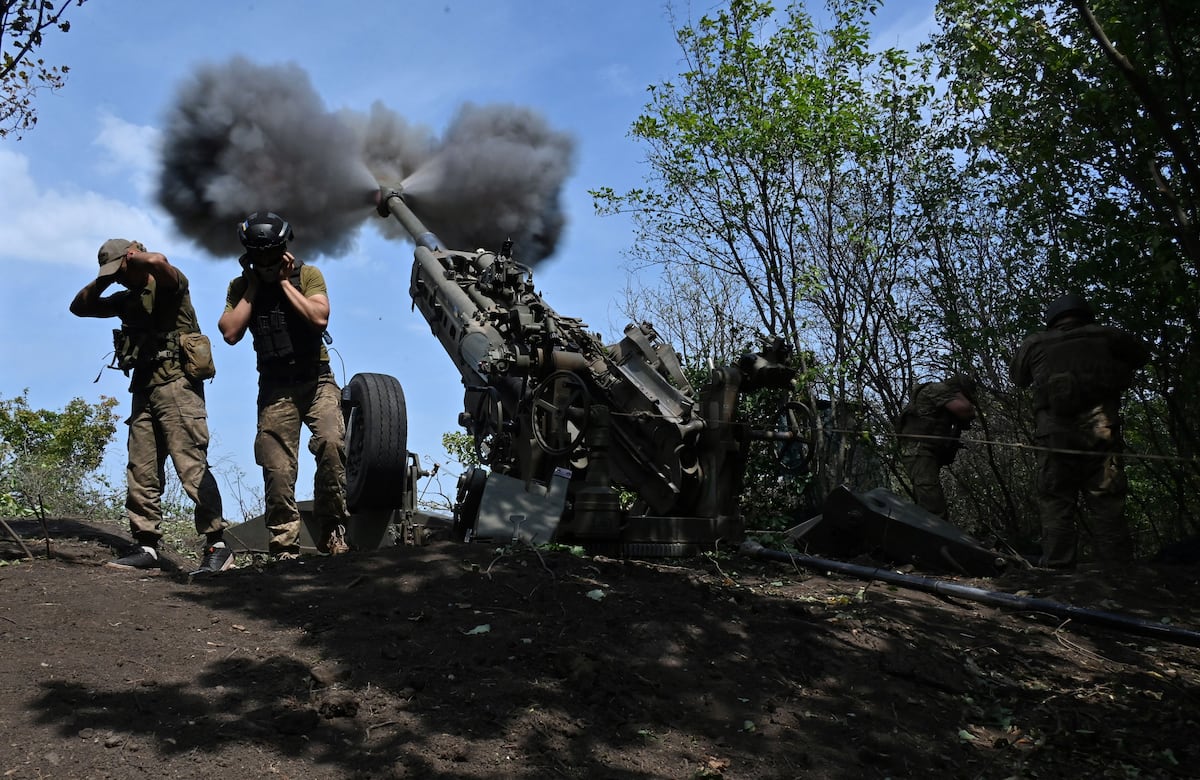
WASHINGTON — U.S. Army officials overseeing long-range weaponry are urging their counterparts in Europe to link artillery capabilities with those of NATO members, as the war in Ukraine highlights the importance of the weapon.
The push comes amid a growing belief that defending the alliance rests in large part on interoperability among friendly militaries. In the case of field artillery, that means synchronizing weapons and sensors of weapons of different countries so they can engage targets as one force.
Maj. Gen. Stephen Maranian, commanding general of the U.S. Army’s 56th Artillery Command in Germany, said he and his staff have been fanning out to allies in Europe to gauge their plans and capabilities when it comes to fires, and what obstacles exist to netting the systems for greater combat punch.
“What we’re seeing from watching what’s happening to our east is fires formations are very relevant in 2022 and in the future,” the said this week at the annual convention of the Association of the United States Army in Washington. As a result, he added, nations want to invest in modernized artillery.
Russia’s war against Ukraine has featured long-range fires as key element of combat since 2014, when Moscow’s forces established a front line in the Donbas region following the annexation of Crimea. The full-scale invasion in February 2022 saw Russia throw even more of the weapons at the front lines.
Western countries, in turn, have supported Ukraine with limited amounts of their own weapons, including HIMARS and M777 howitzers from the U.S. , CAESAR guns from France, the self-propelled Krab from Poland and Panzerhaubitze 2000 from Germany and the Netherlands. Weapon stocks in Europe are low, however, and most nations have said they are sending only what they can spare while maintaining a credible national defense.
Maranian said U.S. Army officials are piggy-backing on the service’s exercise campaign in Europe to test new concepts for linking artillery forces. At this year’s iteration of the Dynamic Front drill in July, for example, participants put on a “proof of principle” to that end at the Grafenwöhr training area in Germany, he said. The event paired a U.S. artillery brigade with a multinational fires brigade comprised of 11 nations, with NATO’s Allied Rapid Reaction Corps providing command and control.
“We were able to validate the concept that you could put together formations of smaller donations from countries that don’t necessarily have a whole battalion or brigade to give,” Maranian said.
The idea now is to see how neighboring nations – ideally with the same equipment, but not necessarily – decide to form regional clusters of linked artillery on the continent, he explained. Suitable groupings could be in Scandinavia, the Baltics and the nations of south-eastern Europe, for example.
“I think that’s the way ahead: to be able to optimize the artillery that does exist in the alliance as we modernize,” said Maranian.
Sebastian Sprenger is associate editor for Europe at Defense News, reporting on the state of the defense market in the region, and on U.S.-Europe cooperation and multi-national investments in defense and global security. Previously he served as managing editor for Defense News. He is based in Cologne, Germany.
华盛顿——美国陆军负责远程武器的官员敦促欧洲同行将美国的火炮能力与北约成员国的火炮能力联系起来,因为乌克兰战争凸显了这种武器的重要性。
这项举措的出台,正值人们日益认识到,保卫联盟在很大程度上取决于友好国家军队之间的互操作性。就野战炮兵而言,这意味着协调不同国家的武器和传感器,以便它们能够像一支整体力量一样打击目标。
美国陆军第56炮兵司令部(驻德国)司令斯蒂芬·马拉尼安少将表示,他和他的参谋人员一直在前往欧洲盟友处,评估他们在火力方面的计划和能力,以及在利用这些系统增强作战能力方面存在的障碍。
“从我们东部地区的情况来看,火力部署在2022年及未来都非常重要,”他本周在华盛顿举行的美国陆军协会年会上表示。他补充说,因此,各国都希望投资现代化火炮。
自2014年俄罗斯吞并克里米亚后在顿巴斯地区建立前线以来,远程火力一直是俄罗斯对乌克兰战争的关键作战要素。2022年2月的全面入侵中,俄罗斯更是将更多此类武器投入前线。
西方国家也向乌克兰提供了少量武器援助,包括美国的HIMARS和M777榴弹炮、法国的CAESAR自行火炮、波兰的“螃蟹”自行火炮以及德国和荷兰的Panzerhaubitze 2000装甲榴弹炮。然而,欧洲的武器库存普遍较低,大多数国家表示,他们只会在维持自身国防能力的前提下,尽可能地提供自身能够提供的武器。
马兰尼安表示,美国陆军官员正借着该军种在欧洲的演习活动,测试炮兵部队协同作战的新概念。例如,在今年7月举行的“动态战线”演习中,参演人员在德国格拉芬沃尔训练区进行了一次“概念验证”。他指出,此次演习将一支美国炮兵旅与一支由11个国家组成的多国火力旅联合起来,北约盟军快速反应部队负责指挥和控制。
“我们验证了这样一个概念,那就是你可以将来自那些不一定有整个营或旅可以捐赠的国家的较小规模的捐赠组合起来,”马拉尼安说。
他解释说,现在的想法是观察邻国——理想情况下装备相同,但不一定——如何决定在欧洲大陆组建区域性火炮集群。例如,斯堪的纳维亚半岛、波罗的海国家和东南欧国家都可能成为合适的集群。
“我认为这是未来的发展方向:在联盟现代化进程中,优化利用现有的火炮,”马拉尼安说道。
塞巴斯蒂安·斯普伦格是《防务新闻》欧洲版副主编,负责报道该地区的防务市场状况,以及美欧在防务和全球安全领域的合作和多国投资。此前,他曾担任《防务新闻》执行主编。他现居德国科隆。