EXCLUSIVE: How the DIA measures a military’s ‘Will to Fight’独家报道:美国国防情报局如何衡量军队的“战斗意志”
After underestimating Ukraine's forces, the Defense Intelligence Agency adopted a new analytical framework to try and quantify the unquantifiable.
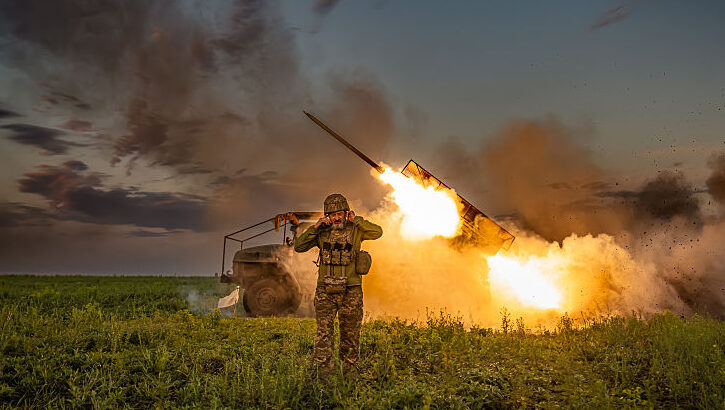
Ukrainian servicemen of the rocket artillery battery of the 23rd Mechanized Brigade fire a BM-21 Grad multiple launch rocket system at firing positions near the settlement of Pokrovske on May 24, 2026 in Dnipropetrovsk Oblast, Ukraine. (Photo by Oxana Chorna/Global Images Ukraine via Getty Images)
WASHINGTON — The Defense Intelligence Agency revealed today the analytical framework it’s using to try to answer a key but difficult question: When conflict arises, what is a foreign military’s “will to fight”?
“Will to Fight is one of the most challenging elements of military capability analysis because of its fundamentally intangible nature,” states the framework, shared exclusively with Breaking Defense ahead of its publication. Unlike the specific number of tanks or the condition of fighter jets that form the basis for so much analysis of military readiness, the framework says “most elements relative to will to fight are not quantitative; nor are they easily observed.”
The document, aptly titled Analyzing Will To Fight, indicates it was last updated in September 2024.
“While this guidance is designed to support intelligence community analysis, Analyzing Will to Fight is part of DIA’s ongoing series of unclassified, foundational overviews designed to help the public achieve a deeper understanding of key challenges and functional threats to U.S. national security,” the DIA said in a press release .
A spokesperson for the agency said DIA was releasing it now in the context of the fifth anniversary of the US withdrawal from Afghanistan, which was completed on Aug. 30, 2021.
It was then that the US Intelligence Community and White House were caught somewhat flatfooted by the speed at which Afghan forces collapsed in the face of the Taliban’s takeover of the country, giving up several strategic areas without a fight. Then-President Ashraf Ghani fled the country as the Taliban bore down on Kabul on Aug. 15.
In November 2024, then-head of the DIA Lt. Gen. Jeffrey Kruse contrasted the experience of Afghanistan with that of Ukraine in the immediate aftermath of Russia’s February 2022 invasion. In that case, the DIA erred in the opposite direction: Kyiv had been expected to fall in days , but instead Ukrainian forces pushed the much larger Russian army back and fought them into the eastern part of the country where the two have settled into a bloody stalemate to this day.
How integrated modeling and simulation accelerates Europe’s defensive edge
Lockheed Martin’s ACES platform delivers a shared virtual battlespace that strengthens readiness, interoperability, and faster decision-making through advanced, integrated modeling and simulation capabilities designed for evolving global threats.
Kruse said DIA miscalculated a few factors in their predictive analysis, but highlighted one especially: how hard Ukrainians would fight to defend their land.
“The Ukrainians … exhibited a will to fight that was far beyond anything any of us had estimated,” Kruse said at an event put on by the Intelligence and National Security Alliance (INSA).
For the DIA, whose job it is to estimate the relative might of foreign militaries, it was an error that Kruse appeared eager to correct. He said the agency was implementing the new “‘will to fight’ all-source tradecraft methodology [to ask], ‘What does that look like? How do we assess what that looks like?'”
The result is the framework released today. It attempts to quantify the unquantifiable by advising DIA analysts to carefully judge dynamics at all levels of power — from the “authority” and “integrity” of national leadership down to the “Esprit de corps” among individual soldiers.
Had it been in place in 2022, the framework likely would’ve looked kindly on Ukrainian President Volodymyr Zelenskyy. At the time he drew praise in the West for his decision, unlike Ghani, to stay in Kyiv as the Kremlin’s forces approached the capital, including famously remarking to then-US President Joe Biden, “I need ammunition, not a ride.” (Perceived support from allies is another key factor in the Will to Fight analysis.)
The framework also deals with the “Stakes of the Conflict,” asking analysts to assess whether victory or defeat is “an existential condition for combatant[s] e.g. an existential threat to the state, organization, or regime[.]”
A sample page from the Defense Intelligence Agency’s “Analyzing Will To Fight” framework. (DIA)
But it warns the answers to any and all of the questions can change over time.
“[The] will to fight can change quickly, dramatically, and many times over the course of a conflict for each party to the conflict,” the framework says. “A change in a combatant’s will to fight status does not inherently mean that a previous baseline assessment is wrong. Analysts should seek to establish causality between events or criteria that have the ability to affect will to fight.”
Kruse said in 2024 that the DIA had used the then-new framework to assess the US’s top strategic priority, China. A spokesperson for the DIA declined to say what other militaries had been evaluated or to describe any conclusions that had been drawn.
In the document, the DIA notes that the will to fight is just one of multiple “intangibles” to be factored into a much more complicated “military capabilities” analytic picture that also takes into account factors like training, the demographics of both active and reserve duty troops, defense budgets and military doctrine.
But, it says, professional analysis of the will to fight can “enable us to meaningfully drive collection as part of enhancing our understanding of what factors matter most, at what subsets, across the combat spectrum and timeline.”
And, presumably, it’ll help keep the agency from being surprised like it was in August 2021 or February 2022.
2026年5月24日,乌克兰第聂伯罗彼得罗夫斯克州波克罗夫斯克镇附近,乌克兰第23机械化旅火箭炮兵连的士兵在射击阵地发射BM-21“冰雹”多管火箭炮系统。(图片由Oxana Chorna/Global Images Ukraine通过Getty Images提供)
华盛顿——美国国防情报局今天公布了它用来试图回答一个关键但又困难的问题的分析框架:当冲突发生时,外国军队的“战斗意志”是什么?
“战斗意志是军事能力分析中最具挑战性的要素之一,因为它本质上是无形的,”该框架指出,并在正式发布前独家提供给了《防务新闻》(Breaking Defense)。与构成军事战备分析基础的坦克数量或战斗机状况等具体指标不同,该框架指出,“大多数与战斗意志相关的要素既不量化,也不容易观察。”
这份题为《分析战斗意志》的文件表明,它最后一次更新是在 2024 年 9 月。
“虽然本指南旨在支持情报界的分析,但《分析战斗意志》是国防情报局 (DIA) 正在进行的一系列非机密基础概述的一部分,旨在帮助公众更深入地了解美国国家安全面临的关键挑战和实际威胁,”国防情报局在一份新闻稿中表示。
该机构的一位发言人表示,国防情报局现在发布这份文件,是为了纪念美国从阿富汗撤军五周年,撤军于 2021 年 8 月 30 日完成。
当时,阿富汗军队在塔利班接管国家后迅速溃败,不战而降多个战略要地,令美国情报界和白宫措手不及。8月15日,塔利班逼近喀布尔,时任总统阿什拉夫·加尼被迫逃离该国。
2024年11月,时任美国国防情报局局长杰弗里·克鲁斯中将对比了阿富汗的经验和俄罗斯2022年2月入侵乌克兰后乌克兰的局势。在乌克兰,国防情报局的预测恰恰相反:当时人们预期基辅会在几天内陷落,但乌克兰军队却击退了兵力远胜于己的俄军,并将其拖入乌克兰东部地区,双方至今仍在那里陷入血腥的僵持局面。
集成建模与仿真如何加速欧洲的防御优势
洛克希德·马丁公司的 ACES 平台提供了一个共享的虚拟战场空间,通过先进的集成建模和仿真功能,增强了战备能力、互操作性和更快的决策速度,旨在应对不断演变的全球威胁。
克鲁斯表示,DIA 在其预测分析中误算了一些因素,但他特别强调了一点:乌克兰人会如何奋力保卫自己的土地。
克鲁斯在情报与国家安全联盟 (INSA) 举办的活动上说:“乌克兰人……展现出的战斗意志远远超出了我们任何人的预期。”
对于负责评估外国军队相对实力的国防情报局(DIA)来说,这是一个克鲁斯似乎急于纠正的错误。他说,该机构正在实施新的“‘战斗意志’全源情报方法论”,即“要问:‘这究竟意味着什么?我们如何评估这究竟意味着什么?’”
最终成果就是今天发布的这个框架。它试图量化那些无法量化的因素,建议国防情报局的分析人员仔细评估各个权力层面的动态——从国家领导层的“权威”和“正直”到普通士兵的“团队精神”。
如果该框架在2022年就已经生效,那么它很可能对乌克兰总统泽连斯基有利。当时,与加尼不同,泽连斯基决定留在基辅,而克里姆林宫的军队正逼近首都,这让他赢得了西方的赞誉。他曾对时任美国总统乔·拜登说过一句名言:“我需要的是弹药,而不是搭车。”(盟友的支持是“战斗意志”分析的另一个关键因素。)
该框架还涉及“冲突的利害关系”,要求分析人士评估胜利或失败是否“对战斗人员而言是生存的条件,例如对国家、组织或政权构成生存威胁”。
这是美国国防情报局“分析战斗意志”框架中的一个示例页面。(DIA)
但它也警告说,任何问题的答案都可能随着时间而改变。
该框架指出,“冲突各方的战斗意志在冲突过程中可能会迅速、剧烈且多次发生变化。战斗人员战斗意志的变化并不一定意味着之前的基线评估是错误的。分析人员应努力确定可能影响战斗意志的事件或标准之间的因果关系。”
克鲁斯在2024年表示,国防情报局(DIA)当时已利用这一新框架评估了美国最重要的战略优先事项——中国。国防情报局发言人拒绝透露还评估了哪些其他国家的军队,也拒绝描述任何已得出的结论。
在该文件中,国防情报局指出,战斗意志只是众多“无形因素”之一,需要纳入更为复杂的“军事能力”分析图景中,该图景还考虑了训练、现役和预备役部队的人口统计数据、国防预算和军事理论等因素。
但报告指出,对战斗意志的专业分析可以“使我们能够有意义地推动信息收集,从而更好地了解在整个战斗范围和时间线中,哪些因素在哪些子集中最为重要”。
而且,想必这将有助于避免该机构像 2021 年 8 月或 2022 年 2 月那样措手不及。