In the age of 24/7 convenience, wet markets are upping their game to stay relevant在24小时便利时代,菜市场正不断提升自身竞争力以保持竞争力。
As younger shoppers increasingly turn elsewhere to buy meal ingredients or household items, wet-market vendors are rethinking how they do business while preserving the human connections, personal service and generations of expertise that remain their strengths.
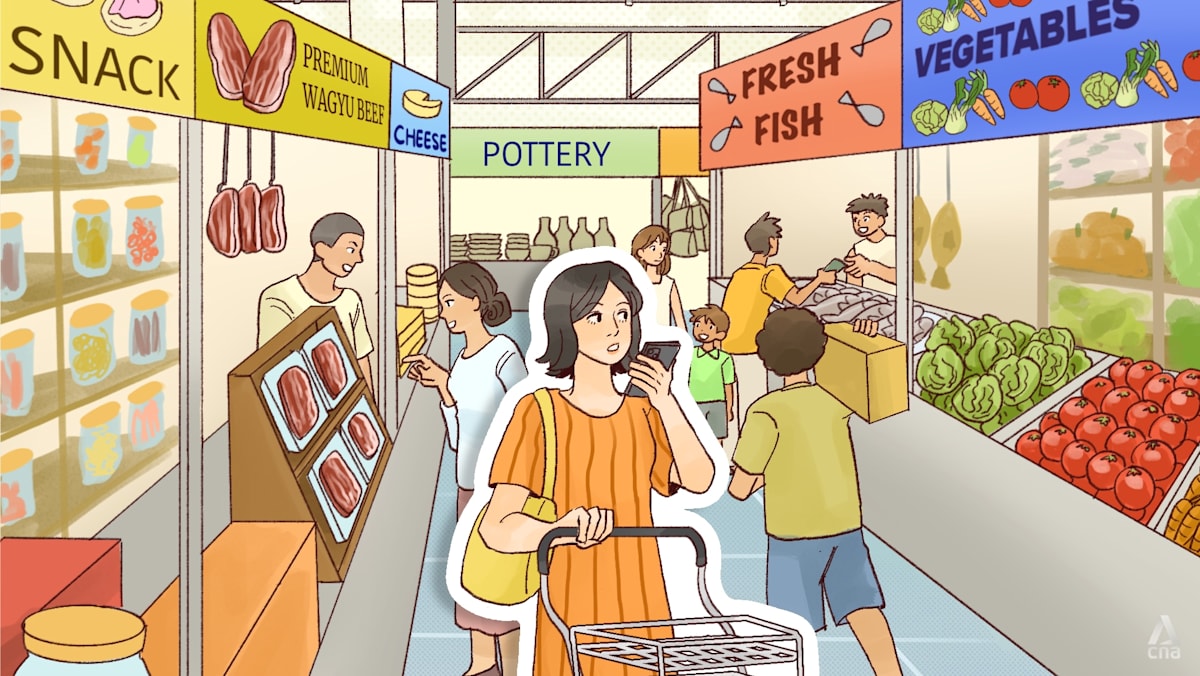
As younger shoppers increasingly turn elsewhere to buy meal ingredients or household items, wet-market vendors are rethinking how they do business while preserving the human connections, personal service and generations of expertise that remain their strengths.
As shopping habits change, wet markets are not dying, but are entering a new phase. (Illustration: CNA/Clara Ho)
This audio is generated by an AI tool.
Singaporean rapper and writer Andre Frois is a diehard wet market fan, keenly aware that this makes him something of an outlier among his peers.
"I love that feeling of connection with my community and generations of epicurean know-how. Above all, I love that I am contributing to small local businesses," the 41-year-old told CNA TODAY.
Mr Frois' memories of the wet market run deep. As a toddler, he would tag along when his mum and aunts visited the market. His grandfather also worked as a fishmonger on Queen Street after migrating from Swatow, China to Singapore around 1920.
To this day, Mr Frois still enjoys accompanying his mother to the wet market and listening to her impassioned chats with other marketgoers.
CNA Games Guess Word Crack the word, one row at a time Buzzword Create words using the given letters Mini Sudoku Tiny puzzle, mighty brain teaser Mini Crossword Small grid, big challenge Word Search Spot as many words as you can Show More Show Less Another reason he is firmly "Team Wet Market", over shoppers who choose supermarkets, is how easily he can find ingredients such as buah keluak ( a nut used in Peranakan cooking) and rempah (a spice paste) for traditional dishes. Mr Frois, who tries to visit the wet market at least once or twice a month, said: "Most Singaporeans don't venture beyond supermarkets these days and many prefer home grocery deliveries. "But when I need fresh herbs and spices, I need to go to the wet market, because supermarkets tend to carry them in powdered form." His ardent affection for the wet market stands in stark contrast to many supermarket-going Singaporeans, particularly younger generations, casting a pall of despondency over stallholders worried about the future of their trade. Ms Aileen Toh, 53, who sells goods such as vegetables, bean sprouts and kueh at Teck Ghee Court Market, admitted that today's wet markets are a far cry from their heyda decades ago. She said wryly: "When I just started in November 2025, my neighbours around me who have been here for 10 or 20 years said, 'Aiyah, here is like that one, lah – very hard to do'." Ms Toh, who previously worked in sales and project management at food delivery firm Deliveroo, decided to take the plunge and start her own stall to share her passion for nutrition and local agriculture. She has her work cut out for her as she tries to bring some vibrancy to an ageing market . She remains optimistic in the meantime. Her focus on local produce has already earned her a small but growing base of regular customers.
Another reason he is firmly "Team Wet Market", over shoppers who choose supermarkets, is how easily he can find ingredients such as buah keluak ( a nut used in Peranakan cooking) and rempah (a spice paste) for traditional dishes.
Mr Frois, who tries to visit the wet market at least once or twice a month, said: "Most Singaporeans don't venture beyond supermarkets these days and many prefer home grocery deliveries.
"But when I need fresh herbs and spices, I need to go to the wet market, because supermarkets tend to carry them in powdered form."
His ardent affection for the wet market stands in stark contrast to many supermarket-going Singaporeans, particularly younger generations, casting a pall of despondency over stallholders worried about the future of their trade.
Ms Aileen Toh, 53, who sells goods such as vegetables, bean sprouts and kueh at Teck Ghee Court Market, admitted that today's wet markets are a far cry from their heyda decades ago.
She said wryly: "When I just started in November 2025, my neighbours around me who have been here for 10 or 20 years said, 'Aiyah, here is like that one, lah – very hard to do'."
Ms Toh, who previously worked in sales and project management at food delivery firm Deliveroo, decided to take the plunge and start her own stall to share her passion for nutrition and local agriculture.
She has her work cut out for her as she tries to bring some vibrancy to an ageing market . She remains optimistic in the meantime. Her focus on local produce has already earned her a small but growing base of regular customers.
Ms Aileen Toh and her mother, Madam Tan Siew Khim, who helps to run the produce stall at Teck Ghee Court Market, pictured on Sep 1, 2026. (Photo: CNA/Raydza Rahman)
Wet markets are still a fixture of Singapore's housing estates, but they are much less bustling these days, with fewer young people visiting or setting up shop there.
A 2018 National Environment Agency (NEA) survey showed that 39 per cent of Singaporeans aged 18 to 69 had not visited a wet market in the preceding year, up from 33 per cent in 2016 and 23 per cent in 2014.
Concerns about the viability of wet markets even led Member of Parliament Joan Pereira (PAP-Tanjong Pagar) to raise a parliamentary question in October last year, asking whether measures were in place to attract younger stallholders to wet markets.
In a written response, Ms Grace Fu, Minister for Sustainability and the Environment, said: "The continued viability of wet markets ultimately depends on whether there is adequate consumer demand rather than just the availability of younger stallholders."
This shift in demand was already on the government's radar decades ago. In 1981, it convened a committee to look into the future of wet markets, which recommended building more supermarkets and air-conditioned grocery shops instead of wet markets.
Mr Chor Yeok Eng, then Senior Parliamentary Secretary for Environment, noted at the time that consumer behaviour was changing because the rise in dual-income households meant "a wife has little time for marketing" and wet markets with their short opening hours "will eventually fall short of people's demands".
Although wet markets are no longer the thriving hives of commerce they once were, some people still hope that they do not become obsolete, especially since they have evolved with the times in recent years.
New stalls have cropped up in some wet markets with wares catered to contemporary tastes.
Among them: Eliko Picture Books & Collectibles at Chinatown Complex Market and Food Centre, which specialises in vintage picture books; micro-roastery Luli Roasts, which sells coffee beans sourced from Ethiopia, Guatemala and other countries out of a wet market stall in Toa Payoh; and Sideway at Tiong Bahru Market, which showcases a carefully curated selection of handmade ceramics and homeware.
Elsewhere, some wet-market stalwarts have begun selling premium produce such as kale, wagyu and Italian herbs to attract discerning shoppers who could otherwise patronise high-end delis, while also offering mobile ordering, delivery services and even after-sales support.
As a result of such changes, a sociologist, stallholders and fans of wet markets said that these spaces are not dying, but entering a new phase – turning into community hubs where shoppers can get super fresh premium produce, one-on-one advice on ingredients and cooking, even concierge services.
INCONVENIENT NO MORE
Mr Neo Jun He, general manager of the Quan Shui Wet Market company, which oversees eight traditional wet market stalls, a modern concept store and an e-commerce arm, said that the decline in wet market footfall "has been noticeable, particularly since COVID-19".
Shopping habits have changed over the years, with more people buying groceries online, and the pandemic accelerated the trend, he added.
A view of Tekka Centre's wet market in Little India on Sep 1, 2026. (Photo: CNA/Raydza Rahman)
Many younger shoppers who spoke to CNA TODAY said that they rarely, if ever, set foot in a wet market, or had only done so in childhood when accompanying their parents and grandparents.
For some of them, it comes down to opening hours. Supermarkets typically close at night, or even stay open around the clock, whereas wet market stalls often close by the afternoon.
Ms Shona Suresh, a 32-year-old pet care professional, said that she occasionally visits the wet market because it is easier to buy smaller portions for her two-person household. However, the supermarket is sometimes still the better option for her.
"The convenience is there, especially if you have a schedule that is difficult to coincide with the market opening hours. Supermarkets also have quite a large variety of groceries, so it's a one-stop shop for all your household needs, beyond just cooking ingredients."
Ms Melissa Teo, 31, also prefers shopping in the evenings.
"I'm usually too busy or tired to get groceries (at the wet market) in the morning. Supermarkets usually open late till 10pm or 11pm, so it's more convenient for me."
The media professional, who is now on a work break, added that another advantage of shopping at supermarkets is the opportunity to use her credit card and accumulate air miles.
Ms Toh, the stallholder from Teck Ghee Court Market, recognised the stiff competition that supermarkets pose. Some of them even have wet market-like stations nowadays, she observed, which gives younger people little reason to visit a wet market.
Ms Aileen Toh stocks only homegrown produce at her Teck Ghee Court Market stall, highlighting the Singapore farms behind the vegetables she sells. (Photo: CNA/Raydza Rahman)
Some stall operators, such as Ms Wende Niew, 60, are unfazed. Ms Niew owns Choon Kooi Provision Shop, which has been at Teck Ghee Court Market for more than 40 years.
She keeps her business running even though the market is "very, very, very quiet", because she likes to go to the market every day for "bonding time" with her fellow stallholders.
Other stallholders at the same wet market are raising their game, offering phone or online ordering and delivery services, and they said that the results have been promising.
Former chef Kelvin Sim, who runs Chef Sim's Cuts at Teck Ghee Court Market, said that his younger customers like to order meat online, while older ones tend to visit his stall "to see the meat in real life".
A few stalls away from Mr Sim's is Amina Halal Fresh Poultry, where remote orders make up 60 per cent of the takings.
Stall owners Sarah Norman, 38, and Norman Firdaus, 37, started taking delivery orders by phone and WhatsApp when they first started the business eight years ago.
Mr Norman, a former civil servant, said: "We started seeing the new generation walking around, but they don't know what exactly we sell or how we sell it."
He decided to meet these younger customers where they were, by offering a virtual catalogue. He didn't just include his own halal poultry, but also a list of offerings from the other stalls at Teck Ghee Court Market.
Stall owner Sarah Norman serving customers at Amina Halal Fresh Poultry, Teck Ghee Court Market, on Sep 1, 2026. (Photo: CNA/Raydza Rahman)
Instead of ordering separately from multiple stalls, customers can place all their grocery orders with Mr Norman, who then sources the items from neighbouring stalls and delivers everything in one bundle to their doorstep.
All this is done without charging the other stall owners, and borne out of a desire to help them out, he said.
The service has worked so well that the married couple have some regular customers they have never even met.
"We don't even know what they look like. They will text us their orders, but they live there," Mr Norman said, pointing to a cluster of housing blocks a mere stone's throw away from the market.
Convenience and practicality aside, some young people are not confident of shopping at wet markets – from deciding how much to buy to communicating with the sellers, stallholders said.
Mr Chris Teo, 32, falls squarely within this category. The data scientist admitted: "My wife and I don't know where the nearest wet market is. Even if we did, we don't know how to haggle or gauge prices."
This is one of the pain points that Mr Colin Goh, the head chef at Let's Go Tour, hopes to bridge with his market-to-table tours.
The tours, typically consisting of 60 per cent tourists and 40 per cent Singapore residents, take participants through a wet market to shop for ingredients to prepare a dish familiar to Singaporeans.
The tours run about three to four times a week, typically drawing two to 20 participants. Occasionally, they host up to 25 participants.
Mr Colin Goh (centre) from Let's Go Tour with two participants of the Market to Table tour. (Photo: Colin Goh)
Mr Goh, 43, said that before the tours, some Singaporeans expected the wet markets to be confusing, unclean or a place where they will be overcharged, but they typically leave with a sense that these markets are full of warmth and offer the best ingredients one can find in Singapore.
Despite the lingering stereotypes against wet markets, Mr Neo, the third-generation owner of Quan Shui Wet Market, is rising to the challenge.
"I don't think the question should only be, 'How do we persuade young people to accept the traditional model?' We should also ask whether the model itself needs to evolve," he said.
That is exactly what the family business has been doing. They started out as Quan Shui Fresh Pork in 1968, growing to a chain of 15 wet market pork stalls over the years.
Then, the Neos started taking their business online in 2020, during the COVID-19 pandemic, out of necessity. What started as delivering online orders of fresh pork to customers gradually ballooned into a full online wet market, including produce and seafood.
"The opportunity for us is therefore not to convince younger Singaporeans to shop exactly like their parents did, but to make the wet market experience accessible in a form that works for them," Mr Neo added.
LESS BUSINESS, MORE HEART
As a big question mark hangs over the future of Singapore's wet markets, it is worth considering what makes them deserving of preservation, and which aspects of the institution should be maintained, observers said.
Mr Goh said that he still insists on taking his tour participants to a wet market for its distinctive character, even though a supermarket visit might give tourists a better idea of the average Singaporean’s daily routine.
"I wouldn’t want to take my tourists to a supermarket, because it’s not authentic enough."
Customers interacting with stall owners at Teck Ghee Court Market on Sep 1, 2026. (Photo: CNA/Raydza Rahman)
Professor Kelvin Low, head of the Department of Sociology and Anthropology at the National University of Singapore (NUS), said that wet markets carry a sense of the nation's history.
And beyond the history of how roving street hawkers were relocated into hawker centres and wet markets, these spaces have become important parts of Singapore's food culture and everyday life.
"People who have grown up shopping at wet markets with their families usually remember their sensory experiences," Prof Low added. These include the noise and smells, touching the produce and interacting with others.
These sights, sounds and smells then bring back memories, drawing them back to wet markets not just to buy food but also to socialise with others and enjoy the experience.
If wet markets decline further as Singaporeans' shopping habits continue to change, Mr Neo said that there would be a lot to lose.
Beyond stallholders' livelihoods lost, generations of knowledge and expertise could also disappear.
"A good fishmonger knows what arrived that morning. A butcher can recommend a cut based on what you're cooking and prepare it accordingly," he said.
"A vegetable seller might tell you what's good that day or how to cook something you've never tried before. Much of that knowledge isn't written down – it has been passed from person to person."
A wet-market stall at Tekka Centre in Little India on Sep 1, 2026. (Photo: CNA/Raydza Rahman)
Fresh fish at Tekka Centre's wet market on Sep 1, 2026. (Photo: CNA/Raydza Rahman)
A scene at a butcher stall at Tekka Centre's wet market on Sep 1, 2026. (Photo: CNA/Raydza Rahman)
The stallholders interviewed unanimously agreed that sharing their knowledge with customers remains one of the joys of their work.
Mr Sim, who spent two decades working as a chef, happily dishes out cooking tips to customers.
Wholesome Meat's co-owner Patricia Ng, whose stall is at Holland Village Market & Food Centre, offers "after-sales support" through WhatsApp.
Customers are encouraged to text her "anytime" for cooking advice, she said.
"We don't just sell you a piece of meat and you're on your own. If you have any questions, you have our WhatsApp number.
"We tell them, 'Take this home, we recommend doing it this way. Any problems, WhatsApp us and then we will guide you'."
Some customers also stay to chat at a table in front of Ms Ng's stall, and she said that friendships have been formed this way.
"We have young couples coming and talking to us about their kids. And then we've older people who sit down, and they also talk to us, because they can be quite lonely if their kids are all working overseas."
These communal bonds are another thing that would be lost if wet markets were to die out, Mr Neo pointed out.
"Beyond the food, we'd also lose part of Singapore's pasar (market) culture: familiar faces, conversations between neighbours and stallholders, and that sense of community around buying food for your family."
Ms Patricia Ng at her stall Wholesome Meat, located at Holland Village Market & Food Centre, on Sep 1, 2026. (Photo: CNA/Kimberly Lim)
Mr Norman, the poultry stall owner, agreed that this sense of community is precious to hold onto at a time when he sees people becoming more socially isolated.
"I feel like people don't talk to people anymore. We don't even go downstairs anymore to buy our food. We order delivery, and we ask the riders to leave it at our doors.
"I feel Singaporeans should talk to each other more," he said.
"It's not just about business anymore. It's more about the heart.
"You meet everyday Singaporeans. Some of them talk to us about things like their house, their family. Until I came here, I didn't feel like I was connecting with many Singaporeans," he added.
Perhaps unsurprisingly, Mr Norman has channelled his passion for the job into helping his wet market community adapt to buyers' changing habits.
When Amina Halal Fresh Poultry at Teck Ghee Court Market first started offering delivery services on the phone and via WhatsApp eight years ago, neighbouring stallholders found the idea hard to grasp, he said.
To help them get on board, Mr Norman and his wife went the extra mile, consolidating orders for the stalls and handling all the delivery logistics.
And when the couple started listing their poultry on GrabMart, they helped their neighbours list their products as well.
"Basically, any stall you see here, their items are also on our Grab listing. It didn't make sense only to list our chicken, because people don't just buy chicken," Mr Norman said.
While the other stallholders were initially sceptical, they eventually came around, he added. Now, shoppers can browse offerings from Amina Halal Fresh Poultry and 15 other vendors on GrabMart.
"They realised that it's a form of business for them, and this kind of thing has to be done."
Mr Neo of Quan Shui Wet Market said his family's foray into the digital world has paid off similarly.
"What surprised us was that even after (COVID-19) restrictions eased, customers continued shopping with us online. That showed us that there was a group of Singaporeans who still valued wet-market produce, but wanted to buy it in a way that better suited their lifestyles," he added.
The company still operates eight traditional wet-market locations across Singapore, and Mr Neo's parents still helm their main wet market stall at 156 Bukit Batok Street 11.
Today, Mr Neo estimates that Quan Shui's revenue is split evenly between its modern wet-market business, comprising e-commerce and its Modern Wet Market store at 50 Tagore Lane near Upper Thomson, and its traditional wet-market operations.
Ms Toh, the stallholder selling vegetables at Teck Ghee Court Market, is taking a different approach. Instead of building an online presence, she believes in slowly and steadily growing her customer base by showing why her offerings are special.
While conventional vegetable stalls in most markets sell a mix of imported and homegrown vegetables, Ms Toh stocks only homegrown produce and highlights the farms behind each vegetable.
Some customers are getting on board and will choose her produce even if supermarkets sell a similar item for a slightly lower price. For example, she said, a bundle of kale at her stall might cost S$5, while a supermarket chain might sell it for S$3. Her customers will still buy it from her.
"They understand the value of getting a fresher produce, but at the same time, there is also a small percentage who say that they want to support Singapore's farms, which is very encouraging."
A vegetable seller might tell you what's good that day or how to cook something you've never tried before.
At Holland Village Market & Food Centre, Ms Ng from Wholesome Meats is also targeting the increasingly discerning market-goer, selling grass-fed, free-range beef that is antibiotic-free and hormone-free.
"The same product that we sell here, you probably can't get it at any supermarket for that price. Supermarkets have higher overheads. Our agenda is affordable beef for as many people as possible," she said.
Another product getting to be more common appears to be ready-to-eat meals, directly targeting the busy working adult who has no time to cook, but does not want to eat out.
Ms Ng started selling frozen beef rendang a few weeks ago – made with her stall's beef, of course.
"Interestingly, we sold out on the first day," she said. "Customers say that it is great. They can just put it in a steamer. It's homemade. There are no preservatives. They know it comes from our beef, so the quality is good."
Mr Neo noted that for busy households, "convenience doesn't necessarily mean eating out".
"Sometimes, it simply means having the meat portioned properly, ingredients clearly labelled, or something already marinated so dinner can be prepared quickly," he said.
CHANGING WITH THE TIMES, KEEPING THE HUMAN TOUCH
For decades, the wet market has been defined by a specific and sensorial experience: the early morning trip, the slippery floor, the smell of fresh meat and seafood, the stallholders who remember your orders.
As wet markets get swept by the tide of time, making evolution inevitable, can these traditional spaces still preserve their old soul?
For the people working in and around wet markets, the answer is "yes". They noted that it all comes down to one thing: the human touch.
Ms Toh said that she began to expand her offerings, stocking items such as huat kueh – Chinese steamed cakes typically bought for prayers – after customers asked for them. This is particularly for older residents who might otherwise have to travel farther to find what they needed.
"Before I started this business, I never went to the wet market," Ms Toh admitted.
But after opening her stall, she found herself becoming attached to the community that began to form around her. She has come to know some customers well enough to remember their allergies.
"I think it’s a pity if such a connection is broken. We are an ageing population, right? That’s the reason why I started this journey. I’m in my 50s, so 10 years down the road, I will still have a community."
When Madam Poon Kein Hoon, 65, wanted to set up her Japanese home goods stall, Roomy Heart, at Tiong Bahru Market eight years ago, she had not even decided what to sell when she put in her bid.
She only had one aim – to spread the kampung spirit that her grandfather instilled in her.
She was an architect before she left the workforce to care for her children.
Madam Poon Kein Hoon pictured at Roomy Heart, her Japanese home goods stall located at Tiong Bahru Market, on Sep 1, 2026. (Photo: CNA/Kimberly Lim)
Over the years, Madam Poon has observed a decline in community spirit, with more people keeping their doors closed and windows shuttered.
So when she stumbled upon a stretch of Tiong Bahru Market with far less foot traffic than the rest of the market, she took the chance to add vibrancy to the area and create a space for the community to gather.
"With a background in urban design and architecture, I naturally found myself thinking about how to revitalise this stretch, inject energy into the pedestrian walkway and naturally draw the foot traffic to this area," she said.
"A market should be a destination, a memory creator, an anchor for daily social life – not just a transaction point."
She does not measure the success of her business in financial terms. Instead, she finds her greatest satisfaction in customers' smiles.
"Seeing each one of them leaving my shop with a smile and getting a little spark back, that's the best reward for me to carry on my business and the motivation."
Maintaining the human touch remains non-negotiable for many of the stallholders who spoke to CNA TODAY, but they seem less attached to some other traditional aspects of wet markets.
"Why must wet markets be dirty and smelly? Why must wet markets be hot and stuffy? It doesn't have to be this way," Ms Ng from Wholesome Meats said, adding that she would welcome air-conditioning in wet markets.
Madam Poon also believes that perceptions of wet markets need to change.
"Why must these markets limit themselves to selling cheap goods instead of offering high-quality, durable and useful products that stand the test of time? That's what I'm doing."
The slippery floor is a familiar feature of the traditional wet market experience, but some stallholders believe that the markets can modernise without losing their character.. (Photo: CNA/Raydza Rahman)
However, as Singapore's wet markets evolve, could something else be lost along the way – their traditional role as an affordable place for everyday consumers to buy groceries?
Mr Neo of Quan Shui Wet Market sees no inherent contradiction. Wet markets have never competed purely on price, he said.
"Wet markets have always competed on freshness, quality, relationships and value – not simply on being the cheapest place to shop."
What is happening now, he added, is less a departure from the wet market model than an expansion of it.
Indeed, a similar evolution has taken place at hawker centres across the island, Prof Low the sociologist said.
Apart from traditional fare, "hawkerpreneurs" have introduced international cuisines that cater to different consumer groups.
"Bearing in mind the costs of rent and maintenance, I think the influx of more specialised stalls also reflects a widening consumer base with more differentiated expectations or tastes," Prof Low added.
In Mr Neo's view, this diversity in consumer tastes is a good thing.
"To me, that's healthy for the wet-market ecosystem. It shows that the format can evolve rather than having to remain one-dimensional."
And while the physical environment and goods on offer at wet markets may change, their underlying culture can endure, he said.
"Our hope isn't necessarily that every young Singaporean wakes up at 6am to shop at a wet market.
"It's that the values behind the pasar – freshness, knowledge, relationships and community – remain relevant even as the way we shop changes."
Get our pick of top stories and thought-provoking articles in your inbox
Stay updated with notifications for breaking news and our best stories
Join our channel for the top reads for the day on your preferred chat app
随着年轻消费者越来越多地转向其他地方购买食材或家居用品,菜市场摊贩正在重新思考他们的经营方式,同时保留人际关系、个性化服务和几代人积累的专业知识,这些仍然是他们的优势。
随着购物习惯的改变,菜市场并没有消亡,而是进入了一个新的阶段。(插图:CNA/Clara Ho)
这段音频由人工智能工具生成。
新加坡说唱歌手兼作家安德烈·弗罗伊斯是菜市场的铁杆粉丝,他敏锐地意识到这使他在同辈人中显得有些另类。
“我喜欢与我的社区以及几代人的美食技艺建立联系的感觉。最重要的是,我喜欢为当地的小型企业做出贡献,”这位41岁的男子告诉CNA TODAY。
弗罗伊斯先生对菜市场的记忆非常深刻。他还是个蹒跚学步的孩子时,就经常跟着母亲和姨妈们去菜市场。他的祖父大约在1920年从中国汕头移民到新加坡后,也在皇后街当过鱼贩。
时至今日,弗罗伊斯先生仍然喜欢陪母亲去菜市场,听她与其他顾客热情洋溢地聊天。
CNA 游戏 猜词游戏 逐行破解单词 流行词游戏 用给定的字母组成单词 迷你数独 小小的谜题,强大的脑力挑战 迷你填字游戏 小方格,大挑战 单词搜索 尽可能多地找出单词 显示更多 显示更少 他坚定地支持“菜市场”而不是选择超市的购物者的另一个原因是,他很容易就能找到诸如黑果(娘惹菜中使用的一种坚果)和香料酱(一种香料糊)等传统菜肴的食材。弗罗伊斯先生每月至少会去菜市场一两次,他说:“现在大多数新加坡人都不怎么去超市以外的地方,很多人更喜欢送货上门。但如果我需要新鲜的香草和香料,就得去菜市场,因为超市里卖的都是粉状的。”他对菜市场的热爱与许多经常去超市的新加坡人,尤其是年轻一代形成了鲜明的对比,这让那些担心生意前景的摊贩们感到沮丧。53岁的杜爱琳女士在德义阁市场卖蔬菜、豆芽和糕点等商品,她承认如今的菜市场与几十年前的鼎盛时期相比已经相去甚远。她苦笑着说:“我2025年11月刚开始做菜的时候,周围那些在这里做了10年或20年的邻居就说,‘哎呀,这里跟以前一样——很难做下去。’”曾在外卖公司Deliveroo从事销售和项目管理工作的Toh决定放手一搏,开设自己的摊位,分享她对营养和本地农业的热情。她面临着艰巨的任务,要为日渐老化的市场注入新的活力。与此同时,她依然保持乐观。她对本地农产品的专注已经为她赢得了一批数量虽少但不断增长的忠实顾客。
他坚定地支持“菜市场”,而不是选择超市的购物者,另一个原因是,他可以很容易地找到诸如黑果(娘惹菜中使用的一种坚果)和香料酱(一种香料糊)等传统菜肴的食材。
弗罗伊斯先生尽量每月至少去菜市场一两次,他说:“如今大多数新加坡人都很少去超市以外的地方,许多人更喜欢送货上门的杂货。
“但是当我需要新鲜的香草和香料时,我需要去菜市场,因为超市里通常只出售粉末状的香料。”
他对菜市场的热爱与许多经常去超市的新加坡人,尤其是年轻一代形成了鲜明的对比,这让摊贩们忧心忡忡,担心自己的生意能否继续下去。
53岁的杜爱琳女士在德义阁市场出售蔬菜、豆芽和糕点等商品,她承认,如今的菜市场与几十年前的鼎盛时期相比,已经相去甚远。
她苦笑着说:“我刚开始工作的时候(2025 年 11 月),我周围那些在这里住了 10 年或 20 年的邻居们就说,‘哎呀,这里跟那里一样,啦——很难做’。”
曾在外卖公司 Deliveroo 从事销售和项目管理工作的 Toh 女士决定放手一搏,开设自己的摊位,分享她对营养和当地农业的热情。
她肩负重任,要为这个日渐老化的市场注入新的活力。与此同时,她依然保持乐观。她专注于本地农产品,已经为她赢得了一小批但不断增长的固定顾客群。
图为2026年9月1日,艾琳·杜女士和她的母亲陈秀琴女士在德义阁市场帮忙经营蔬果摊位。(图片:CNA/Raydza Rahman)
新加坡的住宅区仍然保留着菜市场,但如今菜市场已不如以往那样熙熙攘攘,很少有年轻人光顾或在那里开店。
2018 年国家环境局 (NEA) 的一项调查显示,18 至 69 岁的新加坡人中有 39% 在过去一年中没有去过湿巴刹,高于 2016 年的 33% 和 2014 年的 23%。
人们对湿货市场的生存能力表示担忧,甚至促使国会议员琼·佩雷拉(人民行动党-丹戎巴葛)于去年 10 月在议会提出质询,询问是否有措施吸引年轻的摊贩到湿货市场经营。
永续发展及环境部长傅海燕女士在书面答复中表示:“湿货市场的持续生存最终取决于是否有足够的消费需求,而不仅仅是年轻摊贩的数量。”
这种需求转变早在几十年前就引起了政府的注意。1981年,政府成立了一个委员会,研究菜市场的未来,该委员会建议建造更多的超市和带空调的杂货店,而不是菜市场。
时任环境部高级政务次长曹耀荣先生当时指出,消费者的行为正在发生变化,因为双职工家庭的增加意味着“妻子很少有时间去购物”,而营业时间短的菜市场“最终将无法满足人们的需求”。
虽然菜市场已不再像以前那样繁荣热闹,但有些人仍然希望它们不会过时,尤其是在近年来它们与时俱进的情况下。
一些菜市场里出现了新的摊位,出售迎合现代人口味的商品。
其中包括:位于牛车水综合市场和熟食中心的 Eliko Picture Books & Collectibles,专门经营复古图画书;位于大巴窑菜市场摊位的 Luli Roasts 小型烘焙店,出售来自埃塞俄比亚、危地马拉和其他国家采购的咖啡豆;以及位于中峇鲁市场的 Sideway,展示精心挑选的手工陶瓷和家居用品。
在其他地方,一些老牌菜市场商贩开始销售羽衣甘蓝、和牛和意大利香草等优质农产品,以吸引那些原本可能光顾高档熟食店的挑剔顾客,同时还提供手机订购、送货服务,甚至售后支持。
由于这些变化,一位社会学家、摊主和菜市场的爱好者表示,这些地方并没有消亡,而是进入了一个新阶段——转变为社区中心,购物者可以在这里获得超级新鲜的优质农产品、关于食材和烹饪的一对一建议,甚至还有礼宾服务。
不再不方便
泉水菜市场公司总经理梁俊和先生表示,菜市场客流量的下降“非常明显,尤其是在新冠疫情爆发之后”。泉水菜市场公司管理着八个传统菜市场摊位、一家现代概念店和一个电子商务部门。
他补充说,近年来人们的购物习惯发生了变化,越来越多的人选择在网上购买食品杂货,而疫情加速了这一趋势。
2026年9月1日,小印度竹脚中心菜市场的景象。(图片:CNA/Raydza Rahman)
许多接受 CNA TODAY 采访的年轻购物者表示,他们很少(如果有的话)去过菜市场,或者只是在小时候跟随父母和祖父母去过。
对他们中的一些人来说,关键在于营业时间。超市通常晚上关门,甚至24小时营业,而菜市场摊位往往下午就关门了。
32岁的宠物护理员肖娜·苏雷什女士表示,她偶尔会去菜市场,因为那里更容易买到适合她两口之家的小份量食材。不过,对她来说,超市有时仍然是更好的选择。
“超市的便利性显而易见,尤其适合那些作息时间难以与市场营业时间配合的人。超市的食品种类也非常丰富,除了烹饪食材之外,还能满足您所有的家庭需求,是一站式购物的好去处。”
31岁的梅丽莎·特奥女士也喜欢在晚上购物。
“我早上通常太忙或太累,没时间去菜市场买菜。超市通常营业到晚上10点或11点,所以对我来说更方便。”
这位目前正在休假的媒体从业人员补充说,在超市购物的另一个好处是可以使用信用卡并积累航空里程。
来自德义阁市场的摊主杜女士意识到超市带来的激烈竞争。她观察到,如今有些超市甚至设有类似菜市场的区域,这使得年轻人几乎没有理由再去菜市场了。
艾琳·杜女士在德义阁市场摊位上只出售本地种植的农产品,以此凸显她所售蔬菜背后的新加坡农场。(图片:CNA/Raydza Rahman)
一些摊主,例如60岁的Wende Niew女士,则毫不在意。Niew女士拥有一家名为“春贵杂货店”的店铺,这家店已经在德义阁市场经营了40多年。
即使市场“非常、非常、非常冷清”,她仍然坚持经营自己的生意,因为她喜欢每天去市场和同行摊主们“联络感情”。
同一菜市场的其他摊贩也在提升服务水平,提供电话或在线订购和送货服务,他们表示效果令人满意。
在德义阁市场经营“沈师傅肉铺”的前厨师沈凯文表示,他的年轻顾客喜欢在网上订购肉类,而年长的顾客则倾向于到他的摊位“亲自查看肉的品质”。
离沈先生的摊位不远就是阿米娜清真鲜禽店,该店的营业额中有 60% 来自远程订单。
摊主 Sarah Norman(38 岁)和 Norman Firdaus(37 岁)在八年前刚开始创业时,就开始通过电话和 WhatsApp 接受送货订单。
曾任公务员的诺曼先生说:“我们开始看到新一代的年轻人四处走动,但他们不知道我们究竟卖什么,也不知道我们是如何卖的。”
他决定迎合这些年轻顾客,于是推出了虚拟产品目录。目录中不仅包括他自家的清真禽肉,还包括德义阁市场其他摊位的产品。
2026年9月1日,摊主Sarah Norman在德义阁市场(Teck Ghee Court Market)的Amina Halal Fresh Poultry摊位为顾客服务。(图片:CNA/Raydza Rahman)
顾客无需分别从多个摊位订购,只需向诺曼先生下单,他便会从邻近的摊位采购商品,并将所有商品打包送到顾客家门口。
他说,所有这一切都是出于帮助其他摊主的愿望,而且没有向他们收取任何费用。
这项服务非常成功,这对夫妇甚至拥有一些素未谋面的回头客。
“我们甚至不知道他们长什么样。他们会发短信给我们下单,但他们就住在那里,”诺曼先生指着离市场只有几步之遥的一片住宅楼群说道。
摊主们表示,除了便利性和实用性之外,一些年轻人对在菜市场购物缺乏信心——从决定买多少东西到与卖家沟通。
32岁的克里斯·张先生就属于这种情况。这位数据科学家坦言:“我和妻子不知道最近的菜市场在哪里。即使知道,我们也不知道如何讨价还价或估价。”
这是 Let's Go Tour 的主厨 Colin Goh 先生希望通过他的“从市场到餐桌”之旅来解决的痛点之一。
这些旅行团通常由 60% 的游客和 40% 的新加坡居民组成,带领参与者逛逛菜市场,购买食材来烹制新加坡人熟悉的菜肴。
这些旅行团每周大约组织三到四次,通常每次吸引两到二十名参与者。偶尔也会有多达二十五名参与者。
来自 Let's Go Tour 的 Colin Goh 先生(中)与两位参加“从市场到餐桌”之旅的游客合影。(照片:Colin Goh)
43岁的吴先生表示,在参观之前,一些新加坡人认为菜市场会很混乱、不干净,或者会被宰客,但他们通常离开时都会觉得这些市场充满温馨,并且提供了新加坡能找到的最好的食材。
尽管人们对湿货市场仍然存在一些刻板印象,但泉水湿货市场的第三代传人梁先生正在迎接挑战。
“我认为问题不应该仅仅是‘我们如何说服年轻人接受传统模式?’我们还应该问问这种模式本身是否需要发展,”他说。
这正是这家家族企业一直以来所做的。他们于 1968 年以“泉水鲜肉”起家,多年来发展成为拥有 15 个菜市场猪肉摊位的连锁企业。
随后,在2020年新冠疫情期间,出于无奈,尼奥一家开始将生意转移到线上。起初,他们只是向顾客配送新鲜猪肉订单,后来逐渐发展成为一个涵盖农产品和海鲜的综合性线上菜市场。
“因此,我们的机会不是说服年轻的新加坡人像他们的父母那样购物,而是以一种适合他们的方式,让他们也能体验到菜市场购物的乐趣,”Neo先生补充道。
少些商业考量,多些真心关怀
观察人士表示,由于新加坡湿货市场的未来充满未知数,因此值得思考是什么让它们值得保留,以及该机构的哪些方面应该得到维护。
吴先生表示,他仍然坚持带游客去菜市场参观,因为菜市场具有独特的特色,尽管参观超市可能让游客更好地了解新加坡普通人的日常生活。
“我不想带游客去超市,因为那里不够地道。”
2026年9月1日,顾客在德义阁市场与摊主互动。(图片:CNA/Raydza Rahman)
新加坡国立大学社会学与人类学系主任 Kelvin Low 教授表示,湿货市场承载着国家的历史感。
除了将流动街头小贩迁至小贩中心和菜市场的历史意义之外,这些场所也已成为新加坡饮食文化和日常生活的重要组成部分。
“从小就和家人一起逛菜市场的人,通常都能记住当时的感官体验,”罗教授补充道。这些体验包括市场里的声音和气味,触摸新鲜蔬果以及与他人互动。
这些景象、声音和气味会唤起人们的回忆,吸引他们回到菜市场,不仅是为了购买食物,也是为了与他人社交,享受这种体验。
Neo先生表示,如果随着新加坡人购物习惯的持续改变,湿货市场进一步衰落,将会造成巨大的损失。
除了摊贩们失去生计之外,几代人的知识和专业技能也可能消失。
“好的鱼贩知道当天早上到了什么鱼。肉贩可以根据你烹饪的菜肴推荐合适的部位,并据此进行处理,”他说。
“卖菜的人可能会告诉你当天什么蔬菜新鲜,或者教你做一道你从未尝试过的菜。这些知识大多没有写下来,而是口口相传的。”
2026年9月1日,位于小印度竹脚中心的一家菜市场摊位。(图片:CNA/Raydza Rahman)
2026年9月1日,竹脚中心菜市场的新鲜鱼类。(图片:CNA/Raydza Rahman)
2026年9月1日,竹脚中心菜市场肉铺的场景。(图片:CNA/Raydza Rahman)
接受采访的摊主们一致认为,与顾客分享知识仍然是他们工作的一大乐趣。
曾担任厨师二十年的沈先生乐于向顾客分享烹饪技巧。
Wholesome Meat 的共同所有人 Patricia Ng 的摊位位于 Holland Village Market & Food Centre,她通过 WhatsApp 提供“售后支持”。
她表示,鼓励顾客“随时”给她发短信咨询烹饪建议。
“我们不会只卖给你一块肉就让你自生自灭。如果你有任何问题,可以联系我们的WhatsApp号码。”
“我们会告诉他们,‘把这个带回家,我们建议这样做。如有任何问题,请通过 WhatsApp 联系我们,我们会指导您。’”
有些顾客还会留在吴女士的摊位前的桌子旁聊天,吴女士说,就这样结下了友谊。
“我们经常会遇到年轻夫妇,他们会来和我们谈论他们的孩子。也会有一些年纪较大的人坐下来和我们聊天,因为如果他们的孩子都在海外工作,他们会感到非常孤独。”
Neo先生指出,如果湿货市场消失,这些社区纽带也会随之消失。
“除了食物之外,我们还会失去新加坡巴刹(市场)文化的一部分:熟悉的面孔、邻里和摊主之间的交谈,以及围绕着为家人购买食物而产生的社区感。”
2026年9月1日,Patricia Ng女士在位于荷兰村市场及熟食中心的“Wholesome Meat”摊位前。(图片:CNA/Kimberly Lim)
家禽摊主诺曼先生也认为,在人们日益社会孤立的当下,这种社区意识弥足珍贵。
“我觉得现在人们都不跟人说话了。我们甚至都不下楼去买吃的了。我们都叫外卖,然后让送餐员把东西放在门口。”
他说:“我觉得新加坡人应该多互相交流。”
“这不再仅仅是生意了,更多的是人与人之间的情感。”
“你会遇到很多普通的的新加坡人。他们中的一些人会和我们聊聊他们的房子、家人等等。在我来到这里之前,我感觉自己和很多新加坡人并没有建立起真正的联系,”他补充道。
不出所料,诺曼先生将他对工作的热情投入到帮助他所在的菜市场社区适应买家不断变化的习惯中。
他说,八年前,当德义阁市场的 Amina Halal Fresh Poultry 首次开始通过电话和 WhatsApp 提供送货服务时,邻近的摊主们很难理解这个想法。
为了帮助他们顺利开展业务,诺曼先生和他的妻子格外用心,整合了各个摊位的订单,并处理了所有的配送物流。
当这对夫妇开始在 GrabMart 上架他们的家禽时,他们也帮助邻居们上架了他们的产品。
“基本上,你在这里看到的任何摊位,他们的商品也都在我们的Grab列表中。只列出我们的鸡肉没有意义,因为人们不只是买鸡肉,”诺曼先生说。
他补充说,虽然其他摊主起初持怀疑态度,但最终也接受了这种做法。现在,消费者可以在GrabMart上浏览Amina Halal Fresh Poultry和其他15家商户的商品。
“他们意识到这对他们来说是一种生意,这种事情必须要做。”
泉水菜市场的梁先生表示,他家进军数字领域也获得了类似的成功。
“令我们感到惊讶的是,即使在(新冠疫情)限制措施放宽后,顾客仍然继续在线购物。这表明,有一部分新加坡人仍然重视菜市场的食材,但他们希望以更适合自己生活方式的方式购买,”他补充道。
该公司在新加坡仍然经营着八家传统菜市场,而Neo先生的父母仍然掌管着位于武吉巴督11街156号的主要菜市场摊位。
据Neo先生估计,如今泉水的收入在现代菜市场业务(包括电子商务和位于汤申路上段附近泰戈尔巷50号的现代菜市场门店)和传统菜市场业务之间平均分配。
在德义阁市场摆摊卖菜的杜女士采取了不同的策略。她没有选择建立线上业务,而是相信通过展示自家产品的独特之处,循序渐进地发展客户群。
虽然大多数市场的传统蔬菜摊位出售进口蔬菜和本地种植的蔬菜,但 Toh 女士只出售本地种植的农产品,并重点介绍每种蔬菜背后的农场。
有些顾客开始接受她的摊位,即使超市里类似的商品价格略低,他们也会选择购买她的产品。例如,她说,她摊位上的一捆羽衣甘蓝可能要5新元,而连锁超市可能只卖3新元。但她的顾客仍然会从她这里购买。
“他们明白新鲜农产品的价值,但与此同时,也有一小部分人表示他们想要支持新加坡的农场,这非常令人鼓舞。”
卖菜的人可能会告诉你当天什么蔬菜比较新鲜,或者教你如何烹饪你以前从未尝试过的菜肴。
在荷兰村市场和美食中心,来自 Wholesome Meats 的 Ng 女士也瞄准了越来越挑剔的市场顾客,出售不含抗生素和激素的草饲、散养牛肉。
“我们这里卖的同款产品,你可能在任何超市都买不到这个价钱。超市的运营成本更高。我们的目标是让尽可能多的人都能买到价格实惠的牛肉,”她说道。
另一种越来越常见的产品是即食食品,其目标客户是忙碌的上班族,他们没有时间做饭,但又不想外出就餐。
吴女士几周前开始出售冷冻牛肉仁当——当然是用她摊位上的牛肉制成的。
“有趣的是,我们第一天就卖光了,”她说。“顾客们都说味道很棒。他们只需要把它放进蒸锅里蒸一下就行了。这是自制的,不含防腐剂。他们知道这是用我们自己的牛肉做的,所以质量很好。”
Neo先生指出,对于忙碌的家庭来说,“方便并不一定意味着外出就餐”。
他说:“有时候,这仅仅意味着将肉分成合适的份量,将配料清楚地贴上标签,或者将食材腌制好,这样就可以快速准备晚餐。”
与时俱进,不失人文关怀
几十年来,菜市场一直以一种独特的感官体验为特征:清晨的旅程、湿滑的地板、新鲜肉类和海鲜的香味、以及记得你订单的摊主。
随着时代潮流的推移,传统市场不可避免地要经历变革,这些传统场所还能保留其古老的灵魂吗?
对于在菜市场及其周边工作的人们来说,答案是“是的”。他们指出,这一切归根结底在于一点:人情味。
杜女士表示,应顾客要求,她开始扩大商品种类,例如进购发糕(一种通常在祈福时购买的中国蒸糕)。这尤其方便了老年居民,否则他们可能需要走更远的路才能买到所需物品。
“在我开始做这门生意之前,我从来没去过菜市场,”杜女士坦言。
但自从摆摊之后,她发现自己渐渐融入了周围形成的小社区。她甚至和一些顾客很熟,记得他们的过敏史。
“我觉得如果这样的联系断了,那就太可惜了。我们的人口正在老龄化,对吧?这就是我开始这段旅程的原因。我已经五十多岁了,所以十年后,我仍然会拥有一个社群。”
八年前,65岁的潘金芬女士想在Tiong Bahru市场开设她的日本家居用品摊位“Roomy Heart”,当时她甚至还没决定要卖什么。
她只有一个目标——传播祖父灌输给她的甘榜精神。
她以前是一名建筑师,为了照顾孩子而离开职场。
2026年9月1日,潘锦芬女士在位于中峇鲁市场的日式家居用品摊位“Roomy Heart”前拍照。(图片:CNA/Kimberly Lim)
多年来,潘女士注意到社区精神有所下降,越来越多的人紧闭家门,紧闭门窗。
所以,当她偶然发现中峇鲁市场有一段人流量远低于市场其他区域的地方时,她抓住机会为该地区增添活力,并为社区创造一个聚集的空间。
“我拥有城市设计和建筑方面的背景,因此我自然而然地开始思考如何振兴这段街区,为人行道注入活力,并自然而然地吸引人流到这个区域,”她说。
“市场应该是一个目的地,一个回忆的创造者,一个日常社交生活的中心——而不仅仅是一个交易点。”
她并不以金钱来衡量生意的成功。相反,顾客的笑容才是她最大的满足感来源。
“看到他们每个人离开我的店时都面带笑容,重新焕发活力,这就是我继续经营下去的最大回报和动力。”
对于许多接受 CNA TODAY 采访的摊主来说,保持人情味仍然是不可妥协的,但他们似乎不太在意菜市场的其他一些传统方面。
“为什么菜市场就一定要脏乱臭气熏天?为什么菜市场就一定要闷热难耐?其实不必如此。”来自Wholesome Meats的吴女士说道,并补充说她欢迎菜市场安装空调。
潘女士也认为,人们对湿货市场的看法需要改变。
“为什么这些市场非要局限于销售廉价商品,而不是提供经得起时间考验的高质量、耐用且实用的产品呢?而我正在做的正是后者。”
湿滑的地面是传统菜市场的一大特色,但一些摊主认为,菜市场可以在现代化的同时保留其特色。(图片:CNA/Raydza Rahman)
然而,随着新加坡菜市场的发展演变,会不会也有一些东西在过程中消失——比如它们作为普通消费者购买食品杂货的平价场所的传统作用?
泉水菜市场的梁先生认为这并不矛盾。他说,菜市场从来就不是单纯靠价格竞争的。
“菜市场一直以来都在新鲜度、质量、人际关系和价值方面展开竞争,而不仅仅是比拼价格是否最低。”
他补充说,现在发生的事情与其说是对湿货市场模式的背离,不如说是对其的扩展。
社会学家罗教授表示,事实上,全岛各地的小贩中心都发生了类似的演变。
除了传统美食外,“小贩企业家”还引进了迎合不同消费群体的国际美食。
“考虑到租金和维护成本,我认为更多专业摊位的涌入也反映出消费者群体不断扩大,他们的期望或品味也更加多样化,”罗教授补充道。
在Neo先生看来,消费者口味的这种多样性是一件好事。
“在我看来,这对生鲜市场的生态系统来说是件好事。这表明这种模式可以不断发展,而不是一成不变。”
他表示,虽然菜市场的物质环境和商品可能会发生变化,但其内在文化却可以延续下去。
“我们并不希望每个新加坡年轻人早上6点就起床去菜市场购物。
“即使我们的购物方式发生了变化,巴刹背后的价值观——新鲜、知识、人际关系和社区——仍然具有现实意义。”
订阅我们的邮件,即可获取精选热点新闻和引人深思的文章。
订阅通知,第一时间获取突发新闻和精彩报道。
加入我们的频道,即可在您常用的聊天应用上获取当日热门文章。