Nuclear fusion can create economic opportunity for Singapore: Tan See Leng陈思玲:核聚变可为新加坡创造经济机遇
Singapore has strong talent in the fusion sector, and research and engineering strengths to solve problems. Read more at straitstimes.com.
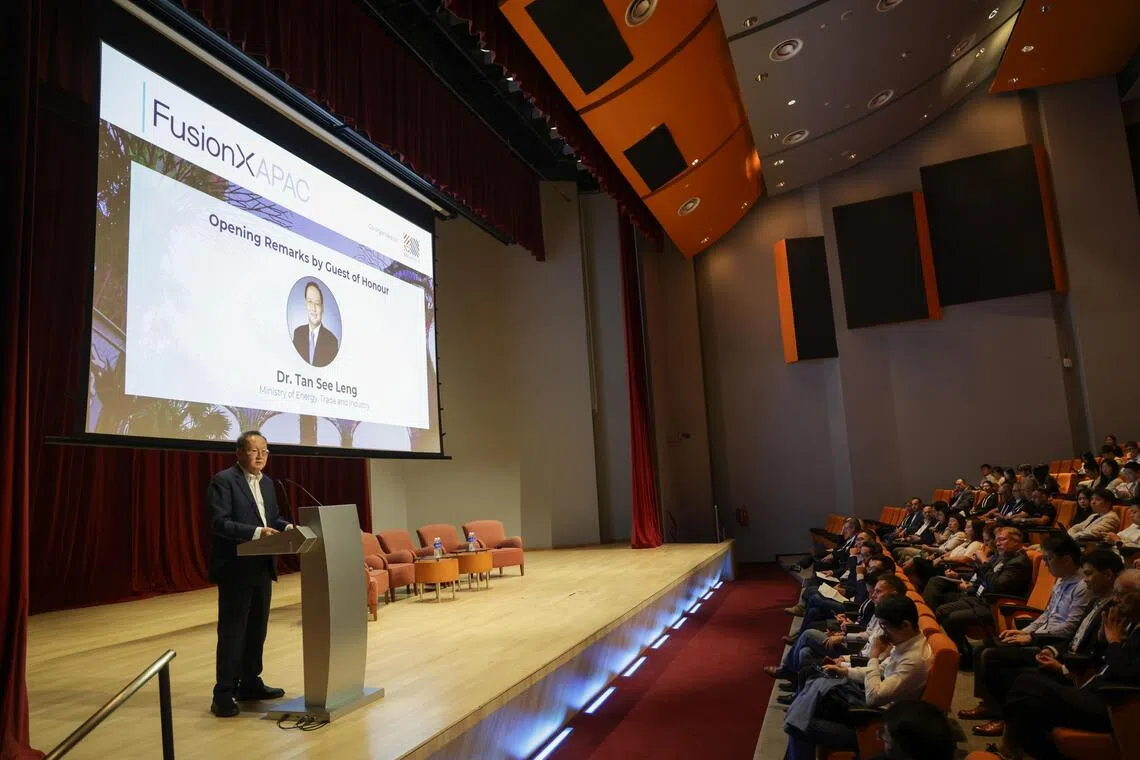
Minister for Energy, Trade and Industry (Energy and Industry) Tan See Leng speaking at the opening of FusionX:APAC on Oct 1.
PHOTO: LIANHE ZAOBAO
Published Oct 01, 2026, 11:30 AM
Updated Oct 01, 2026, 11:31 AM
Singapore is preparing to seize economic opportunities in nuclear fusion despite the technology being years away from commercialisation.
Fusion energy is one potential energy pathway it is following closely.
Tan See Leng highlights Singapore's advantage due to its available talent pool in this sector.
SINGAPORE - Tapping the process of nuclear fusion for energy generation may still be some years away, but there are still economic opportunities in this area that Singapore is well-placed to capture, Minister for Energy, Trade and Industry (Energy and Industry) Tan See Leng said on Oct 1.
Speaking at the opening of a nuclear fusion conference FusionX:APAC held at the Biopolis, he highlighted how the fusion ecosystem is forecast to reach a value of US$419.84 billion (S$535 billion) by the end of this decade.
The three-day conference organised by SGInnovate, a Government-backed venture builder, will bring together global fusion firms, researchers and investors to take stock of the opportunities and challenges of the emerging field.
“Even for countries like Singapore without our own fusion reactor, we can leverage our talent, R&D, and industrial capabilities to support the broader fusion economy,” Tan said.
Currently, commercial nuclear energy plants tap the process of fission - where the nucleus of a uranium atom splits - to generate electricity. Nuclear fusion, on the other hand, refers to reactions that produce energy when hydrogen particles are forced - or fused - together.
Tan said he is encouraged by a fusion reactor that has produced more energy under experimental conditions. Most experiments usually require more energy to deliver a reaction.
In 2022, the National Ignition Facility in California used 2.05 megajoules of energy to deliver a fusion reaction that produced 3.15 megajoules of energy.
“Such technical progress in fusion has been met with growing commercial interest, with sizeable investment flows going into fusion energy companies,” he said.
Fusion is the same process that happens on the sun, and is more challenging to replicate on Earth because the reaction must be done in temperatures of 100 million deg C or more - which is several times hotter than the sun.
But it is an attractive option in the energy sector as the fusion process has less of a risk of a runaway chain reaction or meltdown, while releasing no planet-warming carbon emissions.
Even as research continues on this front, there are other uses for fusion technology, such as in space .
During the event, Tan highlighted plasma scientist Mark Lim, who now heads space-tech firm Aliena, which develops plasma-based engines for spacecraft.
Fusion reactors include a futuristic doughnut-shaped chamber, called a tokamak, that contains plasma - a superheated soup of ions - where the fusion reaction takes place.
Tan said that Singapore has much to offer the global fusion economy.
For one, the Republic has nurtured expertise and talent in areas relevant to fusion, such as as in precision engineering, advanced manufacturing and in measuring the properties and behaviour of plasma .
Moreover, Singapore’s research and engineering efforts have also helped to overcome technical challenges in fusion.
For instance, he said A*STAR has also worked with another US fusion company Realta Fusion since 2023 and successfully delivered a tool to measure the speed and direction of plasma.
Tan also cited A*STAR’s recent partnership in May with the world’s largest nuclear fusion firm, Commonwealth Fusion Systems, which will focus on developing technologies for commercial fusion power plants.
A*STAR and ST Engineering had also entered an agreement with Commonwealth to produce components for the US company’s fusion demo reactor, building on Singapore’s advanced manufacturing capabilities.
Singapore’s vibrant tech ecosystem , which brings together research, industry, talent and capital, also matters for emerging technologies like fusion, Tan added.
“Turning scientific breakthroughs into commercial opportunities requires not just technical expertise, but patient capital and strong industry partnerships,” he added.
On the potential of nuclear fusion energy for Singapore, Tan added that global developments have given Singapore new impetus to leave “no option unexplored in (its) energy transition”.
The country is diligently study and build capabilities in more nascent energy pathways such as hydrogen. “Fusion energy is one potential pathway we are following closely,” he said.
Tan noted that his ministry was officially renamed the Ministry of Energy, Trade and Industry (METI) on Oct 1. It was previously known as the Ministry of Trade and Industry.
He said the renaming reflects the increasing recognition of the importance of energy as an enabler for economic growth, climate goals, and resilience.
Singapore has not decided on whether it will tap nuclear energy, but is making strides in closely studying nuclear fission. It will undergo an assessment by the UN atomic watchdog , the International Atomic Energy Agency in 2027 to determine the Republic’s ability to make an informed decision on nuclear energy deployment.
A*Star/Agency for Science, Technology and Research
能源、贸易及工业部长(能源及工业)陈思龙于10月1日在FusionX:APAC开幕式上发表讲话。
图片来源:联合早报
发布于2026年10月1日上午11:30
更新于2026年10月1日上午11:31
尽管核聚变技术距离商业化还有数年时间,但新加坡正准备抓住核聚变带来的经济机遇。
聚变能是它正在密切关注的潜在能源发展路径之一。
陈思玲强调,新加坡在该领域拥有丰富的人才储备,这使其具有优势。
新加坡——能源、贸易和工业部长(能源和工业)陈思龙10月1日表示,利用核聚变发电可能还需要几年时间,但该领域仍然存在经济机遇,新加坡在这方面具有得天独厚的优势。
在生物城举行的核聚变会议 FusionX:APAC 开幕式上,他强调,预计到本十年末,聚变生态系统的价值将达到 4198.4 亿美元(5350 亿新元)。
由政府支持的风险投资机构 SGInnovate 主办的为期三天的会议,将汇聚全球聚变公司、研究人员和投资者,共同评估这一新兴领域的机遇和挑战。
“即使像新加坡这样没有自己的聚变反应堆的国家,我们也可以利用我们的人才、研发和工业能力来支持更广泛的聚变经济,”谭说。
目前,商业核电站利用核裂变过程(即铀原子核分裂)来发电。而核聚变则是指氢粒子被迫(或融合)在一起时产生能量的反应。
谭教授表示,他很高兴看到一个聚变反应堆在实验条件下产生了更多能量。大多数实验通常需要更多能量才能引发反应。
2022 年,加利福尼亚州的国家点火装置利用 2.05 兆焦耳的能量引发聚变反应,产生了 3.15 兆焦耳的能量。
他说:“聚变技术的这种进步引起了越来越多的商业兴趣,大量投资涌入聚变能源公司。”
核聚变是太阳上发生的相同过程,但在地球上复制核聚变更具挑战性,因为该反应必须在 1 亿摄氏度或更高的温度下进行——这比太阳的温度高出好几倍。
但在能源领域,这是一个很有吸引力的选择,因为聚变过程发生失控链式反应或熔毁的风险较小,而且不会释放导致全球变暖的碳排放。
尽管这方面的研究仍在继续,但聚变技术还有其他用途,例如在太空中。
活动期间,谭重点介绍了等离子体科学家马克·林,他现在领导着航天技术公司 Aliena,该公司为航天器开发基于等离子体的发动机。
聚变反应堆包括一个未来主义的甜甜圈形状的腔室,称为托卡马克,其中包含等离子体——一种过热的离子汤——聚变反应就在其中发生。
谭表示,新加坡可以为全球融合经济做出很多贡献。
首先,共和国在与聚变相关的领域培养了专业知识和人才,例如精密工程、先进制造以及测量等离子体的性质和行为。
此外,新加坡的研究和工程努力也帮助克服了聚变领域的技术挑战。
例如,他表示,A*STAR 自 2023 年以来还与另一家美国聚变公司 Realta Fusion 合作,并成功交付了一种用于测量等离子体速度和方向的工具。
谭还提到了新加坡科技研究局 (A*STAR) 于 5 月份与世界最大的核聚变公司 Commonwealth Fusion Systems 建立的合作关系,该合作关系将专注于开发用于商业聚变发电厂的技术。
新加坡科技研究局 (A*STAR) 和新加坡科技工程公司 (ST Engineering) 也与联邦公司 (Commonwealth) 达成协议,利用新加坡先进的制造能力,为这家美国公司的聚变示范反应堆生产部件。
谭补充说,新加坡充满活力的科技生态系统将研究、产业、人才和资本聚集在一起,这对聚变等新兴技术也至关重要。
“将科学突破转化为商业机会不仅需要技术专长,还需要耐心资金和强大的行业合作伙伴关系,”他补充道。
关于核聚变能源对新加坡的潜力,谭补充说,全球发展为新加坡注入了新的动力,使其“在能源转型过程中不放过任何选择”。
该国正积极研究并发展氢能等新兴能源领域的能力。“聚变能源是我们正在密切关注的潜在发展方向之一,”他说道。
谭先生指出,他的部门于10月1日正式更名为能源、贸易和工业部(METI)。此前,该部门被称为贸易和工业部。
他表示,更名反映了人们越来越认识到能源对于经济增长、气候目标和韧性的重要性。
新加坡尚未决定是否开发核能,但正在大力推进核裂变技术的研究。联合国原子能机构——国际原子能机构将于2027年对新加坡进行评估,以确定该国是否具备就核能部署做出明智决策的能力。
新加坡科技研究局/新加坡科学、技术与研究局