Over $30 million to be pumped into construction research programme on greener building methods超过3000万美元将投入到绿色建筑方法的建筑研究项目中
Singapore invests over $30 million in sustainable construction research to develop greener building methods and reduce embodied carbon in the construction sector. Read more at straitstimes.com.
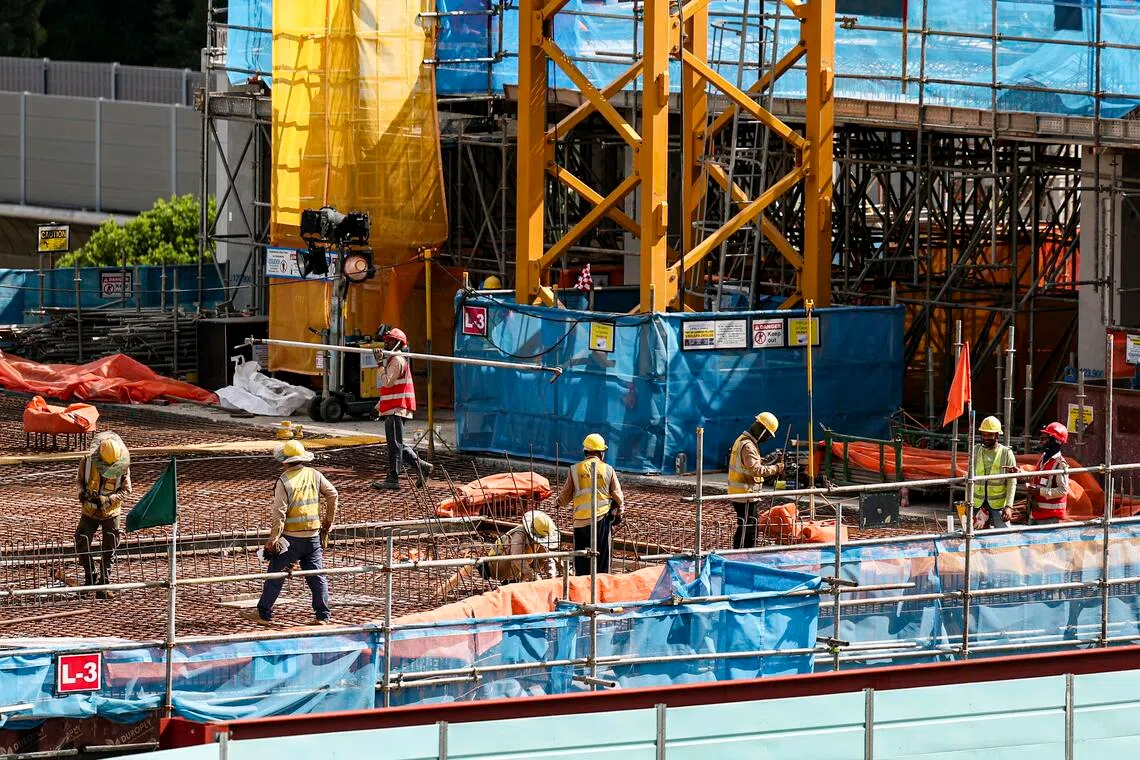
Construction workers at a worksite in Clementi on April 16, 2026.
Published Oct 01, 2026, 12:32 PM
Updated Oct 01, 2026, 12:32 PM
More than $30 million is invested in a research programme by SIT, A*STAR, and Woh Hup to develop greener construction methods focusing on sustainable materials and low-carbon structures.
The programme targets innovations like ultra-low carbon concrete, AI-enabled design tools, and reusing demolition waste to reduce embodied carbon and improve productivity.
A working group will create guidelines to optimise diaphragm wall construction, reducing steel use by 10%, saving costs and improving quality and safety in underground projects.
SINGAPORE – More than $30 million is being pumped into a research programme that will help the construction sector develop greener building methods.
The programme will be funded by the Singapore Institute of Technology (SIT), A*STAR, and other industry players , and also involves construction and civil engineering firm Woh Hup.
Speaking at the Construction Technology Innovation Laboratory Seminar on Oct 1, National Development Minister Chee Hong Tat said the research programme is one of the largest private-sector research and development investments in the built environment sector, so far .
The programme – called the Woh Hup-SIT-A*STAR Consortium Research Programme for Sustainable Construction Technology – will take on seven research projects spanning sustainable construction materials, innovative substructural systems, and low-carbon structures and reusability over the next three years.
Chee added that research will focus on areas where the built environment sector has clear needs, such as scaling up ultra-low carbon concrete production, developing AI-enabled design and optimisation tools, transforming demolition waste into useful construction materials, and enabling the reuse of structural steel.
Solutions developed, he said, can help reduce embodied carbon, improve productivity and resource efficiency, and strengthen the resilience of Singapore’s construction supply chain.
Embodied carbon refers to greenhouse gases that result from the extraction, creation and transportation of building materials, as well as the construction of buildings.
Chee said: “These investments will also build longer-term capabilities in Singapore.
“We want our firms and professionals to develop new competencies in areas such as AI-enabled design, sustainable materials and data analytics, and we hope that by doing this we can create more good job opportunities for our people, so that they to take on higher-value work as construction methods continue to evolve and out industry continues to transform.”
He added that the research programme builds on the work done by the Construction Technology Innovation Laboratory, which was set up in January 2021 by SIT and Woh Hup, along with three other industry players, for construction companies to research and develop construction technologies.
The lab developed solutions such as ultra-low carbon concrete, which has been deployed in projects like condominium developments Copen Grand and Lumina Grand, as well as the upcoming Union Square.
At the seminar held at the SIT campus in Punggol, Chee said the Building and Construction Authority and Land Transport Authority have formed a joint working group with industry professionals, specialist contractors and practitioners.
The working group, which will develop technical guidelines to improve the construction quality of diaphragm walls, is one outcome of an “action team” made up of Government and industry representatives to identify ways for firms to save time, costs and manpower, without compromising high standards of safety and quality.
Chee, who chairs the action team, announced its formation in February 2026 .
He added that diaphragm walls, which are made of reinforced concrete, are commonly used in underground projects such as MRT stations and basements, and support the surrounding ground during construction and keep the completed structure watertight.
Construction firms, he said, gave feedback that in some diaphragm walls, steel reinforcement within the walls was “highly congested”, which made it difficult for concrete to flow around the steel bars, and that could impact construction quality and potentially lead to water leakage.
Chee added that the guidelines developed by the work group on diaphragm walls will “set out how improved concrete performance and appropriate detailing can be used to optimise reinforcement, while maintaining the required structural safety and water-tightness”.
He said the measures are expected to reduce reinforcement usage in such walls by about 10 per cent, which saves up to $3 million per km of diaphragm wall construction.
“At the same time, these measures will improve construction quality and productivity, and reduce the need for subsequent rectification works,” Chee added.
The minister said innovation does not always involve a new technology.
“Sometimes, it means taking a fresh look at the way we do things today, working with our industry partners to identify what are the areas that we can do better, and finding ways to achieve the same desired outcomes, but with lower costs, less time, and less value.”
A*Star/Agency for Science, Technology and Research
SIT/Singapore Institute of Technology
2026年4月16日,金文泰一处工地上的建筑工人。
发布于 2026 年 10 月 1 日下午 12:32
更新于2026年10月1日下午12:32
新加坡理工大学 (SIT)、新加坡科技研究局 (A*STAR) 和和合集团 (Woh Hup) 共同投资超过 3000 万美元开展一项研究计划,旨在开发更环保的建造方法,重点关注可持续材料和低碳结构。
该计划旨在推广超低碳混凝土、人工智能设计工具和再利用拆除废料等创新技术,以减少隐含碳排放并提高生产力。
一个工作组将制定指导方针,以优化地下连续墙施工,减少钢材用量 10%,从而节省成本,提高地下工程的质量和安全性。
新加坡——一项旨在帮助建筑行业开发更环保建筑方法的研究计划正获得超过3000万美元的资金投入。
该计划将由新加坡理工大学 (SIT)、新加坡科技研究局 (A*STAR) 和其他行业参与者资助,并有建筑和土木工程公司和合集团 (Woh Hup) 参与。
10月1日,国家发展部长徐芳达在建筑技术创新实验室研讨会上表示,该研究计划是迄今为止建筑环境领域最大的私营部门研发投资之一。
该计划名为“和合-SIT-A*STAR可持续建筑技术联盟研究计划”,将在未来三年内开展七个研究项目,涵盖可持续建筑材料、创新型下部结构系统、低碳结构和可重复利用性等领域。
Chee补充说,研究将重点关注建筑环境领域存在明确需求的领域,例如扩大超低碳混凝土的生产规模、开发人工智能赋能的设计和优化工具、将拆除废料转化为有用的建筑材料以及实现结构钢的再利用。
他表示,所开发的解决方案可以帮助减少隐含碳排放,提高生产力和资源效率,并增强新加坡建筑供应链的韧性。
隐含碳是指建筑材料的开采、生产和运输以及建筑物建造过程中产生的温室气体。
Chee表示:“这些投资也将为新加坡建立长期的能力。”
“我们希望我们的企业和专业人员在人工智能赋能设计、可持续材料和数据分析等领域发展新的能力,我们希望通过这样做,能够为我们的员工创造更多良好的就业机会,使他们能够从事更高价值的工作,因为建筑方法不断发展,我们的行业也在不断转型。”
他还补充说,该研究计划建立在建筑技术创新实验室的工作基础上。该实验室由新加坡理工大学和和合大学以及其他三家行业参与者于 2021 年 1 月成立,旨在为建筑公司提供研究和开发建筑技术的机会。
该实验室开发出了超低碳混凝土等解决方案,这些解决方案已应用于 Copen Grand 和 Lumina Grand 等公寓开发项目,以及即将建成的 Union Square 项目。
在榜鹅新加坡理工大学校园举行的研讨会上,Chee表示,建设局和陆路交通管理局已与行业专业人士、专业承包商和从业人员组成联合工作组。
该工作组将制定技术指南,以提高隔墙的施工质量。该工作组是由政府和行业代表组成的“行动小组”的成果之一,旨在寻找企业在不降低安全和质量高标准的前提下节省时间、成本和人力的方法。
担任行动小组主席的徐顺全于2026年2月宣布成立该小组。
他还补充说,钢筋混凝土隔墙通常用于地铁站和地下室等地下工程,在施工期间支撑周围的地面,并保持竣工后的结构不漏水。
他说,建筑公司反馈,在一些隔墙中,墙内的钢筋“非常拥挤”,导致混凝土难以绕过钢筋流动,这可能会影响施工质量,并可能导致漏水。
Chee补充说,工作组制定的关于隔墙的指导方针将“阐明如何利用改进的混凝土性能和适当的细部构造来优化钢筋,同时保持所需的结构安全性和水密性”。
他表示,这些措施预计将使此类墙体的钢筋用量减少约 10%,每公里隔墙施工可节省高达 300 万美元。
Chee补充道:“与此同时,这些措施将提高施工质量和生产效率,并减少后续整改工作的需要。”
部长表示,创新并不总是意味着新技术。
“有时候,这意味着要重新审视我们今天的做事方式,与我们的行业伙伴合作,找出我们可以做得更好的领域,并找到以更低的成本、更少的时间和更少的价值来实现相同预期结果的方法。”
新加坡科技研究局/新加坡科学、技术与研究局
新加坡理工学院