Young Singaporeans on Singapore at 100: Safe, fair, united and offering a better life新加坡青年谈新加坡建国百年:安全、公平、团结,并提供更美好的生活
Discover what young Singaporeans envision for the nation's future at 100, focusing on safety, fairness, unity, and quality of life. Read more at straitstimes.com.
新闻视频
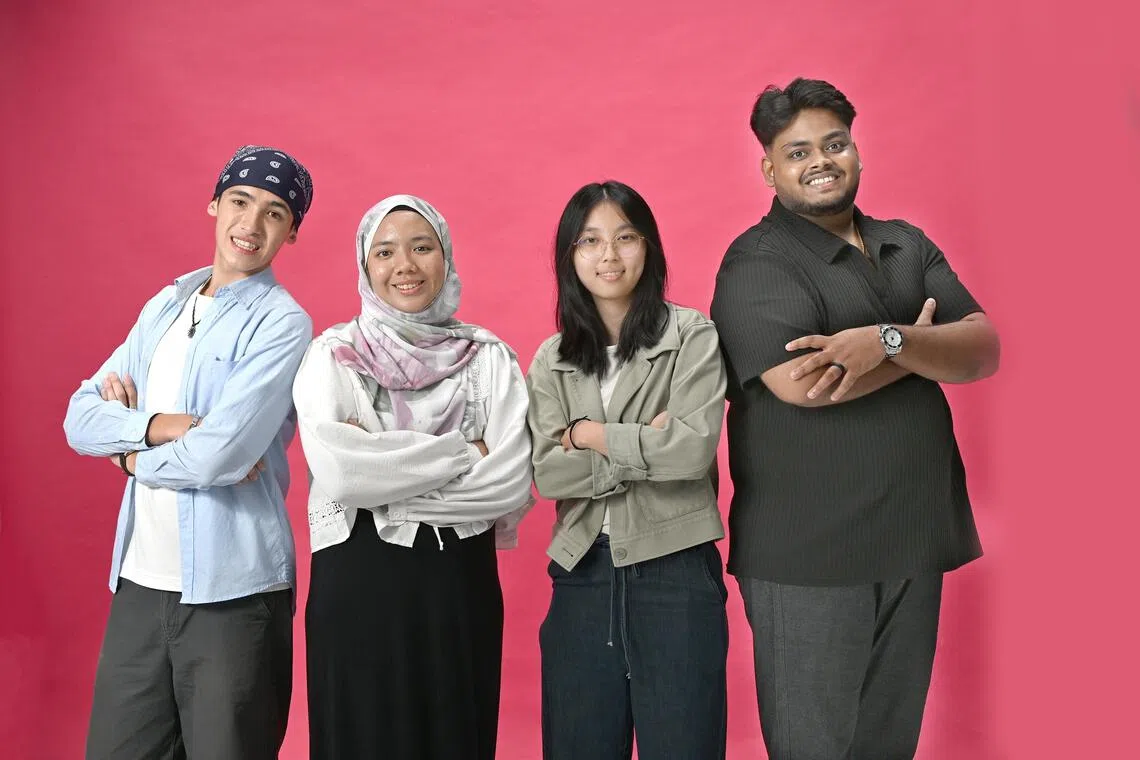
(From left) Alexander Peter Lin-You Burton, Humaira Safiya, Trina Lee and Vishnukeshn Sivapragasam are among youngsters who are proud and optimistic about the future.
ST PHOTO: DESMOND WEE
Published Aug 13, 2026, 05:30 AM
Updated Aug 14, 2026, 10:59 AM
Some things should remain. Some things should change.
Singapore’s first six decades were built on grit, discipline and a belief that a small country could carve its own way in the world. As it looks towards turning 100 in 2065, young Singaporeans say the question is no longer just how far the Republic can go, but what kind of home it wants to remain as.
For them, the answer lies not only in growth, but also in whether people continue to feel safe, whether multiculturalism remains a reality, whether meritocracy still affords Singaporeans a fair shot in life, and whether harmonious living stays on even as society becomes more complex.
Young Singaporeans still see Singapore as safe, stable and worth building a life in, but they want to inherit a country that offers an easier life, is more caring and less defined by the chase for success.
A Straits Times poll on what young people’s hopes for Singapore are at 100 found that 95 per cent of respondents were proud to be Singaporean, while 68 per cent felt hopeful about growing up and building their future here.
Student Vishnukeshn Sivapragasam, 20, said Singapore gives young people like him the hope that effort can lead somewhere.
“I’m studying, working part-time, and planning for the future at the same time. It’s not always easy, but I know that if I keep putting in the effort, there are opportunities here for me to grow.”
Vishnukeshn Sivapragasam said Singapore gives young people like him the hope that effort can lead somewhere. ST PHOTO: DESMOND WEE
Vishnukeshn Sivapragasam said Singapore gives young people like him the hope that effort can lead somewhere.
For 19-year-old Alexander Peter Lin-You Burton, the quiet acts of care that occur throughout Singapore’s community are something he has come to better appreciate.
He says it is one of Singapore’s most overlooked yet defining values. “Whether it be in small everyday acts of kindness, such as giving up your seat on the MRT for a passenger in greater need of it, or in larger efforts such as community involvement projects and regular volunteering sessions, acts like these are remarkably common, and collectively shape the society that Singapore strives to be; one that is not only safe and prosperous, but also built on equality and respect for all.”
For Alexander Peter Lin-You Burton, the quiet acts of care that occur throughout Singapore’s community are something he has come to better appreciate. ST PHOTO: DESMOND WEE
For Alexander Peter Lin-You Burton, the quiet acts of care that occur throughout Singapore’s community are something he has come to better appreciate.
On the kind of society they want Singapore to be in 2065, half of those polled said they want a country that remains safe, stable and resilient in an uncertain world; 44 per cent want a society that gives every Singaporean the opportunity to pursue their dreams; and 38 per cent said everyone should feel they belong, regardless of background.
But the poll also indicated a shift in the Singapore Dream, particularly among the younger cohorts.
On what areas needed improving the most for Singapore to be the ideal society at 100, 38 per cent picked better work-life balance and mental well-being, 35 per cent said it was about a more affordable cost of living, and 22 per cent voted for more equal opportunities for all, as well as better education and career opportunities.
As for the meaning of the Singapore Dream today, 39 per cent chose achieving work-life balance and prioritising mental well-being, 37 per cent said it was financial security, and 30 per cent picked a fulfilling career.
The poll surveyed 1,109 Singapore citizens and permanent residents aged 13 to 35 from June 15 to July 5. Its findings were echoed by young Singaporeans interviewed by ST, who said Singapore’s next chapter should still be defined by safety, fairness and opportunity, but also by compassion, belonging and room for people to grow at their own pace.
Student Trina Lee, 18, hopes for a Singapore where failure is more accepted, life is not just about coming in first, and curiosity and creativity are not dismissed.
Trina Lee hopes for a Singapore where failure is more accepted, life is not just about coming in first, and curiosity and creativity are not dismissed. ST PHOTO: DESMOND WEE
Trina Lee hopes for a Singapore where failure is more accepted, life is not just about coming in first, and curiosity and creativity are not dismissed.
Vishnukeshn believes Singapore at 100 should be a place where people feel they belong, no matter their background, that he will be proud “if young people can still afford to build a life here, families continue to feel safe, and we don’t lose the sense of unity that makes Singapore special”.
Political science undergraduate Humaira Safiya, 22, wants Singapore at 100 to be a place where a young Malay-Muslim girl can feel proud of her identity, while feeling fully part of the larger Singapore story.
“It should be a place where diversity is not just accepted, but valued,” she said. “For future generations, I hope they grow up in a society where they can be proud of their own culture, faith and language, while also learning from others.”
Humaira Safiya wants Singapore at 100 to be a place where a young Malay-Muslim girl can feel proud of her identity, while feeling fully part of the larger Singapore story. ST PHOTO: DESMOND WEE
Humaira Safiya wants Singapore at 100 to be a place where a young Malay-Muslim girl can feel proud of her identity, while feeling fully part of the larger Singapore story.
For Burton, Singapore’s future should be culturally vibrant and green, with respect for diversity remaining central to everyday life.
The medical school entrant said Singapore’s commitment to building sustainable communities is a value that inspires him. More than that, he hopes future generations can grow up in a country that retains compassion and unity.
Role model on the world stage
Lawyer Loh Tian Kai, 35, said Singapore must continue to be a role model on the world stage, whether in sociopolitical stability or economic strategy.
But to do so, it must reinforce its commitment to meritocracy and mobility across society. Loh said intergenerational transfers of resources and networks need to be balanced, so that Singaporeans who are able and hungry still have the chance to succeed on their own.
“We must be careful about entrenching privileges and opportunities, so that we can be confident that Singaporean society remains dynamic over the years and exceptional over the ages,” he said.
Among the issues young people think Singapore must focus on over the next 40 years are: cost of living and housing affordability, jobs and economic opportunities, mental health and holistic well-being, and social inclusion.
In June, Prime Minister Lawrence Wong said Singapore must become more cohesive as the world turns more fractured.
Open economies like Singapore are often among the first to feel the impact of global changes such as technological shifts and geopolitical tensions.
So what is one key risk Singapore needs to watch for in a more divided world? Chew Han Ei, associate director at the Singapore Management University’s Office of Impact, told ST that the risk is weakening social trust.
Singapore imports not only talent, technology and ideas, but also ideologies, anxieties and grievances, he said. Respect and harmony therefore have to be actively renewed and strengthened, online and in person.
Chew cautioned that some forms of divisiveness are not always the kind that can be corrected as falsehoods or taken down as online harms.
“They can be lawful but corrosive – narratives that travel through derisive humour, influencers, online communities and algorithmic feeds, and slowly change what people feel allowed to dismiss or dehumanise,” he said.
Founding director of the Dialogue Centre Mohamed Imran Mohamed Taib said one silver lining is that there is now greater awareness that social identities are becoming more complex and fragmented.
This is a natural state of affairs as inter-ethnic, inter-religious and transnational marriages become more common, he said. Official data shows that the proportion of inter-ethnic marriages among citizen marriages rose from 17 per cent in 2022 to 19.3 per cent in 2025.
Transnational marriages also rose from 33.2 per cent to 36.6 per cent over the same period. Imran said Singaporeans have to be vigilant, adding that “we must inculcate good values that can guide the moral compass of our nation”.
“The fundamental aspects of justice and equality that govern our citizenry in the pursuit of happiness, prosperity and progress as found in our Pledge must be internalised,” he said.
This means Singapore has to narrow inequality and guard against attempts to sow xenophobic attitudes, he added.
Commitment to the National Pledge
The poll found that 81 per cent of respondents agreed that the values reflected in Singapore’s National Pledge – multiculturalism, democracy, justice and equality – remain relevant today.
About 86 per cent agreed that every Singaporean has a responsibility to live out these values in daily actions.
Some young Singaporeans are already thinking about how they can contribute. At the top of the list, youth here believe they have a role to play in driving technological advancement and building a future-ready economy. Trailing behind is the goal of reshaping Singapore’s work and study culture so there is less stress and more fulfilment, followed by the need to keep Singapore relevant and respected on the world stage.
Burton sees Singapore’s fast-ageing population as one of the biggest challenges ahead.
Through his medical studies, he hopes to help older people access quality, compassionate and affordable healthcare.
Loh, an international arbitration lawyer, hopes to keep Singapore on the map through thought leadership, innovation and top-notch client service.
For Humaira, progress can also come through small, consistent efforts. Besides telling stories and building spaces where people feel seen, she hopes to contribute through Satura, a modest fashion brand she started last year that focuses mainly on hijabs.
“While it began as a business, I hope it can grow into something more meaningful, as a platform that celebrates identity and giving back to the community,” she said.
Elevated insights from seasoned perspectives. Crafted by journalists. Powered by Purpose: The Straits Times Signature Series is a new editorial project helmed by experienced journalists to shine a light on people, themes and ideas that rarely get the attention they deserve in everyday news cycles.
This article is part of a special collaboration between The Straits Times and Nexus – the lead agency that drives Singapore’s national education and Total Defence efforts – to spotlight national issues.
The writer was a journalist at The Straits Times’ business desk.
(从左至右)亚历山大·彼得·林-尤·伯顿、胡迈拉·萨菲亚、特里娜·李和维什努克什·西瓦普拉加萨姆等年轻人对未来感到自豪和乐观。
圣街照片:德斯蒙德·魏
发布于2026年8月13日 上午5:30
更新于2026年8月14日上午10:59
有些东西应该保留,有些东西应该改变。
新加坡建国的头六十年,建立在坚韧不拔、严于律己以及坚信小国也能在世界舞台上闯出一片天地之上。展望2065年建国百年之际,新加坡的年轻一代表示,问题不再仅仅是共和国能走多远,而是它想成为怎样的家园。
对他们来说,答案不仅在于经济增长,还在于人们是否继续感到安全,多元文化主义是否仍然是现实,精英制度是否仍然为新加坡人提供公平的人生机会,以及即使社会变得更加复杂,和谐的生活是否还能继续下去。
新加坡的年轻人仍然认为新加坡安全、稳定,值得在此安家落户,但他们希望继承一个生活更轻松、更有人情味、不那么以追求成功为导向的国家。
《海峡时报》一项关于年轻人对新加坡百年后的期望的民意调查发现,95%的受访者为自己是新加坡人而感到自豪,而68%的受访者对在这里成长和建设未来感到充满希望。
20岁的学生Vishnukeshn Sivapragasam表示,新加坡让像他这样的年轻人看到了努力终会带来回报的希望。
“我一边学习,一边兼职工作,同时还在规划未来。这并不总是容易的,但我知道,只要我坚持努力,这里就会有让我成长的机会。”
维什努克什·西瓦普拉加萨姆表示,新加坡让像他一样的年轻人看到了希望,相信努力终会带来回报。(海峡时报照片:魏德蒙)
Vishnukeshn Sivapragasam 表示,新加坡让像他这样的年轻人看到了努力终会带来回报的希望。
对于 19 岁的 Alexander Peter Lin-You Burton 来说,新加坡社区中发生的那些默默无闻的关爱之举,让他更加感激。
他表示,这是新加坡最容易被忽视却又最具代表性的价值观之一。“无论是日常生活中微小的善举,例如在地铁上给更需要的乘客让座,还是更大规模的活动,例如社区参与项目和定期志愿服务,这些行为都非常普遍,共同塑造了新加坡努力打造的社会:一个不仅安全繁荣,而且建立在平等和尊重所有人基础上的社会。”
对于亚历山大·彼得·林-尤·伯顿来说,新加坡社区中那些默默无闻的关怀之举,让他更加深刻地体会到其中的价值。(海峡时报摄影:魏德蒙)
对于 Alexander Peter Lin-You Burton 来说,新加坡社区中发生的那些默默无闻的关怀行为,让他更加感激。
在被问及他们希望新加坡在 2065 年成为怎样的社会时,一半的受访者表示,他们希望新加坡在不确定的世界中保持安全、稳定和韧性;44% 的人希望新加坡成为一个让每个新加坡人都有机会追求梦想的社会;38% 的人表示,无论背景如何,每个人都应该感到自己属于这里。
但民调也显示,新加坡梦正在发生转变,尤其是在年轻一代中。
在谈到新加坡要成为100岁的理想社会最需要改进的领域时,38%的人选择了更好的工作与生活平衡和心理健康,35%的人认为生活成本更实惠,22%的人则投票支持为所有人提供更平等的机会,以及更好的教育和职业机会。
至于“新加坡梦”在今天意味着什么,39%的人选择实现工作与生活的平衡并优先考虑心理健康,37%的人表示是经济保障,30%的人选择一份充实的职业。
这项民意调查于6月15日至7月5日期间进行,调查对象为1109名年龄在13岁至35岁之间的新加坡公民和永久居民。调查结果与《海峡时报》采访的新加坡年轻人的观点相呼应,他们认为新加坡的下一个篇章仍应以安全、公平和机遇为特征,但同时也应以同情心、归属感和让人们能够按照自己的节奏成长的空间为特征。
18 岁的学生 Trina Lee 希望新加坡能够更加包容失败,生活不仅仅是追求第一名,好奇心和创造力也不会被忽视。
特丽娜·李希望新加坡能成为一个更能接受失败、不以争第一为目标、不忽视好奇心和创造力的地方。(海峡时报摄影:魏德蒙)
Trina Lee 希望新加坡能够更包容失败,生活不仅仅是追求第一,好奇心和创造力也不会被忽视。
Vishnukeshn认为,新加坡建国100周年应该是一个无论出身如何,人们都能感到归属感的地方;如果“年轻人仍然能够在这里安家落户,家庭继续感到安全,而且我们不会失去使新加坡与众不同的团结感”,他会感到自豪。
22岁的政治学本科生胡迈拉·萨菲亚希望,在新加坡建国100周年之际,年轻的马来穆斯林女孩能够为自己的身份感到自豪,同时也能充分感受到自己是新加坡这个大家庭的一部分。
“这里应该是一个不仅接受多元化,而且重视多元化的地方,”她说。“我希望子孙后代在一个能够让他们为自己的文化、信仰和语言感到自豪,同时也能向其他文化学习的社会中成长。”
胡迈拉·萨菲亚希望新加坡建国百年之际,能成为一个让年轻的马来穆斯林女孩为自己的身份感到自豪,同时又能充分融入新加坡大家庭的地方。(海峡时报摄影:魏德蒙)
胡迈拉·萨菲亚希望新加坡建国100周年之际,能够让年轻的马来穆斯林女孩为自己的身份感到自豪,同时感受到自己完全融入了新加坡这个更大的故事之中。
伯顿认为,新加坡的未来应该是文化充满活力、环境优美的,尊重多样性仍然是日常生活的核心。
这位医学院新生表示,新加坡致力于建设可持续发展社区的理念深深地激励着他。不仅如此,他还希望子孙后代能够在充满关爱与团结的国家中成长。
世界舞台上的榜样
35岁的律师罗天凯表示,新加坡必须继续在世界舞台上扮演榜样角色,无论是在社会政治稳定还是经济战略方面。
但要做到这一点,新加坡必须强化其对精英制度和社会流动性的承诺。罗先生表示,资源和人脉的代际转移需要保持平衡,这样才能确保有能力且渴望成功的新加坡人仍然有机会凭借自身努力获得成功。
他说:“我们必须谨慎对待特权和机会的固化,这样我们才能确信新加坡社会能够随着时间的推移保持活力,并在每个时代都保持卓越。”
年轻人认为新加坡在未来 40 年必须关注的问题包括:生活成本和住房负担能力、就业和经济机会、心理健康和整体福祉以及社会包容。
今年6月,总理黄循财表示,随着世界日益分裂,新加坡必须变得更加团结。
像新加坡这样的开放型经济体往往最先感受到全球变化的影响,例如技术变革和地缘政治紧张局势。
那么,在当今世界日益分裂的情况下,新加坡需要警惕的关键风险是什么?新加坡管理大学影响力办公室副主任周汉怡告诉《海峡时报》,这一风险是社会信任的削弱。
他表示,新加坡不仅引进人才、技术和理念,也引进意识形态、焦虑和不满。因此,无论在线上还是线下,都必须积极地维护和加强尊重与和谐。
Chew 提醒说,有些分裂行为并不总是能被纠正为谎言或被清除为网络危害。
他说:“它们可能合法但却具有腐蚀性——这些叙事通过嘲讽的幽默、有影响力的人、在线社区和算法推送传播,并慢慢改变人们认为可以忽视或非人化的东西。”
对话中心创始主任穆罕默德·伊姆兰·穆罕默德·泰布表示,一个值得欣慰的消息是,人们现在更加意识到社会身份正变得越来越复杂和碎片化。
他表示,随着跨种族、跨宗教和跨国婚姻日益普遍,这种情况是自然而然发生的。官方数据显示,公民婚姻中跨种族婚姻的比例将从2022年的17%上升到2025年的19.3%。
同期,跨国婚姻比例也从33.2%上升至36.6%。伊姆兰表示,新加坡人必须保持警惕,并补充说,“我们必须培养良好的价值观,以指引我们国家的道德方向”。
他说:“我们的公民在追求幸福、繁荣和进步的过程中所遵循的正义和平等的基本原则,必须被内化于心。”
他补充说,这意味着新加坡必须缩小不平等,并防范散播仇外情绪的企图。
对国家誓词的承诺
民意调查发现,81%的受访者认为新加坡国家誓词中所体现的价值观——多元文化、民主、正义和平等——在今天仍然具有现实意义。
约86%的人认为,每个新加坡人都有责任在日常行动中践行这些价值观。
一些新加坡年轻人已经在思考如何贡献力量。他们最看重的是推动科技进步和构建面向未来的经济,并认为自身在其中扮演着重要角色。其次,他们希望重塑新加坡的工作和学习文化,减轻压力,提升成就感;最后,他们也希望保持新加坡在国际舞台上的地位和影响力。
伯顿认为新加坡人口快速老龄化是未来面临的最大挑战之一。
他希望通过医学学习,帮助老年人获得高质量、有爱心且价格合理的医疗保健服务。
身为国际仲裁律师的罗先生希望通过思想领导力、创新和一流的客户服务,让新加坡在国际舞台上保持领先地位。
对胡迈拉来说,进步也可以来自细微而持续的努力。除了讲述故事和营造让人们感到被关注的空间之外,她还希望通过她去年创立的时尚品牌Satura做出贡献,该品牌主要专注于头巾。
“虽然它最初是一家企业,但我希望它能发展成为更有意义的东西,成为一个颂扬身份认同和回馈社区的平台,”她说。
资深记者以独到的视角,带来深刻的见解。由资深记者精心打造,秉持“使命驱动”的理念:《海峡时报》特色系列是《海峡时报》推出的全新编辑项目,旨在聚焦那些在日常新闻报道中鲜少获得应有关注的人物、主题和观点。
本文是《海峡时报》与新加坡国家教育和全民防卫牵头机构 Nexus 合作推出的特别专题报道的一部分,旨在聚焦国家议题。
作者曾是《海峡时报》财经版的记者。