Most young adults in S’pore surveyed want to have children, but many lack fertility knowledge: Study一项研究显示,新加坡大多数受访的年轻人都希望生育子女,但许多人缺乏生育知识。
A study finds most young adults in Singapore want children but lack fertility knowledge, highlighting the need for better fertility education and awareness. Read more at straitstimes.com.
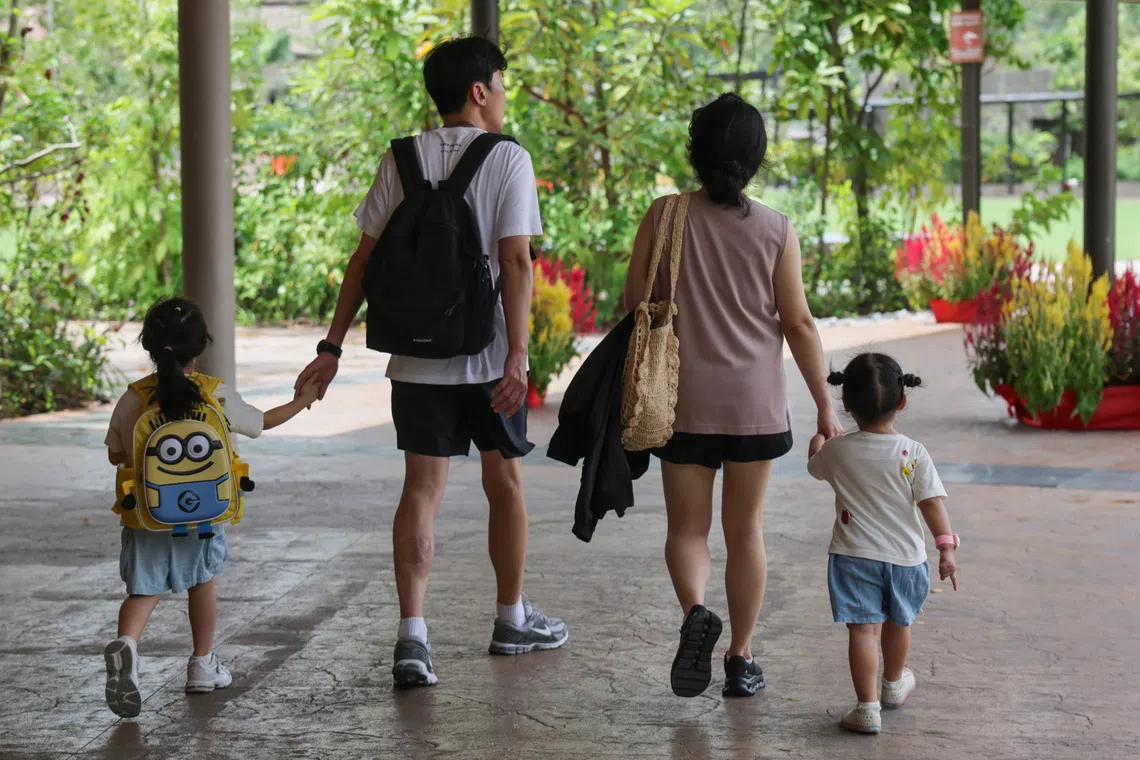
About 84 per cent of young adults surveyed said they ideally wanted at least one child.
Published Oct 01, 2026, 01:00 PM
Updated Oct 01, 2026, 01:00 PM
Most young adults in Singapore want to become parents, but only 10% answered all basic fertility questions correctly, showing a significant gap in fertility knowledge.
Many respondents underestimate or are unsure about key fertility facts, such as the decline of egg production and male fertility with age, a new study found.
The survey also found that people’s intentions towards parenthood may not be fixed, and can change as they move through different stages of life.
SINGAPORE - Only one in 10 young adults surveyed in Singapore knew the answers to basic fertility questions, despite more than half believing they were well-informed about fertility and reproductive health.
The knowledge gap was also evident among those who want to become parents. Among childless respondents who said having children one day was important to them, 43 per cent answered two or fewer of five questions on fertility literacy correctly.
Most respondents in the Thomson Medical-National University of Singapore (NUS) study aspired to be parents, with 84 per cent saying they ideally wanted at least one child. About half, or 51 per cent, said their ideal family would have two children, while 16 per cent did not want any children.
The inaugural study polled 1,035 people in June 2026 on their parenthood aspirations, reproductive timing and fertility knowledge. It was led by Associate Professor Reuben Ng, the study’s principal investigator from the Lee Kuan Yew School of Public Policy.
The respondents, aged 18 to 39, were also asked about their awareness or attitudes towards fertility services.
The average age of respondents was 28.8 years old, and 87 per cent of them were Singapore citizens.
The findings, which were released on Oct 1 at a media briefing, found that while most respondents understood broadly that fertility declines with age, there were gaps in their knowledge of reproductive health.
Four in five knew that a woman’s chances of becoming pregnant naturally decrease as she gets older, while 75 per cent knew that it generally becomes more difficult for both men and women to conceive naturally as they age.
But only 29 per cent knew that ovaries do not continue to produce new eggs throughout a woman’s reproductive years. About 40 per cent answered this incorrectly, while another 30 per cent were unsure.
While 57 per cent correctly identified that men’s fertility declines with age, 19 per cent thought otherwise and another 24 per cent were unsure.
These findings come ahead of a full report by the Marriage and Parenthood Reset Workgroup expected to be ready in early 2027. The inter-agency work group, chaired by Minister in the Prime Minister’s Office Indranee Rajah, was set up to address issues affecting the country’s birth rate, including areas like fertility support.
The Thomson Medical-NUS study also found a gap between some respondents’ preferred timeline for having children and where they were in life.
The most common ideal age to start trying for children was 27 to 29 for women and 30 to 32 for men. Among childless respondents, 22 per cent of women and 25 per cent of men were already older than the upper end of the age range they themselves considered ideal.
Some 40 per cent of all respondents also felt some urgency or pressure around their reproductive timeline.
Awareness of fertility services was also uneven.
While 93 per cent of respondents knew of at least one fertility service, awareness was highest for more prominent interventions like in-vitro fertilisation (IVF), and egg or sperm freezing.
About 54 per cent were aware of earlier interventions like fertility screening, while 31 per cent knew about intrauterine insemination and 28 per cent about surgical treatments such as polyp or cyst removal.
Researchers said the findings point to a need for fertility support before couples encounter problems trying to conceive.
About 80 per cent of respondents supported financial subsidies for fertility screening, while 79 per cent wanted easier access to assisted fertility care and 78 per cent agreed that more should be done to provide fertility awareness education.
Almost two-thirds, or 64 per cent, wanted tertiary institutions to partner fertility providers on fertility awareness education, while 59 per cent supported similar partnerships with employers.
Cassandra Loh, chief executive of Thomson Medical, said: “Many young adults... deserve clear, trusted and practical fertility information earlier, so that when they are ready to think about family planning, they can do so with greater confidence.”
The survey also found that people’s intentions towards parenthood can change through different stages of life.
Among respondents who recalled being neutral about having children when they were younger, 83 per cent now wanted children. Among those who said they did not want children when younger, half now wanted at least one child.
LKYSPP’s Ng said the findings challenged a simple opt-out narrative around parenthood.
“Most respondents still ideally want children, but parenthood aspirations are not static. Many people move from ‘not sure’ to ‘maybe’ to ‘yes’ as life changes,” he said.
“Thinking can change over the life course, and that’s actually good news for us. Things can change, and people can be nudged towards that,” he added.
The study showed that fertility should be viewed as a decision across a person’s life course, shaped by knowledge, timing, relationships and social context, he added.
Among respondents who had always wanted children and continued to do so, 38 per cent cited the cost of living as having reshaped their expectations, such as by delaying parenthood or having fewer children.
Relationships are also a factor, with 76 per cent of respondents saying it was important for their partner or spouse to share their views on how many children to have.
Around 63 per cent agreed that raising children was one of the most meaningful things a person could do in life, while 67 per cent agreed that life could be just as fulfilling without children.
Loh said fertility education should meet young adults at different life stages, including through schools, workplaces, homes and clinics.
The study called for fertility conversations to start earlier, and healthcare providers to make screening and care options easier to understand before people actively try for children.
约84%的受访年轻人表示,他们理想情况下至少想要一个孩子。
发布于2026年10月1日下午1点
更新于2026年10月1日下午1点
新加坡大多数年轻人都想成为父母,但只有 10% 的人正确回答了所有基本的生育问题,这表明他们在生育知识方面存在很大的差距。
一项新的研究发现,许多受访者低估或不确定一些关键的生育事实,例如随着年龄增长,卵子产量和男性生育能力会下降。
调查还发现,人们对生育意愿的理解可能并非一成不变,而是会随着人生阶段的变化而改变。
新加坡——一项针对新加坡年轻人的调查显示,尽管超过半数的年轻人认为自己对生育和生殖健康非常了解,但只有十分之一的受访年轻人知道基本生育问题的答案。
在那些渴望为人父母的人群中,知识差距也十分明显。在那些表示将来想要孩子但目前没有孩子的受访者中,43%的人对五个有关生育知识的问题只答对了两个或两个以下。
汤森路透医学中心与新加坡国立大学联合开展的一项研究显示,大多数受访者渴望为人父母,其中84%的人表示理想情况下至少想要一个孩子。约半数(51%)受访者表示理想的家庭会有两个孩子,而16%的人则表示不想要孩子。
这项首项研究于2026年6月对1035人进行了调查,内容涉及他们的为人父母愿望、生育时机和生育知识。该研究由李光耀公共政策学院副教授、首席研究员吴瑞斌领导。
受访者年龄在 18 至 39 岁之间,还被问及他们对生育服务的了解或态度。
受访者的平均年龄为 28.8 岁,其中 87% 为新加坡公民。
10 月 1 日在新闻发布会上公布的调查结果显示,虽然大多数受访者大致了解生育能力会随着年龄的增长而下降,但他们对生殖健康的了解存在不足。
五分之四的人知道,随着年龄的增长,女性自然怀孕的几率会降低;75%的人知道,随着年龄的增长,男性和女性自然受孕的难度都会增加。
但只有29%的人知道卵巢在女性整个生育期内不会持续产生新的卵子。约40%的人回答错误,另有30%的人不确定。
57% 的人正确地认识到男性的生育能力会随着年龄的增长而下降,19% 的人持相反观点,另有 24% 的人表示不确定。
这些研究结果发布之前,婚姻与育儿重置工作组的完整报告预计将于 2027 年初完成。该跨部门工作组由总理公署部长英兰妮·拉贾主持,旨在解决影响该国出生率的问题,包括生育支持等领域。
汤姆森医学-新加坡国立大学的研究还发现,一些受访者理想的生育时间与他们目前的生活状态之间存在差距。
最常见的理想生育年龄是女性27至29岁,男性30至32岁。在没有孩子的受访者中,22%的女性和25%的男性年龄已经超过了他们自己认为的理想生育年龄上限。
约 40% 的受访者也感到在生育时间方面存在一些紧迫感或压力。
人们对生育服务的了解程度也参差不齐。
虽然 93% 的受访者至少了解一种生育服务,但对体外受精 (IVF) 和卵子或精子冷冻等更主要的干预措施的了解程度最高。
约 54% 的人了解生育力筛查等早期干预措施,31% 的人了解宫腔内人工授精,28% 的人了解息肉或囊肿切除等外科治疗。
研究人员表示,研究结果表明,在夫妇尝试怀孕遇到问题之前,就需要提供生育支持。
约 80% 的受访者支持对生育筛查提供财政补贴,79% 的受访者希望更容易获得辅助生育治疗,78% 的受访者同意应该做更多工作来提供生育意识教育。
近三分之二(64%)的人希望高等院校与生育服务机构合作开展生育意识教育,而 59% 的人支持高等院校与雇主开展类似的合作。
汤姆森医疗首席执行官卡桑德拉·洛表示:“许多年轻人……应该更早地获得清晰、可靠和实用的生育信息,这样当他们准备考虑家庭计划时,就能更有信心地进行。”
调查还发现,人们在人生的不同阶段,对生育的意愿也会发生变化。
在那些回忆起年轻时对生育持中立态度的受访者中,83%的人现在想要孩子。而在那些年轻时表示不想要孩子的受访者中,有一半人现在想要至少一个孩子。
李光耀公共政策研究所的吴先生表示,研究结果挑战了关于为人父母的简单“选择退出”的说法。
他说:“大多数受访者仍然希望拥有孩子,但为人父母的愿望并非一成不变。随着生活的变化,许多人的想法会从‘不确定’转变为‘也许’,最终变成‘是’。”
“人的思维方式会随着人生历程而改变,这其实对我们来说是件好事。事物是可以改变的,人们也可以被引导向这种改变,”他补充道。
他补充说,研究表明,生育应该被视为一个人一生中的一项决定,受到知识、时机、人际关系和社会环境的影响。
在一直想要孩子并且现在仍然想要孩子的受访者中,38%的人表示生活成本改变了他们的期望,例如推迟生育或少生孩子。
人际关系也是一个因素,76% 的受访者表示,伴侣或配偶在生育子女数量方面表达自己的看法非常重要。
约 63% 的人认为养育子女是人生中最有意义的事情之一,而 67% 的人认为没有孩子,生活同样可以很充实。
罗表示,生育教育应该面向处于不同人生阶段的年轻人,包括通过学校、工作场所、家庭和诊所等途径。
该研究呼吁更早地开始生育方面的对话,并要求医疗保健提供者在人们积极备孕之前,让筛查和护理方案更容易理解。