ASEAN should focus on building up regional power grid, climate finance and resilience: Grace Fu葛丽丝·傅:东盟应重点建设区域电网、气候融资和增强抵御能力。
Extreme weather events and economic recession among SE-Asia's concerns. Read more at straitstimes.com.
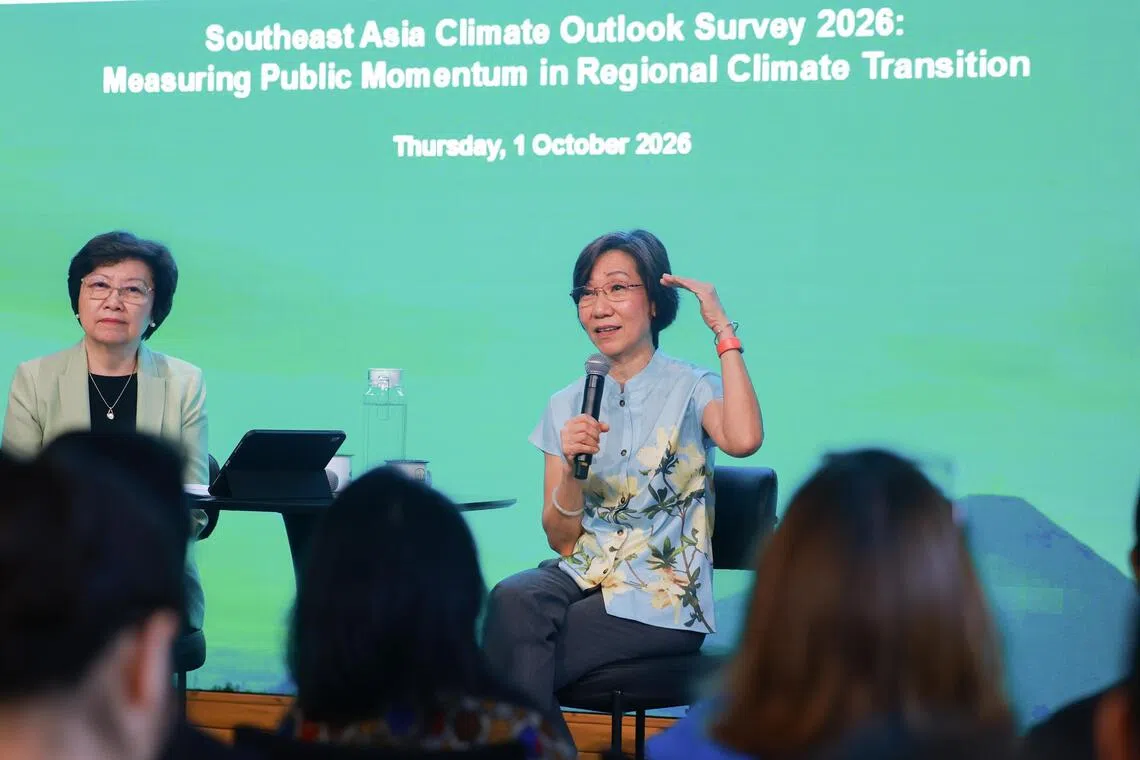
Minister for Sustainability and the Environment Grace Fu speaking alongside moderator SUTD Lee Kuan Yew Centre for Innovative Cities chair Cheong Koon Hean, during a fireside chat at the launch of the Southeast Asia Climate Outlook Survey 2026 report at the Singapore Sustainability Academy Gallery on Oct 1, 2026. ST PHOTO: JASON QUAH
Published Oct 01, 2026, 01:15 PM
Updated Oct 01, 2026, 01:15 PM
SINGAPORE — ASEAN should focus on building up its regional power grid, boosting climate finance and increasing its resilience against climate change impacts, said Minister for Sustainability and the Environment Grace Fu on Oct 1.
Speaking at an event where a survey of South-east Asian perceptions on climate change were released, she said that Singapore will during its chairmanship of ASEAN in 2027 prioritise practical cooperation on these issues.
The South-east Asia Climate Outlook Survey 2026 is a biennial survey that aims to gauge regional attitudes towards climate change.
In its sixth edition, the survey was released by the Climate Change in Southeast Asia Programme at ISEAS – Yusof Ishak Institute and the Lee Kuan Yew Centre for Innovative Cities at the Singapore University of Technology and Design.
The survey found that the top two concerns faced by people in South-east Asia were unemployment and economic recession, as well as climate change and extreme weather events.
This comes at a time where the closure of the Strait of Hormuz is sending shockwaves through global energy markets, Fu said.
“South-east Asia has not been spared. For a region heavily reliant on imported energy, higher fuel prices ripple quickly through everyday life,” she said.
Businesses face rising costs and growing uncertainty, putting jobs and livelihoods at stake. Households also have to grapple with higher electricity bills, while some supermarkets lack food because transportation and logistical support are affected.
At the same time, the region must also respond to impacts already being felt. For example, recent heavy rain in Thailand has led to floods in areas including Bangkok and reportedly affected more than 2.6 million people.
Fu noted that the energy crisis is a good reason for the transition to renewable energy, and that pausing this shift might be the wrong response.
She noted that the rapid deployment of solar energy in countries such as China and Pakistan has reduced their exposure to imported fossil fuels, therefore restricted exposure to volatile fuel prices.
“Particularly, advancing the ASEAN Power Grid will enable countries to better harness the region’s rich energy resources and reduce dependence on any single source,” she said.
Some headway has been made on this front, she noted, pointing to the Laos- Thailand-Malaysia-Singapore power integration project that showed that multilateral electricity trade is feasible.
The next phase of work on the grid calls for clearer rules on cross-border trade and practical norms for submarine power cables, she added.
Climate finance is also one area that Singapore thinks Asean should focus on, Fu added.
Singapore has moved to develop new financial instruments that can raise funds for climate-friendly projects in the region, she said, pointing to its national blended finance initiative Financing Asia’s Transition Partnership (FAST-P) and its work on carbon markets.
The blended finance approach uses public or philanthropic capital to attract risk-averse private capital, which holds most of the world’s wealth , to kick-start investment in sustainable projects. It can fund projects such as those pushing for cleaner sources of electricity to replace coal .
Fast-P has so far raised US$1.14 billion (S$1.5 billion) for various green energy projects in the region, including battery storage, solar plants and improved power grids to help cleaner sources of electricity gradually replace coal.
Carbon markets can also direct funds to green projects in the developing region.
Governments or heavy emitters elsewhere buy carbon credits from green projects in developing countries to offset a fraction of their planet-warming emissions. This carbon revenue can help to finance projects such as renewable energy or nature restoration projects within the region.
Singapore has already signed agreements with its South-east Asian neighbours to cooperate on carbon markets, Fu said, pointing to partnerships with Thailand, Philippines and Vietnam.
“The priority now is implementation: align frameworks, ensure robust accounting and environmental integrity, and develop high-quality projects. We hope to establish similar arrangements with other ASEAN member states,” said Fu.
She also emphasised the need to invest in climate resilience to protect economies, communities and long-term development as climate risks intensify.
Examples of building resilience could include building sea walls to keep out rising sea levels.
Fu said: “The energy crisis and cost-of-living pressures have made the path harder, but they have not changed our destination: a low-carbon, more resilient and prosperous South-east Asia.
“That future remains necessary - and achievable - if we manage the transition with equity and resolve.
The latest climate survey had garnered a total of 3,706 responses from all 11 Asean countries, including Timor-Leste for the first time, over five weeks in 2026.
Unemployment and economic recession were cited by 55.3% of the respondents as being a concern for them, while 53.6% of them opted for climate change and more extreme weather events.
Attitudes toward these concerns differed between ASEAN nations.
For instance, countries like Indonesia and Brunei found unemployment and economic recession to be the most concerning.
However, others like the Philippines and Vietnam are most concerned about climate change, reflecting their lived experiences with natural disasters like typhoons and floods exacerbated by climate change, said the report.
Philippines, for one, has been hit by two back-to-back typhoons in November 2025. According to the World Bank, the Philippines faces losses of 1.2% of its gross domestic product each year from the impacts of typhoons.
The survey also showed that floods and extreme heat were the top two concerns across the region.
In Brunei and Singapore, extreme heat was ranked the most serious climate change impact, they are exposed to as both are highly urbanised countries where the urban heat island effect is prevalent.
Meanwhile, for countries like Malaysia, the Philippines, Timor-Leste and Indonesia, floods were a top concern.
The survey also found that while respondents viewed the transition to renewable energy as being necessary over the long term, it is still seen as challenging, partly due to the costs involved and fears over energy shortages.
A total of 44.6% of the respondents said they were most concerned about rising energy prices and costs of living.
Another 26.1% said they were concerned over energy shortages. This was an increase from the 20.3% of survey respondents who said they were concerned over this in the 2024 study.
“In general, these concerns might reflect the energy shock disruptions caused by geopolitical events in the preceding years,” wrote the report.
However, more than half of the respondents believe that governments should take decisive action against coal, either by halting coal power plants immediately or actively transitioning to alternative fuels while phasing out existing coal facilities.
These sentiments were the strongest in Brunei and Timor-Leste, while support for continued but restricted use of coal plants is more prevalent in Myanmar and coal-dependent countries like Cambodia, Malaysia and Vietnam.
Acknowledging these concerns about the energy transition, Fu said that climate action has to be managed carefully.
Governments have to keep in mind cost concerns, provide support where costs fall most heavily and remain clear about the longer-term gains.
ISEAS – Yusof Ishak Institute’s principal fellow and coordinator Sharon Seah, who is one of the authors, said that the latest report has shown that climate and energy transition require multiple stakeholders including governments, businesses and individuals to work together.
“It needs a cooperation of all countries and all all of the governments in the region to act together… Ultimately, it is political will to want to effect that change.”
Chin Hui Shan is a journalist covering the environment beat at The Straits Times.
Ministry of Sustainability and the Environment
ISEAS-Yusof Ishak Institute
2026年10月1日,在新加坡可持续发展学院画廊举行的《2026年东南亚气候展望调查报告》发布会上,新加坡永续发展及环境部长傅海燕与主持人、新加坡科技设计大学李光耀创新城市中心主席张坤贤共同出席了炉边谈话。照片由《海峡时报》摄影:JASON QUAH
发布于 2026 年 10 月 1 日下午 1:15
更新于2026年10月1日下午1:15
新加坡——永续发展与环境部长傅海燕于10月1日表示,东盟应集中精力建设区域电网,增加气候融资,并提高应对气候变化影响的能力。
在一次发布东南亚地区对气候变化看法的调查报告的活动上,她表示,新加坡将在2027年担任东盟轮值主席国期间,优先考虑在这些问题上开展务实合作。
《2026 年东南亚气候展望调查》是一项两年一度的调查,旨在衡量该地区对气候变化的态度。
该调查报告第六版由新加坡尤索夫伊萨克东南亚研究所东南亚气候变化项目和新加坡科技设计大学李光耀创新城市中心联合发布。
调查发现,东南亚人民面临的两大主要担忧是失业和经济衰退,以及气候变化和极端天气事件。
傅先生表示,此时正值霍尔木兹海峡关闭给全球能源市场带来冲击之际。
“东南亚也未能幸免。对于一个严重依赖进口能源的地区来说,更高的燃料价格会迅速波及到日常生活,”她说道。
企业面临成本上涨和日益加剧的不确定性,就业和民生岌岌可危。家庭也必须应对不断上涨的电费,而一些超市由于运输和物流支持受到影响,导致食品短缺。
与此同时,该地区还必须应对已经显现的影响。例如,泰国近期强降雨导致包括曼谷在内的多个地区发生洪水,据报道,超过260万人受灾。
傅指出,能源危机是向可再生能源转型的一个很好的理由,暂停这种转型可能是错误的应对措施。
她指出,中国和巴基斯坦等国迅速部署太阳能,减少了对进口化石燃料的依赖,从而限制了它们受燃料价格波动的影响。
她表示:“尤其重要的是,推进东盟电网建设将使各国能够更好地利用该地区丰富的能源资源,并减少对任何单一能源的依赖。”
她指出,这方面已经取得了一些进展,例如老挝-泰国-马来西亚-新加坡电力一体化项目表明多边电力贸易是可行的。
她补充说,电网建设的下一阶段工作需要更明确的跨境贸易规则和海底电力电缆的实用规范。
傅先生补充说,气候融资也是新加坡认为东盟应该重点关注的领域之一。
她表示,新加坡已着手开发新的金融工具,为该地区的气候友好型项目筹集资金,并指出其国家混合融资计划“亚洲转型伙伴关系融资计划”(FAST-P)及其在碳市场方面的工作。
混合融资模式利用公共或慈善资本吸引规避风险的私人资本(这些私人资本掌握着世界上大部分财富),从而启动对可持续发展项目的投资。它可以为诸如推动清洁能源替代煤炭等项目提供资金。
Fast-P 迄今已为该地区的各种绿色能源项目筹集了 11.4 亿美元(15 亿新元),包括电池储能、太阳能发电厂和改进的电网,以帮助更清洁的电力来源逐步取代煤炭。
碳市场还可以引导资金流向发展中地区的绿色项目。
其他地区的政府或高排放国通过购买发展中国家绿色项目的碳信用额度来抵消其部分导致全球变暖的排放。这些碳收入可用于资助该地区的可再生能源或自然修复等项目。
傅先生表示,新加坡已经与东南亚邻国签署了在碳市场方面开展合作的协议,并指出新加坡已与泰国、菲律宾和越南建立了伙伴关系。
傅先生表示:“现在的重点是落实:协调框架,确保健全的会计和环境诚信,并开发高质量的项目。我们希望与其他东盟成员国建立类似的安排。”
她还强调,随着气候风险加剧,需要投资于气候适应能力,以保护经济、社区和长期发展。
增强抵御能力的例子包括建造海堤来抵御不断上升的海平面。
傅先生表示:“能源危机和生活成本压力使道路更加艰难,但它们并没有改变我们的目标:建设一个低碳、更具韧性和繁荣的东南亚。”
“如果我们以公平和决心来管理过渡,那么那个未来仍然是必要的,也是可以实现的。”
最新的气候调查在 2026 年的五周内,共收到来自东盟 11 个国家(包括首次参与调查的东帝汶)的 3706 份回复。
55.3% 的受访者表示,失业和经济衰退是他们所担忧的问题,而 53.6% 的受访者则选择了气候变化和更极端的天气事件作为他们关注的问题。
东盟各国对这些问题的态度各不相同。
例如,印度尼西亚和文莱等国认为失业和经济衰退是最令人担忧的问题。
报告指出,菲律宾和越南等国最关注气候变化,这反映了它们在气候变化加剧台风和洪水等自然灾害方面的切身经历。
例如,菲律宾在2025年11月连续遭受两次台风袭击。据世界银行称,台风每年给菲律宾造成的损失相当于其国内生产总值的1.2%。
调查还显示,洪水和极端高温是该地区最令人担忧的两大问题。
在文莱和新加坡,极端高温被列为气候变化带来的最严重影响,因为这两个国家都是高度城市化的国家,城市热岛效应十分普遍。
与此同时,对于马来西亚、菲律宾、东帝汶和印度尼西亚等国家来说,洪水是头等大事。
调查还发现,虽然受访者认为从长远来看向可再生能源转型是必要的,但这仍然被视为一项挑战,部分原因是涉及的成本以及对能源短缺的担忧。
共有 44.6% 的受访者表示,他们最担心的是能源价格和生活成本的上涨。
另有26.1%的受访者表示他们对能源短缺感到担忧。这一比例高于2024年调查中表示担忧的20.3%。
报告写道:“总的来说,这些担忧可能反映了前几年地缘政治事件造成的能源冲击和中断。”
然而,超过半数的受访者认为,政府应该对煤炭采取果断行动,要么立即停止燃煤电厂,要么积极过渡到替代燃料,同时逐步淘汰现有的燃煤设施。
在文莱和东帝汶,这种情绪最为强烈;而在缅甸以及柬埔寨、马来西亚和越南等煤炭依赖型国家,支持继续但有限制地使用燃煤电厂的呼声更为普遍。
傅先生承认人们对能源转型存在这些担忧,并表示气候行动必须谨慎管理。
政府必须考虑到成本问题,在成本最高的地方提供支持,并明确长期收益。
尤索夫伊萨克东南亚研究所首席研究员兼协调员莎伦·西(Sharon Seah)是该报告的作者之一,她表示,最新报告表明,气候和能源转型需要包括政府、企业和个人在内的多个利益相关者共同努力。
“这需要该地区所有国家和所有政府的合作与共同行动……归根结底,这取决于是否有政治意愿来实现这一改变。”
Chin Hui Shan是《海峡时报》负责环境报道的记者。
可持续发展与环境部
尤索夫伊萨克东南亚研究所