F1 Singapore Grand Prix value proposition still strong after 18 years新加坡F1大奖赛18年后依然具有强大的价值
The Singapore Grand Prix remains a key F1 event, boosting tourism, business, and the city’s global profile after 18 years of night racing. Read more at straitstimes.com.
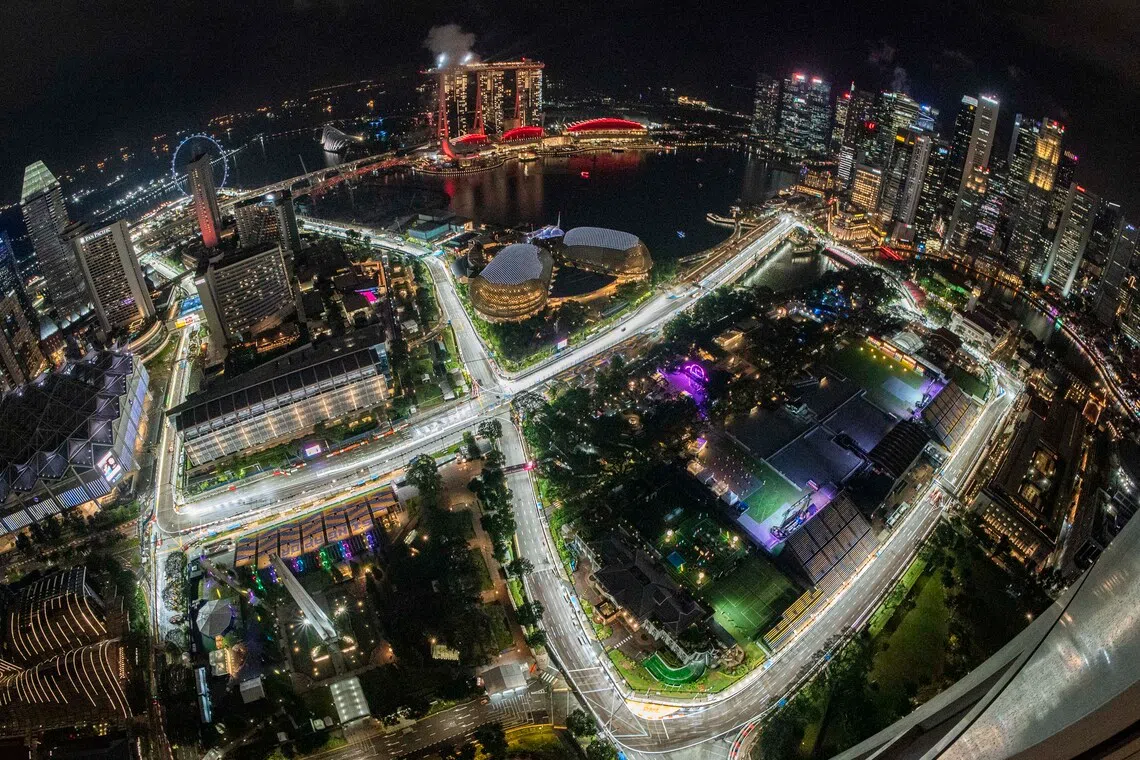
The Marina Bay street circuit as seen Swissotel The Stamford Singapore ahead of the Formula One Singapore Airlines Singapore Grand Prix on Oct 1, 2025.
Published Oct 01, 2026, 05:45 PM
Updated Oct 01, 2026, 08:14 PM
Singapore's F1 Grand Prix has been a unique night race since 2008, boosting tourism, business, and global profile with over 300,000 attendees and $2.2 billion in tourism receipts.
The event supports 30,000 jobs annually, attracts high-spending visitors, international conferences, and benefits many local SMEs in logistics, hospitality, and engineering.
To stay competitive, Singapore will host its first F1 Sprint Race in 2025 and aims to link race week with conferences and business events to enhance tourism and economic impact.
SINGAPORE – For 18 years, Singapore has marketed its Formula 1 Grand Prix not just as a motor race, but as a showcase of what the Lion City can do when it turns several kilometres of floodlit roads along the waterfront at dusk into a global stage.
Since September 2008, the Marina Bay Street Circuit has become one of the most iconic events on the F1 calendar, offering something no other city did – the first-ever night race.
The spectacle helped establish Singapore as a distinctive stop on the F1 calendar, while giving the city-state a high-profile platform to promote its hospitality industry, infrastructure, business environment and ability to stage a complex international event.
Now, a few countries in the region are seeking to replicate Singapore’s success and join the F1 bandwagon in hopes of gaining global attention and attracting high-spending visitors.
After a nine-year hiatus, Malaysia is set to host an F1 race in Sepang again in October , while Thailand is targeting a street race in Bangkok’s Chatuchak area as early as 2028.
Since September 2008, the Marina Bay Street Circuit has become one of the most iconic events on the F1 calendar. PHOTO: LIANHE ZAOBAO
Since September 2008, the Marina Bay Street Circuit has become one of the most iconic events on the F1 calendar.
PHOTO: LIANHE ZAOBAO
The emergence of new Asian contenders raises questions about whether the Singapore Grand Prix can continue to distinguish itself or if fans will be drawn away to rival races. Market observers and economists believe it can.
“F1 is still delivering benefits to Singapore that outweigh the cost of hosting the event,” said Brian Lee, an economist at Maybank.
“While the direct tourism benefits may face diminishing returns, the race remains valuable as a platform for attracting high-spending visitors, business events and global capital,” he added.
He noted that the 2025 F1 race weekend drew a sell-out crowd of more than 300,000 fans. That was the second-highest attendance in the event’s history and an almost 12 per cent jump from 2024, suggesting the novelty remained.
Guy Llewellyn, academic director for Asia-Pacific at EHL Hospitality Business School, said it would be hard for other cities to replicate Singapore’s experience after it has run the event for 18 years, coordinating different stakeholders and building a strong international reputation.
“Singapore’s strategy has gradually evolved from hosting a sporting event to hosting a citywide festival. The concerts, entertainment zones, dining experiences, and new Barge Stage programming mean that visitors can spend an entire day in Marina Bay without focusing exclusively on racing,” the assistant professor said.
The Barge Stage waterfront amphitheatre will be unveiled in 2026 along with a line-up of international DJs.
“Few destinations can offer a Formula 1 circuit, internationally branded hotels, fine dining, nightlife and entertainment venues all within walking distance of one another,” Llewellyn said.
However, while being the first night race was once a powerful differentiator, the novelty naturally fades over time, making the broader ecosystem increasingly important in setting the experience apart, he added.
Faizal Yahya, senior research fellow at the Institute of Policy Studies at NUS’ Lee Kuan Yew School of Public Policy, also believes the race should go on.
The returns have been “a massive net positive”, as Singapore has gained a lot economically, strategically, and in terms of its global image, Yahya said.
From the inaugural night race in 2008 until 2024, the event generated around $2.2 billion in incremental tourism receipts, mostly for accommodation, attraction tickets, food and beverage, shopping and airfares. It also attracted more than 720,000 visitors over the period.
Lee said that this is equivalent to $129 million a year in incremental spending from tourists attending the race. That is 0.4 per cent of Singapore’s 2025 aggregate tourism receipts.
While this may be close to the $140 million annual cost of organising the race, there are other beneficiaries that are not captured by the tourism receipt figures.
These include companies involved in the track and venue setup, advertising and others that support the event, ranging from raw material suppliers, equipment rental, logistics and even laundry and cleaning services, Lee said.
Beyond grandstand ticket sales, F1’s ripple effect extends to drawing other high-profile events around the race period.
Every year, about 25 to 30 international conferences – including the Forbes Global CEO Conference, the Milken Institute Asia Summit and TOKEN2049 – have been held around race week, bringing in around 90,000 C-suites to Singapore.
High-net-worth travellers, who make up 30 per cent of F1 visitors, account for 40 per cent of tourist spending during race week, pushing up occupancy rates and hotel room rates even outside the race vicinity.
A large share of the race’s contracts is subcontracted to Singapore-based small and medium-sized enterprises, including firms in engineering, construction and hospitality, the Ministry of Energy, Trade and Industry (METI) said.
About 30,000 staff, contractors and stakeholders work on each race. More than 1,000 students from the Institute of Technical Education and polytechnics are also trained each year for roles around the circuit, giving them exposure to the organisation of a major international event.
“This creates temporary employment for over 30,000 workers and students across logistics, advanced engineering, hospitality and specialised event staging,” Yahya said.
With millions of people around the world watching the Singapore race on television and online, the event is a global advertisement for the Republic, showcasing its infrastructure, safety, business environment and city life, he added.
The 2019 Singapore Grand Prix was estimated to have generated $70 million to $75 million in media value, according to a McKinsey study cited by METI.
Maintaining the head start
In 2026 , Singapore will host its first-ever F1 Sprint race, on Saturday, Oct 10 – a two-day, 100km race that is hosted by just six circuits this season.
The Sprint format alters the dynamic of the traditional Marina Bay Street Circuit weekend, and could make the Singapore race weekend feel like two big race days instead of one, said Llewellyn.
Saturday gets its own race, giving fans another reason to come earlier and stay longer.
For hotels, it offers an opportunity to earn more if more guests arrive on Thursday and stay longer.
It remains to be seen whether fans will see the Sprint as a must-attend event, since this is Singapore’s first time hosting it, Llewellyn said.
To keep its competitive edge, experts said Singapore must continue to convert more F1 race visitors into long-term tourists and business connections by linking race week with high-value conferences, business-cum-leisure packages, and MICE (meetings, incentives, conferences, and exhibitions) events.
Regional travel partnerships can encourage onward trips across ASEAN, while digital matchmaking connects delegates with local businesses. Hosting networking events in Marina Bay and Orchard Road can further showcase Singapore’s commercial ecosystem.
The Singapore Grand Prix was never just a sporting event from the start. It is being used as a tourism draw, a business-networking platform, a showcase for local companies and a recurring global advertisement for the city.
“The issue is less about whether Singapore should continue hosting F1, and more about whether it can continue extracting scarcity value from the event as competing cities replicate the street-race model,” Lee said.
Singapore Grand Prix
Mice events industry
2025 年 10 月 1 日,新加坡航空一级方程式大奖赛在新加坡举行,图为新加坡史丹福瑞士酒店拍摄的滨海湾街道赛道。
发布于 2026 年 10 月 1 日下午 5:45
更新于2026年10月1日晚上8:14
自 2008 年以来,新加坡的 F1 大奖赛一直是独一无二的夜间赛事,吸引了超过 30 万名观众,旅游收入达 22 亿美元,极大地促进了旅游业、商业发展和全球知名度。
该活动每年支持 30,000 个就业岗位,吸引高消费游客和国际会议,并使许多当地的物流、酒店和工程中小企业受益。
为了保持竞争力,新加坡将于 2025 年举办首届 F1 冲刺赛,并计划将比赛周与会议和商务活动联系起来,以增强旅游业和经济影响。
新加坡——18 年来,新加坡一直将一级方程式大奖赛宣传为一场盛大的赛事,而不仅仅是一场赛车比赛,更将其视为狮城在黄昏时分将沿海数公里灯火通明的道路变成全球舞台的展示舞台。
自 2008 年 9 月以来,滨海湾街道赛道已成为 F1 赛历上最具标志性的赛事之一,它提供了其他城市从未有过的东西——有史以来第一次夜间比赛。
这场盛事帮助新加坡确立了其在F1赛历上的独特地位,同时也为这座城市国家提供了一个高调的平台,以宣传其酒店业、基础设施、商业环境以及举办复杂国际赛事的能力。
现在,该地区的一些国家正试图复制新加坡的成功,加入F1的行列,希望获得全球关注并吸引高消费游客。
时隔九年,马来西亚将于今年十月在雪邦再次举办F1赛事,而泰国则计划最早于2028年在曼谷乍都乍周末市场举办街道赛。
自2008年9月以来,滨海湾街道赛道已成为F1赛历上最具标志性的赛事之一。图片:联合早报
自 2008 年 9 月以来,滨海湾街道赛道已成为 F1 赛历上最具标志性的赛事之一。
图片来源:联合早报
亚洲新晋竞争者的涌现引发了人们的疑问:新加坡大奖赛能否继续保持其独特性,还是会被其他赛事吸引而流失车迷?市场观察人士和经济学家认为,新加坡大奖赛依然可以。
“F1 仍然给新加坡带来的好处超过了举办这项赛事的成本,”马来亚银行经济学家 Brian Lee 表示。
“虽然直接的旅游收益可能会递减,但这项赛事作为吸引高消费游客、商务活动和全球资本的平台仍然很有价值,”他补充道。
他指出,2025 年 F1 比赛周末吸引了超过 30 万名车迷到场,门票全部售罄。这是该赛事历史上第二高的上座率,比 2024 年增长了近 12%,这表明这项赛事的新鲜感依然存在。
EHL酒店管理学院亚太区学术主任盖伊·卢埃林表示,新加坡已经举办了18年该活动,协调了不同的利益相关者,并建立了强大的国际声誉,其他城市很难复制新加坡的经验。
“新加坡的策略已经逐渐从举办体育赛事演变为举办全城盛会。音乐会、娱乐区、餐饮体验以及全新的驳船舞台节目意味着游客可以在滨海湾度过一整天,而不必只关注赛马,”这位助理教授说道。
驳船舞台滨水露天剧场将于 2026 年揭幕,届时将有一系列国际 DJ 登台献艺。
“很少有地方能像这里一样,在步行范围内就拥有F1赛道、国际品牌酒店、高级餐厅、夜生活场所和娱乐场所,”卢埃林说道。
然而,他补充说,虽然作为首个夜间比赛曾经是一个强大的差异化优势,但这种新鲜感会随着时间的推移自然消退,因此更广泛的生态系统对于打造独特体验变得越来越重要。
新加坡国立大学李光耀公共政策学院政策研究所高级研究员费萨尔·亚赫亚也认为,竞选应该继续进行。
Yahya表示,这些回报是“巨大的净收益”,因为新加坡在经济、战略和国际形象方面都获得了巨大收益。
从2008年首届夜间赛到2024年,该赛事创造了约22亿美元的额外旅游收入,主要用于住宿、景点门票、餐饮、购物和机票。在此期间,该赛事还吸引了超过72万名游客。
李显龙表示,这相当于每年因游客观看比赛而增加1.29亿美元的消费。这相当于新加坡2025年旅游总收入的0.4%。
虽然这可能接近每年组织这项赛事 1.4 亿美元的成本,但还有其他受益者并未体现在旅游收入数据中。
李表示,这些公司包括参与赛道和场地搭建、广告宣传以及其他为赛事提供支持的公司,涵盖原材料供应商、设备租赁、物流,甚至洗衣和清洁服务等各个方面。
除了看台门票销售之外,F1 的连锁反应还延伸到吸引其他在比赛期间举办的高规格活动。
每年,大约有 25 到 30 场国际会议——包括福布斯全球 CEO 大会、米尔肯研究院亚洲峰会和 TOKEN2049——在赛马周期间举行,吸引了大约 9 万名企业高管来到新加坡。
高净值游客占 F1 观众的 30%,他们在比赛周期间的旅游消费占 40%,即使在比赛区域外,也推高了酒店入住率和房价。
新加坡能源、贸易和工业部(METI)表示,该赛事的大部分合同都分包给了总部位于新加坡的中小型企业,其中包括工程、建筑和酒店行业的公司。
每场比赛大约需要3万名工作人员、承包商和利益相关者参与。每年还有1000多名来自技术教育学院和理工学院的学生接受培训,担任赛道相关的各种职务,从而有机会了解大型国际赛事的组织运作。
“这将为物流、先进工程、酒店服务和专业活动搭建等领域的 3 万多名工人和学生创造临时就业机会,”Yahya 说。
他补充说,全球数百万人通过电视和网络观看新加坡赛车,这项赛事是新加坡共和国的全球广告,展示了其基础设施、安全、商业环境和城市生活。
据日本经济产业省(METI)援引麦肯锡的一项研究估计,2019 年新加坡大奖赛创造了 7000 万至 7500 万美元的媒体价值。
保持领先优势
2026 年,新加坡将举办首届 F1 冲刺赛,比赛将于 10 月 10 日星期六举行——这是一场为期两天、全程 100 公里的比赛,本赛季只有六个赛道举办过这项赛事。
卢埃林表示,冲刺赛制改变了传统的滨海湾街道赛道周末的格局,可能会让新加坡的比赛周末感觉像是两个大型比赛日,而不是一个。
周六将举行一场比赛,这让车迷们又多了一个早到、久留的理由。
对于酒店而言,如果周四有更多客人入住并延长入住时间,则酒店有机会赚取更多收入。
卢埃林表示,由于这是新加坡首次举办短程赛,车迷们是否会将短程赛视为必去赛事还有待观察。
专家表示,为了保持竞争优势,新加坡必须继续将更多 F1 赛事游客转化为长期游客和商业伙伴,方法是将赛事周与高价值会议、商务休闲套餐和 MICE(会议、奖励旅游、大会和展览)活动联系起来。
区域旅游合作可以促进东盟各国的后续旅行,而数字化对接平台则能帮助代表们与当地企业建立联系。在滨海湾和乌节路举办交流活动,可以进一步展示新加坡的商业生态系统。
新加坡大奖赛从一开始就不仅仅是一项体育赛事。它还被用作吸引游客的平台、商业交流的平台、本地企业的展示窗口以及这座城市在全球范围内持续进行的广告宣传。
李说:“问题不在于新加坡是否应该继续举办F1赛事,而在于随着其他城市效仿街头赛车模式,新加坡是否还能继续从这项赛事中榨取稀缺价值。”
新加坡大奖赛
会议活动行业