Singapore navy launches new patrol vessel that can combat unmanned threats新加坡海军推出新型巡逻舰,可应对无人威胁
Read more at straitstimes.com.
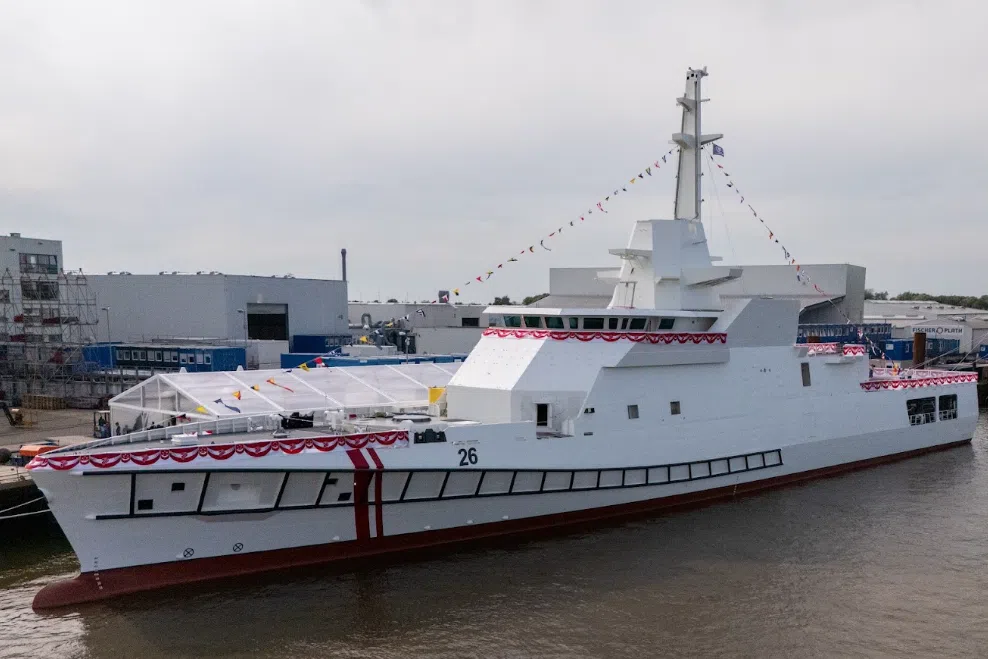
The first Sentinel-class offshore patrol vessel was launched in Germany on Oct 1, 2026.
Published Oct 02, 2026, 09:25 AM
Updated Oct 02, 2026, 09:25 AM
SINGAPORE - The Republic of Singapore Navy (RSN) has launched the first of its new fleet of patrol vessels that are nearly twice the length of their predecessors and can be configured for a wide range of maritime security missions.
The first Sentinel-class offshore patrol vessel (OPV), which was developed by German shipbuilder Fassmer, was launched on Oct 1 at a ceremony in Berne, a municipality in Germany.
The new vessel, named Sentinel, is the first of four OPVs that will replace four Sentinel-class maritime security and response vessels (MSRVs) in conducting maritime security operations and protecting Singapore’s territorial waters.
The OPVs, which have the capacity to combat unmanned threats, will operate under RSN’s Maritime Security and Response Flotilla.
At the launch ceremony held at Fassler’s shipyard, Defence Minister Chan Chun Sing said the new OPV reflects the Singapore Armed Forces’ commitment to keep striving for excellence by preparing not just for today’s challenges, but for future ones as well, given the ship’s ability to add capabilities that can meet new and emerging threats.
He said the project shows a deep relationship between Singapore and Germany and its two navies, and that Singapore sees Germany as a trusted partner amid turbulent times.
The design of the OPV is not a static one, “where we are just satisfied with what we have designed and have built together”, said Chan.
“I would rather see this as a living design - a design whereby, yes, it is the best of its class for today, but with a determination for us to want it to be the best of its class for many more years to come,” he added.
“And with that, we constantly share the data, share the operational experience, and keep improving the design throughout the entire life cycle of this ship.”
The ceremony was also attended by the German Federal Minister of Defence Boris Pistorius, the Chief of German Navy Vice Admiral Wilhelm Tobias Abry and Singapore’s Chief of Navy Rear Admiral Sean Wat.
The OPV Sentinel will undergo a series of platform acceptance and sea trials to validate the ship’s systems and performance before coming to Singapore.
It will be delivered and operationalised from 2028. The remaining three OPVs are still under construction, said the Defence Ministry.
The new OPVs measure 94.85m in length, far larger than the 55m-long MSRVs. They also have a beam of 15.2m - their width at the widest point - and a displacement of 2,700 tonnes, compared to the MSRV’s beam of 8.6m and displacement of 525 tonnes.
The added heft brings greater endurance at sea and more options to implement cutting-edge technologies, “marking a significant leap forward in overall capability”, said Senior Lieutenant-Colonel Jackson Hong, who is the deputy director at the OPV project office at the RSN’s shipbuilding group.
Despite the vessels’ size, Hong said they are designed specifically for Singapore’s congested and highly active maritime environment, with high manoeuvrability and operational flexibility required to operate safely and effectively.
The OPVs are also equipped with a suite of lethal and less-lethal capabilities to provide calibrated responses against a wide spectrum of maritime threats.
“Learning from conflicts around the world in recent years, we have also designed the ship to be ready for threats posed by drones,” said Hong.
The OPVs are equipped with advanced sensors and layered weapons, including the STRALES guided gun, that can combat unmanned threats in the maritime domain.
Military Expert 2 Vijayan Manimaran, the weapon control system supervisor (designate) onboard the OPV Sentinel, said t he new vessel’s improved capabilities allow commanders to calibrate their response through a combination of conventional weapons, a less-lethal grenade launcher, water and foam cannons, and advanced surveillance systems.
“This allows the ship to respond proportionately to different situations by applying the appropriate level of force while avoiding unnecessary escalation,” he said.
“The flexibility to employ both kinetic and non-kinetic options such as a laser dazzler, makes the OPV a highly effective maritime security platform.”
Hong said the ship’s design ensures it can remain relevant in the future, as it has been engineered with extra space for power, cooling and network infrastructure that future capabilities may need, allowing upgrades without major structural redesigns or costly retrofits.
Despite being significantly larger than its predecessor, the OPV operates with a crew of just 40, compared with the MSRV’s crew of 30.
This is made possible by smart automation, said Lieutenant-Colonel Lin Dianxue, who is the OPV Sentinel’s commanding officer (designate).
For example, the ship’s integrated bridge platform management system allows the crew to monitor and control the various systems remotely, rather than having to walk through the entire vessel manually.
Automated systems reduce the need for manual checks and upkeep, shortening maintenance time.
“With a fall in population numbers, it is necessary to find ways to more efficiently manage the requirements of the OPV,” said Lin.
ME4 Angela Chan, who is a coxswain (designate) on the OPV Sentinel, said some of the crew have gone for a six-week familiarisation course in Germany where they were introduced to the various platform systems, deck machineries and firefighting systems.
Looking ahead, she said the crew - many of whom are familiar with the MSRVs - will continue with advanced training and specialised courses to ensure they are ready for operationalisation.
“These programmes are designed to ensure that the crew can confidently manage the OPV’s new capabilities from day one,” she said.
首艘哨兵级近海巡逻舰于2026年10月1日在德国下水。
发布于 2026 年 10 月 2 日上午 9:25
更新于2026年10月2日上午9:25
新加坡——新加坡共和国海军(RSN)已下水其新型巡逻舰艇舰队的首艘舰艇,该舰队的舰艇长度几乎是其前身的两倍,并可配置用于各种海上安全任务。
由德国造船商法斯默公司开发的首艘哨兵级近海巡逻舰(OPV)于 10 月 1 日在德国伯尔尼市举行下水仪式。
这艘名为“哨兵”号的新船是四艘近海巡逻舰中的第一艘,它将取代四艘“哨兵”级海上安全和响应舰(MSRV),执行海上安全行动并保护新加坡的领海。
这些具备打击无人威胁能力的近海巡逻舰将在新加坡海军海上安全与响应舰队的指挥下行动。
在法斯勒造船厂举行的下水仪式上,国防部长陈振声表示,这艘新型近海巡逻舰体现了新加坡武装部队致力于不断追求卓越,不仅为应对当今的挑战做好准备,也为应对未来的挑战做好准备,因为该舰能够增加应对新出现的威胁的能力。
他表示,该项目展现了新加坡和德国及其两国海军之间的深厚关系,也表明在动荡时期,新加坡将德国视为值得信赖的伙伴。
陈先生说,OPV的设计并非一成不变,“我们并非只是对我们已经设计和建造的东西感到满意”。
“我更愿意将其视为一个鲜活的设计——一个设计,是的,它在今天是同类产品中最好的,但我们决心让它在未来的许多年里仍然是同类产品中最好的,”他补充道。
“通过这种方式,我们不断分享数据、分享运营经验,并在该舰的整个生命周期内不断改进设计。”
德国联邦国防部长鲍里斯·皮斯托瑞斯、德国海军司令威廉·托比亚斯·阿布里海军中将和新加坡海军司令肖恩·沃特海军少将也出席了仪式。
在抵达新加坡之前,OPV Sentinel 将进行一系列平台验收和海上试验,以验证该舰的系统和性能。
国防部表示,该舰将于2028年交付并投入使用。其余三艘近海巡逻舰仍在建造中。
新型近海巡逻舰全长94.85米,远大于55米长的海上支援船。它们的舰宽(最宽处)为15.2米,排水量为2700吨,而海上支援船的舰宽为8.6米,排水量为525吨。
新加坡海军造船集团近海巡逻舰项目办公室副主任杰克逊·洪中校表示,增加的重量带来了更强的海上续航能力和更多实施尖端技术的选择,“标志着整体能力的重大飞跃”。
尽管这些船只体积庞大,但洪表示,它们的设计充分考虑了新加坡拥挤且高度活跃的海上环境,具备安全有效运营所需的高机动性和操作灵活性。
近海巡逻舰还配备了一系列致命和非致命武器,可针对各种海上威胁做出精准反应。
“吸取近年来世界各地冲突的经验教训,我们还将这艘船设计成能够应对无人机带来的威胁,”洪说。
这些近海巡逻舰配备了先进的传感器和多层武器,包括 STRALES 制导炮,可以打击海上领域的无人威胁。
二级军事专家维贾扬·马尼马拉恩是“哨兵”号近海巡逻舰上的武器控制系统主管(指定人选),他表示,这艘新舰艇改进后的能力使指挥官能够通过结合常规武器、非致命性榴弹发射器、水炮和泡沫炮以及先进的监视系统来校准他们的反应。
他说:“这使得该舰能够根据不同的情况做出适当的反应,施加适当的武力,同时避免不必要的升级。”
“近海巡逻舰能够灵活运用动能和非动能选项,例如激光眩目器,使其成为一种高效的海上安全平台。”
洪表示,该舰的设计确保其在未来仍能保持相关性,因为它在设计时预留了额外的空间用于电力、冷却和网络基础设施,以满足未来能力的需求,从而无需进行重大的结构重新设计或昂贵的改造即可进行升级。
尽管 OPV 比其前身大得多,但其船员只有 40 人,而 MSRV 的船员为 30 人。
“这得益于智能自动化,”即将上任的“哨兵”号近海巡逻舰舰长林殿雪中校说道。
例如,船舶的集成式驾驶台平台管理系统允许船员远程监控和控制各种系统,而无需手动巡视整艘船。
自动化系统减少了人工检查和维护的需求,缩短了维护时间。
林说:“随着人口数量的下降,有必要找到更有效的方法来管理口服脊髓灰质炎疫苗的需求。”
“哨兵”号近海巡逻舰的候任舵手安吉拉·陈(Angela Chan)表示,部分船员已前往德国参加为期六周的熟悉课程,学习了各种平台系统、甲板机械和消防系统。
展望未来,她表示,船员们(其中许多人熟悉MSRV)将继续接受高级培训和专业课程,以确保他们做好投入使用的准备。
“这些计划旨在确保船员从第一天起就能自信地驾驭近海巡逻舰的新能力,”她说。