China approves string of ‘telepathy’ devices amid push to leapfrog Elon Musk中国批准了一系列“心灵感应”设备,力图超越埃隆·马斯克。
Chinese regulators have approved a group of brain-technology products this year, as local start-ups push to surpass Musk's Neuralink
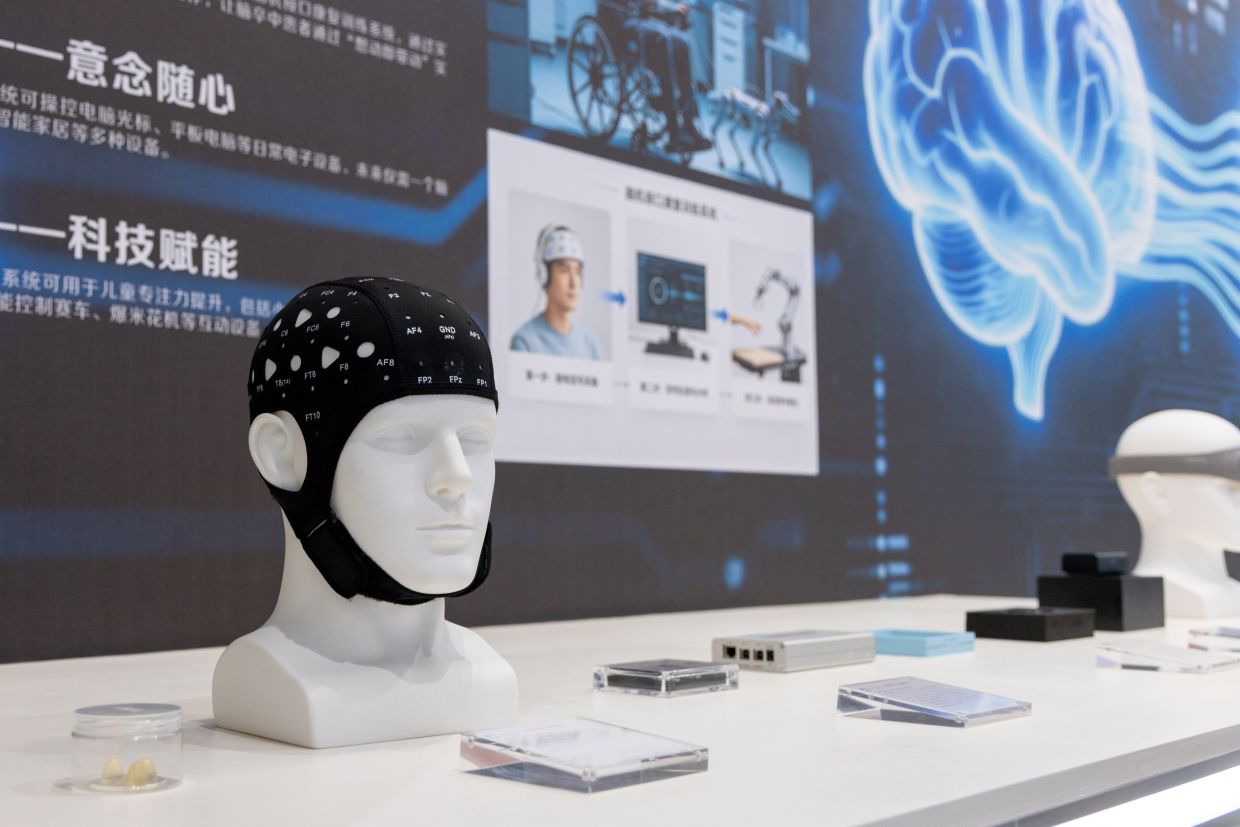
The approvals come as Beijing bids to lead the world in brain-computer interfaces, offering generous policy support to help Chinese firms compete with overseas players such as Elon Musk’s Neuralink. — SCMP
China’s health regulators have granted approvals for a string of brain-technology products this year, as domestic start-ups push to transform the treatment of conditions ranging from paraplegia to Alzheimer’s and depression.
The approvals come as Beijing bids to lead the world in brain-computer interfaces – devices that allow patients to control digital devices using thought alone – offering generous policy support to help Chinese firms compete with overseas players such as Elon Musk’s Neuralink.
The sector in China has become increasingly competitive in recent years, with local governments across the country offering financing support and private investment surging as investors eye a spiralling need for novel health tech solutions in an era of rapid population ageing.
Among the brain tech products to win Chinese market approval recently is a system developed by a domestic firm named Tiankai Suishi (Tianjin) Intelligent Technology, which helps doctors assess whether a patient’s cognitive functions have been impaired.
The device is a cap studded with electrodes that fits over a patient’s scalp and can be used to read the electrical signals given off by the brain, according to an article posted to the company’s official WeChat feed. It was approved by China’s National Medical Products Administration (NMPA) on Aug 19, official records show.
Tiankai Suishi also sells BCI devices that aid early diagnosis of cognitive dysfunction linked to conditions such as Alzheimer’s disease and schizophrenia. It is currently seeking regulatory approval for a product to assist with diagnosing depression.
The company, founded in 2023, has registered capital of 10.67mil yuan (US$1.59mil/RM6.42mil), according to the corporate database Qichacha. It is led by Gu Bin, who completed a doctoral degree at Tianjin University’s medical school, according to Chinese media reports.
Another recent approval went to a micro-electrode driver developed by StairMed Technology – a start-up backed by Chinese tech giants Tencent Holdings and Alibaba Group Holding – which is used to help implant BCI devices during brain surgery. Alibaba owns the South China Morning Post .
The approval, granted by the NMPA in June, marks a boost for StairMed’s push to develop a working BCI implant. The company was still trying out its implant, with 18 patients having received it so far, domestic media reported in July.
These trials had shown promise, with the implant allowing one paraplegic patient to communicate with customers on the Chinese e-commerce platform JD.com by using their thoughts to operate a digital device, said Zhao Zhengtuo, the company’s co-founder, during an event last month.
Shanghai-based start-up Neuracle Medical Technology, meanwhile, in March won China’s first regulatory approval for an implantable BCI device designed to help people with spinal cord injuries regain hand movement.
Another start-up, Hangzhou-based BrainCo, is developing BCI products to aid depression screening in partnership with a hospital affiliated to Beijing’s Capital Medical University, according to the company.
Local governments are ramping up support for the sector. Eastern China’s Zhejiang province has unveiled plans to encourage related firms to go public, while the southern tech hub of Shenzhen has pledged to help firms expand overseas and complete mergers and acquisitions.
China’s ageing population has fuelled a rise in neurological disorders such as Alzheimer’s and Parkinson’s disease, with cases climbing from about 329 million in 1990 to about 468 million by 2021, according to a study published in the journal Med last year.
China’s BCI market is projected to reach 6.14 bil yuan (RM3.69bil) by 2028, according to Xinhua . – South China Morning Post
Hong Kong hospital uses VR tour to ease children’s fears ahead of operations
Medical chatbots are here: What are the side-effects of Doctor AI?
Thank you for your report!
Trump says China is driving anger at US data centres. These residents disagree, reports SCMP
SMG, SCMP ink MOU aimed at strengthening business ties between M'sia, Hong Kong
SMG and SCMP ink landmark deal
这些审批正值北京力图引领全球脑机接口领域之际,北京方面提供慷慨的政策支持,帮助中国企业与埃隆·马斯克的Neuralink等海外企业竞争。——《南华早报》
今年,中国卫生监管机构已批准了一系列脑技术产品,国内初创企业正努力改变从截瘫到阿尔茨海默病和抑郁症等疾病的治疗方法。
在北京力图引领脑机接口(一种允许患者仅凭意念控制数字设备的设备)领域之际,这些审批结果出台,北京方面提供了慷慨的政策支持,以帮助中国企业与埃隆·马斯克的Neuralink等海外企业竞争。
近年来,随着人口老龄化加剧,投资者看到对新型医疗技术解决方案的需求不断增长,中国各地的地方政府纷纷提供融资支持,私人投资也随之激增,中国医疗技术行业的竞争日益激烈。
最近获得中国市场批准的脑科技产品中,有一款是由国内公司天凯睿仕(天津)智能科技有限公司开发的系统,该系统可以帮助医生评估患者的认知功能是否受损。
据该公司官方微信公众号发布的一篇文章称,该设备是一个布满电极的帽子,戴在患者头皮上,可以用来读取大脑发出的电信号。官方记录显示,该设备已于8月19日获得中国国家药品监督管理局(NMPA)的批准。
天凯瑞仕还销售脑机接口(BCI)设备,用于辅助早期诊断与阿尔茨海默病和精神分裂症等疾病相关的认知功能障碍。该公司目前正在寻求监管部门批准其用于辅助诊断抑郁症的产品。
据企业数据库奇查查显示,该公司成立于2023年,注册资本为1067万元人民币(约合159万美元/642万令吉)。据中国媒体报道,该公司由顾斌领导,顾斌毕业于天津大学医学院,获得博士学位。
最近,由腾讯控股和阿里巴巴集团控股的中国科技巨头StairMed Technology公司研发的微电极驱动器也获得了批准。该驱动器用于辅助脑部手术中植入脑机接口(BCI)设备。阿里巴巴集团旗下拥有《南华早报》。
国家药品监督管理局6月批准的这项申请,标志着StairMed公司研发实用型脑机接口植入体取得了重大进展。据国内媒体7月报道,该公司仍在进行植入体试验,目前已有18名患者接受了植入。
该公司联合创始人赵正拓在上个月的一次活动中表示,这些试验已经显示出前景,植入式设备可以让一名截瘫患者通过意念操作数字设备,与中国电子商务平台京东上的顾客进行交流。
与此同时,总部位于上海的初创公司Neuracle Medical Technology于3月份获得了中国首个植入式脑机接口(BCI)设备的监管批准,该设备旨在帮助脊髓损伤患者恢复手部运动。
据该公司称,另一家位于杭州的初创公司 BrainCo 正在与北京首都医科大学附属医院合作,开发用于辅助抑郁症筛查的脑机接口产品。
地方政府正在加大对该行业的支持力度。中国东部的浙江省已公布鼓励相关企业上市的计划,而南方科技中心深圳也承诺帮助企业拓展海外市场并完成并购。
根据去年发表在《医学》杂志上的一项研究,中国人口老龄化加剧了阿尔茨海默病和帕金森病等神经系统疾病的增加,病例数从 1990 年的约 3.29 亿增加到 2021 年的约 4.68 亿。
据新华社报道,预计到2028年,中国脑机接口(BCI)市场规模将达到61.4亿元人民币(约合36.9亿令吉)。——《南华早报》
香港医院利用VR虚拟参观缓解儿童术前恐惧
医疗聊天机器人时代已经到来:人工智能医生有哪些副作用?
感谢您的报告!
特朗普称中国煽动民众对美国数据中心的愤怒。据《南华早报》报道,当地居民对此表示反对。
SMG与SCMP签署谅解备忘录,旨在加强马来西亚与香港之间的商业联系
SMG和SCMP签署里程碑式协议