Complex works, tough terrain: Building Jurong Region Line no easy task工程复杂,地形崎岖:建设裕廊区域线绝非易事
The Jurong Region Line is the first Singapore train network to be built entirely above ground. Find out how the work was done -- in the wee hours and within four-hour windows.
SINGAPORE – For years, motorists driving on the PIE watched large concrete columns rising near the highway as the groundwork was laid for the new Jurong Region Line (JRL).
Trains will start running in about two years on what will be the country’s seventh MRT line, but getting the viaducts built was no simple task.
It meant construction crews working in the dead of night in four-hour blocks, when traffic becomes light and roads can be closed.
The 24km JRL is the first MRT line to be built entirely above ground. The North-South and East-West lines have a mix of above-ground and underground sections.
The JRL was unveiled in the 2013 Land Transport Master Plan, when plans were taking shape to transform the western region with new homes and employment centres. It was first announced in 2001 as a light rail system.
When completed, it will have 25 stations and three interchanges – in Choa Chu Kang, Boon Lay and Jurong East. The station names will be made known later.
The JRL will provide transport links to people living in Choa Chu Kang, Boon Lay and Tengah, and improve access to the Jurong Innovation District, Jurong Lake District and Nanyang Technological University.
This is the JRL, Singapore’s seventh MRT line and its first to be built entirely above ground.
The new line is set to serve some areas that are previously under-reached by MRT lines, including in Jurong East, Choa Chu Kang, Yuhua, Pioneer and Gek Poh.
The first phase, which will be completed in 2028, will add 10 stations linking Choa Chu Kang to Boon Lay and Tawas, with interchanges to the North-South Line, East-West Line and Bukit Panjang LRT.
The second phase will add seven new stations for a quicker ride between Tengah and Pandan Reservoir, with an interchange at Jurong East.
The third phase extends the line through NTU and down to Jurong Pier, adding another seven stations.
JS2A station, situated between JS2 and JS3 stations, will serve future commuter demand in the Tengah area. It is targeted to open in the mid-2030s, in tandem with the completion of developments surrounding the station.
The JRL will save commuters time when travelling in the western part of Singapore. For example, a trip from Choa Chu Kang MRT station to NTU’s Lee Wee Nam Library could be shortened from 60 minutes to 35 minutes.
It was also designed to do something existing MRT lines generally do not: weave through an already built-up area.
Today, Stage 1 is about 80 per cent complete, the Land Transport Authority (LTA) told The Straits Times.
Structural works at all 10 stations and their viaducts have been completed, while electrical and mechanical installations, architectural finishes and external works are moving along.
The JRL will be a medium-capacity line, with smaller three-car trains that can navigate tighter curves through built-up areas. There is an option to add a fourth car in future if demand goes up.
The decision to build an above-ground line meant there were a few construction challenges – and made the works particularly visible to residents, with viaducts and stations taking shape right outside some homes, bringing years of noise, dust and disruption to their doorstep.
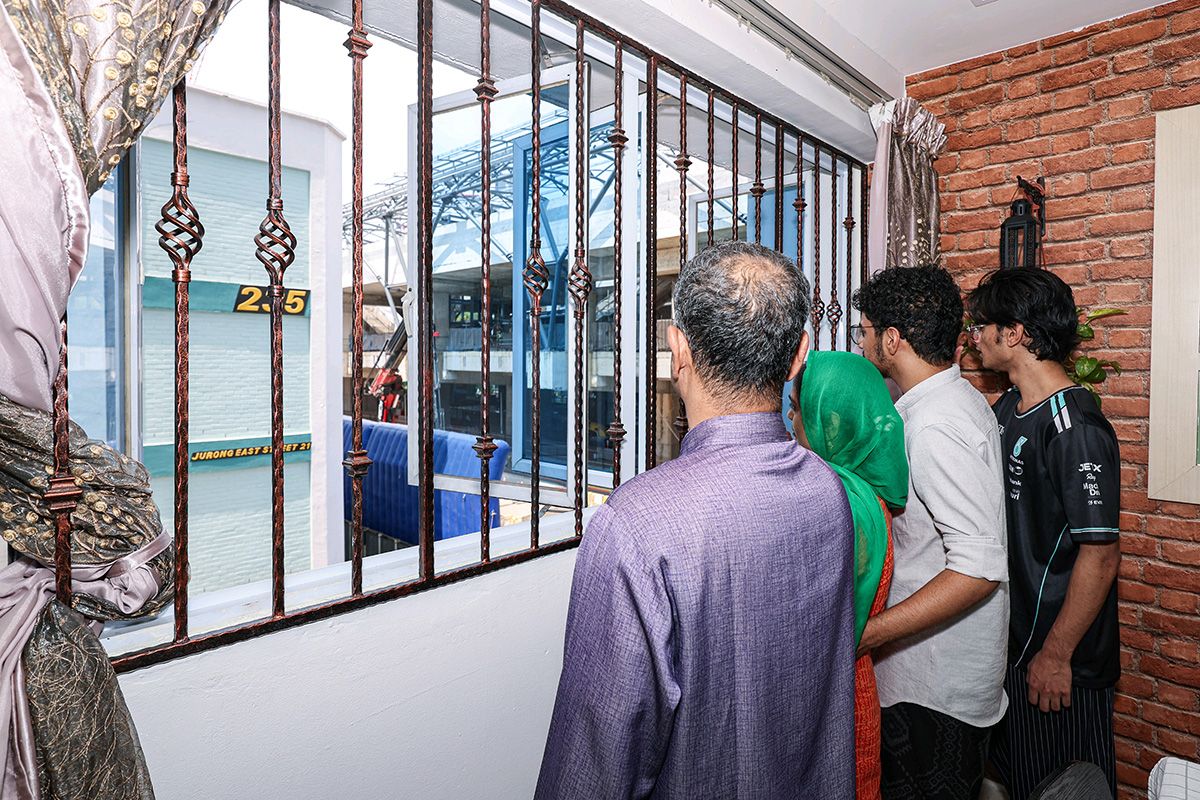
Mechanical engineer Ameer Kaisar Ali, 55, who lives in Block 234 Jurong East Street 21 overlooking the future JE4 station, said the noise from the construction work is constantly in the background when he is home.
He said: “We are experiencing a lot of noise all the time. Twenty-four hours, it’s noisy.” He added that the flat needs sweeping daily because there is “such a huge amount of dust”.
But Ameer said he understands that the construction work is necessary.
“I’m an engineer, so I understand the situation. This spot is very sensitive… That’s the reason we are patient,” he added.
Ameer Kaisar Ali and his family are among residents affected by noise and environmental pollution from ongoing Jurong Region Line construction work outside their home. ST PHOTO: BRIAN TEO
View of the Jurong Region Line construction from Ameer Kaisar Ali's home in Jurong East on Aug 23. ST PHOTO: BRIAN TEO
Boon Lay resident Tze Lin, 36, who works nearby in Joo Koon, said travelling around the western region – where many of her family members live – will become a lot more convenient once the JRL opens.
But noise and bright lights from the construction site at night have irked her family. “I don’t think the windows are soundproof,” she said.
A few residents said all the inconveniences will be worth it when the JRL is completed.
Purchasing manager Lay Ching Ong, 48, who lives in Jurong West, said it will likely take about five minutes to walk to the future JS5 station from her home. Now, it takes her about 20 minutes or more to walk to Lakeside MRT station.
The JRL, she added, will make it easier for her to go to her office in Tanjong Pagar.
The JRL will cross over the AYE and PIE at five places.
Construction crews cannot easily close the lanes on the PIE during the day and lift into place the huge concrete sections needed for building works. What they get is a short window at night.
A timelapse of the construction of JRL on the PIE crossing.
Project director Phua Hooi Leng said lane closures usually start at about 11pm. Segment launching takes place between 1am and 3am, with the works completed and lanes reopened by 5am – in time for the first buses to pass through.
At one section near the Jurong East Flyover, an existing 7.4m-wide open canal also ruled out the conventional method of lifting viaduct segments vertically.
Engineers designed a special lifting frame to lift and slide the segments into position instead, said Phua, who is an engineer.
The construction of the viaducts is also a challenge.
Phua said elevated viaducts are built by first installing deep foundation piles, which can extend up to 40m underground.
Precast concrete segments, each weighing up to 120 tonnes, are then lifted and connected between piers using high-strength steel cables. This allows the structures to be built efficiently while maintaining precise alignment for safe train travel in densely built areas.
Eleven precast yards were set up, mainly in Tengah and Tuas, to manufacture all the viaduct segments.
At the AYE crossing, the Teban Flyover had to be fully closed in both directions while segments were hoisted from ground level and moved across to the opposite pier.
The work also had to be completed within a four-hour window, from 1am to 5am.
An overview of the lifting frame machinery at the segment of the viaduct crossing the PIE, constructed as part of the Jurong Region Line (JRL), beside the Jurong East Flyover, on Jan 16. ST PHOTO: BRIAN TEO
Building above, under and around
Among the most complicated construction sites is near Jurong Hill, where the JRL viaduct goes over an existing flyover.
Below it, there is a road as well as an underpass – making it a four-layer intersection.
Running underground is a dense channel of critical utility lines serving Jurong Island, including telecoms cables, water mains and high-voltage power cables.
That means construction must be done above, below and around the utility lines.
Some utility lines needed to be diverted and roads temporarily realigned, said Phua. When the utility lines cannot be moved, steps must be taken to make sure no damage is done.
The construction team also used tools like tiltmeters, vibration sensors, settlement markers and real-time 3D prisms to monitor nearby buildings and structures, he said. Readings are recorded daily so that steps can be taken if any abnormal movement of the buildings and structures is detected.
In Jurong East, the JRL viaduct crosses over the East-West Line, and safety concerns meant the usual way of lifting a precast concrete segment vertically from the ground would not work.
The segments can each weigh up to 120 tonnes, and a 1,700-tonne crawler crane – one of the largest cranes on land in Singapore – was brought in for the lifting works.
Construction crews had to wait for engineering hours, approximately between 1.30am and 4am, to begin work, after the last passenger train had returned to the depot and engineering trains gave the green light.
Much of the JRL runs through built-up areas like Choa Chu Kang, Jurong, Pioneer and Tengah.
At one section in Jurong East, the gap between the JRL track and the fully running North-South Line’s viaduct is only about 1m.
That is why the line’s trains were designed to be smaller and more manoeuvrable, and why the same constraints shape the way the train line is being built.
Where the alignment is straight or gently curved, launching girders – a special type of crane that is up to 150m long and weighs more than 300 tonnes – can be used.
Then there are ground conditions to consider.
The JRL is being built largely over sedimentary rock formations, but ground cavities in some spots needed more reinforcement, said Phua.
Before a viaduct could be built over a 25m-wide canal in Jurong West, for example, ground improvement works had to be done to strengthen the soil before heavy equipment could be deployed.
Almost at the finish line
Construction of the JRL started in January 2023, after more than three years of preparation.
At the time, LTA estimated that the line would open in three stages between 2027 and 2029, with an expected daily ridership of about 200,000 that can rise to more than 500,000 as Tengah town, the Jurong Innovation District and Jurong Lake District grow.
More than 60,000 additional homes were expected to be within a 10-minute walk to a train station when the line is completed.
In March, then Acting Transport Minister Jeffrey Siow, speaking in Parliament, said the opening of the JRL is delayed by six months to the middle of 2028 due to construction delays and testing.
The first stage – comprising 10 stations linking Choa Chu Kang to Boon Lay and Tawas off Jalan Bahar – was slated to open by end-2026.
It was delayed by a year because of the Covid-19 pandemic and pushed back another six months to mid-2028 in March because of construction delays and testing requirements.
The new Jurong Region Line (JRL) under construction is progressively built in segments and will eventually run above the AYE (bottom) at an intersection along Jurong Town Hall Road. ST PHOTO: KUA CHEE SIONG
On Sept 20, Siow said shuttle services that shadow the JRL route will be rolled out until the trains start running. The shuttle services will start from the second half of 2027, and take commuters to key stations.
The complexity of building an entirely elevated line in a densely populated area contributed to the delays. For example, construction over the 25m-wide canal required more extensive ground preparation than what was initially planned.
The JRL will open in three stages, with Stage 1 expected now to start running from mid-2028.
LTA said it would provide updates on Stages 2 and 3 as work progresses. Stage 2, from Tengah to Pandan Reservoir, is currently slated to open in 2028. Stage 3, which will extend the JRL into Nanyang Technological University and towards Jurong Pier, is currently expected to open in 2029.
The new line will provide alternative routes for Choa Chu Kang and Boon Lay residents and help redistribute passenger loads on the existing network. It is also part of efforts to support the west’s transformation into a major residential and employment centre.
While 24 stations were originally planned for the line, a new station, JS2A in Tengah, is now being built between Choa Chu Kang and Tengah to serve future residents of the Forest Hill district. This will bring the total number of stations to 25.
The trains will be fully automated and driverless. They will also have three wide doors on each side of every car, each 1.5m wide, wider than those on existing MRT lines. Each car will have space for wheelchair users and strollers.
Compared with trains on other MRT lines, JRL train cars will be smaller to better navigate built-up areas.
Five of the 62 JRL trains have arrived in Singapore so far, LTA said.
The JRL will also be the first MRT line to operate under a new rail contracting model marked by a joint venture between SBS Transit and French transport firm RATP Dev. The venture won a nine-year operating contract in 2024, with the option of a two-year extension.
The service fee quoted by SBS Transit and RATP Dev Asia-Pacific to operate the line for 11 years came to about $750 million.
For commuters, the JRL will be a key node that will connect them to the larger Singapore transport network.
Building it, however, was far from straightforward. Challenging situations were met with innovative decisions, and soon, it will be an engineering feat that will serve Singaporeans well.
新加坡——多年来,驾车行驶在泛岛高速公路 (PIE) 上的司机们都看到高速公路附近竖起了巨大的混凝土柱,这是为新的裕廊区域线 (JRL) 打下基础的迹象。
这条国家第七条地铁线路将在大约两年后开始运行,但建造高架桥并非易事。
这意味着施工人员要在深夜进行施工,每次施工持续四个小时,因为那时交通比较顺畅,可以封闭道路。
全长24公里的裕廊西线是首条完全建于地面以上的捷运线路。南北线和东西线则采用地上和地下相结合的模式。
2013年陆路交通总体规划中首次公布了联合区域轻轨(JRL)项目,当时正着手通过建设新住宅和就业中心来改造西部地区。该项目最初于2001年作为轻轨系统提出。
建成后,该轻轨将设有25个车站和三个换乘站,分别位于蔡厝港、文礼和裕廊东。车站名称稍后公布。
裕廊区域线将为蔡厝港、文礼和登加的居民提供交通连接,并改善前往裕廊创新区、裕廊湖区和南洋理工大学的交通条件。
这是裕廊区域线(JRL),新加坡的第七条地铁线路,也是第一条完全建在地面以上的地铁线路。
新线路将服务于一些以前地铁线路覆盖不足的地区,包括裕廊东、蔡厝港、裕华、先驱和玉宝。
第一阶段将于 2028 年完成,届时将新增 10 个车站,连接蔡厝港、文礼和塔瓦斯,并可换乘南北线、东西线和武吉班让轻轨。
第二阶段将新增七个车站,加快登加和班丹蓄水池之间的通勤速度,并在裕廊东设立换乘站。
第三期工程将线路延伸至南洋理工大学,并一直延伸到裕廊码头,新增七个车站。
JS2A站位于JS2站和JS3站之间,将满足登加地区未来的通勤需求。该站计划于2030年代中期开通,届时车站周边开发项目也将竣工。
联合区域线(JRL)将为通勤者节省在新加坡西部出行的时间。例如,从蔡厝港地铁站到南洋理工大学李伟南图书馆的行程时间将从60分钟缩短至35分钟。
它的设计目的还在于实现现有地铁线路通常无法实现的目标:穿过已建成的区域。
陆路交通管理局(LTA)告诉《海峡时报》,目前第一阶段工程已完成约 80%。
所有 10 个车站及其高架桥的结构工程已经完成,而电气和机械安装、建筑装饰和外部工程正在顺利进行。
捷运系统(JRL)将是一条中等运力线路,采用较小的三节车厢编组列车,以便在人口密集的城区内以更小的弯道行驶。如果未来需求增加,还可以选择增加第四节车厢。
修建高架线路的决定意味着施工面临一些挑战,也使得工程对居民来说格外显眼,高架桥和车站就在一些居民家门口拔地而起,给居民家门口带来了多年的噪音、灰尘和干扰。
55岁的机械工程师阿米尔·凯撒·阿里住在裕廊东21街234座,可以俯瞰未来的JE4地铁站。他说,在家时,施工噪音一直萦绕耳畔。
他说:“我们一直都受到噪音的困扰。一天24小时都很吵。”他还补充说,公寓需要每天打扫,因为“灰尘太多了”。
但阿米尔表示,他理解这项建设工程是必要的。
“我是一名工程师,所以我了解情况。这个地方非常敏感……这就是我们保持耐心的原因,”他补充道。
阿米尔·凯撒·阿里和他的家人是受裕廊区域线施工噪音和环境污染影响的居民之一,他们的家就在施工现场附近。(海峡时报照片:布莱恩·张)
8月23日,从阿米尔·凯撒·阿里位于裕廊东的家中眺望裕廊区域线施工现场。(海峡时报摄影:张文杰)
居住在文礼的 36 岁居民 Tze Lin 在附近的裕群工作,她说,裕群铁路开通后,前往西部地区(她的许多家人都住在那里)将变得更加方便。
但夜间建筑工地的噪音和强光让她的家人很烦恼。“我觉得窗户不隔音,”她说。
一些居民表示,JRL建成后,所有不便之处都将是值得的。
48岁的采购经理Lay Ching Ong住在裕廊西,她说从她家步行到未来的JS5地铁站大约只需要5分钟。而现在,她步行到湖畔地铁站需要20分钟甚至更久。
她补充说,JRL 将使她更容易前往位于丹戎巴葛的办公室。
JRL 将在五个地点与 AYE 和 PIE 交汇。
施工人员白天很难封闭PIE高速公路的车道,也无法吊装建筑工程所需的大型混凝土构件。他们只能在夜间短暂作业。
一段记录PIE大桥JRL建设过程的延时摄影。
项目总监潘慧玲表示,车道封闭通常从晚上11点左右开始。路段开通时间为凌晨1点至3点,工程将于早上5点完成,车道重新开放——正好赶上首批公交车通行。
在裕廊东高架桥附近的一个路段,一条现有的 7.4 米宽的明渠也排除了垂直提升高架桥段的传统方法。
工程师 Phua 表示,工程师们设计了一种特殊的升降框架,可以将各个部件提升并滑入到位。
高架桥的建设也是一项挑战。
Phua表示,高架桥的建造首先要安装深基础桩,这些桩可以延伸到地下40米。
预制混凝土构件,每个重达120吨,随后被吊装并用高强度钢索连接在桥墩之间。这使得结构能够高效建造,同时保持精确的对齐,从而确保在人口密集区域内列车安全运行。
为了生产所有高架桥段,主要在登加和图阿斯设立了 11 个预制构件堆场。
在 AYE 路口,Teban 高架桥必须双向完全封闭,同时将桥段从地面吊起并移至对面的桥墩。
这项工作还必须在凌晨 1 点到 5 点这四个小时内完成。
1月16日,在裕廊东高架桥旁,拍摄了横跨泛岛高速公路(PIE)的高架桥段的起重设备概览。该高架桥是裕廊区域线(JRL)的一部分。(海峡时报摄影:BRIAN TEO)
在上面、下面和周围建造建筑物
其中最复杂的施工地点之一是裕廊山附近,那里的裕廊区域线高架桥要跨越现有的高架桥。
下面有一条路和一个地下通道——使其成为一个四层交叉路口。
裕廊岛地下埋设着密集的公用设施线路,包括电信电缆、供水干线和高压电力电缆。
这意味着必须在公用设施线路的上方、下方和周围进行施工。
普阿表示,部分公用设施线路需要改道,道路也需要临时调整。如果公用设施线路无法移动,则必须采取措施确保不会造成任何损害。
他说,施工团队还使用了倾斜仪、振动传感器、沉降标记和实时三维棱镜等工具来监测附近的建筑物和构筑物。每天都会记录读数,以便在检测到建筑物和构筑物出现任何异常移动时采取相应措施。
在裕廊东,JRL 高架桥跨越东西线,出于安全考虑,通常将预制混凝土构件从地面垂直吊起的方法行不通了。
每个部件的重量可达 120 吨,为此,新加坡调来了一台 1700 吨的履带式起重机——新加坡陆地上最大的起重机之一——进行吊装作业。
施工人员必须等到工程时间(大约在凌晨 1 点 30 分到 4 点之间)才能开始工作,前提是最后一班客运列车返回车站,并且工程列车发出绿灯。
裕廊区域线的大部分路段都穿过蔡厝港、裕廊、先驱和登加等人口稠密地区。
在裕廊东的某个路段,裕廊区域线轨道与全面运行的南北线高架桥之间的间隙只有大约 1 米。
正因如此,这条线路的列车被设计得更小巧、更灵活,同样的限制也影响着这条铁路的建设方式。
如果线路是直线或略微弯曲的,可以使用架设梁——一种长达 150 米、重达 300 多吨的特殊起重机。
此外,还需要考虑地质条件。
Phua表示,JRL主要建在沉积岩层上,但某些地方的地面空洞需要更多加固。
例如,在裕廊西一条 25 米宽的运河上修建高架桥之前,必须先进行地基改良工程以加固土壤,然后才能部署重型设备。
几乎到达终点线了
JRL的建设在经过三年多的准备后于2023年1月开始。
当时,陆路交通管理局估计,该线路将在 2027 年至 2029 年分三个阶段开通,预计日客流量约为 20 万人次,随着登加镇、裕廊创新区和裕廊湖区的发展,客流量可能会增加到 50 万人次以上。
该线路建成后,预计将有超过 6 万户家庭步行 10 分钟即可到达火车站。
今年 3 月,时任交通部代理部长萧敬腾在国会表示,由于施工延误和测试,联合区域线的开放时间将推迟 6 个月至 2028 年年中。
第一阶段工程包括 10 个车站,连接蔡厝港、文礼和位于 Jalan Bahar 附近的 Tawas,原计划于 2026 年底开通。
由于新冠疫情,该项目推迟了一年;由于施工延误和测试要求,该项目在3月份又推迟了六个月,至2028年年中。
正在建设中的裕廊区域线(JRL)将分段逐步建设,最终将在裕廊市政厅路的一个交叉路口,从亚逸拉惹高速公路(AYE)(下图)上方穿过。海峡时报摄影:柯志雄
9月20日,萧先生表示,在裕廊区域线(JRL)正式开通运营前,将推出与JRL线路并行的接驳巴士服务。接驳巴士服务将于2027年下半年开始运行,并将乘客送往主要车站。
在人口稠密地区修建全高架线路的复杂性是造成工期延误的原因之一。例如,跨越25米宽的运河所需的地面准备工作比最初计划的要多得多。
JRL 将分三个阶段开放,第一阶段预计将于 2028 年年中开始运行。
陆路交通管理局表示,将随着工程进展及时发布第二阶段和第三阶段的最新消息。第二阶段工程从登加(Tengah)延伸至班丹蓄水池(Pandan Reservoir),目前计划于2028年开通。第三阶段工程将把裕廊区域线(JRL)延伸至南洋理工大学和裕廊码头附近,目前预计将于2029年开通。
新线路将为蔡厝港和文礼居民提供更多出行选择,并有助于重新分配现有线路的客流量。同时,这也是支持西部地区转型为主要居住和就业中心举措的一部分。
该线路最初计划设24个车站,但为了服务未来森林山(Forest Hill)地区的居民,目前正在蔡厝港(Choa Chu Kang)和登加(Tengah)之间新建一个车站——JS2A站。这将使车站总数达到25个。
这些列车将实现全自动化无人驾驶。每节车厢两侧各设有三扇宽大的车门,每扇车门宽1.5米,比现有地铁线路的车门更宽。每节车厢都将设有供轮椅使用者和婴儿车停放的空间。
与其他地铁线路的列车相比,JRL 列车车厢较小,以便更好地在人口稠密地区行驶。
陆路交通管理局表示,目前已有 62 列 JRL 列车中的 5 列抵达新加坡。
裕廊区域线(JRL)也将成为首条采用新型铁路承包模式运营的地铁线路,该模式由新加坡捷运公司(SBS Transit)和法国交通运输公司巴黎大众运输发展公司(RATP Dev)合资成立。该合资公司于2024年赢得了为期九年的运营合同,并可选择续签两年。
SBS Transit 和 RATP Dev Asia-Pacific 为运营该线路 11 年提供的服务费报价约为 7.5 亿美元。
对于通勤者来说,JRL 将成为连接他们与新加坡更大交通网络的关键节点。
然而,建造过程远非一帆风顺。面对重重挑战,人们做出了诸多创新决策。不久之后,这项工程奇迹将造福新加坡人民。