Singapore factory activity expands in September, ‘supercharged’ by AI demand新加坡工厂活动在9月份扩张,人工智能需求“加速”推动了这一增长。
Singapore’s factory activity expanded in September, driven by strong AI demand and electronics growth despite supply chain pressures and rising input costs. Read more at straitstimes.com.
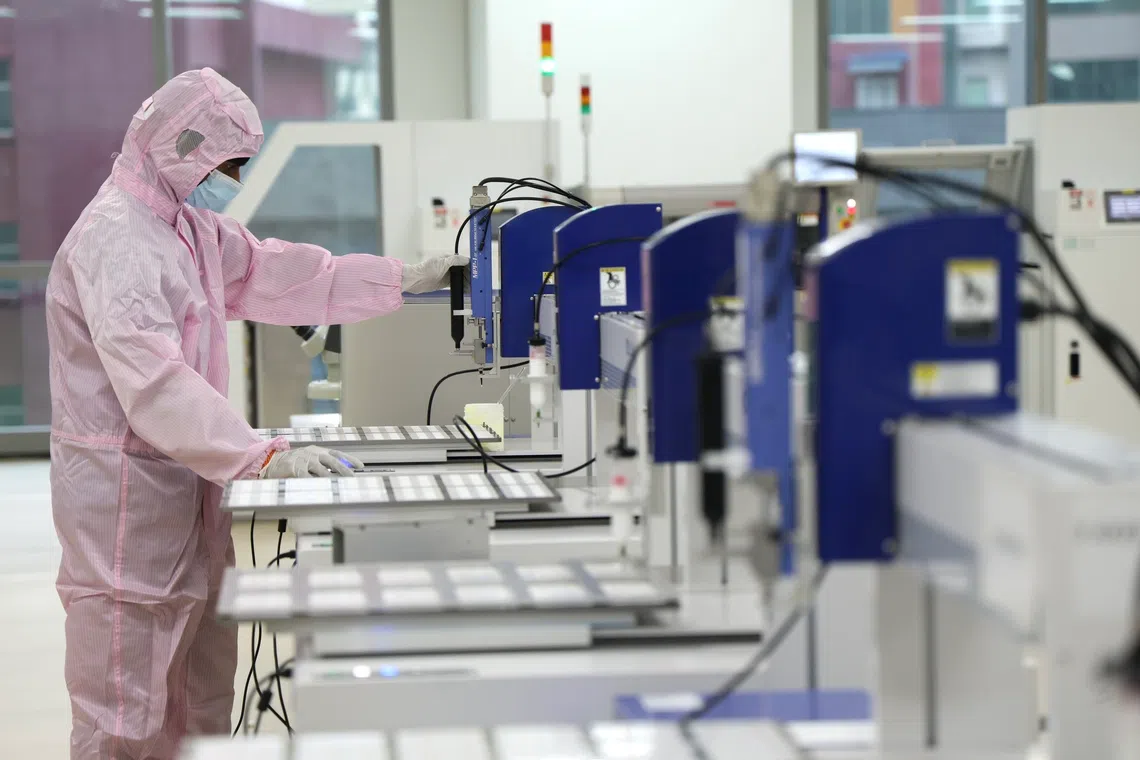
The Republic’s purchasing managers’ index rose to 51.7 points in September, from 51.5 points in August. This was its highest reading since October 2018.
PHOTO: LIANHE ZAOBAO FILE
Published Oct 02, 2026, 09:00 PM
Updated Oct 02, 2026, 09:22 PM
Singapore's factory activity expanded for the 14th month in September, driven by strong AI-related demand.
The electronics sector led growth supporting stronger orders, production, and employment.
Supply chain disruptions from the Middle East conflict and energy issues threaten manufacturers, although firms remain confident about near-term business conditions.
SINGAPORE – Strong AI-related demand drove Singapore’s factory activity to expand in September for the 14th consecutive month, even as the persisting conflict in the Middle East places pressure on supply chains.
The Republic’s purchasing managers’ index (PMI) – a barometer of the manufacturing industry’s overall health – rose to 51.7 points in September, from 51.5 points in August. This was its highest reading since October 2018.
A PMI reading above 50 indicates growth, while one below that signals contraction.
The electronics sector, which accounts for 40% of Singapore’s manufacturing output, posted a PMI of 52.9 points in its 16th straight month of expansion.
DBS Bank senior economist Chua Han Teng told The Straits Times: “Strength in Singapore’s manufacturing sector continued to be driven primarily by the electronics cluster, supercharged by sustained global AI-related tailwinds.”
Stephen Poh, executive director at the Singapore Institute of Purchasing and Materials Management, which compiles the monthly survey, said the electronics sector has supported stronger orders, production and employment in the manufacturing industry.
But Poh also said that rising input costs and prolonged supplier lead times were intensifying operational pressures on manufacturers.
“Growing order backlogs and declining finished goods inventories suggest that manufacturers are working to meet demand while managing persistent supply constraints,” he added.
Stronger growth in new orders, new exports, factory output, input inventories and employment drove September’s PMI higher.
Even so, the supplier deliveries index contracted at a faster pace for the ninth consecutive month. This came as the order backlog index recorded stronger growth, and the finished goods index contracted at a faster rate.
NUS associate professor of analytics and operations Goh Puay Guan said the strong PMI readings were in line with the continued growth of AI and electronics, the recent turnaround in China’s PMI, and strong US economic growth.
He said: “Taken together, the continued reduction in the finished goods index probably indicates that demand remains strong, rather than constrained by supply chain disruptions.”
China’s official PMI returned to expansion territory in September after two straight months of contraction. Meanwhile, robust consumer spending and AI-related business investment drove the US economy to grow at a 2.2% annualised rate in the second quarter, according to the latest official estimate.
Here, the future business index expanded for the 11th consecutive month, showing manufacturers’ sustained confidence in near-term business conditions.
Chua said manufacturing growth in South Korea and Taiwan, key players in the global semiconductor supply chain, has indirectly benefited Singapore, which has close trade linkages with the two economies.
South Korea, home to leading memory-chip makers Samsung Electronics and SK Hynix, saw factory activity grow in September by the biggest margin in four months, as demand for its exports grew at the fastest pace in 15.5 years.
Taiwan, where chip giant TSMC is headquartered , also saw its manufacturing activity expand because of robust demand for chips and AI-related goods.
Chua noted that some sectors within Singapore’s manufacturing industry continue to face difficulties from rising energy and material costs, and supply chain disruptions.
He said: “The constraints faced by petrochemical firms are well known, given the feedstock shortages arising from the persistent closure of the Strait of Hormuz, amid the unresolved conflict in the Middle East.”
Priyanka Kishore from consultancy Asia Decoded said energy supply disruptions stemming from the Iran war have taken time to be felt through supply chains.
“But increasing delays in supplies and rising input prices suggest that constraints are beginning to bite, pointing towards a manufacturing slowdown in the fourth quarter,” she said.
Annabelle Liang is a business correspondent at The Straits Times, where she specialises in trade and macroeconomics.
Artificial Intelligence
爱尔兰共和国9月份采购经理人指数升至51.7点,高于8月份的51.5点。这是自2018年10月以来的最高读数。
照片:联合早报档案
发布于2026年10月2日晚上9点
更新于2026年10月2日晚上9:22
受人工智能相关强劲需求的推动,新加坡工厂活动在9月份连续第14个月扩张。
电子行业引领增长,带动了订单、生产和就业的增加。
中东冲突和能源问题导致的供应链中断对制造商构成威胁,但各公司对近期商业环境仍充满信心。
新加坡——尽管中东持续冲突给供应链带来压力,但强劲的人工智能相关需求推动新加坡工厂活动在9月份连续第14个月扩张。
爱尔兰共和国的采购经理人指数(PMI)——衡量制造业整体健康状况的晴雨表——9月份升至51.7点,高于8月份的51.5点。这是自2018年10月以来的最高读数。
PMI 指数高于 50 表示经济增长,低于 50 则表示经济萎缩。
新加坡电子行业占新加坡制造业产出的 40%,其采购经理人指数 (PMI) 连续第 16 个月扩张,达到 52.9 点。
星展银行高级经济学家蔡汉腾告诉《海峡时报》:“新加坡制造业的强劲增长主要由电子产业集群推动,并受到全球人工智能相关利好因素的极大推动。”
负责编制月度调查的新加坡采购与物料管理协会执行董事史蒂芬·波表示,电子行业为制造业的订单、生产和就业提供了强有力的支持。
但 Poh 也表示,投入成本上升和供应商交货周期延长正在加剧制造商的运营压力。
他补充说:“订单积压不断增加,成品库存不断下降,这表明制造商正在努力满足需求,同时应对持续存在的供应限制。”
新订单、新出口、工厂产出、投入库存和就业的强劲增长推动9月份PMI走高。
尽管如此,供应商交货指数连续第九个月加速收缩。与此同时,订单积压指数增长强劲,而成品指数收缩速度加快。
新加坡国立大学分析与运营学副教授吴培源表示,强劲的采购经理人指数读数与人工智能和电子产品的持续增长、中国采购经理人指数最近的好转以及美国经济的强劲增长相一致。
他表示:“综合来看,成品价格指数的持续下降可能表明需求依然强劲,而不是受到供应链中断的限制。”
中国官方采购经理人指数(PMI)在连续两个月收缩后,于9月份重回扩张区间。与此同时,根据最新官方数据,强劲的消费支出和人工智能相关业务投资推动美国经济在第二季度实现2.2%的年化增长率。
在此,未来商业指数连续第 11 个月扩张,表明制造商对近期商业环境持续充满信心。
蔡先生表示,韩国和台湾是全球半导体供应链的关键参与者,这两个地区的制造业增长间接惠及了与新加坡和台湾有着密切贸易联系的新加坡。
韩国是领先的存储芯片制造商三星电子和SK海力士的所在地,9月份韩国工厂活动实现了四个月来的最大增幅,因为其出口需求以15.5年来最快的速度增长。
台湾是芯片巨头台积电的总部所在地,由于对芯片和人工智能相关产品的需求强劲,台湾的制造业活动也随之扩大。
蔡先生指出,新加坡制造业的一些领域仍然面临能源和材料成本上涨以及供应链中断等困难。
他说:“由于中东冲突悬而未决,霍尔木兹海峡持续关闭导致原料短缺,石化企业面临的制约因素众所周知。”
来自咨询公司 Asia Decoded 的 Priyanka Kishore 表示,伊朗战争造成的能源供应中断需要一段时间才能通过供应链感受到影响。
“但供应延迟加剧和投入价格上涨表明,这些限制开始产生影响,预示着第四季度制造业将放缓,”她说道。
梁安娜贝尔是《海峡时报》的商业记者,专门报道贸易和宏观经济。
人工智能