A year on since the Kwek family feud, CDL is in better shape. So why is its share price falling?郭氏家族纷争已过去一年,城市发展有限公司(CDL)的状况有所好转。那么,其股价为何下跌呢?
City Developments Limited unveils a three-year plan targeting asset divestments and growth, but investors seek clearer execution and financial outcomes. Read more at straitstimes.com.
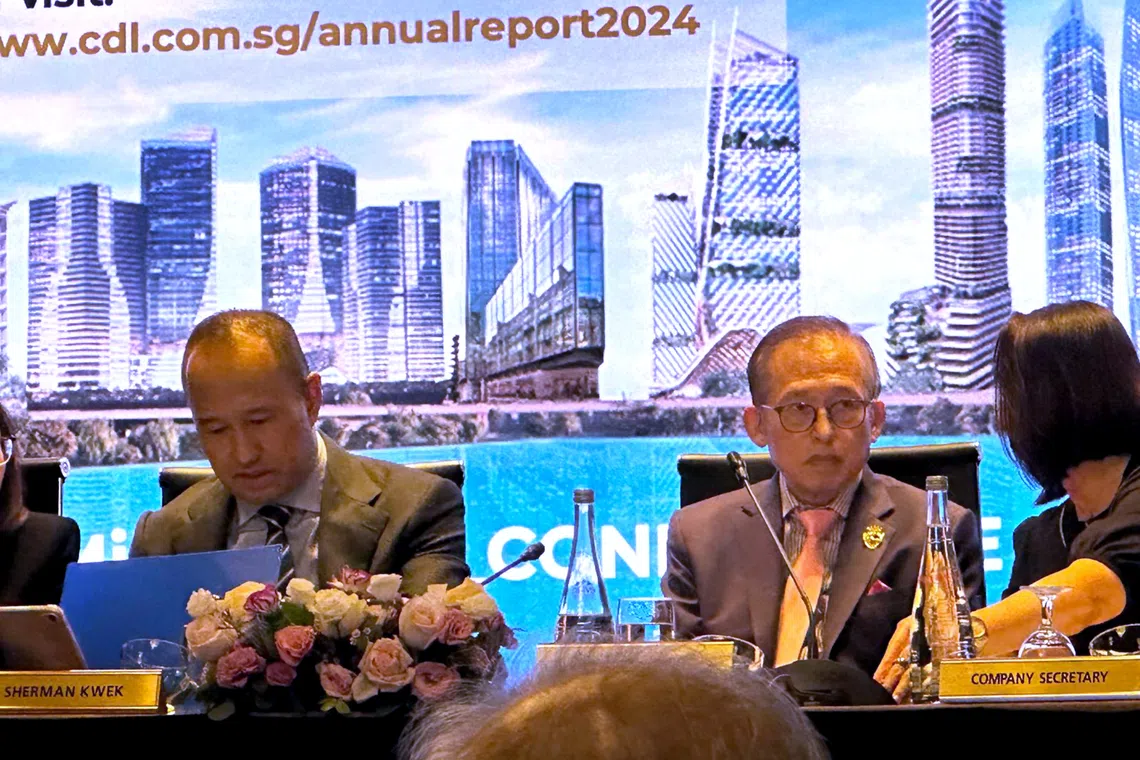
CDL executive chairman Kwek Leng Beng (right) and his son, group CEO Sherman Kwek, at the hotel and property group’s annual general meeting in April.
ST PHOTO: ANGELA TAN
Published Oct 02, 2026, 06:20 PM
Updated Oct 02, 2026, 09:11 PM
CDL has recovered from its 2025 family feud and unveiled a three-year plan targeting $6 billion in asset sales, $5 billion in growth capital, and aims for 35% dividend payouts by 2029.
Despite positive strategies, CDL’s share price fell nearly 15% due to unclear execution details, succession concerns, China market risks, and investor doubts about near-term financial outcomes.
Key challenges include selling $6 billion in assets amid market uncertainty, reducing net gearing from over 70% to 55%, and expanding fund management to improve capital efficiency over time.
SINGAPORE – A year after a bitter family feud rattled City Developments Limited (CDL), the hotel and property group appears to have regained its footing.
Its finances are steadier, its business is moving ahead and the father-and-son dispute has largely faded from the headlines.
On Sept 28, the group unveiled a three-year execution roadmap for 2027 to 2029 aimed at divesting non-core assets and redeploying capital into growth areas.
Yet the market is unhappy.
CDL has already staged a substantial recovery from its 2025 trough, when the stock fell as low as $4.35 in April amid the boardroom conflict, before ending the year at around $8, a 56% gain .
But since Sept 28 , the share price has been sliding. It was trading around $7 on Oct 2, down from more than $8 before the review.
That is an almost 15% slide despite many analysts’ buy recommendations after CDL’s chief executive officer, Sherman Kwek, said the group is targeting $6 billion of divestments across the residential, commercial, hospitality and living sectors, and deploying $5 billion of growth capital in the four sectors.
Its plan is to achieve more than 35% in dividend payout annually – about 55% net gearing by 2029, and more than $1 billion net profit from divestment gains and $10 billion assets under management.
Tabitha Foo, an analyst with DBS Research, said: “Our view is that the strategic review does not disappoint on intent, but it leaves investors wanting more on execution details, near-term milestones and measurable financial outcomes.”
She added that the target achievements are all positive developments that should improve CDL’s capital efficiency and return on equity over time. It also offers investors measurable financial targets and greater accountability.
JPMorgan analysts Mervin Song and Terence Khi noted that investors welcome the plan, but management did not give enough clarity on how much extra profit and dividends they could expect.
That uncertainty, along with its China plans, made investors less enthusiastic about the stock.
Vijay Natarajan, an analyst with RHB Group, pointed out that the shares are trading at a hefty discount to CDL’s revalued net asset value (RNAV) of about $20, as well as analysts’ RNAV estimates, which range from $14 to $18.
Rival property and hotel group UOL is trading at a discount of 30% to 40%.
CDL’s review contained many of the things investors had been waiting for: asset sales, lower gearing, higher dividends and a bigger fund-management business.
So, what is spooking investors?
Remiser S. Nallakaruppan, better known as Nalla, said that while retail investors are buying CDL shares, large institutional funds are getting out.
It is the typical “buy the rumour, sell the news”, where prices move in anticipation of a future event, then reverse or stabilise once the news breaks.
A stockbroker with a local brokerage attributed the recent rise in CDL’s trading volatility to institutional funds which are not long-term investors.
He reckoned that hedge funds, which provide up to 50% of market liquidity, sensed an opportunity to “short” CDL shares, driving the price down. To short a stock, people borrow shares from brokers, sell them on the open market, and hope to buy them back later at a lower price to return.
Beyond these, nagging doubts remain in the market over whether the feud between the younger Kwek and his father, CDL executive chairman Kwek Leng Beng, is truly water under the bridge.
In early 2025, the father accused his son of orchestrating a boardroom takeover.
Brokers noted that the market may have construed negatively the fact that the senior Kwek, 85, was not at the unveiling of the roadmap. His reluctance to name Sherman Kwek, 50, as his successor also suggests a lack of readiness to hand over the reins despite his age .
“The two main issues that triggered the strategic review were not addressed. They are the board unity and succession plan,” said one broker.
While the review is largely welcome, the problem is the execution risks. For shareholders looking for an immediate catalyst, selling assets and then reinvesting the proceeds is less straightforward than selling assets and distributing the cash.
Analysts noted it may not be easy to dispose of $6 billion worth of assets in this environment, especially with London’s property crisis only just beginning.
A recent report by British daily The Telegraph cited CDL mothballing a £1.3 billion (S$2.2 billion) project – including 1,000 new homes, shops and offices – despite winning planning permission in May 2025, due to rising costs and tepid buy demand.
CDL’s net gearing – a measure of debt to equity – was more than 70% at the close of 2025, after accounting for fair-value gains on investment properties. The new target is to bring net gearing down to about 55% by FY2029.
“That is a meaningful target, but it also tells investors that the balance sheet still needs work,” said one analyst.
CDL has a large and valuable property portfolio, but property development is capital-intensive. Acquiring land, building projects and holding investment properties all require substantial financing.
So the market is likely to be watching not just whether CDL can sell $6 billion of assets, but also how much debt actually disappears as a result, and how quickly.
Another complication is CDL’s China ambition.
Of the $5 billion earmarked for new investments, about 60 per cent is intended for Singapore, while 30 per cent is allocated to China and Japan combined. The remaining 10 per cent will go to other markets.
That keeps Singapore firmly at the centre of the strategy, but it also means CDL remains exposed to markets where property conditions and returns can be less predictable.
For CDL, the substantial losses incurred in the China property market are still fresh in investors’ minds, Nalla said.
The group suffered a major financial and boardroom crisis after its disastrous acquisition of a roughly 51% stake in Chinese developer Chongqing Sincere Yuanchuang Industrial for $1.9 billion in 2020. CDL took a massive impairment write-down that year .
Investors want to know if the China partnerships and future cash flows will be ring-fenced to protect the group.
Perhaps one of the most important structural changes is CDL’s ambition to rely more heavily on fund management.
The company wants to double its assets under management from about $5 billion in June 2026 to $10 billion by 2029, under plans to establish a dedicated fund-management entity and expand through real estate investment trusts, private funds, partnerships and joint ventures.
The attraction is straightforward.
Instead of putting all of its own capital into every property, CDL can bring in outside investors while retaining exposure to the assets and earning management-related fees.
That could make the business less capital-intensive over time.
But again, this is a future earnings and capital-efficiency story, rather than something that immediately changes the current balance sheet.
What investors want to see next
From the week-long slide in share price since the unveiling of the roadmap, it is clear that investors want more clarity on recurring net profit and what is a sustainable return on equity in the immediate term.
CDL has set a minimum 35 per cent dividend payout ratio, but the actual cash dividend will depend on earnings, cash flows, capital requirements and other considerations.
Investors want tangible evidence of the asset disposals, hotel monetisation, deleveraging and fund management initiatives, before assigning a meaningful value to longer-dated targets.
The next leg of performance will depend more on execution, particularly within the next six months.
Billionaires/Millionaires
4 月,城市发展有限公司 (CDL) 执行主席郭令明(右)和他的儿子、集团首席执行官郭令明出席了该酒店及房地产集团的年度股东大会。
圣路易斯邮报照片:ANGELA TAN
发布于2026年10月2日 下午6:20
更新于2026年10月2日晚上9:11
CDL 已从 2025 年的家族纷争中恢复过来,并公布了一项为期三年的计划,目标是出售 60 亿美元的资产,筹集 50 亿美元的增长资本,并力争到 2029 年实现 35% 的股息支付率。
尽管采取了积极的策略,但由于执行细节不明朗、继任问题、中国市场风险以及投资者对近期财务业绩的疑虑,CDL的股价下跌了近15%。
主要挑战包括在市场不确定性下出售 60 亿美元的资产,将净负债率从 70% 以上降低到 55%,以及扩大基金管理规模以随着时间的推移提高资本效率。
新加坡——在经历了一场激烈的家族纷争一年后,城市发展有限公司(CDL)这家酒店和房地产集团似乎已经重新站稳了脚跟。
公司财务状况更加稳定,业务稳步发展,父子纠纷也基本从新闻头条中淡出。
9 月 28 日,该集团公布了 2027 年至 2029 年的三年执行路线图,旨在剥离非核心资产并将资本重新部署到增长领域。
然而,市场对此并不满意。
CDL 的股价已从 2025 年的低点大幅回升。4 月份,由于董事会冲突,股价一度跌至 4.35 美元的低点,而到年底时股价约为 8 美元,涨幅达 56%。
但自9月28日以来,股价一直在下滑。10月2日,股价约为7美元,低于评估前的8美元以上。
尽管许多分析师在CDL首席执行官Sherman Kwek表示该集团计划在住宅、商业、酒店和生活领域剥离60亿美元的资产,并在这四个领域投入50亿美元的增长资本后,都建议买入,但CDL的股价仍然下跌了近15%。
其计划是每年实现超过 35% 的股息支付率,到 2029 年实现约 55% 的净负债率,并通过资产剥离获得超过 10 亿美元的净利润,以及管理 100 亿美元的资产。
星展研究分析师 Tabitha Foo 表示:“我们认为,战略评估在意图上没有令人失望,但投资者希望看到更多执行细节、近期里程碑和可衡量的财务结果。”
她补充说,这些目标的实现都是积极的进展,随着时间的推移,将有助于提高CDL的资本效率和股本回报率。此外,这也为投资者提供了可衡量的财务目标和更高的问责制。
摩根大通分析师 Mervin Song 和 Terence Khi 指出,投资者对该计划表示欢迎,但管理层并未就投资者可以预期获得的额外利润和股息给出足够的明确说明。
这种不确定性,加上其对华计划,降低了投资者对该股票的热情。
RHB集团分析师Vijay Natarajan指出,该股目前的交易价格较CDL的重估净资产值(RNAV)约20美元大幅折让,也较分析师对RNAV的估计值(14美元至18美元)大幅折让。
竞争对手房地产和酒店集团 UOL 的股价目前折让 30% 至 40%。
CDL 的审查报告包含了投资者一直期待的许多内容:资产出售、降低杠杆率、提高股息和扩大基金管理业务。
那么,究竟是什么让投资者感到恐慌呢?
投资者 S. Nallakaruppan(又名 Nalla)表示,虽然散户投资者正在买入 CDL 股票,但大型机构基金正在抛售。
这是典型的“买传闻,卖消息”现象,即价格会因预期未来事件而波动,然后在消息公布后反转或稳定下来。
当地一家证券公司的股票经纪人将CDL近期交易波动性的上升归因于机构基金,而这些机构基金并非长期投资者。
他认为,对冲基金(它们提供了高达50%的市场流动性)嗅到了做空CDL股票的机会,从而压低了股价。做空股票是指投资者从经纪人那里借入股票,在公开市场上卖出,希望之后能以更低的价格买回获利。
除此之外,市场仍然对小郭与他父亲、城市发展有限公司执行主席郭令明之间的不和是否真的已经过去抱有疑虑。
2025年初,父亲指控儿子策划了一场董事会接管行动。
经纪人指出,市场可能对85岁的老郭荣铿未出席路线图发布会这一事实做出了负面解读。他迟迟不愿任命50岁的谢尔曼·郭为继任者,也表明尽管年事已高,他仍未做好交接的准备。
一位经纪人表示:“引发此次战略评估的两大主要问题并未得到解决,即董事会团结和继任计划。”
尽管此次审查总体上值得欢迎,但问题在于执行风险。对于寻求立竿见影的股东而言,出售资产并将所得款项再投资,远不如出售资产并直接分配现金来得直接。
分析人士指出,在当前环境下处置价值 60 亿美元的资产可能并不容易,尤其是在伦敦房地产危机才刚刚开始的情况下。
英国《每日电讯报》最近的一篇报道指出,尽管城市发展有限公司 (CDL) 已于 2025 年 5 月获得规划许可,但由于成本上升和购买需求疲软,该公司已搁置一项价值 13 亿英镑(22 亿新元)的项目——其中包括 1000 套新住宅、商店和办公室。
截至2025年底,CDL的净负债率(衡量债务权益比的指标)在计入投资性房地产的公允价值收益后超过70%。新的目标是到2029财年将净负债率降至55%左右。
一位分析师表示:“这是一个有意义的目标,但也告诉投资者,资产负债表仍需改进。”
CDL拥有庞大且极具价值的房地产投资组合,但房地产开发是资本密集型行业。购置土地、建设项目和持有投资性房地产都需要大量资金。
因此,市场不仅会关注 CDL 能否出售价值 60 亿美元的资产,还会关注最终会有多少债务消失,以及消失的速度有多快。
另一个复杂因素是CDL在中国的雄心壮志。
在拨出的50亿美元新投资中,约60%用于新加坡,30%分配给中国和日本,剩余的10%将用于其他市场。
这使得新加坡牢牢占据了该战略的核心地位,但也意味着城市发展有限公司仍然会受到房地产状况和回报可能不太可预测的市场的影响。
纳拉表示,对于城市发展有限公司(CDL)而言,中国房地产市场遭受的巨额损失仍然让投资者记忆犹新。
2020 年,CDL 斥资 19 亿美元收购了中国开发商重庆诚源创实业约 51% 的股份,结果惨败,导致集团遭遇重大财务和董事会危机。当年,CDL 计提了巨额减值准备。
投资者想知道,中国合作伙伴关系和未来的现金流是否会受到隔离,以保护集团利益。
或许最重要的结构性变化之一是CDL希望更加依赖基金管理。
该公司计划成立专门的基金管理实体,并通过房地产投资信托基金、私募股权基金、合伙企业和合资企业进行扩张,使其管理的资产规模从 2026 年 6 月的约 50 亿美元增长到 2029 年的 100 亿美元。
吸引力就在于此。
CDL 无需将所有自有资金投入到每处房产中,而是可以引入外部投资者,同时保持对资产的参与度并赚取管理相关费用。
从长远来看,这可能会降低企业的资本密集度。
但再说一遍,这关乎未来的收益和资本效率,而不是会立即改变当前资产负债表的事情。
投资者接下来想看到什么
自路线图公布以来,股价已连续一周下跌,这清楚地表明投资者希望更清楚地了解经常性净利润以及短期内可持续的股本回报率。
CDL设定了最低35%的股息支付率,但实际现金股息将取决于收益、现金流、资本需求和其他因素。
投资者希望看到资产处置、酒店货币化、去杠杆化和基金管理举措的切实证据,然后再对长期目标进行有意义的估值。
接下来的业绩表现将更多地取决于执行力,尤其是在接下来的六个月内。
亿万富翁/百万富翁