A family in distress: How MSF’s SAFER helped a social worker step in earlier一个陷入困境的家庭:无国界医生组织的SAFER项目如何帮助社工更早介入
How SAFER, a new MSF unit, is helping frontline professionals spot signs of risk earlier and reach families before problems escalate. Read more at straitstimes.com.
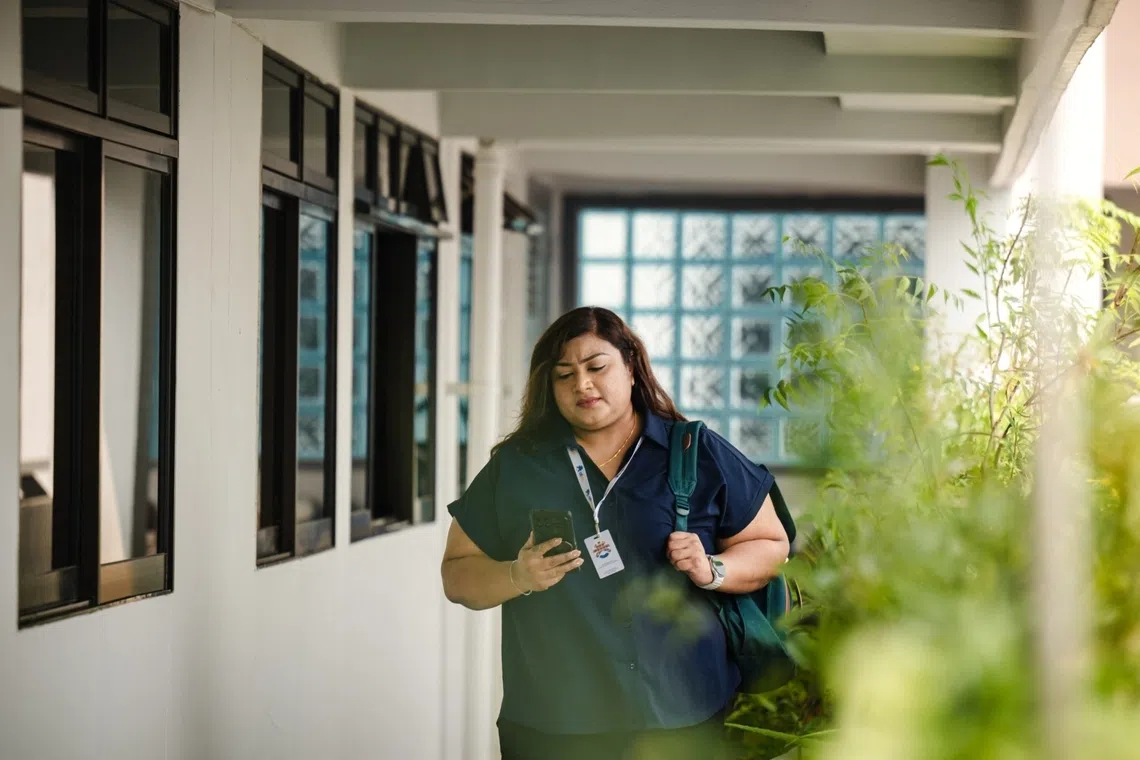
While abuse can be difficult to detect, a new government unit is helping frontline professionals spot signs of risk earlier and reach families before problems escalate.
Allkin Singapore senior social worker Kalajayanthi Jayagomar, 38, makes home visits to understand families’ needs and connect them with timely support
Rachel Chia, Brand Newsroom
Published Oct 04, 2026, 04:00 AM
When senior social worker Kalajayanthi Jayagomar, 38, and her colleague from social service agency Allkin Singapore visited a family’s home in early August, they were following up on an incident. A parent had used harsh physical punishment on their child aged under six.
But what they found was a household grappling with much more.
The parents were overwhelmed with caregiving, faced significant emotional and financial stress, and quarrelled often, Kalajayanthi recalls. There was also a history of spousal violence.
One of them told her that struggling with their child’s behaviour – who Kalajayanthi observed to be restless – had led to the harsh physical punishment, she says.
Their visit had been triggered by an alert from a new Ministry of Social and Family Development (MSF) unit: Sensemaking Alerts for Frontline Engagement and Response (SAFER), which flags information that may require a closer look at a family to assess if they need support. (See box below).
In this case, SAFER drew on data from a police report. The family told Kalajayanthi that the police had conducted checks, she says.
She shared support options with them, including for the child’s behavioural needs.
The parents agreed to a safety plan to prevent repeated family violence, she adds. They would avoid harsh physical punishment on the child, seek counselling, and ensure the child is not exposed to spousal or family conflicts.
An alert from MSF’s new SAFER unit led senior social worker Kalajayanthi Jayagomar to a struggling family – one who had not sought social services’ help before. PHOTO: SAMUEL HE
An alert from MSF’s new SAFER unit led senior social worker Kalajayanthi Jayagomar to a struggling family – one who had not sought social services’ help before.
Kalajayanthi also roped in their extended family members to help keep watch and support the family’s safety and well-being. No further incidents have been reported since, she says.
The case demonstrated the importance of reaching a family early, she says. “There were so many layers of issues, and they may not have sought help,” she says
Without SAFER’s alert, the family – which had never been in touch with social services before – might not have received the support they needed in time, she adds.
Reaching families early
Reaching families early gives social service professionals a chance to match them with the right support before harm deepens, explains Kalajayanthi.
The work involves a qualified professional helping them better understand their own behaviour patterns and the support available, and to “unlearn (the harmful habits) they have learnt”, she says.
How SAFER joins the dots
Rolled out since end-June 2026, the Sensemaking Alerts for Frontline Engagement and Response (SAFER) unit brings together information from different government agencies to give frontline professionals a fuller picture of a family’s situation. This helps them provide the right level of support earlier.
It was set up by the Ministry of Social and Family Development (MSF) after a 2025 review of Singapore’s child protection system, prompted by the death of four-year-old Megan Khung.
In its first two months, SAFER has flagged 70 cases to MSF’s Protective Service (PSV) and Child Protection Case Management Agencies’ case managers to step up or strengthen support for the families involved.
These comprised 68 existing cases updated with new information, a known case escalated to MSF PSV, and a new case referred to a family service centre.
It currently draws on data from MSF, the Singapore Police Force and the Central Narcotics Bureau.
SAFER will initially focus on families with children aged below seven where there are child protection concerns, says MSF.
Left without support for too long, those patterns could become entrenched and harder to undo. Victims, including children who grow up in abusive households, may come to see those harmful habits as normal, she adds, and not recognise them as harm.
But families in need must be found first – and some may suffer in silence.
Victims sometimes hesitate to disclose what is happening because they want to “save face” or fear implicating themselves, she says. Others may not realise they were harmed, Kalajayanthi adds.
Senior social worker Kalajayanthi Jayagomar helps families recognise unhealthy patterns and the support available to them – so they can unlearn any harmful habits. PHOTO: SAMUEL HE
Senior social worker Kalajayanthi Jayagomar helps families recognise unhealthy patterns and the support available to them – so they can unlearn any harmful habits.
While physical abuse can leave visible signs, psychological abuse – from economic control and intimidation to gaslighting and using children as leverage – can be harder to spot.
Detection has traditionally depended on outsiders, such as schools noticing cane marks on a child, she adds.
When more comes to light
To better understand the families they support, social workers typically contact schools, hospitals or community agencies about attendance, behavioural concerns or medical compliance, says Kalajayanthi.
Kalajayanthi says certain agencies require consent from clients before social workers can access certain information. When they refuse, it leaves gaps in what caseworkers know, she adds.
Family service centres (FSCs), or community-based social services that support vulnerable individuals and families with social and emotional issues, also work with community police units on these cases, she adds.
Before SAFER, a caseworker would usually be unaware of a family member’s arrest unless shared by the family, or if circumstances required existing protocols for law enforcement agencies to notify MSF of possible child safety risks.
In this family’s case, MSF’s initial checks with the child’s school did not turn up any signs of family violence. The school had identified behavioural concerns, and referred the child for assessment and support, Kalajayanthi says.
By bringing together relevant information across government agencies, SAFER now helps social workers like Kalajayanthi spot child safety risks that may not be apparent when the information is viewed separately.
But SAFER’s alert is only the starting point. Early intervention also means strengthening a person’s support network, from their own family to the wider community, she says.
Senior social worker Kalajayanthi Jayagomar encourages the wider community to help protect families and individuals. PHOTO: SAMUEL HE
Senior social worker Kalajayanthi Jayagomar encourages the wider community to help protect families and individuals.
“Protecting families is a shared responsibility,” adds Kalajayanthi, who encourages the public to report suspected abuse cases to the authorities.
“When individuals and families are given opportunities to access the right support at the right time, positive change becomes possible.”
National Anti-Violence & Sexual Harassment Helpline: 1800-777-0000 (24 hours) / go.gov.sg/navh (online report)
National helpline: 1771 (24 hours) / 6669-1771 (via WhatsApp)
Samaritans of Singapore: 1-767 (24 hours) / 9151-1767 (24 hours CareText via WhatsApp)
Singapore Association for Mental Health: 1800-283-7019
Silver Ribbon Singapore: 6386-1928
Chat, Centre of Excellence for Youth Mental Health: 6493-6500/1
Women’s Helpline (Aware): 1800-777-5555 (weekdays, 10am to 6pm)
The Seniors Helpline: 1800-555-5555 (weekdays, 9am to 5pm)
Touchline (Counselling): 1800-377-2252
Touch Care Line (for caregivers): 6804-6555
Counselling and Care Centre: 6536-6366
We Care Community Services: 3165-8017
Shan You Counselling Centre: 6741-9293
Clarity Singapore: 6757-7990
chat.mentalhealth.sg
carey.carecorner.org.sg (for those aged 13 to 25)
limitless.sg/talk (for those aged 12 to 25)
Better Starts With Us
Better Starts with Us is the Ministry of Social and Family Development’s (MSF) multi-year effort to build a more caring and inclusive Singapore through the shared “We First” spirit.
MSF works with social service agencies, corporates, institutes of higher learning, volunteers, and the community to pool collective expertise and resources, with the aim of building strong families and resilient individuals.
Find out how MSF, its partners, and you can play a part at go.gov.sg/betterstartswithus
In partnership with the Ministry of Social and Family Development
Ministry of Social and Family Development
虽然虐待行为可能难以发现,但一个新的政府部门正在帮助一线专业人员更早地发现风险迹象,并在问题升级之前接触到相关家庭。
新加坡Allkin高级社工Kalajayanthi Jayagomar(38岁)会进行家访,了解家庭需求,并及时为他们提供帮助。
Rachel Chia,品牌新闻编辑室
发布于 2026 年 10 月 4 日 上午 4:00
38岁的高级社工卡拉贾扬蒂·贾亚戈玛尔和她来自新加坡社会服务机构Allkin Singapore的同事在8月初走访了一户人家,调查一起事件。一位家长对他们六岁以下的孩子使用了严厉的体罚。
但他们发现,这个家庭面临的问题远不止这些。
卡拉贾扬蒂回忆说,这对父母不堪重负,承受着巨大的情感和经济压力,而且经常争吵。此外,他们还有配偶暴力史。
卡拉贾扬蒂说,其中一位家长告诉她,由于孩子行为不端(卡拉贾扬蒂观察到孩子很烦躁不安),家长们不得不对孩子进行严厉的体罚。
他们的此次访问是由社会及家庭发展部(MSF)新成立的一个部门发出的警报引发的:一线参与和响应意义构建警报(SAFER),该部门会标记一些信息,这些信息可能需要对某个家庭进行更深入的了解,以评估他们是否需要支持。(见下方方框)。
在这种情况下,SAFER 参考了警方报告中的数据。卡拉贾扬蒂说,家属告诉她,警方已经进行过调查。
她与他们分享了各种支持方案,包括针对孩子行为需求的方案。
她补充说,父母同意制定一项安全计划,以防止家庭暴力再次发生。他们将避免对孩子进行严厉的体罚,寻求心理咨询,并确保孩子不会接触到夫妻或家庭冲突。
无国界医生组织新成立的SAFER小组发出警报,高级社工卡拉贾扬蒂·贾亚戈玛尔(Kalajayanthi Jayagomar)因此了解到一户生活困难的家庭——此前他们从未寻求过社会服务的帮助。照片:塞缪尔·赫(SAMUEL HE)
无国界医生组织新成立的 SAFER 部门发出警报,高级社会工作者 Kalajayanthi Jayagomar 便联系上了一个陷入困境的家庭——这个家庭以前从未寻求过社会服务的帮助。
卡拉贾扬蒂还动员了其他家庭成员帮忙照看,以确保家人的安全和福祉。她说,此后未再发生任何意外事件。
她说,这个案例表明及早接触到受害者家庭的重要性。“这其中牵涉到很多层面的问题,他们可能根本不会寻求帮助。”
她补充说,如果没有 SAFER 的提醒,这个以前从未与社会服务机构接触过的家庭可能无法及时获得他们需要的支持。
尽早接触家庭
卡拉贾扬蒂解释说,及早接触到这些家庭可以让社会服务专业人员有机会在伤害加深之前为他们匹配合适的帮助。
这项工作包括由合格的专业人员帮助他们更好地了解自己的行为模式和可获得的帮助,并“改掉(他们已经养成的)有害习惯”,她说。
SAFER 如何将这些点连接起来
自2026年6月底推出以来,“一线人员参与和响应信息预警系统”(SAFER)整合了来自不同政府机构的信息,使一线专业人员能够更全面地了解家庭情况,从而帮助他们更早地提供恰当的支持。
该机构由社会及家庭发展部 (MSF) 设立,此前新加坡政府对儿童保护系统进行了审查,审查于 2025 年进行,起因是四岁女童 Megan Khung 的死亡。
在成立的头两个月里,SAFER 已向无国界医生组织保护服务机构 (PSV) 和儿童保护个案管理机构的个案管理人员报告了 70 个案例,要求他们加强或加大对相关家庭的支持力度。
其中包括 68 个更新了新信息的现有案例、一个升级为 MSF PSV 的已知案例,以及一个转介至家庭服务中心的新案例。
目前,该机构的数据来源于新加坡无国界医生组织、新加坡警察部队和中央肃毒局。
无国界医生组织表示,SAFER项目初期将重点关注有7岁以下儿童且存在儿童保护问题的家庭。
如果长期得不到支持,这些模式可能会根深蒂固,难以改变。她补充说,受害者,包括在虐待家庭中长大的孩子,可能会把这些有害习惯视为正常现象,而意识不到它们是伤害。
但首先必须找到有需要的家庭——有些家庭可能会默默承受痛苦。
卡拉贾扬蒂说,受害者有时会因为想要“保住面子”或害怕牵连自己而犹豫是否要透露真相。她还补充说,有些人可能根本没有意识到自己受到了伤害。
资深社工卡拉贾扬蒂·贾亚戈玛尔帮助家庭识别不健康的生活模式以及可获得的帮助,以便他们能够改掉任何有害的习惯。照片:塞缪尔·赫
资深社会工作者 Kalajayanthi Jayagomar 帮助家庭认识不健康的模式以及他们可以获得的帮助——以便他们能够改掉任何有害的习惯。
虽然身体虐待会留下明显的痕迹,但心理虐待——从经济控制和恐吓到煤气灯效应和利用孩子作为筹码——可能更难被发现。
她补充说,传统上,发现藤条伤痕主要依靠外部人员,例如学校注意到孩子身上的藤条痕迹。
当更多真相大白时
卡拉贾扬蒂表示,为了更好地了解他们所支持的家庭,社会工作者通常会联系学校、医院或社区机构,了解出勤率、行为问题或医疗依从性。
卡拉贾扬蒂表示,某些机构要求社工在获取某些信息前必须征得客户的同意。她补充说,如果客户拒绝,就会导致社工掌握的信息出现空白。
她补充说,家庭服务中心(FSC)或以社区为基础的社会服务机构,为有社会和情感问题的弱势个人和家庭提供支持,也会与社区警察部门合作处理这些案件。
在 SAFER 实施之前,除非家庭成员告知,或者根据现有协议要求执法机构将可能的儿童安全风险通知无国界医生组织,否则社工通常不会知道家庭成员被捕的情况。
卡拉贾扬蒂表示,在这个家庭的案例中,无国界医生组织最初与孩子所在学校的核实并未发现任何家庭暴力迹象。学校发现了一些行为问题,并将孩子转介至相关机构进行评估和支持。
SAFER 通过整合各政府机构的相关信息,帮助像 Kalajayanthi 这样的社会工作者发现单独查看信息时可能不明显的儿童安全风险。
但SAFER的预警仅仅是开始。她表示,早期干预还意味着加强个人的支持网络,从他们的家庭到更广泛的社区。
资深社工卡拉贾扬蒂·贾亚戈玛尔鼓励广大社区成员帮助保护家庭和个人。照片:塞缪尔·赫
资深社会工作者 Kalajayanthi Jayagomar 鼓励广大社区成员帮助保护家庭和个人。
“保护家庭是每个人的共同责任,”Kalajayanthi补充道,她鼓励公众向当局举报疑似虐待案件。
“当个人和家庭有机会在合适的时间获得合适的帮助时,积极的改变就成为可能。”
全国反暴力和性骚扰热线:1800-777-0000(24小时)/ go.gov.sg/navh(在线举报)
全国求助热线:1771(24小时)/ 6669-1771(通过WhatsApp)
新加坡撒玛利亚会:1-767(24小时)/ 9151-1767(24小时通过WhatsApp发送短信)
新加坡心理健康协会:1800-283-7019
新加坡银丝带:6386-1928
聊天,青少年心理健康卓越中心:6493-6500/1
妇女帮助热线(Aware):1800-777-5555(工作日,上午10点至下午6点)
长者热线:1800-555-5555(工作日,上午9点至下午5点)
咨询热线:1800-377-2252
关爱热线(面向护理人员):6804-6555
咨询关怀中心:6536-6366
我们关爱社区服务:3165-8017
山友辅导中心:6741-9293
新加坡 Clarity:6757-7990
chat.mentalhealth.sg
carey.carecorner.org.sg(面向13至25岁人群)
limitless.sg/talk(面向12至25岁人群)
美好生活从我们开始
“美好从我们开始”是新加坡社会及家庭发展部(MSF)一项为期多年的计划,旨在通过共同的“我们优先”精神,建设一个更加关爱和包容的新加坡。
无国界医生与社会服务机构、企业、高等学府、志愿者和社区合作,汇集集体的专业知识和资源,旨在建立强大的家庭和具有韧性的个人。
了解无国界医生组织、其合作伙伴以及您如何参与其中,请访问 go.gov.sg/betterstartswithus
与社会和家庭发展部合作
社会及家庭发展部