Angler’s Pokedex: Youth build free app to help identify and log Singapore’s fish钓鱼宝可梦图鉴:年轻人开发免费应用程序,帮助识别和记录新加坡的鱼类
It includes a pop-up feature that alerts users on what to do if a scanned fish is a protected, rare or harmful species. Read more at straitstimes.com.
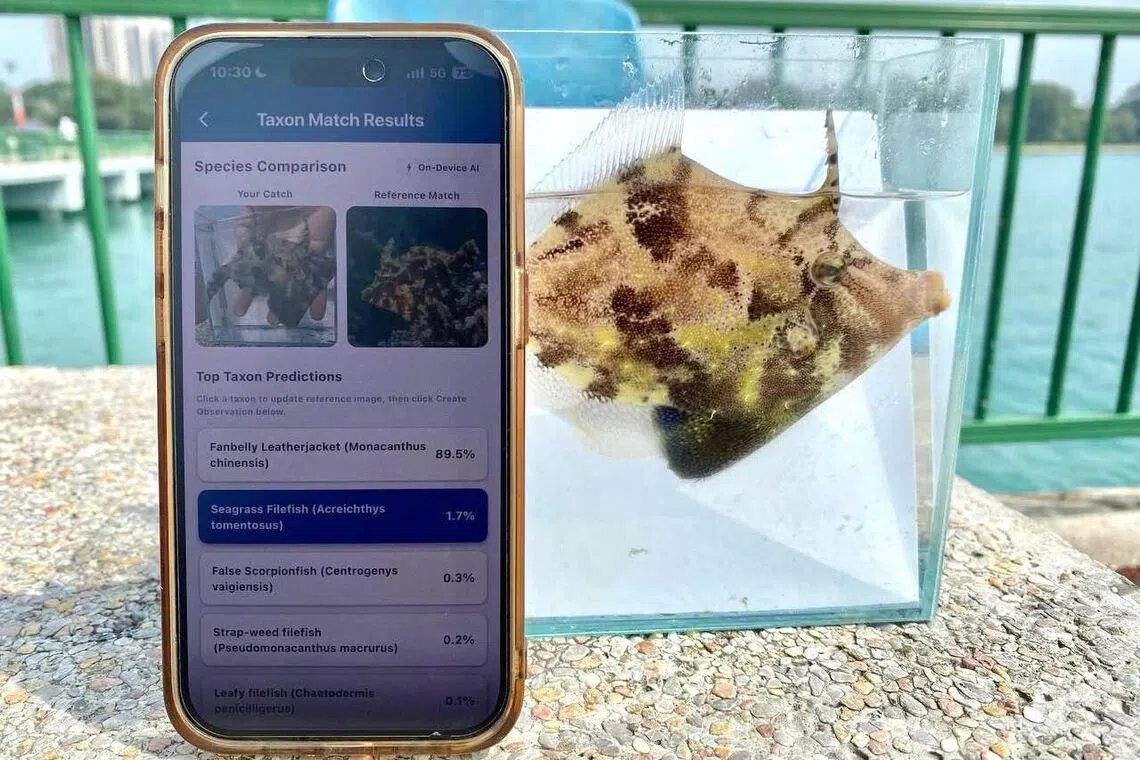
The SGFish app built by Ichthyological Society of Singapore volunteers.
Published Oct 04, 2026, 05:00 AM
Updated Oct 04, 2026, 05:00 AM
Enthusiasts developed SGFish, a free app that identifies over 900 fish species in Singapore using image recognition with 82.7% accuracy to anglers identify what they find.
The app includes features like offline identification, tide data, a fish encyclopedia, and alerts for protected or harmful species.
Citizen science data from anglers aids fish population monitoring in murky waters.
SINGAPORE - Despite its busy straits, Singapore’s position near one of the world’s most biodiverse marine areas has allowed it to yield a surprising variety of fishes, though their significance is occasionally lost on those who catch them.
Such was the case at Bedok Jetty in August , when an angler mistook a globally endangered zonetail butterfly ray ( Gymnura zonura ) for the average stingray. The butterfly ray is distinguished by its wide, triangular body and short tail, compared with the rounder body and long tail of more common stingrays .
Fellow fishing enthusiast Brian Sng, a Singapore Management University software engineering student, quickly realised the value of the catch from the photo he was shown, and informed the angler of his rare find .
To avoid these cases of mistaken identities, Sng, 21, and a group of fellow enthusiasts interested in the scientific study of fish built a free mobile app to help people identify the fishes that live in Singapore’s murky waters.
On Sept 17, the Ichthyological Society of S ingapore (ISS) , which has more than 150 members, launched SGFish on the Apple App Store. The app can identify more than 900 species using an image recognition model.
Users snap a photograph of their catch via the app, and the program will identify the species. It will also log down where each find was made.
To maintain scientific integrity, volunteers and co-founders of the society will manually verify all submitted records before they are officially logged into a database.
Currently , the database has about 2,300 observations covering more than 400 species. Before the launch of the app, this database was compiled using a Telegram bot built by volunteer and fellow app developer Samuel Pua, a 36-year-old cybersecurity professional.
The bot was dubbed Angler’s Pokedex, a reference to the portable electronic encyclopaedia from hit franchise Pokemon that is used to identify and record new monsters encountered.
Pua said the team decided to develop the app partly because time and location details could not be extracted from images submitted on Telegram, making it difficult to pinpoint data accurately.
To build the app’s computer vision model, Sng, who is the lead developer of the mobile app, collated and vetted more than 90,000 photos of fish species found near Singapore and neighbouring waters. These were sourced from international databases, society members and his own photos.
It took two months to train the model with his dataset until it reached an 82.7% accuracy rate, said Sng, who was working on this while studying. He noted that it is more accurate than the model created by the US-based flora and fauna database iNaturalist, which has an accuracy rate of about 80% for fish across the world .
Novice anglers can sometimes mistake dangerous fish for harmless ones or lack awareness of sustainable fishing practices, the developers told The Straits Times.
This prompted them to include a pop-up feature that alerts users on what to do if a scanned fish is a protected, rare or harmful species. For example, if an endangered fish is caught, users are advised to release it.
To minimise the risk of incorrect identifications, the app shows th e top five predictions of the scanned fish’s identity, ranked according to how similar they are to the specimen. Users then finalise the identity of species by selecting one of the options.
For convenience in the field, the app uses a lightweight offline model for quick identifications when mobile connections are spotty, alongside a more accurate online version.
To reel recreational anglers in, the app also includes tide data to indicate the best times to go fishing. A fish encyclopaedia was also included, added fellow developer Guan Chen Di, a 22-year-old computer science student at Nanyang Technological University.
“One of the most complex hurdles we faced was how to maximise and condense a variety of information onto a tiny phone screen,” he said, adding that the team figured out how to seamlessly fit the image, species and catch method into a single view.
The app can identify more than 900 species using an image recognition model. PHOTO: BRIAN SNG
The app can identify more than 900 species using an image recognition model.
In future updates, the developers hope to make the app available on the Google Play Store and incorporate the initial Telegram bot’s popular gamification elements, such as a high-score board that recognises users who record the highest diversity of unique species.
Fish biologist Jeffrey Kwik said citizen science initiatives like the SGFish app can help supplement fish surveys involving diving or snorkelling, which rely heavily on good water visibility.
Spotting and counting fish populations visually in Singapore is particularly challenging owing to the Republic’s murky waters.
“This is exacerbated for well-camouflaged species or species that find refuge in associated marine habitats like seagrass and corals, which are even harder to spot,” said the associate professor at the Singapore Institute of Technology.
Records from anglers are particularly useful for covering large survey areas, Kwik added, as gathering detailed, wide-ranging data through official surveys requires significant resources.
Even with potential biases from hook sizes or bait types, data from anglers is useful for supplementing species lists and tracking the distribution of fish, he said.
As the community logs more observations, ISS co-founder Andriel Cheong hopes the database built from these records can inform environmental impact assessments, giving the authorities a clearer picture of marine biodiversity when planning coastal developments.
Beyond recreational fishing and divers, the team hopes the public will use the app to learn about fishes.
“We encourage the average person to test it out on everyday sightings of fish, such as those you see in the market, just to learn more about the varieties of fish that can be found in our local markets,” said Cheong, noting that this could promote more conscious consumption of seafood.
The app joins a growing list of community-led wildlife databases in Singapore.
In 2021, for instance, a group of seasoned birders and scientists was formed to review records of species rarely encountered in Singapore and made such sightings available in the Singapore Bird Database.
Technology and research
SGFish应用程序由新加坡鱼类学会的志愿者开发。
发布于 2026 年 10 月 4 日上午 5:00
更新于2026年10月4日上午5:00
爱好者们开发了 SGFish,这是一款免费应用程序,它使用图像识别技术识别新加坡 900 多种鱼类,准确率高达 82.7%,可以帮助垂钓者识别他们钓到的鱼。
该应用程序包含离线识别、潮汐数据、鱼类百科全书以及受保护或有害物种警报等功能。
来自垂钓者的公民科学数据有助于监测浑浊水域中的鱼类种群数量。
新加坡——尽管海峡繁忙,但新加坡靠近世界上生物多样性最丰富的海洋区域之一,因此盛产种类繁多的鱼类,尽管捕捞它们的人有时会忽略它们的重要性。
今年8月在勿洛码头就发生了这样一件事,一位垂钓者将一种全球濒危的带尾蝴蝶鳐(Gymnura zonura)误认为是普通的魟鱼。蝴蝶鳐的身体宽阔呈三角形,尾巴较短,而常见的魟鱼身体较圆,尾巴较长。
同为钓鱼爱好者的 Brian Sng 是新加坡管理大学软件工程系的学生,他从照片中很快意识到这条鱼的价值,并告知了这位垂钓者他有多么幸运。
为了避免这些身份误认的情况,21 岁的 Sng 和一群对鱼类科学研究感兴趣的爱好者开发了一款免费的手机应用程序,以帮助人们识别生活在新加坡浑浊水域中的鱼类。
9月17日,拥有150多名会员的新加坡鱼类学会(ISS)在苹果应用商店推出了SGFish应用程序。该应用程序利用图像识别模型,可以识别900多种鱼类。
用户通过应用程序拍摄渔获物的照片,程序即可识别物种,并记录每次发现渔获物的地点。
为了维护科学的完整性,该协会的志愿者和联合创始人将手动核实所有提交的记录,然后才会正式将其录入数据库。
目前,该数据库包含约 2300 条观测数据,涵盖 400 多个物种。在应用程序发布之前,该数据库是由志愿者兼应用程序开发者 Samuel Pua(一位 36 岁的网络安全专家)使用 Telegram 机器人构建的。
该机器人被命名为“垂钓者的宝可梦图鉴”,这是对热门系列游戏《宝可梦》中用于识别和记录新遇到的怪物的便携式电子百科全书的致敬。
Pua表示,团队决定开发这款应用程序的部分原因是,无法从Telegram上提交的图片中提取时间和位置详细信息,这使得准确定位数据变得困难。
为了构建该应用程序的计算机视觉模型,作为该移动应用程序的主要开发人员,Sng收集并审核了超过9万张在新加坡及其邻近水域发现的鱼类照片。这些照片来源于国际数据库、学会成员以及他自己的拍摄作品。
Sng表示,他花了两个月时间用自己的数据集训练模型,最终准确率达到了82.7%。他当时还在读书,同时也在研究这个模型。他指出,这个模型比美国动植物数据库iNaturalist创建的模型更准确,后者对全球鱼类的准确率约为80%。
开发商告诉《海峡时报》,新手垂钓者有时会将危险的鱼误认为无害的鱼,或者缺乏对可持续捕鱼方式的认识。
这促使他们添加了一个弹出窗口功能,提醒用户如果扫描到的鱼类是受保护物种、稀有物种或有害物种应该怎么做。例如,如果捕获到濒危鱼类,建议用户将其放生。
为了最大限度地降低误判风险,该应用程序会显示扫描鱼类物种的五个最佳预测结果,并根据它们与标本的相似度进行排序。用户随后通过选择其中一个选项来最终确定物种身份。
为了方便现场使用,该应用程序采用轻量级的离线模型,以便在移动网络连接不稳定时快速识别,同时还提供更准确的在线版本。
为了吸引休闲垂钓者,这款应用还加入了潮汐数据,指示最佳垂钓时间。此外,该应用还内置了鱼类百科全书,另一位开发者、22岁的南洋理工大学计算机科学系学生关晨迪补充道。
他说:“我们面临的最复杂的障碍之一是如何最大限度地将各种信息浓缩到小小的手机屏幕上。”他还补充说,团队已经找到了将图像、物种和捕获方法无缝地融入单个视图的方法。
这款应用利用图像识别模型,可以识别超过900种物种。照片:布莱恩·斯恩
该应用程序使用图像识别模型可以识别 900 多种物种。
开发者希望在未来的更新中,将该应用程序上架 Google Play 商店,并融入最初 Telegram 机器人的流行游戏化元素,例如高分榜,以表彰记录了最多样化独特物种的用户。
鱼类生物学家杰弗里·奎克表示,像 SGFish 应用程序这样的公民科学计划可以帮助补充涉及潜水或浮潜的鱼类调查,这些调查很大程度上依赖于良好的水体能见度。
由于新加坡水域浑浊,用肉眼观察和统计鱼类数量尤其具有挑战性。
“对于伪装能力强的物种或在海草和珊瑚等相关海洋栖息地中寻找庇护的物种来说,这种情况会更加严重,因为这些物种更难被发现,”新加坡理工大学的副教授说。
Kwik补充说,垂钓者的记录对于覆盖大范围调查区域尤其有用,因为通过官方调查收集详细、广泛的数据需要大量资源。
他表示,即使鱼钩大小或鱼饵类型可能存在偏差,垂钓者提供的数据对于补充物种名录和追踪鱼类分布仍然很有用。
随着社区记录更多观测数据,ISS 联合创始人 Andriel Cheong 希望根据这些记录建立的数据库能够为环境影响评估提供信息,使当局在规划沿海开发时能够更清楚地了解海洋生物多样性。
除了休闲垂钓者和潜水员之外,该团队还希望公众能够使用这款应用程序来了解鱼类。
“我们鼓励普通民众在日常生活中遇到的鱼类,例如市场上常见的鱼类,进行测试,以便更多地了解我们当地市场上可以找到的鱼类品种,”张先生说,并指出这可以促进人们更加有意识地消费海鲜。
该应用程序加入了新加坡日益增多的社区主导型野生动物数据库行列。
例如,2021 年,一群经验丰富的观鸟者和科学家组成了一个小组,审查在新加坡很少见到的物种的记录,并将这些目击记录发布在新加坡鸟类数据库中。
技术与研究