‘Why me? Did I cause it?’: Sex assault survivors on grappling with abuse by family members“为什么是我?是我造成的吗?”:性侵幸存者讲述如何应对家庭成员的虐待
Sex assault cases by family members in Singapore have risen, with victims facing abuse, self-blame, and challenges in reporting and recovery. Read more at straitstimes.com.
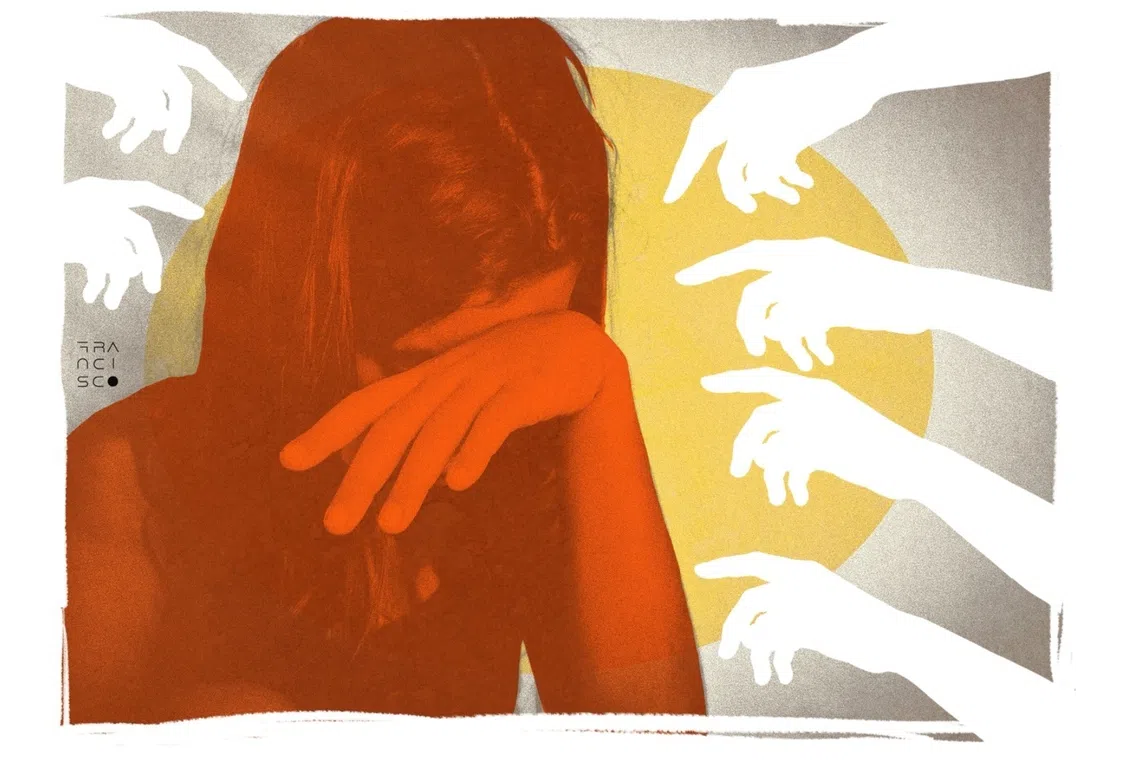
The police said in most rape and molestation cases, the offenders and victims knew each other.
ST ILLUSTRATION: MANNY FRANCISCO
Published Oct 04, 2026, 05:00 AM
Updated Oct 04, 2026, 05:00 AM
Sexual abuse by family members often starts with grooming, leaving victims confused and blaming themselves for the assaults.
Rape and sexual assault cases in Singapore have increased, with many victims under 16 and offenders usually known to them.
Counsellors stress the importance of support systems in victims' recovery.
SINGAPORE – When male family members asked their female relatives to give them massages, the girls felt uncomfortable and declined.
The men would persist, and question if the girls loved them, until they relented. But, for some, one massage would lead to sexual abuse that lasted for years.
Advocacy group AWARE said victims who attended therapy sessions asked why the abuse happened, what they could have done differently to prevent it, and if they had done anything to bring about the assaults.
According to the police’s mid-year crime brief released on Aug 24 , the number of rape cases rose from 230 in the first half of 2025 to 261 in the first half of 2026.
National Mindline: 1771 (24 hours) / 6669-1771 (via WhatsApp)
Samaritans of Singapore: 1-767 (24 hours) / 9151-1767 (24 hours CareText via WhatsApp)
Singapore Association for Mental Health: 1800-283-7019
Silver Ribbon Singapore: 6386-1928
Chat, Centre of Excellence for Youth Mental Health: 6493-6500/1
Women’s Helpline (AWARE): 1800-777-5555 (weekdays, 10am to 6pm)
The Seniors Helpline: 1800-555-5555 (weekdays, 9am to 5pm)
Tinkle Friend (for primary school-age children): 1800-2744-788
Mindfull Community HQ (for caregivers, families and persons in recovery): 6460-4400 (weekdays, 9am to 5pm)
Touchline (Counselling): 1800-377-2252
Touch Care Line (for caregivers): 6804-6555
Counselling and Care Centre: 6536-6366
We Care Community Services: 3165-8017
Shan You Counselling Centre: 6741-9293
Clarity Singapore: 6757-7990
Care Corner Counselling Centre: 6353-1180
chat.mentalhealth.sg
carey.carecorner.org.sg (for those aged 13 to 25)
limitless.sg/talk (for those aged 12 to 25)
In April, The Straits Times reported there were more sexual assault cases involving victims under the age of 16 in 2025, according to police figures. It rose from 943 cases in 2024 to 1,031 cases in 2025. There were 998 cases in 2023.
The number of sexual assault cases allegedly committed by family members or relatives involving victims below 16 also increased, from 169 cases in 2023, to 184 cases in 2024, to 192 cases in 2025.
On victims questioning their reactions to the assaults, Ruth Ng, the principal social worker at AWARE’s Sexual Assault Care Centre, said self-blaming behaviour is due to a coercive control dynamic in the relationship. She said it is a repeated pattern of abusive behaviour that makes someone feel afraid, controls their choices, and takes away their freedom and independence over time.
In such relationships, the abuser usually cuts the victim off from their friends, family and other forms of support after gaining everyone’s trust. This leaves the victim with no choice but to obey the abuser’s instructions.
Ng said: “This trust gets access in a way that keeps the victims silent about the assault.”
One of the worst predators was dealt with recently.
On Sept 17, the 71-year-old man was sentenced to 21 years’ jail for sexually abusing 11 girls over 30 years . His victims included his daughter, his son’s two daughters and his four nieces – with some as young as five years old.
Ng , who has 19 years’ experience in the industry, said in such coercive controlling relationships, grooming usually takes place first.
She noted: “Providing love and affection from an adult to a younger person, like buying gifts, is nothing wrong. Grooming involves predatory behaviour with a negative intent to gain access for abuse to happen in secrecy.”
This is why the victims unknowingly endure the abuse for a longer period of time, simply because they are not aware what inappropriate touching is, and that it is wrong, she added. Said Ng: “The abuse can happen to people in their 20s, 30s and 40s. Anyone can be trapped in a relationship that has abusive dynamics because the perpetrators are usually skilled at what they are doing. It is premeditated.”
John Shepherd Lim, Singapore Counselling Centre’s chief well-being officer, said that when reporting a crime, there are other elements to consider, like betrayal, lost trust, self-blame, shame and confusion.
“The victim may still see the perpetrator, if it is a family member, partner, colleague or someone in the same social circle, so safety is not as simple as staying away.
“They may think, ‘I trusted him’, ‘maybe I misunderstood’ or ‘people will think I consented because I knew him’. That can delay disclosure and recovery.”
Counsellors said being abused by family members can affect their attitudes towards relationships, could cause them to isolate themselves from others, and experience post-traumatic stress disorder symptoms.
Victims also worry that nobody will believe them.
Clinical psychologist Carol Balhetchet said if their claims are not believed, victims will feel like the incident is being minimised, and it will hit like a second betrayal. This will delay the process of reporting the crime or getting help.
She said this could make it very difficult for the victim to trust others, including family members, as they face conflicting emotions wavering between anger, hate, fear, love, guilt and self-blame.
Ng recounted an incident when a victim told her mother that her brother was abusing her. But instead of reporting the crime, the mother forgave him for religious reasons . Her children were minors.
Said Ng: “The denial of the harm is very impactful. Some victims say when they are not believed, it feels worse than the crime itself.”
After the case is reported to the authorities comes the long road to recovery. Ng said since the perpetrators have very likely stripped them of their self-worth, AWARE then works with the victims to restore normalcy in their lives, like resuming school or routines.
For younger victims, it is important to work with immediate carers, relatives and friends to ensure they have an existing support system where the victim feels safe.
Annabelle Chow, principal clinical psychologist at Annabelle Psychology, noted that trauma-informed care services, helplines and resources to support victims have risen over the years. But for those who do not have reliable support, counsellors said witnesses like relatives, neighbours, classmates, teachers and friends play a critical role in breaking up the cycle of abuse.
Chow urged witnesses to not remain silent and report assaults to the police.
She said those helping should ensure that the victims are not in immediate danger and refrain from interrogation, confrontation or force them to take action. Instead, witnesses should offer choices, help them understand available options and respect what the victims are ready to do.
But Ng said some victims are more vocal and will turn to group therapy or social media to express their feelings and help fellow survivors.
She said: “They also want to understand the legal process in the judicial system, so they can seek some justice for themselves and tell their stories. That step is them regaining their sense of control.”
Fatimah Mujibah is a journalist at The Straits Times covering crime-related stories.
Counsellors/Psychologists
Behaviour/Psychology
警方表示,在大多数强奸和性骚扰案件中,犯罪者和受害者彼此认识。
插图:曼尼·弗朗西斯科
发布于 2026 年 10 月 4 日上午 5:00
更新于2026年10月4日上午5:00
家庭成员之间的性虐待往往始于诱导,这会让受害者感到困惑,并责怪自己没有对受害者进行性侵犯。
新加坡的强奸和性侵犯案件有所增加,许多受害者未满 16 岁,而施暴者通常是她们认识的人。
咨询师强调支持系统对受害者康复的重要性。
新加坡——当男性家庭成员要求女性亲戚为他们按摩时,女孩们感到不自在,并拒绝了。
这些男人会锲而不舍,质问女孩们是否爱他们,直到她们屈服为止。但对某些女孩来说,一次按摩却会导致长达数年的性虐待。
倡导组织 AWARE 表示,参加治疗课程的受害者会询问虐待发生的原因、他们本可以采取哪些不同的措施来防止虐待发生,以及他们是否做了什么导致了袭击的发生。
根据警方8月24日发布的年中犯罪简报,强奸案数量从2025年上半年的230起上升到2026年上半年的261起。
全国热线:1771(24 小时)/6669-1771(通过 WhatsApp)
新加坡撒玛利亚会:1-767(24小时)/ 9151-1767(24小时通过WhatsApp发送短信)
新加坡心理健康协会:1800-283-7019
新加坡银丝带:6386-1928
聊天,青少年心理健康卓越中心:6493-6500/1
妇女帮助热线(AWARE):1800-777-5555(工作日,上午10点至下午6点)
长者热线:1800-555-5555(工作日,上午9点至下午5点)
Tinkle Friend(面向小学生):1800-2744-788
正念社区总部(面向照顾者、家属和康复人士):6460-4400(工作日,上午 9 点至下午 5 点)
咨询热线:1800-377-2252
关爱热线(面向护理人员):6804-6555
咨询关怀中心:6536-6366
我们关爱社区服务:3165-8017
山友辅导中心:6741-9293
新加坡 Clarity:6757-7990
关爱角落咨询中心:6353-1180
chat.mentalhealth.sg
carey.carecorner.org.sg(面向13至25岁人群)
limitless.sg/talk(面向12至25岁人群)
《海峡时报》4月份报道称,根据警方数据,2025年涉及16岁以下受害者的性侵案件数量将有所增加。案件数量从2024年的943起上升到2025年的1031起。2023年则有998起案件。
据称,家庭成员或亲属对 16 岁以下受害者实施的性侵犯案件数量也有所增加,从 2023 年的 169 起增加到 2024 年的 184 起,再到 2025 年的 192 起。
针对受害者质疑自己对性侵事件的反应,AWARE性侵关怀中心首席社工Ruth Ng表示,这种自责行为源于关系中存在的胁迫控制模式。她指出,这种反复出现的虐待行为模式会使受害者感到恐惧,控制他们的选择,并随着时间的推移剥夺他们的自由和独立。
在这种关系中,施虐者通常会在取得所有人的信任后,切断受害者与朋友、家人和其他支持渠道的联系。这使得受害者别无选择,只能服从施虐者的指示。
吴说:“这种信任能够以某种方式获取信息,让受害者对性侵犯保持沉默。”
最近,最凶残的捕食者之一被消灭了。
9月17日,一名71岁的男子因在30多年间性侵11名女孩而被判处21年监禁。他的受害者包括他的女儿、他儿子的两个女儿和他的四个侄女——其中一些年仅5岁。
拥有19年行业经验的吴女士表示,在这种胁迫控制关系中,通常是先进行诱导。
她指出:“成年人对未成年人表达爱意和关怀,比如送礼物,并没有错。而诱骗未成年人则涉及带有恶意、企图接近未成年人并秘密实施虐待的掠夺性行为。”
她补充说,这就是为什么受害者会在不知不觉中忍受更长时间的虐待,仅仅是因为他们没有意识到什么是不恰当的触摸,以及这种行为是错误的。吴女士说:“这种虐待可能发生在20多岁、30多岁甚至40多岁的人身上。任何人都有可能陷入一段充满虐待的关系中,因为施虐者通常都很擅长此道。这是预谋的。”
新加坡辅导中心首席福利官林约翰·谢泼德表示,在举报犯罪时,还有其他因素需要考虑,例如背叛、失去信任、自责、羞耻和困惑。
“如果施害者是家庭成员、伴侣、同事或同一社交圈内的人,受害者可能仍然会见到施害者,因此,安全并非仅仅是远离施害者那么简单。
“他们可能会想,‘我信任他’,‘也许我误会了’,或者‘人们会认为我同意是因为我认识他’。这可能会延误披露和康复。”
咨询师表示,遭受家庭成员虐待会影响他们对人际关系的态度,可能导致他们把自己与他人隔离,并出现创伤后应激障碍症状。
受害者还担心没有人会相信他们。
临床心理学家卡罗尔·巴尔赫切特表示,如果受害者的陈述不被相信,他们会觉得事件被轻描淡写,这会让他们感到如同遭受了第二次背叛。这将延误他们报案或寻求帮助的进程。
她说,这可能会让受害者很难信任他人,包括家人,因为他们会面临愤怒、仇恨、恐惧、爱、内疚和自责等相互矛盾的情绪。
吴女士讲述了一个案例:一名受害者告诉母亲,她的哥哥虐待她。但这位母亲没有报警,而是出于宗教原因原谅了他。她的孩子当时都未成年。
吴女士说:“否认伤害的影响非常大。一些受害者表示,当他们不被相信时,感觉比犯罪本身还要糟糕。”
案件报案后,受害者将面临漫长的康复之路。吴女士表示,由于施暴者很可能已经剥夺了受害者的自尊,AWARE会与受害者合作,帮助他们恢复正常生活,例如重返校园或恢复日常作息。
对于年龄较小的受害者来说,重要的是与直接照护者、亲戚和朋友合作,确保他们拥有一个让受害者感到安全的现有支持系统。
安娜贝尔心理诊所的首席临床心理学家周安娜贝尔指出,近年来,创伤知情护理服务、求助热线和支持受害者的资源有所增加。但咨询师表示,对于那些缺乏可靠支持的人来说,亲属、邻居、同学、老师和朋友等证人在打破虐待循环中发挥着至关重要的作用。
周先生呼吁目击者不要保持沉默,应向警方举报袭击事件。
她表示,提供帮助的人员应确保受害者不会立即处于危险之中,并避免审问、对抗或强迫他们采取行动。相反,目击者应该提供选择,帮助他们了解可行的方案,并尊重受害者愿意采取的行动。
但吴女士表示,有些受害者更愿意表达自己的感受,他们会通过团体治疗或社交媒体来表达自己的感受,并帮助其他幸存者。
她说:“他们也想了解司法系统的法律程序,这样他们才能为自己伸张正义,讲述自己的遭遇。这一步是他们重新获得掌控感的一步。”
Fatimah Mujibah 是《海峡时报》的一名记者,主要报道犯罪相关新闻。
咨询师/心理学家
行为学/心理学