Meet a 25-year-old third-generation zookeeper whose family has worked at the zoo since it opened 53 years ago来认识一下这位25岁的第三代动物园管理员,他的家族自53年前动物园开园以来就一直在这里工作。
Her grandfather joined Singapore Zoo when it opened in 1973. Her father followed suit at Night Safari in 1994. Now, Rutraajni Gurusamy Kaunder is making her own mark at River Wonders, caring for more than 200 animals.
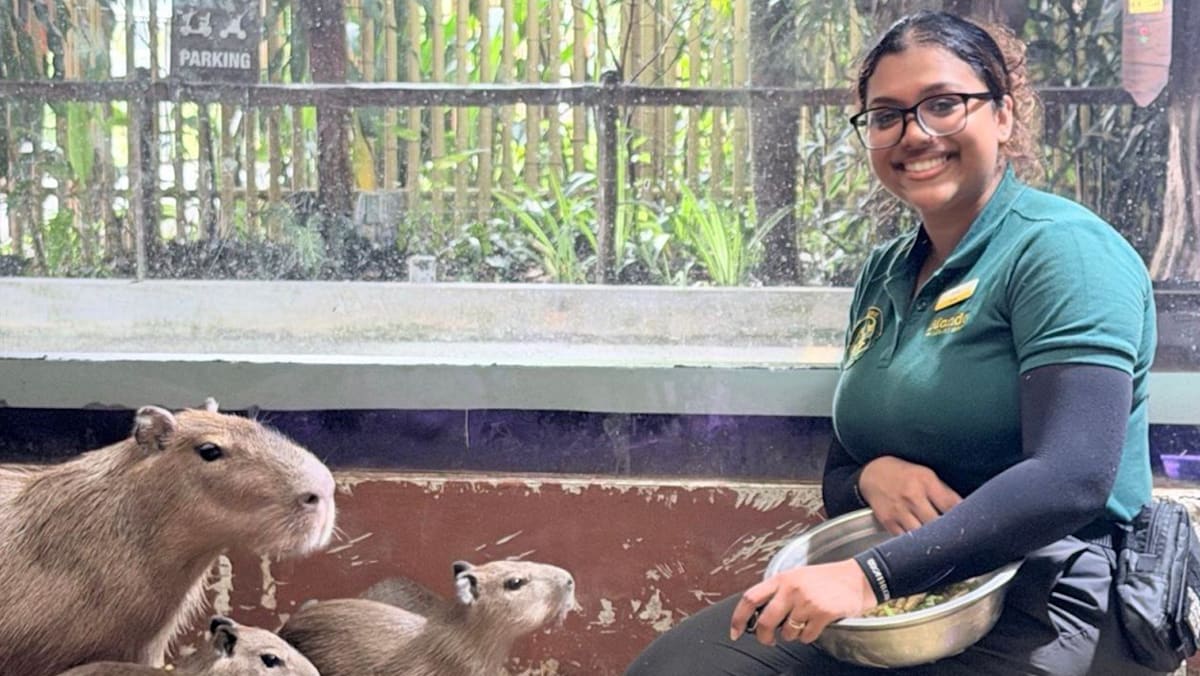
Her grandfather joined Singapore Zoo when it opened in 1973. Her father followed suit at Night Safari in 1994. Now, Rutraajni Gurusamy Kaunder is making her own mark at River Wonders, caring for more than 200 animals.
A third-generation zookeeper, Rutraajni Gurusamy Kaunder was inspired by her father to love animals, and he in turn was inspired by his dad. (Photos: Mandai Wildlife Group; Annie Tan)
This audio is generated by an AI tool.
“If you don’t study hard, you will become a zookeeper.” That was what Rutraajni Gurusamy Kaunder’s teachers used to warn her.
“In those days, people thought zookeepers cleaned faeces all day,” Rutraajni laughed.
So imagine the awkwardness when her teachers found out that Rutraajni’s father was a zookeeper.
Nonetheless, they insisted: “You can do better than being a zookeeper.”
They didn’t know the half of it.
The 25-year-old comes from a family of zookeepers spanning two generations. Her grandfather G Permalo C Gomsamy joined the Singapore Zoo the year it opened, in 1973, while her father Gurusamy Permalo joined Night Safari in 1994, when it opened.
In 2022, Rutraajni followed in her father’s and grandfather’s footsteps as a third-generation zookeeper. She works at River Wonders, caring for more than 200 animals on rotation.
Rutraajni with her father Gurusamy (left) and grandfather Permalo (right). Permalo has worked at the Singapore Zoo since it opened. (Photo: Annie Tan)
For Rutraajni, zookeeping has always been a labour of love, and she is heartened that many guests see it that way too.
“Once, a small girl came up to me and said, ‘I want to be like you when I grow up’,” Rutraajni told CNA Women.
A STORY AS OLD AS THE SINGAPORE ZOO
The Singapore Zoo opened in 1973. Rutraajni’s grandfather Permalo was there, working with the primates – chimpanzees, orangutans and gibbons.
The family lived in the former staff quarters where the Night Safari Amphitheatre is now located, a two- to three-minute walk from the zoo.
In those days, people smuggled gibbons into Singapore and later abandoned them or donated them to the zoo, said Gurusamy. Permalo took them into his quarters and nursed them.
Permalo (right), 76, has worked with primates for more than 50 years and is now a senior keeper; Gurusamy (centre), 55, is a senior curator who oversees the carnivore and small mammal sections across Mandai’s five parks. (Photo: Annie Tan)
“He put them in a basket next to me and woke up to feed them at night. I slept next to gibbons,” laughed Gurusamy. He added that today, the Singapore Zoo limits unnecessary human contact and focuses instead on supporting animals’ natural behaviours.
From the age of eight, Gurusamy roamed freely around the zoo, riding ponies for free. As a teenager, he returned first as a volunteer, then as a part-time keeper.
After completing his National Service, Gurusamy tried working in other industries such as postal services and hospitality, but his mind kept returning to his “childhood playground”. So, in 1994, he joined Night Safari as it first opened its doors.
At that time, his father was strongly opposed to his son’s job because of the manual labour and heavy lifting involved. But Gurusamy could not be swayed.
Working hard, he advanced to leadership roles. The fourth of five children, Rutraajni remembers Gurusamy frequently taking her and her siblings to work with him before she was old enough to go to primary school.
The former staff quarters where he grew up had become the Night Safari office and Rutraajni spent many hours there, swivelling on a chair, waiting for him to finish work.
Rutraajni as a baby, hoisted up by her father Gurusamy, at Singapore Zoo. (Photo: Rutraajni Gurusamy Kaunder)
When she was in primary school, her father would take her to the back of house to see the animals up close. Rutraajni’s eyes still light up when she recalls the cool rush of air as Krishna the sloth bear first sucked food from her hand through a protective mesh.
Back at home, the family had their own mini zoo. There were around 10 animals at any one point, including poodles, birds and hamsters. Rutraajni would come home from school to feed and clean up after them.
She learnt to notice changes in pregnant animals – how they started to hoard and hide their food. She also learnt how to prepare a cosy area for them when they were about to give birth.
Six-year-old Rutraajni (left) with her brother at Singapore Zoo – her family used to visit Singapore Zoo and Night Safari every few months with complimentary tickets from her father. (Photo: Rutraajni Gurusamy Kaunder)
The young girl dreamt of being a veterinarian and working at the zoo. But because her grades did not qualify, she did a diploma in aviation management on her father’s advice.
As she wanted to save up to pursue a degree in a related course, her father offered her a part-time keeper job at the Night Safari in March 2022. The temporary arrangement felt like home to Rutraajni.
A THIRD-GENERATION ZOOKEEPER
“It was interesting and scary to finally work in the place I’ve seen from young,” Rutraajni said.
At Night Safari, Rutraajni worked with carnivores – Asiatic lions, Malayan tigers and sloth bears, including Krishna, the same bear she had fed as a child.
She recalled the first thrill of seeing lions up close through a protective mesh. She fed them their medication every day and bonded with them, especially with a lioness, Shweta.
“Sometimes she’d throw a little tantrum and turn away (when I was giving her medication). So I’d sing her name, and her tail would wag along to my song,” Rutraajni said.
Four months was all it took for Rutraajni to decide to go full-time.
White-faced saki monkeys at Amazonia Encounters in River Wonders. “Each animal has its own personality. Rico, one of the white-faced saki monkeys, will be upset over the littlest thing, like when I bring worms and hide them. He will stick out his tongue,” says Rutraajni. (Photo: Mandai Wildlife Group)
Rutraajni recommends taking the River Wonders boat ride in the late morning or afternoon when the animals are more active. (Photo: Mandai Wildlife Group)
“You will sometimes see the squirrel monkeys pulling each other’s hair when they want food,” says Rutraajni. (Photo: Mandai Wildlife Group)
Funnily, like his father before him, Gurusamy was initially against the idea.
Zookeeping has traditionally been a male-dominated environment, he reasoned. The keepers are often required to carry heavy logs for refurbishing enclosures, and 25kg pellet bags. Gurusamy wondered if the job would be suitable for Rutraajni.
But Rutraajni is a boxer and powerlifter who can lift 160kg. And she was absolutely passionate about animals.
After mulling over it, Gurusamy supported Rutraajni. But he had one condition.
Permalo was already working at the zoo, and Gurusamy at Night Safari. Wanting her to succeed on her own merit, he suggested she work at a different park. So, in July 2022, Rutraajni joined River Wonders, working with the primates, carnivores, herbivores and crocodiles.
Her work includes feeding the animals, checking their health, maintaining their exhibits, and conducting training and enrichment activities.
One of her key roles is training the capybaras, including the pups, to be more comfortable with human touch during health checks by the keepers and veterinarian.
The goal was also for them to be comfortable in the presence of guests during the daily 2.30pm interaction session.
One of Rutraajni’s key roles is training the capybaras, the world’s largest living rodents which are “very social animals, but also very skittish”. (Photo: Mandai Wildlife Group)
“The first step is desensitising them to the keeper. Then, we move on to hand feeding, touching their snout, scratching their head and body, and transitioning from there.
“We also introduce a target stick to tell the capybara where we need it to go, such as on the weighing scale, and use a clicker to indicate when they have done a good job and reward them with food,” she explained.
LIVING HER CHILDHOOD DREAM
Rutraajni witnessed the birth of four capybaras on Jul 10, 2026 – coincidentally, Capybara Appreciation Day – watching vigilantly outside the enclosure.
“The birth took place over a span of almost four hours. It was very nerve-racking,” she said.
Rutraajni remembers carrying the tiny week-old pups at their first weigh-in and how loudly they screamed. And over the past months, she has enjoyed watching them grow and develop their own quirks.
“One baby likes to climb on his mum and brother. Another loves jumping off logs into the water. The third swims around in circles like a shark. The last one is more wary and just follows the other pups,” she laughed.
“Because I love the animals so much, I’m like a mum who is trying to analyse everything around me and assess risk. In a way, it’s my superpower,” says Rutraajni. (Photo: Annie Tan)
Rutraajni said that other than health checks, the keepers try to minimise the handling of the animals. “We want the animals to stay as natural as possible, the way they are in the wild,” she explained.
But she bonds with the animals in other ways.
“When I feel down, I go and sit with the animals in the aviary. They can sense that you’re sad and some of them – mostly the monkeys – will come to you and investigate,” she said.
“They are like my many, many kids,” she laughed.
The young zookeeper is now saving up to pursue an overseas degree in animal behavioural management so she can contribute to River Wonders and Mandai Wildlife Group in a larger way, like her father, who now oversees the carnivore and small mammal sections in Mandai’s five parks as senior curator.
Being a third-generation zookeeper, one can’t help wondering if Rutraajni’s future children will follow in her footsteps.
At this, she laughed out loud. “It’s really up to them. I won’t pressure them either way,” she said.
CNA Women is a section on CNA Lifestyle that seeks to inform, empower and inspire the modern woman. If you have women-related news, issues and ideas to share with us, email CNAWomen [at] mediacorp.com.sg .
A single handpicked story that we think you shouldn't miss. Just one a day.
她的祖父在1973年新加坡动物园开园时就加入了该动物园。她的父亲于1994年加入夜间野生动物园。如今,鲁特拉吉尼·古鲁萨米·考德尔在河畔奇境动物园也取得了自己的成就,照顾着200多只动物。
作为第三代动物园管理员,鲁特拉吉尼·古鲁萨米·考德尔(Rutraajni Gurusamy Kaunder)从小就受父亲的影响热爱动物,而她的父亲又深受其父的影响。(图片:万代野生动物保护组织;安妮·谭)
这段音频是由人工智能工具生成的。
“如果你不努力学习,你就会成为一名动物园管理员。”这是鲁特拉吉尼·古鲁萨米·考德尔的老师们过去常常警告她的话。
“那时候,人们以为动物园管理员整天都在清理粪便,”鲁特拉吉尼笑着说。
想象一下,当她的老师们发现 Rutraajni 的父亲是动物园管理员时,场面该有多尴尬。
然而,他们坚持说:“你完全可以做得比当动物园管理员更好。”
他们对此一无所知。
这位25岁的女孩来自一个两代都从事动物园管理工作的家族。她的祖父G Permalo C Gomsamy在新加坡动物园开园的1973年就加入了动物园,而她的父亲Gurusamy Permalo则在夜间野生动物园开园的1994年加入了该园。
2022年,鲁特拉吉尼继承了父亲和祖父的事业,成为第三代动物园管理员。她在河畔奇境动物园工作,轮流照料200多只动物。
Rutraajni 与她的父亲 Gurusamy(左)和祖父 Permalo(右)合影。Permalo 自新加坡动物园开园以来就一直在那里工作。(摄影:Annie Tan)
对于 Rutraajni 来说,动物园管理员一直都是一份充满爱的工作,令她感到欣慰的是,许多游客也这样认为。
“有一次,一个小女孩走到我面前说,‘我长大后想成为像你一样的人’,”鲁特拉吉尼告诉 CNA Women。
与新加坡动物园一样古老的故事
新加坡动物园于 1973 年开园。鲁特拉吉尼的祖父佩尔马洛当时就在那里工作,负责照料灵长类动物——黑猩猩、猩猩和长臂猿。
这家人住在以前的员工宿舍里,也就是现在的夜间野生动物园露天剧场所在地,距离动物园步行两到三分钟。
古鲁萨米说,那时候,有人把长臂猿走私到新加坡,后来要么遗弃它们,要么捐赠给动物园。佩尔马洛把它们带回自己的住处,悉心照料它们。
76岁的佩尔马洛(右)从事灵长类动物相关工作超过50年,现为资深饲养员;55岁的古鲁萨米(中)是资深馆长,负责管理万代动物园旗下五个园区的食肉动物和小哺乳动物区。(摄影:安妮·谭)
“他把它们放在我旁边的篮子里,晚上起来喂它们。我就睡在长臂猿旁边,”古鲁萨米笑着说。他还补充道,如今新加坡动物园限制了不必要的人为接触,转而专注于支持动物的自然行为。
从八岁起,古鲁萨米就可以在动物园里自由漫步,免费骑小马。十几岁时,他先是以志愿者的身份回到动物园,后来成为兼职饲养员。
完成国民服役后,古鲁萨米尝试过邮政服务和酒店业等其他行业的工作,但他始终无法忘怀儿时的“游乐场”。因此,1994年,他加入了刚刚开业的夜间野生动物园。
当时,他的父亲强烈反对儿子从事这份工作,因为工作性质需要体力劳动和搬运重物。但古鲁萨米不为所动。
他勤奋努力,逐步晋升到领导岗位。作为五个孩子中的老四,鲁特拉吉尼回忆说,在她还没到上小学的年纪时,古鲁萨米就经常带着她和她的兄弟姐妹们一起去工作。
他从小长大的那间以前的员工宿舍变成了夜间野生动物园办公室,鲁特拉吉尼经常在那里坐上椅子,转着身子,等着他下班。
幼年时的Rutraajni被父亲Gurusamy抱起,摄于新加坡动物园。(照片:Rutraajni Gurusamy Kaunder)
鲁特拉吉尼上小学时,父亲会带她到屋后近距离观察动物。每当她回忆起克里希纳——那只懒熊——第一次隔着防护网从她手中吸食食物时,一阵凉风吹过,鲁特拉吉尼的眼睛依然会闪闪发光。
回到家后,他们家就像个小型动物园。任何时候都有大约十只动物,包括贵宾犬、鸟类和仓鼠。鲁特拉吉尼放学回家后会喂它们,并清理它们的粪便。
她学会了观察怀孕动物的变化——比如它们如何开始囤积和藏匿食物。她还学会了如何在它们即将分娩时为它们准备一个舒适的环境。
六岁的鲁特拉吉尼(左)和她的弟弟在新加坡动物园——她的家人过去每隔几个月就会去新加坡动物园和夜间野生动物园游玩,门票都是她父亲赠送的。(照片:鲁特拉吉尼·古鲁萨米·考德尔)
这个小女孩梦想成为一名兽医,在动物园工作。但由于她的成绩不够好,她听从父亲的建议,获得了航空管理文凭。
由于她想攒钱攻读相关专业的学位,她的父亲在 2022 年 3 月为她提供了一份夜间野生动物园的兼职饲养员工作。这份临时工作让 Rutraajni 感觉就像回到了家。
第三代动物园管理员
“终于能在我从小就向往的地方工作,既令人兴奋又令人害怕,”鲁特拉吉尼说道。
在夜间野生动物园,鲁特拉吉尼与食肉动物一起工作——亚洲狮、马来虎和懒熊,其中包括克里希纳,她小时候喂养过的那只熊。
她回忆起第一次透过防护网近距离看到狮子时的激动心情。她每天喂它们吃药,并与它们建立了深厚的感情,尤其是与一头名叫什韦塔的母狮。
“有时候(我给她喂药的时候)她会耍小脾气,转过身去。所以我就会唱她的名字,她的尾巴就会随着我的歌声摇起来,”鲁特拉吉尼说。
Rutraajni 只用了四个月的时间就决定全职投入。
在亚马逊河奇观探险中心,可以看到白面僧面猴。“每只动物都有自己的个性。比如,白面僧面猴里科,哪怕是最小的事情它都会生气,比如我带虫子来藏起来,它就会吐舌头。”鲁特拉吉尼说道。(图片:曼代野生动物保护小组)
鲁特拉吉尼建议在上午晚些时候或下午乘坐“河流奇观”游船,那时动物们比较活跃。(图片:曼代野生动物保护组织)
“你有时会看到松鼠猴为了争抢食物而互相揪毛,”鲁特拉吉尼说道。(图片:曼代野生动物保护组织)
有趣的是,和他的父亲一样,古鲁萨米最初也反对这个想法。
他推断,动物园饲养员这个行业历来以男性为主导。饲养员经常需要搬运沉重的原木来翻新动物圈舍,还要搬运25公斤重的饲料袋。古鲁萨米想知道这份工作是否适合鲁特拉吉尼。
但鲁特拉吉尼是一位拳击手和举重运动员,能举起160公斤的重量。而且她对动物充满热情。
经过一番考虑,古鲁萨米支持鲁特拉吉尼。但他提出了一个条件。
佩尔马洛当时已经在动物园工作,古鲁萨米则在夜间野生动物园工作。为了让她凭借自身实力取得成功,他建议她去另一个动物园工作。于是,在2022年7月,鲁特拉吉尼加入了河畔奇观动物园,负责照顾灵长类动物、食肉动物、食草动物和鳄鱼。
她的工作包括喂养动物、检查它们的健康状况、维护它们的展馆以及进行训练和丰富化活动。
她的主要职责之一是训练水豚(包括幼崽),使它们在饲养员和兽医进行健康检查时能够更适应人类的触摸。
目标还在于让他们在每天下午 2:30 的互动环节中,能够自在地面对来宾。
鲁特拉吉尼的主要职责之一是训练水豚,水豚是世界上最大的啮齿动物,它们“非常喜欢群居,但也非常胆小”。(图片:曼代野生动物保护组织)
“第一步是让它们对饲养员脱敏。然后,我们再进行人工喂食、触摸它们的鼻子、挠挠它们的头部和身体,并以此为基础进行过渡。”
“我们还会引入目标棒来告诉水豚我们需要它去哪里,比如体重秤上,还会使用响片来指示它们何时做得好,并用食物奖励它们,”她解释说。
实现儿时的梦想
2026 年 7 月 10 日,Rutraajni 亲眼见证了四只水豚的诞生——巧合的是,这一天也是水豚欣赏日——它警惕地守在围栏外。
“分娩过程持续了近四个小时,非常令人紧张,”她说。
鲁特拉吉尼还记得第一次给刚出生一周的小小狗称重时,她抱着它们,它们叫得多么响亮。在过去的几个月里,她很享受看着它们长大,并逐渐形成各自的独特个性。
“一只小家伙喜欢爬到妈妈和哥哥身上。另一只喜欢从木头上跳进水里。第三只像鲨鱼一样绕着圈游。最后一只比较谨慎,就跟着其他小家伙们,”她笑着说。
“因为我太爱动物了,所以我就像个妈妈一样,会分析周围的一切,评估风险。从某种意义上说,这是我的超能力。”鲁特拉吉尼说道。(摄影:安妮·谭)
鲁特拉吉尼表示,除了健康检查外,饲养员会尽量减少对动物的干预。“我们希望动物们尽可能保持自然状态,就像它们在野外一样,”她解释道。
但她与动物们还有其他方面的联系。
“当我情绪低落时,我会去鸟舍和动物们待在一起。它们能感觉到你难过,其中一些——尤其是猴子——会走过来关心你,”她说。
“他们就像我的很多很多孩子一样,”她笑着说。
这位年轻的动物园管理员现在正在攒钱,准备出国攻读动物行为管理学位,以便像她的父亲一样,为 River Wonders 和 Mandai Wildlife Group 做出更大的贡献。她的父亲现在是 Mandai 五个公园的高级馆长,负责管理食肉动物和小哺乳动物部分。
作为第三代动物园管理员,人们不禁会想,鲁特拉吉尼未来的孩子是否会继承她的事业。
听到这话,她大笑起来。“这完全取决于他们自己。我不会给他们施加任何压力。”她说。
CNA Women是CNA Lifestyle旗下的一个版块,旨在为现代女性提供信息、赋能和灵感。如果您有与女性相关的新闻、议题或想法想要与我们分享,请发送电子邮件至CNAWomen[at]mediacorp.com.sg。
每天一篇,我们精心挑选一篇您不容错过的精彩故事。