From ‘red ocean’ to ‘blue ocean’: Why Singaporean firms are exploring Nanning to enter China’s market从“红海”到“蓝海”:为什么新加坡企业正考虑在南宁进军中国市场
Recent pyramid scheme arrests involving Singaporeans have put Nanning in the spotlight, but businesses told CNA they remain undeterred from entering the Chinese market - and that making inroads can take months or even years.
Recent pyramid scheme arrests involving Singaporeans have put Nanning in the spotlight, but businesses told CNA they remain undeterred from entering the Chinese market - and that making inroads can take months or even years.
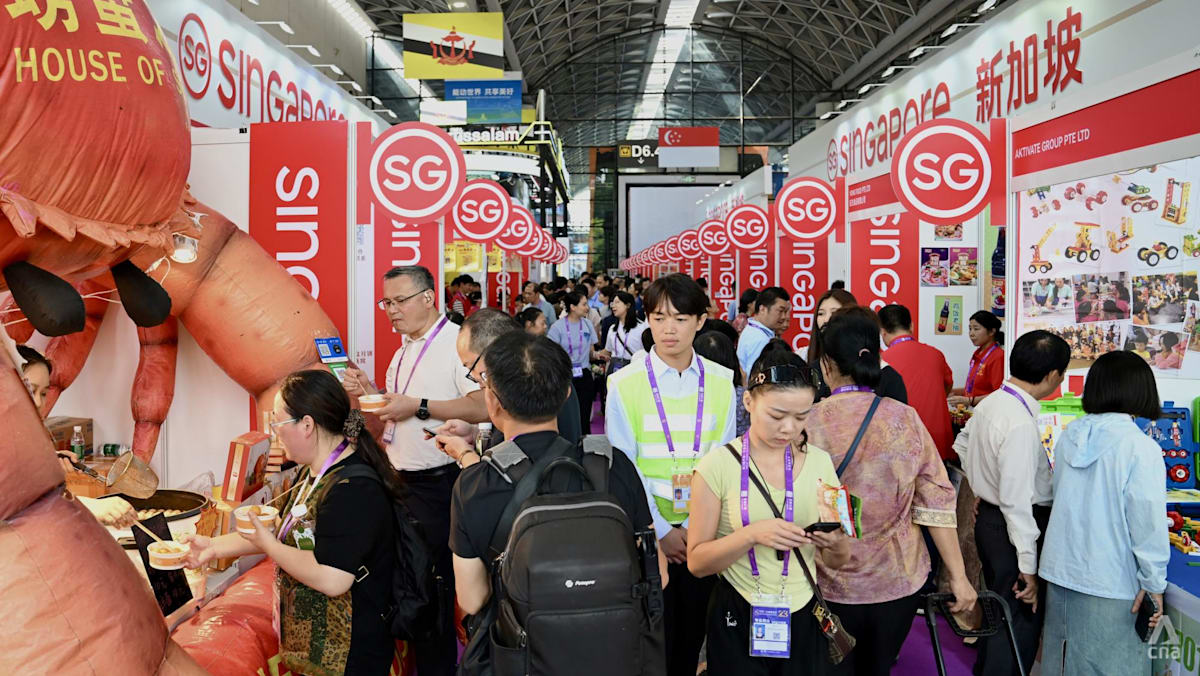
The Singapore pavilion at the 23rd China-ASEAN EXPO in Nanning, China on Sep 17, 2026. (Photo: CNA/Lan Yu)
This audio is generated by an AI tool.
NANNING, Guangxi: Singaporean sales director Tracy Low, 46, came to Nanning in search of a partner to distribute her company’s coffee in China. The company, Kim’s Duet, which sells Singapore-style coffee in single-serve sachets, began exploring the Chinese market earlier this year. At the China-ASEAN Expo (CAEXPO) held in Nanning from Sep 17 to 21, Low met several potential distributors. “It could take between three to six months to filter these distributors before we engage them,” she said.
Tracy Low, sales director of Kim’s Duet coffee, at the 23rd China-ASEAN EXPO in Nanning, China on Sep 17, 2026. (Photo: CNA/Lan Yu)
More than 50 exhibitors from Singapore took part in the five-day event - the highest number since 2023. Some were testing the market for the first time while others had spent years building contacts and turning discussions into business deals.
For many Singaporean companies looking to expand in China, Nanning offers a foothold in a less familiar market.
The capital of Guangxi has been in the spotlight after 52 Singaporeans were arrested over suspected involvement in pyramid-scheme activities , amid longstanding warnings over investment pitches that promised unusually high returns.
CNA Games Guess Word Crack the word, one row at a time Buzzword Create words using the given letters Mini Sudoku Tiny puzzle, mighty brain teaser Mini Crossword Small grid, big challenge Word Search Spot as many words as you can Show More Show Less The Singapore Business Federation (SBF) said it was not aware of companies raising concerns about entering Nanning following the news. Businesses had still been asking the usual questions about “market access, market opportunities, and how they can enter a market”, executive director for international business Soo Wei-Chieh told CNA. Businesses described to CNA a slow process of breaking into China’s massive market - one that can involve spending months or even years finding the right partners, testing relationships and assessing whether opportunities can turn into real business. A “BLUE OCEAN” When most Singaporeans think of China, they often think first of major cities like Beijing and Shanghai, said Tan Teck Yong, chairman and CEO of Singapore education company KinderWorld International Group. But Tan is looking further afield. First-tier cities such as Beijing, Shanghai, Guangzhou and Shenzhen are a “red ocean”, Tan said, referring to a business term for crowded and competitive markets. The Guangxi region, by contrast, is a “blue ocean”, he said - a less saturated market with more room for growth. KinderWorld first entered China in 2000 before expanding into Vietnam. For Tan, venturing into new markets is part of the company’s broader strategy. “We are a Singapore company. Our motto is very clear: internationalise,” he said.
The Singapore Business Federation (SBF) said it was not aware of companies raising concerns about entering Nanning following the news.
Businesses had still been asking the usual questions about “market access, market opportunities, and how they can enter a market”, executive director for international business Soo Wei-Chieh told CNA.
Businesses described to CNA a slow process of breaking into China’s massive market - one that can involve spending months or even years finding the right partners, testing relationships and assessing whether opportunities can turn into real business.
When most Singaporeans think of China, they often think first of major cities like Beijing and Shanghai, said Tan Teck Yong, chairman and CEO of Singapore education company KinderWorld International Group.
But Tan is looking further afield.
First-tier cities such as Beijing, Shanghai, Guangzhou and Shenzhen are a “red ocean”, Tan said, referring to a business term for crowded and competitive markets.
The Guangxi region, by contrast, is a “blue ocean”, he said - a less saturated market with more room for growth.
KinderWorld first entered China in 2000 before expanding into Vietnam. For Tan, venturing into new markets is part of the company’s broader strategy.
“We are a Singapore company. Our motto is very clear: internationalise,” he said.
Tan Teck Yong, Chairman and CEO of KinderWorld International Group at the 23rd China-ASEAN EXPO in Nanning, China on Sep 18, 2026. (Photo: CNA/Lan Yu)
Since the COVID-19 pandemic, Tan has attended CAEXPO in Nanning three times, using the fair to build connections, meet officials and gain a better understanding of the local market.
Those visits became part of a longer process of exploring opportunities in Guangxi, he said.
Turning connections into concrete opportunities also takes time. Tan spent a year and a half in discussions before KinderWorld’s plans in Guangxi began to take shape. The group has since signed agreements with local education institutions.
And the Singapore government has been trying to get more companies to do just that.
“With our small domestic economy, many growth opportunities lie beyond Singapore’s shores,” Deputy Prime Minister and Trade and Industry Minister Gan Kim Yong said during a speech in March, as the government announced increased support for local firms venturing abroad.
Senior Minister Lee Hsien Loong also visited Guangxi in May to better understand its role in ASEAN-China connectivity, with MFA describing the region as a “key gateway” linking China with Southeast Asia.
But for some businesses taking that step, unfamiliar markets can come with steep learning curves.
Wayne Eo, director of Singapore building materials company Sixth Harmony Global, knew little about Nanning before attending his first CAEXPO back in 2024.
He thought of it as an up-and-coming second-tier Chinese city but was surprised to discover modern high-rises and shopping malls.
People he met in restaurants and at street-food stalls were “all very earnest” and local food also took a bit of getting used to, he said.
“If you aren’t a bamboo fan ... you will be really shocked,” he joked, referring to the local fondness for bamboo shoots.
He has kept coming back since. Through CAEXPO, Sixth Harmony has expanded its contacts beyond Nanning and now supplies customers elsewhere in Guangxi and also in Guangdong.
“Nanning is the entry point for us,” Eo said.
The venue where the 23rd China-ASEAN EXPO was held in Nanning, China on Sep 17, 2026. (Photo: CNA/Lan Yu)
BUSINESSES UNDETERRED BY PYRAMID SCHEME ARRESTS
Guangxi’s capital is also becoming better connected. Just this month, the Pinglu Canal opened , giving Nanning and other parts of inland southwestern China a shorter water route to the sea.
But its growing role as a link between China and Southeast Asia has also featured in pitches for a very different kind of opportunity.
Residential developments in Wuxiang New Area in Nanning, China on Sep 19, 2026. (Photo: CNA/Lan Yu)
Last December, Zhang Fan, a 40-year-old Singaporean working in cybersecurity, recalled being approached by a close university friend with an investment proposal.
He was told that Nanning was becoming a strategic geographical link and could even become “the next Shanghai” within a decade.
His friend had also offered to take him around the city to see its high-rises and development projects, presenting them as signs of the city’s potential.
The pitch came with eye-catching figures: an investment of as much as S$40,000 to S$50,000, he recalled - with the prospect of receiving more than S$1 million over two years.
But all that said little about whether the investment being promoted was legitimate.
Zhang ultimately turned down the proposal and said it “sounded too good to be true”.
News of the arrests over suspected pyramid scheme activities in Guangxi, however, has not deterred Singapore businesses looking for opportunities in the city.
“So far, no impact,” said KinderWorld International Group’s Tan. “Look, we are not here to look for money. We are here to bring our export, our education program into Guangxi and China.”
Singaporean sales director Low similarly said that the news had not made her particularly concerned or given her a negative impression of Nanning.
Her company was there because it knew little about the Chinese market and had simply wanted to find out whether there was a place for its coffee.
The Singapore-China Friendship Night dinner taking place at Marriott Hotel, Nanning, China on Sep 17, 2026. (Photo: CNA/Lan Yu)
For Eo of Sixth Harmony Global, China offers a vastly bigger potential market - but venturing into it has also meant learning to do business differently.
In Singapore, companies can easily reach customers relatively directly, he said. In China, different provinces may require different distributors, contacts and ways of working, he added.
Still, for a small Singapore company like his, even capturing a tiny fraction could matter, Eo said - but getting that slice still takes time.
For companies, it can mean spending more than half a year getting to know a potential partner before committing to more business.
So it often starts with small transactions - watching whether payments arrive on time and gauging whether both sides work well together, Eo said.
“We build some form of relationship, and have an understanding of each other. Then we trial a little bit of business here and there,” he added.
Wayne Eo, Director of Sixth Harmony Global Pte Ltd, at the company's booth at the 23rd China-ASEAN EXPO 2026 in Nanning, China on Sep 17, 2026. (Photo: CNA/Lan Yu)
That approach broadly mirrors what lawyers recommend.
Liang Weitan, a partner in the China Practice at Singapore law firm WongPartnership, told CNA that genuine projects and investments should have identifiable partners, proper registrations and contracts - as well as clear funding structures and actual business operations.
“The absence of any of these should prompt further inquiry,” Liang said.
He also advises investors to check a Chinese company’s business licence and registration - along with other precautions like visiting its premises, examining contracts and importantly, establishing how a project would actually make money before transferring funds.
Samuel Chng, a research assistant professor at the Lee Kuan Yew Centre for Innovative Cities at the Singapore University of Technology and Design, urged Singaporeans to scrutinise investment opportunities carefully.
Even “promising market(s) can contain unsound ventures”, said Chng, who also heads the centre’s Urban Psychology Lab.
Taking time and “seeking independent assessments” can also help, he added.
“It would be prudent to pause and ask what evidence supports a particular business proposition, how it generates revenue, and whether its claims can be checked independently of those promoting it.”
Visitors at the 23rd China-ASEAN EXPO in Nanning, China on Sep 17, 2026. (Photo: CNA/Lan Yu)
KinderWorld International Group’s Tan advises smaller Singapore companies to keep their “eyes and ears open” while learning more about the market in China and finding reliable partners.
A good way to start would be through trade missions organised by groups such as SBF, Tan said - where companies can meet potential business and government contacts.
But SBF stressed that an introduction is not an endorsement. “What works for one may not always work,” said Soo.
For Eo, that caution is not a reason to shy away from an unfamiliar market.
There is always “the lure of very big markets”, he said, as well as the question of “how adventurous a business person can be”.
“It’s always about taking the first step,” Eo said.
“One (to) two years in, then we get a good hold on what’s happening.”
Evening at a park in Nanning, China on Sep 18, 2026. (Photo: CNA/Lan Yu)
Our chief editor shares analysis and picks of the week's biggest news every Saturday.
An automated curation of our top stories to start your day.
Get our pick of top stories and thought-provoking articles in your inbox
Stay updated with notifications for breaking news and our best stories
Join our channel for the top reads for the day on your preferred chat app
最近新加坡人因参与传销而被捕,南宁因此成为关注焦点,但企业告诉亚洲新闻台,他们仍然没有放弃进入中国市场的决心——而且打入中国市场可能需要数月甚至数年的时间。
2026年9月17日,新加坡馆亮相中国南宁举行的第23届中国—东盟博览会。(图片:中央社/兰宇)
这段音频是由人工智能工具生成的。
广西南宁:46岁的新加坡销售总监特蕾西·洛(Tracy Low)来到南宁,寻找合作伙伴,在中国分销她公司的咖啡。她的公司金氏咖啡(Kim's Duet)销售新加坡风味的单份包装咖啡,今年年初开始开拓中国市场。在9月17日至21日于南宁举办的中国—东盟博览会(CAEXPO)上,洛女士会见了几位潜在的分销商。“筛选这些分销商可能需要三到六个月的时间,之后我们才能与他们正式合作,”她说。
2026年9月17日,金氏咖啡销售总监Tracy Low在中国南宁举行的第23届中国—东盟博览会上。(图片:中央社/兰宇)
超过 50 家来自新加坡的参展商参加了为期五天的活动,这是自 2023 年以来参展商数量最多的一次。其中一些是首次试水新加坡市场,而另一些则是花费数年时间建立联系,并将讨论转化为商业交易。
对于许多希望在中国扩张的新加坡公司而言,南宁提供了一个进入不太熟悉的市场的立足点。
广西首府广西近日成为舆论焦点,52名新加坡人因涉嫌参与传销活动被捕。此前,人们一直警告不要参与承诺异常高回报的投资骗局。
CNA游戏 猜词游戏 逐行破解单词 流行词游戏 用给定的字母组成单词 迷你数独 小谜题,脑力挑战 迷你填字游戏 小方格,大挑战 单词搜索 尽可能多地找出单词 显示更多 显示更少 新加坡商业联合会(SBF)表示,在新闻报道发布后,他们并未收到任何公司对进入南宁市场表示担忧的消息。国际业务执行董事苏伟杰告诉CNA,企业仍在询问一些常见的问题,例如“市场准入、市场机会以及如何进入市场”。企业向CNA描述了打入中国庞大市场是一个缓慢的过程——这可能需要花费数月甚至数年的时间寻找合适的合作伙伴、测试合作关系并评估机会是否能够转化为真正的业务。“蓝海” 新加坡教育公司健达国际集团董事长兼首席执行官陈德勇表示,大多数新加坡人想到中国时,首先想到的往往是北京和上海等大城市。但陈德勇的目光更远。谭先生表示,北京、上海、广州和深圳等一线城市是“红海”,他用这个商业术语来形容拥挤且竞争激烈的市场。相比之下,广西地区则是一片“蓝海”,他说——这是一个饱和度较低、增长空间更大的市场。健达世界于2000年首次进入中国市场,之后又拓展到越南。对谭先生而言,开拓新市场是公司整体战略的一部分。“我们是一家新加坡公司。我们的座右铭非常明确:国际化。”他说道。
新加坡商业联合会(SBF)表示,在新闻发布后,他们尚未收到有公司对进驻南宁表示担忧的消息。
国际业务执行董事苏伟杰告诉中央社,企业仍然在询问有关“市场准入、市场机会以及如何进入市场”的常见问题。
企业向中央社描述了打入中国庞大市场是一个缓慢的过程——这可能需要花费数月甚至数年的时间寻找合适的合作伙伴、测试关系并评估机会是否能转化为真正的业务。
新加坡教育公司 KinderWorld International Group 的董事长兼首席执行官陈德勇表示,大多数新加坡人想到中国时,首先想到的往往是北京和上海等大城市。
但谭的目光投向了更广阔的领域。
谭先生表示,北京、上海、广州、深圳等一线城市是一片“红海”,他用商业术语来形容拥挤且竞争激烈的市场。
他表示,相比之下,广西地区是一片“蓝海”——一个饱和度较低、增长空间更大的市场。
KinderWorld于2000年首次进入中国市场,之后拓展至越南。对谭先生而言,开拓新市场是公司整体战略的一部分。
“我们是一家新加坡公司。我们的座右铭非常明确:走向国际化,”他说。
2026年9月18日,健达世界国际集团董事长兼首席执行官陈德勇出席在中国南宁举行的第23届中国—东盟博览会。(图片:中央社/兰宇)
自新冠疫情爆发以来,谭先生已三次参加南宁中国国际展览会,利用展会建立人脉、会见官员并更好地了解当地市场。
他说,这些访问是他在广西探索发展机遇的长期过程的一部分。
将人脉转化为实际机遇也需要时间。谭先生花了整整一年半的时间进行磋商,才让健达世界在广西的计划开始成形。此后,该集团已与当地教育机构签署了合作协议。
新加坡政府一直在努力促使更多公司这样做。
“由于我国国内经济规模较小,许多增长机会都在新加坡境外,”副总理兼贸易及工业部长颜金勇在3月份的一次演讲中表示。当时,政府宣布将加大对进军海外市场的本地企业的支持力度。
李显龙高级部长也于5月访问了广西,以更好地了解其在东盟-中国互联互通中的作用。外交部称该地区是连接中国与东南亚的“关键门户”。
但对于一些迈出这一步的企业来说,陌生的市场可能会带来陡峭的学习曲线。
新加坡建材公司 Sixth Harmony Global 的董事 Wayne Eo 在 2024 年首次参加 CAEXPO 之前,对南宁知之甚少。
他原以为那是一个正在崛起的中国二线城市,但却惊讶地发现那里有现代化的高楼大厦和购物中心。
他说,他在餐馆和街头小吃摊遇到的人们“都非常认真”,而且当地的食物也需要一段时间才能适应。
“如果你不是竹子爱好者……你一定会大吃一惊,”他开玩笑说,指的是当地人对竹笋的喜爱。
此后他一直坚持参展。通过中国国际展览会(CAEXPO),六和合唱团的业务范围已拓展至南宁以外,现在也为广西其他地区以及广东的客户供货。
“南宁是我们的切入点,”Eo说道。
2026年9月17日,第23届中国—东盟博览会在中国南宁举行。(图片:中央社/兰宇)
企业并未因传销案被捕而退缩
广西首府南宁的交通连接也日益便利。就在本月,平陆运河正式开通,为南宁及中国西南内陆其他地区提供了一条通往大海的更便捷水路。
但它作为连接中国和东南亚的纽带的作用日益增强,也成为争取另一种截然不同的机会的契机。
2026 年 9 月 19 日,中国南宁五象新区的住宅开发项目。(照片:CNA/Lan Yu)
去年 12 月,40 岁的新加坡网络安全从业者张帆回忆起,一位大学好友曾向他提出一项投资建议。
有人告诉他,南宁正在成为一个具有战略意义的地理枢纽,甚至可能在十年内成为“下一个上海”。
他的朋友还提出带他游览这座城市,看看高楼大厦和开发项目,并将它们作为这座城市潜力的标志。
他回忆说,当时的推介方案中包含了一些引人注目的数字:投资额高达 4 万至 5 万新元,有望在两年内获得超过 100 万新元的回报。
但这并不能说明所推广的投资是否合法。
张最终拒绝了该提议,并表示“这听起来好得令人难以置信”。
然而,广西因涉嫌传销活动而逮捕人员的消息并没有阻止新加坡企业在广西寻找商机。
“目前为止,还没有受到影响,”健达世界国际集团的谭先生说。“我们来这里不是为了赚钱。我们来这里是为了把我们的出口产品和教育项目带到广西和中国。”
新加坡销售总监Low也表示,这一消息并没有让她特别担心,也没有让她对南宁产生负面印象。
她的公司之所以去那里,是因为他们对中国市场知之甚少,只是想看看他们的咖啡在中国是否有市场。
2026年9月17日,新加坡-中国友谊晚宴在中国南宁万豪酒店举行。(图片:中央社/兰宇)
对于 Sixth Harmony Global 的 Eo 来说,中国市场潜力巨大——但进军中国市场也意味着要学习以不同的方式做生意。
他表示,在新加坡,企业可以相对直接地接触客户。他还补充说,在中国,不同的省份可能需要不同的分销商、联系人和运作方式。
Eo表示,对于像他这样的新加坡小公司来说,即使只获得一小部分市场份额也可能意义重大,但获得这部分市场份额仍然需要时间。
对于公司而言,这意味着在决定开展更多业务之前,可能需要花费半年多的时间来了解潜在的合作伙伴。
Eo表示,因此,这通常始于小额交易——观察付款是否按时到账,并评估双方是否合作良好。
“我们建立某种关系,彼此了解。然后我们零星地尝试一些商业合作,”他补充道。
2026年9月17日,六美环球私人有限公司董事Wayne Eo在中国南宁举行的第23届中国—东盟博览会2026上,在公司展位前。(图片:中央社/兰宇)
这种方法与律师的建议大体一致。
新加坡律师事务所 WongPartnership 中国业务合伙人梁伟坦告诉 CNA,真正的项目和投资应该有可识别的合作伙伴、适当的注册和合同,以及清晰的融资结构和实际的业务运营。
梁说:“如果缺少上述任何一项,都应该引起进一步调查。”
他还建议投资者在转移资金之前,检查中国公司的营业执照和注册信息,以及其他预防措施,例如参观公司办公场所、审查合同,更重要的是,要确定项目实际如何赚钱。
新加坡科技设计大学李光耀创新城市中心的研究助理教授张胜(Samuel Chng)敦促新加坡人仔细审查投资机会。
Chng表示,即使是“有前景的市场也可能包含不健全的企业”,他同时也是该中心城市心理学实验室的负责人。
他还补充说,花时间“寻求独立评估”也会有所帮助。
“明智的做法是停下来问问,有什么证据支持某个特定的商业主张,它是如何产生收入的,以及它的说法是否可以独立于那些推广它的人进行核实。”
2026年9月17日,参观者在中国南宁举行的第23届中国—东盟博览会上。(图片:中央社/兰宇)
KinderWorld International Group 的 Tan 建议新加坡规模较小的公司在了解中国市场并寻找可靠合作伙伴的同时,要“睁大眼睛,竖起耳朵”。
Tan表示,一个好的开始方式是通过像新加坡商业联合会(SBF)这样的组织举办的贸易考察团——企业可以在这些考察团中与潜在的商业和政府联系人会面。
但SBF强调,介绍并不代表认可。“适合一个人的方法未必适合所有人,”Soo说道。
对于 Eo 而言,这种谨慎并不是回避陌生市场的理由。
他表示,总会有“巨大的市场所带来的诱惑”,以及“商人能有多大的冒险精神”这个问题。
“关键在于迈出第一步,”Eo说道。
“一到两年后,我们就能很好地掌握情况了。”
2026 年 9 月 18 日,中国南宁的一个公园的夜晚。(照片:CNA/Lan Yu)
我们的主编每周六都会分享对本周重大新闻的分析和精选。
每天清晨,我们都会自动为您推送最热门的新闻资讯,助您开启美好的一天。
订阅我们的邮件,即可获取精选热点新闻和引人深思的文章。
订阅通知,第一时间获取突发新闻和精彩报道。
加入我们的频道,即可在您常用的聊天应用上获取当日热门文章。