‘AI cannot replace relationships’: Why teachers matter more than ever in the modern classroom“人工智能无法取代人际关系”:为什么教师在现代课堂中比以往任何时候都更加重要
With AI entering the classroom, the teacher’s role is more important than ever. Read more at straitstimes.com.
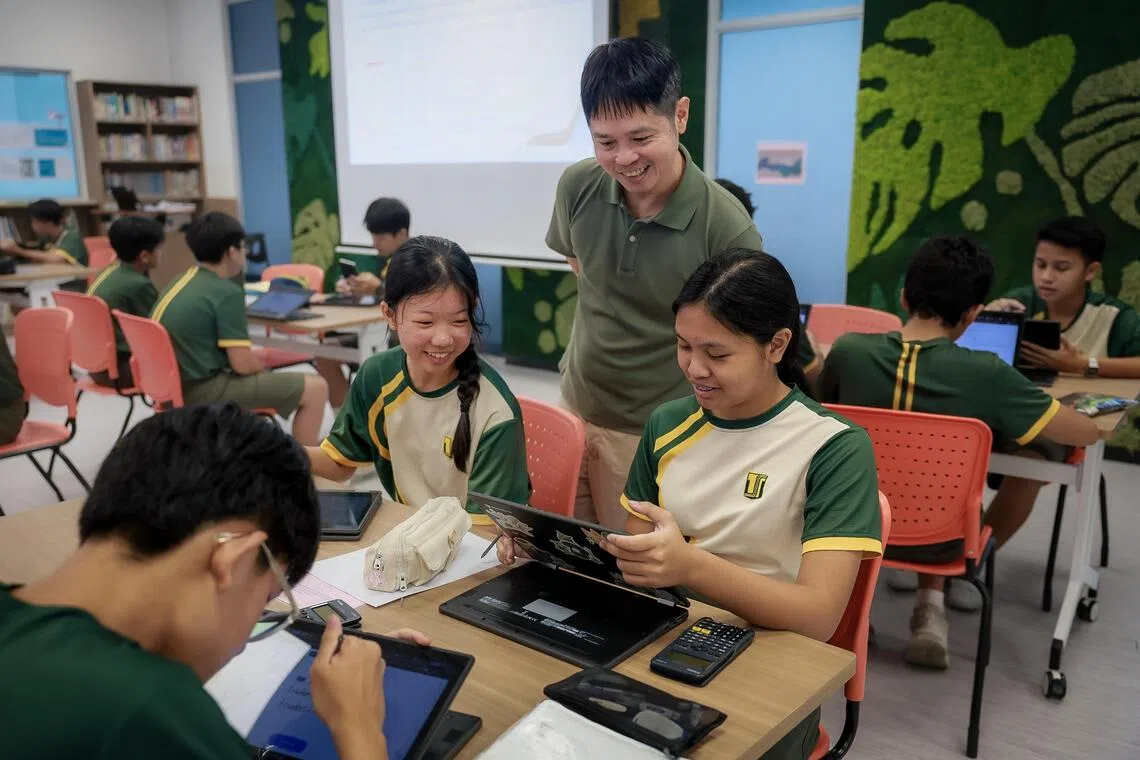
Tampines Secondary School mathematics teacher Charles Yip guiding Secondary Two students (clockwise from bottom left) Alexis Koh, Reiko Toh and Raina Mahani as they use AI-powered learning tools.
Published Sep 05, 2026, 12:00 PM
Updated Sep 05, 2026, 12:00 PM
AI tools help students learn at their own pace and get instant feedback, enhancing independent learning while allowing teachers to focus on individual support.
Teachers use AI to engage students interactively but keep homework offline to ensure independent problem-solving and maintain essential skills.
Despite AI's benefits, teachers remain crucial for nurturing relationships, curiosity, confidence, and holistic student development, which technology cannot replace.
SINGAPORE - In a Chinese language lesson in Bukit Batok, a Primary 3 pupil from Dazhong Primary School is playing a game of flappy bird on a school-loaned laptop, to learn words related to local landmarks.
Across the island, a Sec 2 pupil from Tampines Secondary is scribbling workings for a mathematics problem on his personal laptop - a Chromebook issued by the school. Once he is done, he gets instant online feedback about whether he did well, or where he went wrong.
At the centre of these lessons are two teachers, using artificial intelligence (AI) not to replace their roles but to give students opportunities to learn at their own pace, make mistakes without fear and grow from them.
Having taught mathematics for over 20 years, Charles Yip knows the value of prompt feedback when students are grappling with mathematical concepts.
In a traditional lesson, a student who makes a minor calculation or transference error midway through a complex problem may discover their mistake only days later, after Yip has marked and returned their work.
With Snorkl, an AI-powered commercial tool that can assess handwritten workings and provide immediate feedback, students can correct their mistakes instantly.
Yip said: "In the past, a student might complete a whole table of values before realising there’s an error. And they get very frustrated because they have to redo everything.”
“We want them to understand that learning is an iterative process, not just about memorising formulas," said Yip.
His Sec 2 student Reiko Toh, 14, said the tool does not just mark an answer. It also explains where a student went wrong and suggests steps to correct their mistakes.
She added that such tools help her become an independent learner.
“I’m a bit shy so I don’t usually approach my teachers for help when I need it. But now I don’t have to, because the AI tools can help me,” she said.
Snorkl can assess handwritten workings and provide immediate feedback, students can correct their mistakes instantly. ST PHOTO: GAVIN FOO
Snorkl can assess handwritten workings and provide immediate feedback, students can correct their mistakes instantly.
With students receiving personalised feedback, Yip said he can move away from lessons pitched to the ‘middle’ of the class.
Faster learners can progress to more challenging tasks, while Yip can devote more time to those who need more one-on-one help and encouragement.
Students use the Snorkl during a mathematics lesson at Tampines Secondary School. ST PHOTO: GAVIN FOO
Students use the Snorkl during a mathematics lesson at Tampines Secondary School.
The platform also captures every student’s work and scores, letting Yip review their performance to identify individual learning gaps.
While the tool optimises many aspects of learning, preparing it for students’ use is not that simple.
“The hard part is inputting as many possible wrong answers students might give, and ensuring the AI provides useful feedback that students understand, rather than just blurting out the final answer,” he said, adding that this takes several hours.
At Dazhong Primary, Chinese language teacher Kenny Ng uses AI to engage children who do not use their mother tongue outside the classroom. He started doing this in 2026.
In a lesson observed by The Straits Times on Aug 11, Ng’s Primary 3 pupils borrowed the school’s Chromebooks and logged onto the Singapore Student Learning Space (SLS) - an online platform developed by the Education Ministry.
Once they accessed the lesson on SLS, they first played a version of Flappy Bird which Ng created, to help them master Chinese vocabulary related to Singapore landmarks.
Dazhong Primary School pupil Leong Jun Han, nine, playing a version of Flappy Bird created by Chinese language teacher Kenny Ng. ST PHOTO: BRIAN TEO
Dazhong Primary School pupil Leong Jun Han, nine, playing a version of Flappy Bird created by Chinese language teacher Kenny Ng.
Next, they designed simple digital postcards featuring one landmark, before typing out a short text explaining their postcard design.
For the final task, pupils recorded themselves reading the text they prepared aloud. The AI tool in the online programme grades their reading, and provides instant feedback on their pronunciation and content.
Nine-year-old Leong Jun Han said he is amazed that AI tools can mark audio recordings instantly. Yet, he feels they should not be used too often.
“AI has improved a lot… But I think we should limit its use because the manual way of teaching is too important to us,” he said, adding that he appreciates how his teacher uses it in the right ways.
With his pupils learning independently, Ng walks around the room attending to those who need more support, observing which tasks they struggle with the most.
With his pupils learning independently, Ng walks around the room attending to those who need more support, observing which tasks they struggle with the most. ST PHOTO: BRIAN TEO
Without the digital tool, Ng said his lesson would have looked quite different .
“I would have spent a lot of time doing frontal teaching vocabulary, going at a slower pace, and giving explicit instructions. So there will be less time for the kids to make choices, generate ideas, and have meaningful teacher-pupil interactions,” he said.
Homework is never done online
Despite using digital tools in class , both teachers keep homework firmly offline .
For Yip, written homework ensures students can solve problems independently without relying on prompts, preparing them for national examinations, which are still done on paper.
Ng said physical writing skills are fundamental for learning Chinese, and should not be replaced with typing.
Dazhong Primary School pupil Kaelyn Lim, nine, practising reading a paragraph with the help of the Authoring Co-Pilot tool on the Singapore Student Learning Space during a Chinese lesson. ST PHOTO: BRIAN TEO
Dazhong Primary School pupil Kaelyn Lim, nine, practising reading a paragraph with the help of the Authoring Co-Pilot tool on the Singapore Student Learning Space during a Chinese lesson.
Both educators said they see their role evolving from delivering knowledge to facilitating learning.
But with AI entering the classroom, Yip said the teacher’s role is more important than ever.
“We have to teach our students that AI should only guide them and provide feedback. Students still need to do the thinking, interpret the feedback and use it to improve their learning,” he said.
Though a great learning tool, Ng said AI has its limits.
“AI cannot replace teacher-student relationships, where we nurture curiosity, build confidence and ensure students develop holistically.”
Elisha Tushara is a correspondent at The Straits Times, specialising in Singapore’s education landscape.
AI/artificial intelligence
Education and schools
Ministry of Education
淡滨尼中学数学老师叶嘉伟指导中二学生(从左下角顺时针方向)许艾莉克丝、杜玲子和雷娜·马哈尼使用人工智能学习工具。
发布于 2026 年 9 月 5 日 下午 12:00
更新于2026年9月5日中午12:00
人工智能工具可以帮助学生按照自己的节奏学习并获得即时反馈,增强自主学习能力,同时让教师能够专注于个别辅导。
教师利用人工智能与学生进行互动,但将家庭作业离线布置,以确保学生能够独立解决问题并保持必要的技能。
尽管人工智能有很多优点,但教师在培养师生关系、激发学生的好奇心、增强学生的自信心以及促进学生的全面发展方面仍然至关重要,这是技术无法取代的。
新加坡——在武吉巴督的一堂中文课上,来自大众小学的一名三年级学生正在学校借来的笔记本电脑上玩“Flappy Bird”游戏,以学习与当地地标相关的单词。
在岛的另一边,淡滨尼中学的一名中二学生正在用学校配发的Chromebook笔记本电脑解答一道数学题。完成后,他可以立即在线获得反馈,了解自己做得好不好,或者错在哪里。
这些课程的核心是两位老师,他们使用人工智能(AI)不是为了取代老师的角色,而是为了给学生提供机会,让他们能够按照自己的节奏学习,无所畏惧地犯错,并从中成长。
拥有超过 20 年数学教学经验的 Charles Yip 深知,当学生努力理解数学概念时,及时反馈至关重要。
在传统的课堂教学中,学生在解决复杂问题的过程中如果出现轻微的计算或转换错误,可能要过几天,叶老师批改并返还作业后,学生才会发现自己的错误。
Snorkl 是一款人工智能驱动的商业工具,可以评估手写作业并提供即时反馈,学生可以立即纠正错误。
叶先生说:“过去,学生可能完成一整张数值表后才发现有错误。他们会非常沮丧,因为他们不得不重做一切。”
“我们希望他们明白,学习是一个迭代的过程,而不仅仅是记住公式,”叶说。
他14岁的中二学生Reiko Toh说,这个工具不仅能批改答案,还能解释学生错在哪里,并提供改正步骤。
她补充说,这些工具帮助她成为一名自主学习者。
“我有点害羞,所以需要帮助的时候通常不会去找老师。但现在我不用了,因为人工智能工具可以帮助我,”她说。
Snorkl 可以评估手写作业并提供即时反馈,学生可以立即纠正错误。ST 照片:GAVIN FOO
Snorkl 可以评估手写作业并提供即时反馈,学生可以立即纠正错误。
叶先生表示,由于学生们能够获得个性化的反馈,他可以不再采用针对班级“中间水平”学生的授课方式。
学习速度快的学生可以逐步挑战更具难度的任务,而叶老师可以花更多时间给予那些需要更多一对一帮助和鼓励的学生。
淡滨尼中学学生在数学课上使用Snorkl呼吸机。海峡时报摄影:Gavin Foo
淡滨尼中学的学生们在数学课上使用Snorkl。
该平台还会记录每个学生的作业和分数,让叶教授能够查看他们的表现,从而找出个人的学习差距。
虽然该工具优化了学习的许多方面,但要让它适合学生使用却并非易事。
“难点在于输入学生可能给出的所有错误答案,并确保人工智能提供学生能够理解的有用反馈,而不是直接给出最终答案,”他说道,并补充说这需要几个小时。
在大众小学,中文老师吴肯尼(Kenny Ng)利用人工智能技术来帮助那些在课堂外不使用母语的孩子们进行学习。他从2026年开始使用这项技术。
8 月 11 日,《海峡时报》记者观察了一堂课,吴老师的小学三年级学生借用了学校的 Chromebook 电脑,登录了新加坡学生学习空间 (SLS)——这是教育部开发的在线平台。
他们通过 SLS 访问课程后,首先玩了 Ng 制作的 Flappy Bird 游戏,以帮助他们掌握与新加坡地标相关的中文词汇。
大中小学九岁学生梁俊翰正在玩中文老师吴老师制作的《Flappy Bird》游戏。(海峡时报摄影:张文杰)
大中小学九岁的学生梁俊汉正在玩中文老师吴肯尼创作的 Flappy Bird 游戏版本。
接下来,他们设计了以一个地标为主题的简单电子明信片,然后输入一段简短的文字来解释他们的明信片设计。
最后一项任务是让学生们录制自己朗读事先准备好的文本。在线程序中的人工智能工具会对他们的朗读进行评分,并就发音和内容提供即时反馈。
九岁的梁俊汉表示,他对人工智能工具能够即时标记录音感到非常惊讶。但他认为不应该过度使用这类工具。
“人工智能已经有了很大的进步……但我认为我们应该限制它的使用,因为人工教学对我们来说太重要了,”他说,并补充说他很欣赏他的老师以正确的方式使用人工智能。
学生们自主学习时,吴老师会在教室里走动,关注那些需要更多帮助的学生,观察他们在哪些任务上最吃力。
学生们自主学习时,吴老师会在教室里走动,关注那些需要更多帮助的学生,观察他们在哪些任务上最吃力。(海峡时报照片:BRIAN TEO)
吴先生表示,如果没有这个数字工具,他的课程将会截然不同。
他说:“我会花很多时间进行讲解词汇,语速放慢,并给出明确的指示。这样一来,孩子们就没有太多时间做出选择、产生想法,以及进行有意义的师生互动了。”
家庭作业从来不在网上完成。
尽管课堂上使用数字工具,但两位老师都严格要求学生在线下完成作业。
叶教授认为,书面作业可以确保学生能够独立解决问题,而无需依赖提示,从而为他们参加仍然采用纸笔作答方式的全国性考试做好准备。
吴先生表示,书写技能是学习中文的基础,不应该被打字取代。
大中小学九岁学生林凯琳(Kaelyn Lim)在中文课上,借助新加坡学生学习空间(Singapore Student Learning Space)的“创作助手”(Authoring Co-Pilot)工具练习朗读段落。(海峡时报摄影:张文杰)
大中小学九岁的学生林凯琳(Kaelyn Lim)在中文课上,借助新加坡学生学习空间上的“创作助手”(Authoring Co-Pilot)工具练习朗读一段文字。
两位教育工作者都表示,他们认为自己的角色正在从传授知识转变为促进学习。
但叶先生表示,随着人工智能进入课堂,教师的作用比以往任何时候都更加重要。
他说:“我们必须教导学生,人工智能应该只是引导他们并提供反馈。学生仍然需要思考,解读反馈,并利用反馈来改进学习。”
吴恩达表示,虽然人工智能是一个很棒的学习工具,但它也有局限性。
“人工智能无法取代师生关系,在师生关系中,我们培养学生的好奇心,建立他们的自信心,并确保他们全面发展。”
Elisha Tushara 是《海峡时报》的记者,专门报道新加坡的教育领域。
人工智能
教育和学校
教育部