How do I pick the right secondary school for my child?我该如何为孩子选择合适的初中?
Learn how to choose the right secondary school for your child, considering academics, interests, and school environment after PSLE results. Read more at straitstimes.com.
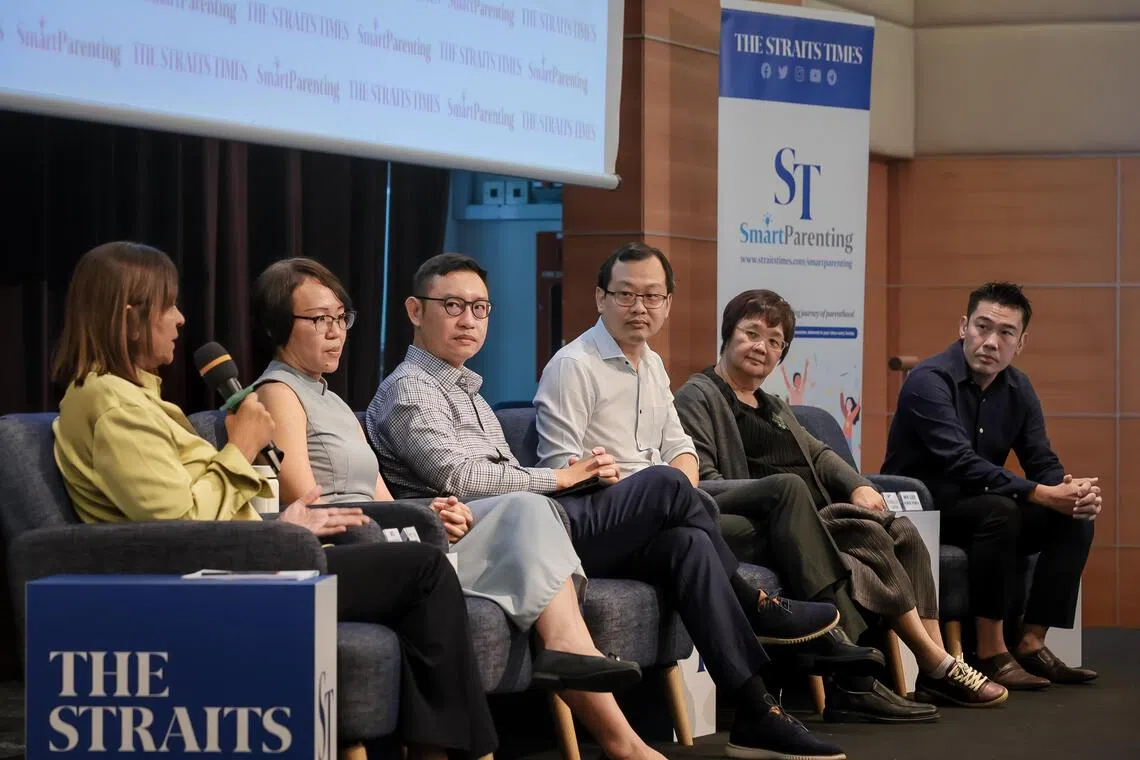
It was full house at the 2023 post-PSLE forum held by The Straits Times to help parents choose a secondary school for their children.
Published Oct 04, 2026, 11:45 AM
Updated Oct 04, 2026, 11:45 AM
Start by listing six to eight secondary schools your child is interested in, balancing ambitious and realistic choices based on her prelim results and past cut-off points.
Consider your child's learning style and response to competition when choosing between an Integrated Programme and the O-level system.
Factor in school distance and co-curricular activities, as they support character development and soft skills; attend The Straits Times post-PSLE forum for more expert advice.
Explore the PSLE Companion microsite for more insights and tips.
I am glad that my daughter is done with her PSLE. Now, for the more difficult part – picking the right secondary school for my child. Based on her prelim results, I feel she can make it to an Integrated Programme (IP) school, but she is not sure if it will be too competitive. How many schools should I shortlist? What are the important things to consider, other than the academics?
PSLE results day isn’t until late November, but it is good that you are thinking of the “right” secondary school for your child and that you want to also take into account her interests outside academics.
For a start, can I suggest sitting down with her and coming up with a list of six to eight schools that she would be interested in?
When it comes to posting, students with lower PSLE scores will be considered first for vacancies in their chosen schools.
So, have a look at 2025’s cut-off points (COP) and compare your child’s prelim scores against them for the schools. It is good to allow two or three ambitious choices, where your score is close to or slightly above the COP . But the other schools on the list should be realistic choices that she is likely to get into based on her results.
You mentioned that she will be able to make it to an IP school, but your daughter worries about the competitive environment.
Most parents are inclined to choose the best school that their child qualifies for. But if you are considering an IP school, you need to ask yourself if your child will do better in the O-level system or in the IP?
Those in the IP skip the O levels, and the programme requires students to be independent learners. This means it does not suit those who need a more structured programme and a major examination, like the O levels, to hunker down and study.
You have to sit your child down and probe her on her worry about competition. Several studies show that selective schools may not suit some students, even if they are high achievers academically.
Consider your child’s strengths and weaknesses. Does she thrive in competition or wilt under stress? Will her self-esteem be dashed if she goes from being first in class to being 30th?
Research has shown that some students, who were near the top of their class in a more academically diverse school, developed a less positive self-image when all of their classmates were high-achieving.
The advice from school heads is that when picking a school, your focus should be on getting your daughter into a school that will boost her confidence.
If you haven’t already, you should read the news report I wrote in 2025, where I quoted figures from the Ministry of Education showing that around 6% to 7% of the IP cohorts that graduated in 2022, 2023 and 2024 left before the six years were up. This translates to about 240 students in a cohort of 4,000.
Parents mistakenly think that distance is not as important when it comes to secondary schools.
It is. For a student, time spent travelling can be better used to take up sports or co-curricular activities, which is a requirement in secondary school.
It is also important to consider the sports and co-curricular activities that a school offers as they are crucial to the development of character and soft skills such as communication and teamwork in children. These skills are becoming even more important in this age of AI.
I suggest you keep relooking and revising the list with your daughter. Applications to secondary schools open on the same day that results are released, and your daughter will then have a week to make up her mind on her final six choices. Posting results will be out in December.
If you need more expert advice and want to discuss your choices further, consider signing up for the post-PSLE forum that The Straits Times is holding on Oct 31.
Five principals will be there to talk about secondary school life, including the IP, same-sex schools versus co-ed schools, and full subject-based banding.
You can ask Lucy Tay, who heads National Junior College, on entry into IP schools and how NJC’s programme differs from the other IP schools.
Lee Han Hwa, principal of St Andrew’s Secondary School, will be able to help parents who are trying to decide between an all-boys school and a co-ed school.
Some parents have already posed questions on subject-based banding, specifically on whether a student who does not meet the prerequisites to take a subject at a more demanding level will still be able to do so.
The other three school heads – Anderson Secondary School’s Tan Po Chin, Ahmad Ibrahim Secondary School’s Goh Soon Hoe and Pasir Ris Crest Secondary School’s Koh Caiyu – will help parents gain a better understanding of full subject-based banding.
There will also be booths set up at the event where you and your child will get the chance to talk to some of the students and teachers from the five schools. Parents who are PSLE Companion subscribers can attend the forum for free and they can take along their child.
I hope parents will seize this opportunity. Meanwhile, have some rest and enjoy the post-PSLE break.
Join us at the ST Post-PSLE Forum by subscribing to the 24-month ST PSLE Companion package ($29.90 a month), and also get $180 worth of Scoot vouchers.
《海峡时报》举办的 2023 年小学离校考试后论坛座无虚席,该论坛旨在帮助家长为孩子选择中学。
发布于 2026 年 10 月 4 日上午 11:45
更新于2026年10月4日上午11:45
首先列出六到八所你孩子感兴趣的中学,根据她的预考成绩和以往的录取分数线,在有挑战性和现实性的选择之间取得平衡。
在选择综合课程还是O水准课程时,请考虑孩子的学习风格和对竞争的反应。
考虑学校距离和课外活动,因为它们有助于品格培养和软技能发展;参加《海峡时报》小学离校考试后论坛,获取更多专家建议。
浏览 PSLE 配套微网站,获取更多见解和技巧。
我很高兴女儿小六会考结束了。现在,更难的部分来了——为她选择合适的中学。根据她的预考成绩,我觉得她可以考上综合课程学校(IP),但她不确定竞争会不会太激烈。我应该筛选多少所学校?除了学术成绩之外,还有哪些重要的因素需要考虑?
小六会考成绩公布日要到11月下旬,但您能为孩子考虑“合适的”中学,并且考虑到她学术以外的兴趣,这很好。
首先,我建议和她坐下来,列出她可能感兴趣的六到八所学校。
在分配名额时,小学离校考试(PSLE)成绩较低的学生将优先获得其所选学校的空缺名额。
所以,请查看2025年的录取分数线(COP),并将您孩子的预考成绩与各学校的录取分数线进行比较。最好选择两到三所分数接近或略高于录取分数线的学校,这样孩子就有了比较有希望被录取的余地。但名单上的其他学校应该是她根据自身成绩有一定把握被录取的现实选择。
您提到她能够考入私立学校,但您的女儿担心竞争激烈的环境。
大多数家长倾向于选择孩子能够考上的最好的学校。但如果您考虑的是私立学校(IP学校),您需要问问自己,您的孩子在普通中等教育证书(O-level)体系下表现会更好,还是在私立学校体系下表现会更好?
IP课程的学生无需参加O水准考试,并且该课程要求学生具备独立学习能力。这意味着它不适合那些需要更系统化的课程和像O水准考试那样需要集中精力学习的重要考试的学生。
你需要和孩子坐下来好好谈谈,了解她为什么会担心竞争。多项研究表明,即使某些学生学业成绩优异,精英学校也未必适合他们。
考虑一下孩子的优势和劣势。她是否在竞争中如鱼得水,还是在压力下会崩溃?如果她从班级第一名跌到第三十名,她的自尊心会受到打击吗?
研究表明,在学术水平较为多元化的学校里,一些成绩名列前茅的学生,当所有同学都成绩优异时,他们的自我形象会变得不那么积极。
学校领导的建议是,在选择学校时,重点应该放在让女儿进入一所能够增强她自信心的学校上。
如果你还没看过,你应该读读我2025年写的那篇新闻报道。我在报道中引用了教育部的数据,显示2022年、2023年和2024年毕业的IP项目学生中,约有6%到7%的人在六年学业期满前就离开了学校。这意味着在4000名学生中,大约有240名学生会辍学。
家长们错误地认为,就中学而言,距离并不那么重要。
的确如此。对于学生而言,花在旅行上的时间可以更好地用于参加体育运动或课外活动,而这些都是中学阶段的必修课。
学校提供的体育运动和课外活动也很重要,因为它们对培养孩子的品格和软技能(例如沟通和团队合作)至关重要。在人工智能时代,这些技能变得愈发重要。
我建议您和女儿一起反复查看和修改名单。中学申请会在成绩公布当天开放,之后您女儿将有一周的时间来决定最终的六所志愿。成绩将于12月公布。
如果您需要更多专家建议并想进一步讨论您的选择,请考虑报名参加《海峡时报》于 10 月 31 日举办的小学离校考试后论坛。
五位校长将出席会议,讨论中学生活,包括IP课程、同性学校与男女混合学校以及完全基于学科的分班制度。
您可以向国家初级学院院长 Lucy Tay 咨询有关进入私立学校的入学事宜,以及国家初级学院的课程与其他私立学校有何不同。
圣安德烈中学的校长李汉华将能够帮助那些正在男校和男女合校之间犹豫不决的家长。
一些家长已经对基于科目的分级提出了疑问,特别是如果学生不符合学习更高难度科目的先决条件,是否还能学习该科目。
其他三位校长——安德森中学的陈宝进、艾哈迈德·易卜拉欣中学的吴顺和以及巴西立中学的许彩玉——将帮助家长更好地了解基于科目的完整分级制度。
活动现场还将设立展位,您和您的孩子将有机会与来自五所学校的学生和老师交流。PSLE Companion订阅用户的家长可以免费参加论坛,并可携带孩子一同前往。
我希望家长们能抓住这个机会。同时,也请大家好好休息,享受小六会考后的假期。
订阅 ST PSLE 24 个月伴侣套餐(每月 29.90 美元),即可加入 ST PSLE 后论坛,并获得价值 180 美元的酷航代金券。