Prediction markets have priced the Trump-Xi summit. Do the bets have any value?预测市场已经对特朗普-习近平峰会进行了定价。这些赌注有价值吗?
Trump has announced a September 24 meeting, but Beijing has not. As prediction market bets multiply, they may begin to shape diplomacy
新闻视频
US President Donald Trump has already announced the date: September 24.
That is when, Trump says, Chinese President Xi Jinping will come to the White House for a visit following the “America first” leader’s own three-day trip to Beijing in May.
But there is a diplomatic wrinkle.
The Trump administration has publicly put the date on the calendar. Beijing has not formally announced Xi’s Washington visit.
According to sources familiar with the plan, Xi is expected to arrive in Washington on September 23 and depart on September 25, mirroring Trump’s last three-day itinerary in China.
The South China Morning Post first reported on August 1 that Xi is likely to remain in Washington rather than travel to another American city.
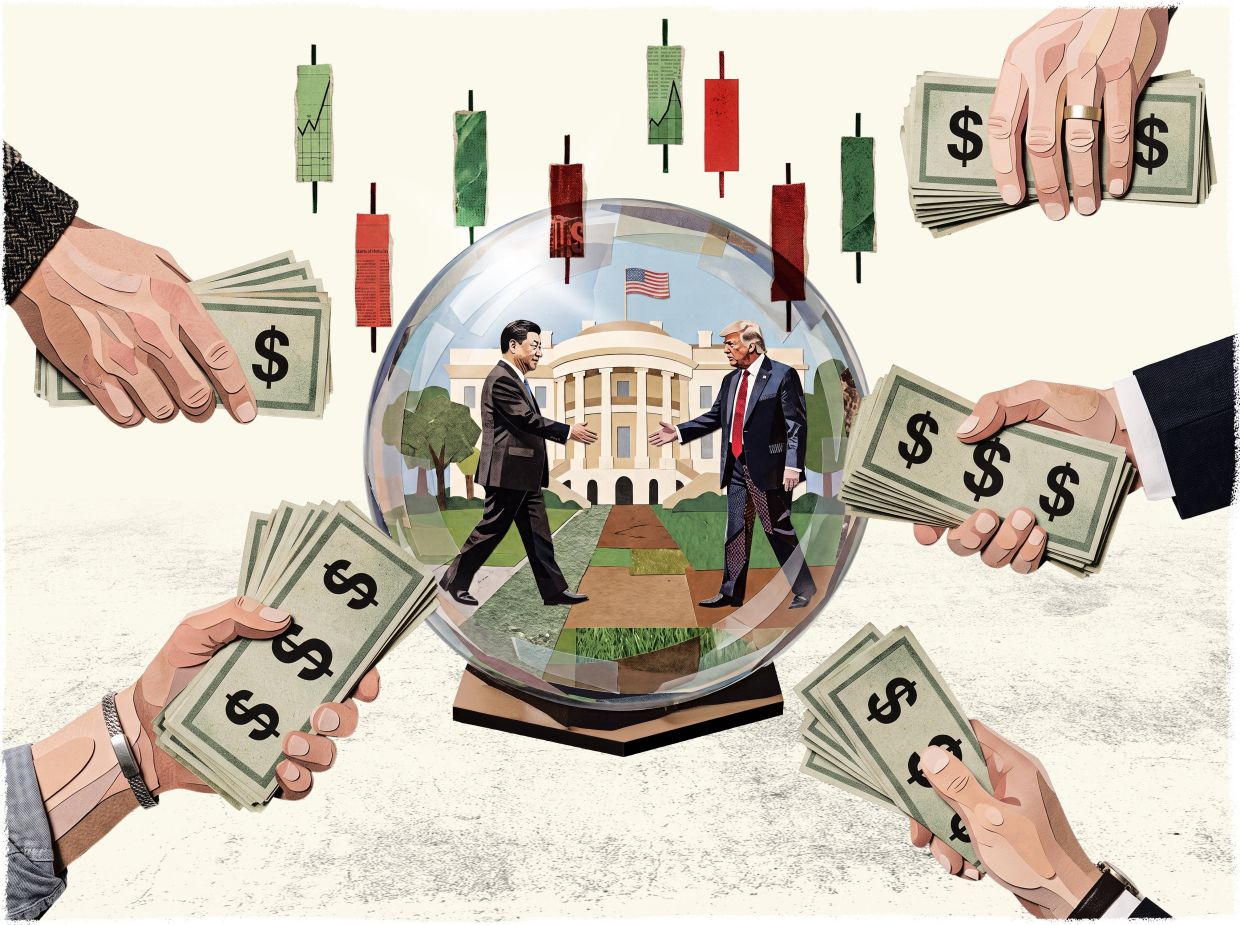
Traders are already pricing the odds of the visit. As of August 27, Polymarket contracts on whether Trump would meet Xi in September and whether Xi would visit the US by September 30 were both priced at about 95 per cent.
Polymarket put the probability of Xi visiting the US by the end of September at 94 per cent. At Kalshi, another prediction market, the chance of a visit before October stood at 88 per cent.
The wager, however, is about to get more complicated. As the expected summit approaches, traders will move beyond the simple question of whether the Chinese president will get on the plane and begin pricing what will happen once he arrives.
Will Trump and Xi announce a trade deal, cut tariffs , make progress on artificial intelligence, or discuss semiconductor controls? Will they say something about Taiwan, or at least strike a conciliatory tone?
Sub-markets linked to Trump’s May visit to Beijing even included the prospect of the two leaders embracing, with “yes” odds that at one point ran into the teens before the market later resolved to “no”.
The growing range of such wagers, observers note, may offer a new way to measure what the world expects next – while also creating the risk that those expectations begin to shape what happens next.
Samuel Lazarus, a research associate at the Council on Foreign Relations, anticipates a “litany” of contracts to emerge around the expected Xi-Trump summit , covering everything from major policy decisions to the “buzzwords” the two leaders might use.
“We should expect markets on potential tariff reductions, progress on the US-China Board of Trade , potential cooperation on AI safety, possible revisions to semiconductor export controls, new or updated purchase and sale agreements, the United States’ pending arms sales to Taiwan, and, of course, rumblings about a ‘fourth communique’,” Lazarus said.
Some contracts will be tied to concrete policy outcomes. Others will be “mention markets”, where the wager comes down to whether Trump or Xi say a particular word or phrase.
But Lazarus cautioned against mistaking every market movement for a meaningful shift in the relationship.
“Markets and analysts are hardly pricing in a major shift in bilateral relations, such as major changes to baseline tariff levels or the status quo in the Taiwan Strait ,” he said.
Trump’s “spontaneity and bluster”, he added, made for “good fodder in mention markets, but his statements have generally proved to be noise, not signal, with respect to the trajectory of the relationship”.
“Instead, the inertia of strategic competition has proved dominant, while prediction markets have proved useful in pricing tactical shifts,” he said.
Hilton Root, a professor of public policy at the Schar School of Policy and Government of George Mason University, in Virginia, noted that during the May meeting markets covered attendance, particular words Trump might use, specific announcements and the possibility of a tariff agreement .
“Kalshi has also offered contracts on a Xi visit to the United States, the tariff rate on China, and even the duration of a Trump-Xi handshake . I would expect many more contracts of this kind as another meeting approaches,” he said.
However, Root added that the prediction markets’ “limitation is equally important to recognise”.
“ Prediction markets favour outcomes that are defined beforehand, publicly observable, and easy to settle,” he said.
“They can price whether a tariff is reduced, an agreement is signed, or a particular phrase is used. They cannot readily price what may be the summit’s most valuable result,” he said, referring to the possibility of greater stability in the US-China relationship.
That distinction could be particularly important for Beijing. Chinese officials have spent years learning how to operate around Trump’s unpredictability .
Sourabh Gupta, a senior fellow at the Institute for China-America Studies, said Beijing was unlikely to let individual presidential comments, or the prediction markets reacting to them, derail its broader objectives.
“Beijing has learned to look beyond the president’s individual, erratic utterances,” Gupta said. It could still watch the overall direction of Trump’s comments “as a general pulse check of his inclinations”, he added, but individual statements would be unlikely to affect Beijing’s strategy .
“While individual utterances may move prediction markets, [they are] unlikely to deflect Beijing from its summit goals and priorities,” Gupta said. Chinese officials “have learned to disregard that which is realistically beyond their control”.
Instead, Beijing will focus on what actually happens. “Actions and adherence to commitments, and not sweet or sour words, are the bottom line by which they operate in their dealings with this administration,” Gupta said.
But the markets carry risks of their own.
The recent case of Gabriel Perez , a White House teleprompter operator placed on unpaid leave after using advance access to Trump’s remarks to bet on Kalshi, showed how quickly privileged information can acquire a dollar value.
A US Army Special Forces soldier was also accused of using advance knowledge of the operation to capture Venezuelan leader Nicolas Maduro to place winning bets on prediction markets.
The stakes are potentially higher around a Xi-Trump summit. Knowing a president will utter “China” in a speech is one thing. Knowing in advance that the US is preparing to loosen semiconductor restrictions, change its position on Taiwan or announce a major tariff concession is something else entirely.
Geopolitical prediction markets create “perverse incentives for government officials to trade on closely held, often classified, information”, according to Lazarus.
At the same time, market transparency provided some protection, and most insiders were either prevented from trading or identified after the fact, he said.
Still, regulators should narrow the scope of listed markets, particularly on offshore exchanges, to “minimise the risk of sensitive information leaking by way of insider trades”, Lazarus said.
The damage caused by leaked government secrets , he warned, had the potential to be both permanent and highly costly.
Prediction markets do not need privileged information to become influential. A relatively small amount of money can move a thin market, and the resulting price can take on a significance far beyond the original bet.
Matthew Wein, a US national security policy expert, warned in a February commentary published by the Atlantic Council that a thinly traded market “could be meaningfully shifted by a single six-figure trade”.
When it comes to a Trump-Xi summit , a sudden move in the odds on a tariff deal or Taiwan-related announcement could be interpreted as a signal that someone knows something, even when it may simply reflect one large bet.
Treating such movements as transparent reflections of public belief, Wein cautioned, risked “granting disproportionate narrative power to actors with both the capital and the incentive to shape prices”.
That possibility is especially interesting in the case of China, where summit diplomacy is typically tightly controlled and carefully choreographed. But Beijing may simply decide to ignore the noise.
Gupta argued that prediction-market distortions could “throw a curveball or two and sour the atmosphere”.
Still, he said, “Beijing is not the type of protagonist to be deflected by such forces”. These are “trivialities in the course of statecraft that just have to be stared down or, better yet, ignored”.
Yun Sun, director of the China programme at Washington-based think tank the Stimson Centre, is similarly cautious about reading too much into the market.
“As it stands now, the trip is expected to happen,” she said. But she sees a more fundamental question ahead: what can the summit actually deliver?
“The market will react to any potential news,” Sun said. “But for this trip, it will be hard to expect major deliverables on specific industries or sectors.
“The low-hanging fruits were picked during the May trip,” she said, adding that “implementation of existing agreements remains difficult, including follow-up to the Boeing deal ”.
“Rumours will always bubble,” Sun added. “But having a practical baseline expectation is more important at this stage.”
Still, Lazarus contended that prediction markets remained “an indispensable tool for navigating an increasingly volatile international landscape and, of course, a uniquely improvisational president”.
With appropriate guardrails, they could provide a “weighted average of popular expectations” at a time when geopolitical forecasting was becoming harder.
“The stakes today are simply too high to outsource all geopolitical forecasting to the commentariat, the whims of the algorithm, or the promises of those who lead us.”
And that may be the real test of the Xi-Trump summit: whether these markets can help reveal what the world expects next, without becoming part of what happens next. -- SOUTH CHINA MORNING POST
Thank you for your report!
Trump says China is driving anger at US data centres. These residents disagree, reports SCMP
SMG, SCMP ink MOU aimed at strengthening business ties between M'sia, Hong Kong
SMG and SCMP ink landmark deal
美国总统唐纳德·特朗普已经宣布了日期:9月24日。
特朗普表示,届时中国国家主席习近平将访问白宫,此前这位奉行“美国优先”的领导人已于5月对北京进行了为期三天的访问。
但其中存在一个外交上的难题。
特朗普政府已公开将该日期列入日程。北京方面尚未正式宣布习近平主席访美行程。
据知情人士透露,习近平预计将于9月23日抵达华盛顿,9月25日离开,与特朗普在中国的最后三天行程安排一致。
《南华早报》8月1日率先报道称,习近平很可能留在华盛顿,而不是前往美国其他城市。
交易员们已经开始评估此次访问的可能性。截至8月27日,Polymarket关于特朗普是否会在9月与习近平会面以及习近平是否会在9月30日前访美的合约价格均约为95%。
Polymarket预测习近平在9月底前访美的概率为94%。另一家预测市场Kalshi则认为,习近平在10月前访美的概率为88%。
然而,这场博弈即将变得更加复杂。随着峰会临近,交易员们将不再仅仅关注中国国家主席是否会登机,而是开始评估他抵达后可能发生的情况。
特朗普和习近平会宣布达成贸易协议、降低关税、在人工智能领域取得进展,还是会讨论半导体管制问题?他们会谈及台湾问题,或者至少表现出和解的姿态吗?
与特朗普 5 月访问北京相关的子市场甚至包括两位领导人拥抱的可能性,“是”的赔率一度达到十几,之后市场才确定为“否”。
观察人士指出,此类赌注范围的不断扩大,可能提供了一种衡量世界对未来预期的新方法——同时也带来了这样的风险:这些预期开始影响未来发生的事情。
外交关系委员会研究员塞缪尔·拉扎勒斯预计,围绕即将到来的习近平-特朗普峰会将出现“一系列”合同,涵盖从重大政策决定到两位领导人可能使用的“流行语”的一切内容。
拉扎勒斯表示:“我们应该关注市场对潜在关税削减、美中贸易委员会进展、人工智能安全方面的潜在合作、半导体出口管制可能修订、新的或更新的购销协议、美国即将对台湾出售武器,当然还有关于‘第四次公报’的传闻。”
部分合约将与具体的政策结果挂钩。另一些则是“提及市场”,赌注取决于特朗普或习近平是否会说出某个特定的词语或短语。
但拉扎勒斯告诫人们不要将每一次市场波动都误认为是双方关系发生的重大转变。
他说:“市场和分析师几乎没有考虑到双边关系的重大转变,例如基本关税水平的重大变化或台湾海峡现状的改变。”
他补充说,特朗普的“自发性和虚张声势”为“媒体报道提供了很好的素材,但就两国关系的走向而言,他的言论通常被证明是噪音,而不是信号”。
“相反,战略竞争的惯性占据了主导地位,而预测市场在为战术转变定价方面发挥了作用,”他说。
弗吉尼亚州乔治梅森大学沙尔政策与政府学院的公共政策教授希尔顿·鲁特指出,在 5 月份的会议期间,市场关注了出席人数、特朗普可能会使用的特定措辞、具体公告以及达成关税协议的可能性。
“卡尔希还就习近平访美、对华关税税率,甚至特朗普与习近平握手的时长等事宜提供过合同。随着下一次会晤的临近,我预计还会有更多类似的合同,”他说道。
然而,Root补充说,预测市场的“局限性同样值得重视”。
他说:“预测市场更倾向于那些事先定义好、公开可见且易于结算的结果。”
“他们可以对降低关税、签署协议或使用特定措辞进行定价。但他们无法轻易对峰会可能带来的最有价值的成果进行定价,”他说道,指的是美中关系更加稳定的可能性。
这一区别对北京而言可能尤为重要。中国官员多年来一直在学习如何应对特朗普的不可预测性。
中国美国研究所高级研究员索拉布·古普塔表示,北京不太可能让个别国家主席的讲话,或者对此做出反应的预测市场,破坏其更广泛的目标。
古普塔表示,“北京已经学会了不去关注总统个别的、反复无常的言论。”他补充说,北京仍会关注特朗普言论的总体走向,“以此来大致了解他的倾向”,但个别言论不太可能影响北京的战略。
古普塔表示:“虽然个别言论可能会影响预测市场,但不太可能改变北京的峰会目标和优先事项。”他还说,中国官员“已经学会了对那些实际上超出他们控制范围的事情置之不理”。
相反,北京方面将关注实际行动。“行动和信守承诺,而不是花言巧语,才是他们与本届政府打交道的底线,”古普塔说。
但市场本身也存在风险。
最近的案例表明,白宫提词器操作员加布里埃尔·佩雷斯利用提前获知特朗普讲话的机会押注卡尔希,结果被停职且不支付薪水。佩雷斯的案例表明,特权信息可以多么迅速地获得金钱价值。
一名美国陆军特种部队士兵还被指控利用事先掌握的有关抓捕委内瑞拉领导人尼古拉斯·马杜罗行动的信息,在预测市场上进行赌博并获胜。
围绕习近平-特朗普峰会的利害关系可能更大。知道一位总统会在演讲中提到“中国”是一回事,但提前知道美国正准备放松半导体限制、改变对台立场或宣布重大关税让步则完全是另一回事。
拉扎勒斯表示,地缘政治预测市场“会给政府官员带来反常的激励,让他们利用高度保密、通常是机密的信息进行交易”。
他表示,与此同时,市场透明度提供了一定的保护,大多数内部人士要么被阻止进行交易,要么事后被识别出来。
拉扎勒斯表示,监管机构仍应缩小上市市场的范围,尤其是在离岸交易所,以“最大限度地降低敏感信息通过内幕交易泄露的风险”。
他警告说,政府机密泄露造成的损害有可能是永久性的,而且代价极其高昂。
预测市场并不需要掌握内幕消息才能产生影响力。相对较少的资金就能撼动交易清淡的市场,而最终的价格走势可能具有远远超出最初投注金额的意义。
美国国家安全政策专家马修·韦恩在大西洋理事会二月份发表的一篇评论中警告说,交易量稀少的市场“可能会因一笔六位数的交易而发生重大变化”。
就特朗普与习近平的峰会而言,关税协议或与台湾相关的声明赔率的突然变化可能被解读为有人知道某些事情的信号,即使这可能仅仅反映了一次大手笔的投注。
Wein 警告说,如果将此类运动视为公众信念的透明反映,则有可能“赋予那些既有资本又有动机影响价格的行动者不成比例的叙事权力”。
就中国而言,这种可能性尤其值得关注,因为中国的峰会外交通常受到严格控制和精心策划。但北京也可能选择对这些杂音置之不理。
古普塔认为,预测市场的扭曲可能会“带来一两个意想不到的结果,破坏市场气氛”。
不过,他表示,“北京并非那种会被此类势力左右的主角”。这些都是“治国理政中的琐事,只需直面它们,或者最好是置之不理”。
华盛顿智库史汀生中心中国项目主任孙云也同样对过度解读市场持谨慎态度。
“就目前情况来看,这次访问预计会成行,”她说。但她认为摆在面前的是一个更根本的问题:这次峰会究竟能带来什么成果?
孙先生表示:“市场会对任何潜在的消息做出反应。但就此次行程而言,很难指望在特定行业或领域取得重大成果。”
“五月份的访问中,我们已经摘取了最容易摘取的果实,”她说道,并补充说,“现有协议的执行仍然很困难,包括波音交易的后续工作”。
孙补充道:“谣言总是会不断涌现,但现阶段更重要的是要有一个切合实际的预期。”
不过,拉扎勒斯认为,预测市场仍然是“应对日益动荡的国际形势以及一位极具即兴精神的总统的不可或缺的工具”。
在适当的指导下,它们可以提供“民众期望的加权平均值”,而此时地缘政治预测变得越来越困难。
“如今的形势太过严峻,我们不能将所有地缘政治预测都外包给评论员、算法的随机应变,或是领导人的承诺。”
这或许才是习近平-特朗普峰会的真正考验:这些市场能否在不成为未来事件一部分的前提下,帮助揭示世界对未来的预期。——《南华早报》
感谢您的报告!
特朗普称中国煽动民众对美国数据中心的愤怒。据《南华早报》报道,当地居民对此表示反对。
SMG与SCMP签署谅解备忘录,旨在加强马来西亚与香港之间的商业联系
SMG和SCMP签署里程碑式协议