Meet Israel’s ‘Suicide Squad’ of Self-Sacrificing Drones认识一下以色列的“自杀小队”——一支自我牺牲的无人机队伍
Israel has pretty much written the book on using light unmanned aircraft to obliterate enemy air defenses.
Updated Sep 29, 2021 4:57 AM EDT
When you first see Israel Aircraft Industries’ Harop drone, the “Star Trek” association is unmistakable. Like the Klingon Bird of Prey it resembles, the Harop is small, maneuverable, nearly impossible to detect, relatively inexpensive, and is downright deadly. And when it comes to accomplishing its mission, it even operates on the belief that “today is a great day to die.”
The diminutive drone doesn’t carry any munitions; it doesn’t need to, because it is the munition . A 50-pound high explosive charge is part of the Harop itself, and if it finds an enemy radar or another target of opportunity in its vicinity, it will creep up, and once close enough, dive right into it, blowing itself and the target to bits in the process.
Mission accomplished!
Harop is primarily a Suppression of Enemy Air Defenses (SEAD) weapon system, used to neuter an enemy’s radio frequency-emitting sensor capabilities. Using drones to help destroy and confuse an unfriendly air defense network is something Israel knows a lot about, as they’ve been using them to do just that since the Yom Kippur War in 1973.
During the conflict, the Israeli Air Force used Firebee and Chukar drones furnished by the US to distract, confuse, and stimulate enemy radar—much like the US had in Vietnam. The tactics helped blunt Israeli combat aircraft losses, and clearly, the IAF knew they were onto something.
Following the Yom Kippur War, Israel began manufacturing their own simple unmanned aircraft, most of which had the same twin tail-boom configuration as many modern (and much larger) unmanned aircraft flying for the IAF today. But these were far simpler systems, with lower performance than the Chukars and Firebees used in combat in 1973. But what they lacked in performance they made up for in expendability and numbers.
Harop drone on display at the 2013 Paris Air Show., Julian Herzog
In the late 1970s and early 1980s, the IAF’s growing armada of unmanned aircraft was flying missions over Lebanon, surveying for Syrian air defense batteries and military emplacements. Some were shot down by the growing surface-to-air missile system network being installed by Syria in the region. But that didn’t matter, since the designs were built for high-risk and even one-way missions.
In 1982, when open hostilities broke out in Lebanon, Israel put its drones to use on a massive scale. It was dubbed Operation Mole Cricket 19—the plan to rapidly eradicate Syrian air defenses in the Bekaa Valley. In just a matter of hours, it did just that.
Israeli Mastiff drone, like the ones used during the Mole Cricket 19 operation., Bukvoed/wikicommons
In the afternoon of June 9th, drone after drone flooded into the Lebanese airspace, acting as decoys that would bait Syrian air defenses into activating their radar systems. This allowed Israeli fighters to swoop in and launch anti-radiation missiles and direct attacks on the radar and/or surface-to-air missile sites, and get away unscathed.
Scout and Mastiff drones were used in the highly technical and ground-breaking operation. It was the first time western hardware had totally eradicated a Soviet-designed and furnished integrated air defense network. Without radars, SAMs were useless and vulnerable to attack. Additionally, Syrian fighter pilots, trained under the Soviet doctrine that centered around direction from ground-based radar intercept controllers, were essentially blind. Selective jamming by the IDF of Syrian Air Force radio frequencies made them even more vulnerable.
Israeli unmanned air vehicles were even stationed over Syrian airfields to watch as MiGs took to the skies. This information was immediately passed on to orbiting E-2C Hawkeyes that directed Israeli fighters to engage the emerging fighters.
With Israeli F-15’s beyond-visual-range AIM-7 Sparrows, Syrian fighters could find themselves engaged without ever seeing their opponents. Additionally, the fact that Israel possessed AIM-9 Sidewinders with all-aspect targeting capabilities (i.e. not having to shoot an enemy from their rear quarter) meant many Syrian MiGs were essentially shot in the face at close range.
It was a slaughter, and a cutting-edge technological combat opera for the world to see. In just the first day of operations, lasting just a few hours, 17 of the 19 SAM sites in and around the Bekaa Valley were obliterated and 29 Syrian tactical aircraft were swatted from the sky. As a result, the battle was dubbed the “Bekaa Valley Turkey Shoot.”
The incredibly lopsided and rapid victory proved the technological supremacy of western air combat over Soviet air defenses, and likely helped bring about the end of the Cold War. Lessons learned from the conflict also figured heavily into future American combat air operations. But above all, it proved the incredible utility of drones—not just for intelligence gathering in real time, but for their ability to assist in dismantling integrated air defense systems.
With this success in mind, Israeli weapons manufacturers started tooling with the idea of completely eliminating the hunter-killer kill chain concept. In other words, instead of unmanned aircraft provoking enemy radars to activate, then sending their location to command and control who then vectors in fighters to engage the radars with expensive anti-radiation missiles and other precision guided munitions, just have the drone do it all autonomously.
This was realized to a certain degree with existing drones that were modified for the mission in the years following the Bekaa Valley Turkey Shoot, but by the 1990s, a small and stealthy “loitering munition” was being fielded just for this purpose—the IAI Harpy.
The IAI Harpy on display at the Paris Air Show., Jastrow/wikicommons
The Harpy was relatively tiny, with a wingspan of just under seven feet and packing a 38-hp rotary engine. But what it lacked in size the little flying-wing drone made up for in punching power, packing a 70-hp high-explosive warhead. On its nose was its most critical piece of equipment, a seeker head capable of detecting and homing in on certain radar frequencies.
The idea was that a single truck could carry and launch dozens of Harpys to act as both bait and hook, flying to their predetermined target area where they would wait for enemy radars to come online. If that were to occur, the Harpy would fly right at the emitter, blowing itself up on arrival and taking the radar system with it.
It was an ingenious and cost-effective weapon system, albeit a one-trick-pony and more of a fire-and-forget SEAD missile than a reusable unmanned aircraft with a propensity toward suicide. Still, the Harpy has been an export success, with India, Turkey, China, Chile, and South Korea buying the system in quantity.
In the late 1990s, Israel began working on a follow-on to the Harpy. It would be a larger design that could be reconfigured for multiple uses, including attacking radars, providing both electronic and electro-optical intelligence, attacking targets of opportunity on the ground (say, vehicles). Plus, it could even be outfitted to come back home and be reused again.
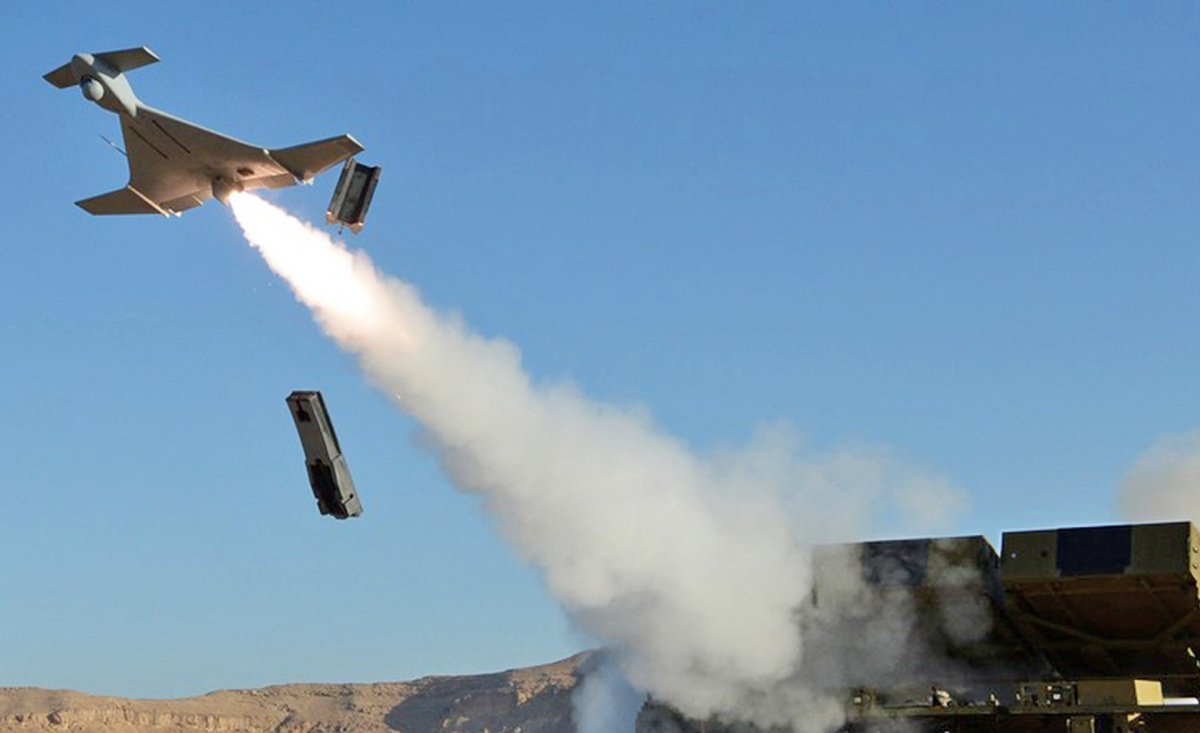
Harop, with its folding wings, can be launched from a truck- or ship-mounted canister, or configured for air-launch. Once in the air, it can be operated by man-in-the-loop control or it can go about its mission totally autonomously. Either way, it can put its warhead to use, using its camera system and operator to track and engage moving targets or its radiation-seeker to sniff out and attack radar sites on its own. It can even be equipped for both missions at the same time, so that if a radar site were to go offline after a Harpy detected it, it can fly to its location and use electro-optical targeting to locate and kill it.
A huge difference between Harop and the Harpy is range and loitering time, with the modern iteration packing about double that of its simpler predecessor, or about 600 miles or six hours. That, plus the fact that it can be equipped to return home autonomously and land once its fuel runs low.
The Harop being launched from a canister., IAI
Basically, the Harop—which has the radar signature of a small bird and virtually no infrared signature whatsoever—offers an inexpensive solution for many unmanned missions in a small, transportable, and optionally reusable package. You can imagine that if you are the enemy, having dozens or even hundreds of these things roaming your countryside during a time of conflict would be pretty terrifying.
In the suppression of enemy air defenses role, you can also imagine that just having a swarm of Harops decend into the area of operations before a major set of airstrikes would keep enemy radar operators from turning on their systems at all. In this case, the Harop accomplishes its mission without even having to destroy itself in the process.
The Harop, like its progenitor, is already an export success, with India and Azerbaijan purchasing the system. In fact, it was put to use with devastating results by the Azeris just last spring, during fighting with the Armenians. The attack drone supposedly hit a bus full of soldiers , killing half a dozen of them in the process, and destroying the bus.
This is what a real-world attack by a Harop looks like:
In many ways, Israel is far ahead of even the US when it comes to easily deployable “loitering attack munitions.” The American-made AeroVironment Switchblade , which is a small, man-portable loitering unmanned aircraft with attack capabilities, is in a whole different class than the far more advanced and strategically relevant Harop—or even the Harpy for that matter.
In fact, Israel has its own version of this system, the ROTEM , and they even have another, larger system, the Green Dragon , that is also forward-deployed with troops, but with more capabilities and endurance.
The truth is that all indicators point to a future where suicidal drones are the norm, not the exception. As such, a bull market is emerging around the concept. Even American domestic law enforcement has crossed over the robotic killer line .
What’s really exciting—or terrifying, depending on how you look at it—is just what the Harop could be capable of if a large quantity of them were networked together as swarm . Using electronic and kinetic attacks, they could wreak havoc on an enemy’s integrated air defense system in a cooperative fashion. Projects like DARPA’s Gremlins aim to accomplish just that , and do it via airborne launch and recovery—although this is likely just the tip of the iceberg when it comes to what is actually out there in the classified world.
An artist rendering of DARPA’s Gremlins project. , DARPA
In the meantime, Israel’s Harop will reign supreme as the most versatile suicide drone on the planet, and one that has already been used effectively in combat.
Contact the author: Tyler@thedrive.com
Comments couldn’t be loaded. Please refresh the page.
更新于美国东部时间2021年9月29日凌晨4:57
当你第一次看到以色列飞机工业公司的哈罗普无人机时,它与《星际迷航》的联系显而易见。就像它外形酷似的克林贡猛禽战舰一样,哈罗普体积小巧、机动灵活、几乎无法被探测到、价格相对低廉,而且威力十足。在执行任务时,它甚至秉持着“今天是个好日子”的信念。
这种小型无人机本身不携带任何弹药;它不需要,因为它本身就是弹药。哈罗普无人机内置一枚50磅重的高爆炸药,如果它发现附近有敌方雷达或其他目标,它就会悄悄靠近,一旦足够接近,就会俯冲攻击,将自身和目标炸成碎片。
任务完成!
“哈罗普”无人机主要是一种压制敌方防空系统(SEAD)的武器系统,用于削弱敌方的射频发射传感器能力。以色列非常擅长利用无人机摧毁和干扰敌方防空网络,自1973年赎罪日战争以来,他们就一直在使用无人机执行此类任务。
冲突期间,以色列空军使用了美国提供的“火蜂”(Firebee)和“丘卡尔”(Chukar)无人机,以干扰、迷惑和扰乱敌方雷达——这与美国在越南战争中的策略非常相似。这些战术有效减少了以色列战斗机的损失,显然,以色列空军意识到他们的策略奏效了。
赎罪日战争后,以色列开始自行生产简易无人机,其中大多数都采用了与如今以色列空军许多现代化(且尺寸更大)无人机相同的双尾梁布局。但这些系统远比1973年战争中使用的“丘卡尔”和“火蜂”无人机简单,性能也更低。不过,它们虽然性能欠佳,但胜在数量多且易于消耗。
哈罗普无人机在2013年巴黎航展上展出。(朱利安·赫尔佐格摄)
20世纪70年代末80年代初,以色列空军日益壮大的无人机群在黎巴嫩上空执行任务,侦察叙利亚的防空阵地和军事设施。一些无人机被叙利亚在该地区不断部署的地对空导弹系统击落。但这无关紧要,因为这些无人机的设计初衷就是为了执行高风险甚至单程任务。
1982年,黎巴嫩爆发公开冲突后,以色列大规模使用无人机。这项行动代号为“鼹鼠蟋蟀19号行动”,旨在迅速摧毁贝卡谷地的叙利亚防空系统。短短几个小时内,以色列就完成了这项任务。
以色列獒犬无人机,类似于“鼹鼠蟋蟀19”行动中使用的那种。(图片来源:Bukvoed/wikicommons)
6月9日下午,一架又一架无人机涌入黎巴嫩领空,充当诱饵,引诱叙利亚防空系统启动雷达。这使得以色列战机得以迅速接近,发射反辐射导弹,直接攻击雷达站和/或地对空导弹阵地,并毫发无损地撤离。
侦察兵和獒犬无人机被用于这次技术含量极高且具有开创性的行动。这是西方装备首次彻底摧毁苏联设计和提供的综合防空网络。没有雷达,地空导弹毫无用处,极易受到攻击。此外,叙利亚战斗机飞行员接受的是以地面雷达拦截控制员指挥为中心的苏联作战理论训练,他们基本上处于盲区。以色列国防军对叙利亚空军无线电频率的选择性干扰使他们更加脆弱。
以色列甚至派遣无人机盘旋在叙利亚机场上空,监视米格战机的升空。这些信息立即传递给盘旋在空中的E-2C“鹰眼”预警机,后者引导以色列战斗机与这些升空的战机交战。
以色列F-15战机配备的超视距AIM-7“麻雀”导弹,使得叙利亚战机在完全看不到对手的情况下就可能遭遇战。此外,以色列还拥有具备全方位瞄准能力的AIM-9“响尾蛇”导弹(无需从敌机后方射击),这意味着许多叙利亚米格战机在近距离几乎是被以色列正面击落。
这是一场屠杀,也是一场举世瞩目的尖端科技战争。在行动的第一天,短短几个小时内,贝卡谷地及其周边地区的19个地空导弹阵地中有17个被摧毁,29架叙利亚战术飞机被击落。因此,这场战斗被戏称为“贝卡谷地火鸡射击”。
这场一边倒、迅速的胜利证明了西方空战在技术上对苏联防空系统的优势,并可能促成了冷战的结束。从这场冲突中汲取的经验教训也对美国未来的空战行动产生了深远的影响。但最重要的是,它证明了无人机的巨大效用——不仅能够实时收集情报,还能协助瓦解敌方一体化防空系统。
鉴于此成功,以色列武器制造商开始着手彻底摒弃猎杀链的概念。换句话说,不再需要无人机诱使敌方雷达启动,然后将位置信息发送给指挥控制中心,再由指挥控制中心引导战斗机使用昂贵的反辐射导弹和其他精确制导武器攻击雷达,而是让无人机自主完成所有操作。
在贝卡谷火鸡射击比赛之后的几年里,人们通过对现有无人机进行改装来实现这一目标,但到了 20 世纪 90 年代,一种小型隐蔽的“巡飞弹”——IAI Harpy——被部署用于此目的。
在巴黎航展上展出的IAI Harpy战斗机。(图片来源:Jastrow/wikicommons)
“哈比”无人机体型相对较小,翼展不足七英尺,配备一台38马力的旋转发动机。但它虽小,火力却十分强大,搭载了一枚70马力的高爆弹头。机头装有其最关键的设备——导引头,能够探测并追踪特定雷达频率。
设想是,一辆卡车可以运载并投放数十架“哈比”无人机,它们既是诱饵又是钩子,飞往预定目标区域,等待敌方雷达启动。一旦雷达启动,“哈比”无人机就会直接冲向雷达发射器,在抵达时自爆,并将雷达系统摧毁。
它是一款设计巧妙且成本效益高的武器系统,尽管功能单一,与其说是可重复使用的无人机,不如说更像是一枚发射后不管的防空压制导弹,而且还有自杀倾向。尽管如此,“哈比”导弹的出口却非常成功,印度、土耳其、中国、智利和韩国都大量采购了该系统。
上世纪90年代末,以色列开始研发“哈比”无人机的后续型号。这款无人机体型更大,可以重新配置用于多种用途,包括攻击雷达、提供电子和光电情报、攻击地面机会目标(例如车辆)。此外,它甚至可以改装成可以返回以色列并再次使用的无人机。
“哈罗普”导弹配备可折叠机翼,可从卡车或舰载发射筒发射,也可配置为空射。升空后,它既可采用人机协同控制,也可完全自主执行任务。无论哪种方式,它都能使用其弹头,利用其摄像系统和操作员跟踪并攻击移动目标,或利用其辐射导引头自主探测并攻击雷达站。它甚至可以同时执行这两种任务,这样,如果雷达站被“哈比”导弹探测到后发生故障,“哈罗普”导弹可以飞到其位置,利用光电瞄准系统将其定位并摧毁。
Harop 和 Harpy 之间最大的区别在于航程和滞空时间,现代 Harop 的航程大约是其结构更简单的前代产品的两倍,约为 600 英里或 6 小时。此外,Harop 还可以配备自主返航功能,在燃料不足时自动降落。
哈罗普导弹从发射筒中发射。以色列航空工业公司
简而言之,Harop无人机雷达信号特征与小型鸟类相似,红外信号特征几乎为零,它体积小巧、便于运输,并且可选地可重复使用,为许多无人任务提供了一种经济实惠的解决方案。您可以想象,如果您是敌人,在战乱时期,几十甚至几百架这样的无人机在您的乡村地区游荡,那将是多么可怕的事情。
在压制敌方防空系统方面,可以想象,在进行大规模空袭之前,只需让一大群“哈罗普”无人机降落到作战区域,就能彻底阻止敌方雷达操作员启动系统。在这种情况下,“哈罗普”无人机无需牺牲自身就能完成任务。
哈罗普无人机与其前身一样,出口成绩斐然,印度和阿塞拜疆都已购买了该系统。事实上,就在去年春天,阿塞拜疆在与亚美尼亚的冲突中就曾使用过它,并取得了毁灭性的战果。据称,这架攻击型无人机击中了一辆满载士兵的巴士,造成六名士兵死亡,巴士也被摧毁。
这就是哈罗普在现实世界中发动攻击的真实样貌:
在许多方面,以色列在易于部署的“巡飞攻击弹药”方面甚至远远领先于美国。美国制造的AeroVironment Switchblade是一种小型、单兵便携式巡飞无人机,具备攻击能力,它与更先进、更具战略意义的Harop无人机,甚至与Harpy无人机都完全不在一个级别。
事实上,以色列有自己的类似系统,即 ROTEM,他们甚至还有另一个更大的系统,即绿龙系统,该系统也与部队一起前沿部署,但功能更强大,续航能力更强。
事实上,所有迹象都表明,未来自杀式无人机将成为常态而非例外。因此,围绕这一概念的市场正在蓬勃发展。甚至美国国内执法部门也已经越过了机器人杀手的界限。
真正令人兴奋——或者说令人恐惧,取决于你的视角——的是,如果将大量“哈罗普”无人机联网组成集群,它们将能发挥怎样的作用。利用电子和动能攻击,它们可以协同作战,对敌方的综合防空系统造成严重破坏。像DARPA的“小精灵”(Gremlins)这样的项目正是旨在实现这一目标,并通过空中发射和回收来实现——但这可能只是冰山一角,因为在机密领域,还有更多技术正在研发中。
这是DARPA“小精灵”项目的艺术家渲染图。
与此同时,以色列的哈罗普无人机将作为地球上用途最广泛的自杀式无人机占据主导地位,并且已经在战斗中得到有效运用。
联系作者:Tyler@thedrive.com
评论加载失败,请刷新页面。