Area 51 Has Its Own Unique Fleet Of HH-60U Ghost Hawk Helicopters51区拥有其独特的HH-60U幽灵鹰直升机机队
Originally intended as replacements for the Air Force's aging HH-60G Pave Hawks, they now exclusively support operations at the top-secret base.
新闻视频
By Joseph Trevithick
Updated Dec 1, 2019 6:03 AM EST
Almost everything about the U.S. military’s Area 51 flight test facility, also known as Groom Lake, is shrouded in secrecy and mystery. This even extends to the base’s small and unique fleet of HH-60U rescue helicopters, sometimes called Ghost Hawks, which at least help provide security, local search and rescue, and other types of utility support in and around the base.
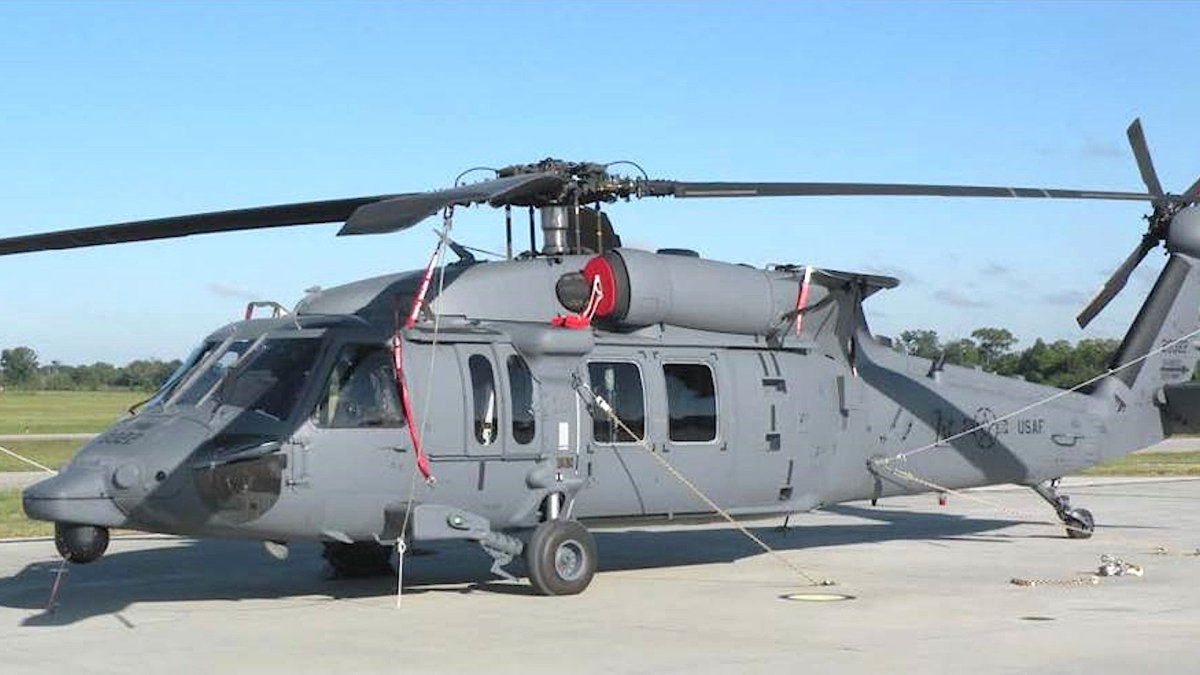
The Air Force is understood to have a total of four HH-60Us, one of which is seen at the top of this story and all of which are modified examples of the U.S. Army’s HH-60M Black Hawk medical evacuation (MEDEVAC), or “Dustoff,” helicopter. Area 51 watchers have determined that the U models are likely assigned to a unit colloquially know as the “ Ghost Squadron .” This helicopter unit is one of a number of secretive elements associated with Detachment 3, Air Force Flight Test Center, which appears to be one of the main Air Force entities at Groom Lake. Detachment 3 also reportedly oversees operations involving other more traditional aircraft and so-called “ Foreign Materiel Exploitation ,” or FME, examining non-American aircraft and systems at the secretive base, along with its other top-secret flight test duties.
The history of how the U models came into existence is similarly convoluted and nebulous as the history of their present home. By the end of the 2000s, with the strains of the Global War on Terror, it had become painfully obvious to the Air Force that its fleets of already aging HH-60G Pave Hawks , the first of which rolled off Sikrosky’s production lines in the 1980s, were getting overworked.
A US Air Force HH-60G Pave Hawk., USAF
The Air Force had kicked off a program to acquire new replacement combat search and rescue helicopters, known as CSAR-X, in 2006, but it had experienced numerous delays and contracting complications, a saga you can read about more in this past War Zone story . The service canceled the project for good three years later and subsequently began what it dubbed the Operational Loss Replacement (OLR) program.
Originally, the plan was for the Air Force to piggyback on Army contracts to buy new UH-60Ms and then convert those helicopters to a configuration similar to the Pave Hawks. The Army’s Aviation and Missile Research and Development Center’s (AMRDEC) Prototype Integration Facility (PIF) at Redstone Arsenal in Alabama was responsible for the initial conversions, beginning in 2010.
The new helicopters would be known as HH-60Us, a designation that caused particular consternation for Special Operations Forces (SOF) and Personnel Recovery Division of what was then known as the Aeronautical Systems Center at Wright-Patterson Air Force Base in Ohio, which was managing the OLR program, according to documents the author previously obtained via the Freedom of Information Act (FOIA). In July 2010, this office put in a request to designate these helicopters as HH-60Ws, or, if that was not possible, as HH-60Ps.
“We understand that DoD 4120-15 [the official U.S. military directive regarding assigned aircraft and missile designations] indicates that the series should be assigned in consecutive order,” the chief of the Rotary Wing Branch of the Special Operations Forces (SOF) and Personnel Recovery Division, who’s name is redacted in the request letter, wrote. “However, the ‘U’ which appears to be the next available series, has [a] negative connotation in the PR community.”
The note about the “negative connotation” with the HH-60U designation, as well as the Air Force’s official description for what it originally wanted to call the HH-60W., USAF via FOIA
The War Zone ‘s has had no luck in determining what this “negative connotation” is or was. One HH-60G pilot previously told the author that it could have to do with the “U” commonly standing for “unsatisfactory” across the Air Force. Whatever the case, the Air Force officials in charge of assigning aircraft designations rejected the request. It’s worth noting that, at this point, HH-60P had already been assigned to a rescue variant of the Black Hawk in service with the South Korean Air Force.
In 2011, the PIF delivered two of the new HH-60Us, which the Air Force described as “ minimally modified ” UH-60Ms in 2011. With the exception of their gray rather than green pain jobs, these helicopters were largely indistinguishable from the Army’s HH-60M configuration.
The U variants had the same FLIR Systems Talon sensor turret with electro-optical and infrared cameras under a duckbill-like sponson on the front of the nose and the rescue hoist on the right side of the fuselage as their Army cousins. The new helicopters lacked the inflight refueling probe and nose-mounted weather radar of the earlier Pave Hawks, though the Air Force had said that it planned to add that capability in later conversions, along with range-extending internal fuel tanks.
A US Army HH-60M., US Army
However, by 2012, the Air Force was already reconsidering whether or not to continue buying new UH-60M-based helicopters or take a more potentially cost-effective approach of acquiring second-hand UH-60Ls , the variant that the HH-60G was originally based on, with low flight hours and converting them into Pave Hawks.
The Air Force had also looked into a deep upgrade program for the existing Pave Hawks, known as the Block 152 configuration . A small number of HH-60Gs were converted to this standard, which most notably included repositioning the weather radar in the center of the nose, similar to the installation on the MH-60Ls, Ks, and Ms, assigned to the Army’s elite 160th Special Operation Aviation Regiment .
The modified Pave Hawks also had a more robust self-defense suite with radar warning receivers and missile warning sensors, as well as countermeasures dispensers loaded with flares and chaff built into the landing gear sponsons, in addition to the ones mounted on the rear fuselage. Some of these helicopters are based at Nellis Air Force Base in Nevada.
Between 2012 and 2014, the Air Force took delivery of two more HH-60Us in the same general configuration, but eventually decided to go with the converted L models. The service took delivery of the first L-based HH-60G OLR helicopter in 2016.
It’s unclear when the decision was made to send the small fleet of four Us to Groom Lake, but it seems plausible that it would have occurred after the decision to shift course in the OLR program. Lacking the inflight refueling probes and weather radars found on the G models, the HH-60Us are certainly better suited to shorter-range missions.
Based on the M, with its more powerful General Electric T700-GE-701D engines, these helicopters would have had better hot-and-high performance than the HH-60G, making them even better candidates for replacing the small contingent of Pave Hawks that had previously supported activities at Area 51. The base sits in the Nevada desert at an altitude of around more than 4,400 feet with surrounding mountain peaks that are even higher.
We do know that, by 2014, the Air Force’s 645th Aeronautical Systems Group, a special projects office better known as Big Safari, had taken responsibility for managing the HH-60Us. That year, the 661st Aeronautical Systems Squadron in Waco, Texas replaced the existing FLIR Systems sensor turrets on all of the helicopters with the L3 WESCAM MX-15HDi type.
The goal of the upgrade was to “improve the pilots’ situational awareness when flying low, at night, in mountainous terrain. etc,” according to another Air Force document the author obtained via FOIA. “A high definition monitor was also added at the Flight Engineer’s crew station, as were a fixed and tethered hand controller, and a video recorder.”
“The team also replaced the hoist system, which due to poor design saw the cable rubbing against the fuselage and presented a safety hazard,” the annual historical review added. “The modified helicopters typically delivered 35-40 days ahead of schedule.”
Little else is known as the HH-60U’s present configuration, which likely also includes additional communications systems and other equipment to perform the security and search and rescue functions for Area 51. The extent of its activities, and whether the Air Force also uses the helicopters for research and development or operational test and evaluation purposes is also unclear.
No available pictures indicate that these helicopters are armed, but any weapons mounted in the crew chief’s windows on either side of the aircraft, as is the case on standard Army Black Hawks, could be stowed when not in use. Personnel on board could easily carry small arms that they could use in flight or after inserting on the ground, as well.
Tourists looking to get a peak of Area 51 from Tikaboo Peak, which sits some 26 miles away, have caught glimpses of the helicopters flying around the base. Video footage of one of the HH-60Us in action appeared online in June.
The Dreamland Resort website also has a pair of photographs of one of the HH-60Us, serial number 10-20323, clearly showing its new MX-15HDi sensor turret, at Centennial Hills Hospital Medical Center in Northwest Las Vegas, Nevada. The helicopter had reportedly dropped off a patient on Aug. 7, 2019. The Air Force Safety Center responded to a FOIA request from The War Zone regarding this by saying it had no records of any mishap that resulted in the transportation of any individual to Centennial Hills. It is possible that this could have been part of an exercise as Centennial Hills would certainly be a likely destination for any casualty from Groom Lake in the event of an actual emergency .
Whether or not the Air Force would ever acquire additional HH-60Us is uncertain, but it would seem unlikely. Last year, Boeing and Italy’s Leonardo won the service’s competition to replace its aging UH-1N Twin Huey helicopters with a variant of the latter company’s AW-139, known as the MH-139 . Sikorsky, now a division of Lockheed Martin, had offered a version of the HH-60U.
Sikorsky did win the Air Force’s Combat Rescue Helicopter (CRH) contract for the HH-60G replacement, which, interestingly enough, is another Black Hawk variant designated the HH-60W . So, in the end, the service’s Personnel Recovery community is getting a helicopter with the designation it wanted nearly a decade ago.
It will be interesting to see if any HH-60Ws or MH-139s, the latter of which the Air Force intends to use for various security and light utility missions, eventually make their way to the Ghost Squadron to supplement or supplant the HH-60Us. In the meantime, we will be keeping our eyes out for any new details about Area 51’s unique helicopter fleet.
Contact the author: joe@thedrive.com
Comments couldn’t be loaded. Please refresh the page.
作者:约瑟夫·特雷维西克
更新于美国东部时间2019年12月1日上午6:03
美国军方51区飞行试验基地(又称格鲁姆湖)几乎一切都笼罩在神秘的面纱之下。就连基地内那支规模虽小却独具特色的HH-60U救援直升机队(有时被称为“幽灵鹰”)也同样神秘莫测。这些直升机至少在基地内外提供安保、局部搜救以及其他类型的后勤保障服务。
据了解,美国空军共拥有四架HH-60U型直升机,其中一架出现在本文开头图片中。所有这些直升机都是由美国陆军的HH-60M“黑鹰”医疗后送(MEDEVAC)直升机(又称“Dustoff”)改装而来。51区观察人士推测,这些U型直升机很可能隶属于一个俗称“幽灵中队”的部队。该直升机部队是空军飞行测试中心第三分遣队下属的众多秘密机构之一,而第三分遣队似乎是格鲁姆湖空军基地的主要空军机构之一。据报道,第三分遣队还负责监督其他更传统飞机的运行,以及所谓的“外国物资利用”(FME)项目,即在该秘密基地对非美国飞机和系统进行测试,此外还承担着其他高度机密的飞行测试任务。
U型直升机的诞生历史与它们如今的归宿一样错综复杂、扑朔迷离。到了21世纪末,随着全球反恐战争的压力,美国空军已经痛苦地意识到,其老旧的HH-60G“铺路鹰”直升机机队(该机型首架于20世纪80年代从西克罗斯基公司的生产线下线)已经不堪重负。
美国空军的HH-60G“铺路鹰”直升机。
美国空军于2006年启动了一项名为CSAR-X的新型战斗搜救直升机采购计划,但该计划遭遇了多次延误和合同纠纷,详情请参阅此前《战区》栏目的报道。三年后,空军彻底取消了该项目,并启动了所谓的“作战损失替换”(OLR)计划。
最初的计划是,空军借用陆军的合同购买新的UH-60M直升机,然后将这些直升机改装成类似于“铺路鹰”的配置。陆军航空与导弹研发中心(AMRDEC)位于阿拉巴马州雷德斯通兵工厂的原型集成设施(PIF)负责最初的改装工作,这项工作始于2010年。
根据笔者此前通过《信息自由法》(FOIA)获取的文件显示,这些新型直升机将被命名为HH-60U,这一命名令当时位于俄亥俄州赖特-帕特森空军基地的航空系统中心(现为特种作战部队)的人员救援部门和特种作战部队尤为不满,该中心负责管理OLR项目。2010年7月,本办公室提出申请,要求将这些直升机命名为HH-60W,如果无法实现,则命名为HH-60P。
“我们了解到,国防部4120-15号指令(美国关于飞机和导弹编号的官方军事指令)指出,编号应按顺序分配,”特种作战部队(SOF)旋翼机分部和人员救援处处长(其姓名在请求信中被隐去)写道。“然而,下一个可用的编号是‘U’,但在公关界,‘U’带有负面含义。”
关于HH-60U名称的“负面含义”的说明,以及美国空军最初想将HH-60W命名为HH-60W的官方描述,均来自《信息自由法》美国空军文件。
《战区》栏目一直未能查明这个“负面含义”究竟是什么。一位HH-60G飞行员此前告诉作者,这可能与空军内部常用的“U”代表“不合格”有关。无论如何,负责飞机命名的空军官员驳回了这一请求。值得注意的是,此时HH-60P已被分配给韩国空军服役的黑鹰救援型直升机。
2011 年,PIF 交付了两架新型 HH-60U,空军在 2011 年将其描述为“最小限度改装”的 UH-60M。除了涂装颜色为灰色而不是绿色之外,这些直升机与陆军的 HH-60M 配置基本没有区别。
U型直升机与陆军版本一样,机头前端鸭嘴状短翼下方装有FLIR Systems Talon传感器转塔,该转塔配备光电和红外摄像机;机身右侧则装有救援绞车。新型直升机缺少早期“铺路鹰”直升机的空中加油探管和机头气象雷达,但空军曾表示计划在后续改装中加装这些功能以及增程型内部油箱。
美国陆军HH-60M直升机。
然而,到了 2012 年,空军已经开始重新考虑是否继续购买新的 UH-60M 型直升机,或者采取一种可能更具成本效益的方法,即购买飞行时间较短的二手 UH-60L 型直升机(HH-60G 最初就是基于这种型号),并将其改装成铺路鹰直升机。
空军还曾考虑对现有的铺路鹰直升机进行深度升级,即所谓的Block 152配置。少量HH-60G直升机被改装成这种标准,最显著的改动是将气象雷达重新安装在机头中央,类似于陆军精锐的第160特种作战航空团所使用的MH-60L、K和M型直升机的安装方式。
改进型“铺路鹰”直升机还配备了更强大的自卫系统,包括雷达告警接收器和导弹告警传感器,以及安装在起落架侧裙板(除后机身外)的干扰弹和箔条干扰弹投放器。部分此类直升机驻扎在内华达州的内利斯空军基地。
2012年至2014年间,美国空军又接收了两架配置相同的HH-60U直升机,但最终决定采用改装后的L型。2016年,空军接收了首架基于L型改装的HH-60G远程远程直升机。
目前尚不清楚何时决定将这四架HH-60U小型机队派往格鲁姆湖,但很可能是在远程侦察(OLR)项目调整方向之后做出的决定。由于缺少HH-60G型机上的空中加油探管和气象雷达,HH-60U显然更适合短程任务。
这些直升机以M型为基础,配备了动力更强劲的通用电气T700-GE-701D发动机,其高温高海拔性能将优于HH-60G,因此更适合取代之前在51区执行任务的少量铺路鹰直升机。该基地位于内华达州沙漠,海拔超过4400英尺,周围环绕着更高的山峰。
我们知道,到 2014 年,空军第 645 航空系统大队(一个以“大狩猎行动”闻名的特种项目办公室)已经负责管理 HH-60U 直升机。同年,位于德克萨斯州韦科的第 661 航空系统中队将所有直升机上原有的 FLIR 系统传感器转塔更换为 L3 WESCAM MX-15HDi 型。
根据作者通过《信息自由法》获得的另一份空军文件,此次升级的目标是“提高飞行员在低空、夜间、山区等地形飞行时的态势感知能力”。文件还显示,“飞行工程师的机组工作站也增加了一台高清显示器、一个固定式系绳手持控制器和一个录像机。”
年度历史回顾报告补充道:“团队还更换了吊装系统,该系统由于设计缺陷,钢缆与机身摩擦,存在安全隐患。改装后的直升机通常比原计划提前35-40天交付。”
关于HH-60U目前的配置知之甚少,它可能还包括额外的通信系统和其他设备,用于执行51区的安保和搜救任务。其活动范围,以及空军是否也使用这些直升机进行研发或作战测试和评估,目前尚不清楚。
目前尚无图片显示这些直升机配备武器,但与标准陆军黑鹰直升机一样,安装在机舱两侧机组长窗口的武器在不使用时可以收起。机上人员也可以轻松携带小型武器,以便在飞行中或着陆后使用。
一些游客想从距离51区约26英里的蒂卡布峰一睹51区的真容,他们曾瞥见过在基地上空盘旋的直升机。今年6月,一段HH-60U直升机执行任务的视频出现在网络上。
梦幻乐园度假村网站上还有两张照片,照片中一架HH-60U直升机(序列号10-20323)停放在内华达州拉斯维加斯西北部的百年山医院医疗中心,清晰地显示了其新型MX-15HDi传感器转塔。据报道,这架直升机于2019年8月7日将一名病人送至该医院。空军安全中心就此事回应了《战区》网站根据《信息自由法》提出的申请,称其没有任何记录表明曾发生过任何导致人员被送往百年山医院的事故。考虑到百年山医院很可能是格鲁姆湖发生紧急情况时伤员的首选目的地,因此这很可能是一次演习。
空军是否会增购HH-60U直升机尚不确定,但可能性似乎不大。去年,波音公司和意大利莱昂纳多公司赢得了空军的竞标,将用后者AW-139的改进型MH-139替换其老旧的UH-1N“双休伊”直升机。西科斯基公司(现为洛克希德·马丁公司旗下部门)曾提交过HH-60U的改进型方案。
西科斯基公司最终赢得了空军HH-60G替代机型的战斗救援直升机(CRH)合同,而有趣的是,这款替代机型正是黑鹰系列的另一种衍生型号,命名为HH-60W。因此,最终,空军人员救援部队终于得到了他们近十年前就梦寐以求的直升机型号。
值得关注的是,空军计划将HH-60W或MH-139(后者用于各种安保和轻型通用任务)最终是否会加入“幽灵中队”,以补充或取代现有的HH-60U。与此同时,我们将密切关注有关51区独特直升机机队的任何新消息。
联系作者:joe@thedrive.com
评论加载失败,请刷新页面。