Commentary: Can commuters’ fatigue from North-South Corridor construction be better managed?评论:能否更好地缓解南北走廊建设给通勤者带来的疲劳?
A liveable city must remain liveable while it is being built, say Samuel Chng and Sarah Chan of Singapore University of Technology and Design.
新闻视频
A liveable city must remain liveable while it is being built, say Samuel Chng and Sarah Chan of Singapore University of Technology and Design.
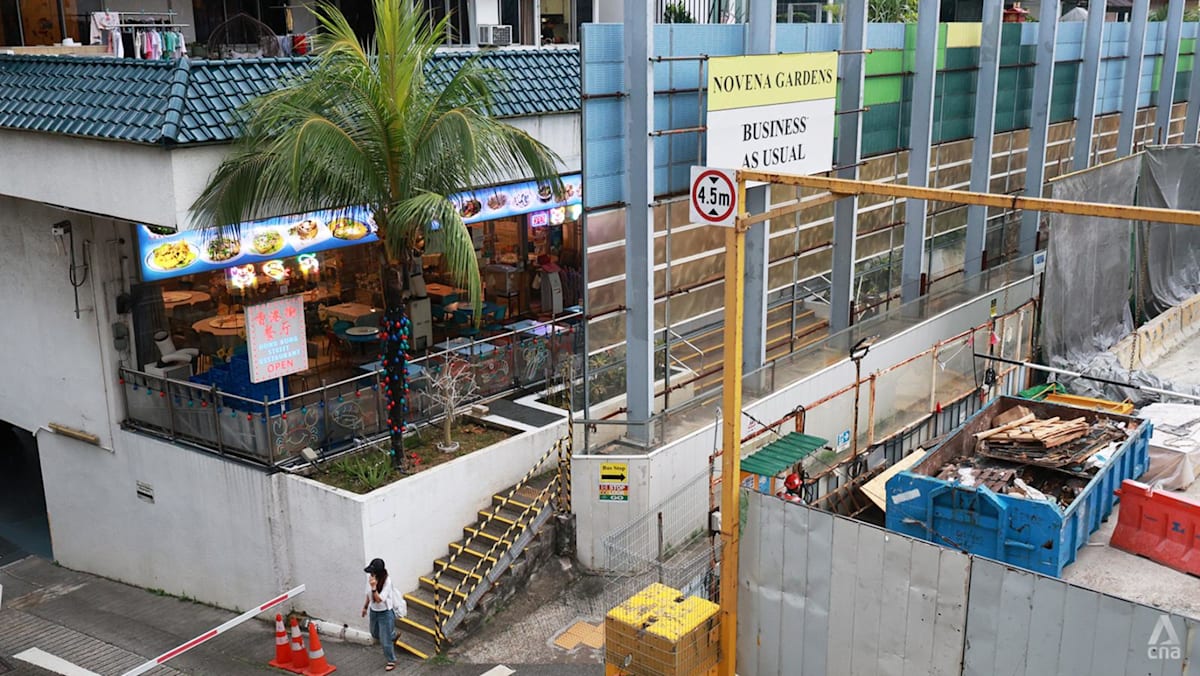
A restaurant partially hidden by a barrier at Novena Gardens along Thomson Road on Jun 8, 2026. (Photo: CNA/Raj Nadarajan)
This audio is generated by an AI tool.
SINGAPORE: Most of us do not give much thought to our everyday journeys. We know how long it takes to walk to the bus stop, where to cross the road and how to get to the shops we frequent.
Delays to North-South Corridor construction extend a period of adjustment that has already lasted years for residents and businesses. Construction had been ongoing since 2018, and the corridor was initially scheduled to open in stages from 2027. It is now expected to begin opening in 2029.
A familiar footpath is diverted, a crossing moves, and the entrance to a shop becomes harder to find. Each change may appear relatively minor, but together they can make everyday life considerably more frustrating. These experiences deserve attention even as we recognise the project’s value.
The corridor promises better connectivity and opportunities to make surface streets more conducive to walking, cycling, public transport and community life. The question is how we care for the people living and working through the transition towards those improvements.
CNA Games Guess Word Crack the word, one row at a time Buzzword Create words using the given letters Mini Sudoku Tiny puzzle, mighty brain teaser Mini Crossword Small grid, big challenge Word Search Spot as many words as you can Show More Show Less
THE EVERYDAY PSYCHOLOGY OF DISRUPTION
When routes change repeatedly, we have to devote more attention to navigating, which previously required little thought. We need to check directions, allow additional time and make alternative arrangements.
For someone balancing work and caregiving, uncertainty about a journey can affect whether they reach an appointment or collect a child on time.
Research on rail commuters has found an association between perceived unpredictability and greater stress. While this does not directly measure the experience of construction along the North-South Corridor, it offers insight into why the ability to anticipate disruption matters. People have more room to adapt when they know what to expect.
There is also a cumulative dimension to these experiences. An additional walk or a delayed bus may be manageable on any given day. Repeated over months and years, alongside noise, dust and other demands, these adjustments can feel exhausting. For those living beside the works, home may offer limited respite.
A revised completion date adds to this burden because it changes the endpoint around which people have organised their expectations. Having anticipated relief, they now have to reconsider how much longer they will need to cope.
This helps explain why support for a project can coexist with frustration about its delivery. People may appreciate the eventual benefits while finding the present circumstances increasingly difficult.
A LONG-TERM INVESTMENT, AN UNEVEN PRESENT COST
The engineering challenges are substantial. The Land Transport Authority (LTA) has described difficult ground conditions and the complexity of working close to existing roads, utilities and operating MRT infrastructure.
Recognising these constraints should also encourage thoughtfulness about what affected communities must bear.
The timescale of infrastructure planning is different from that of everyday life. While an extended construction period may represent a small fraction of a transport corridor’s lifespan, it may occupy a substantial part of a child’s school life, an older resident’s retirement or a small business’s operating history.
Recognising these different timescales helps us appreciate the project’s long-term value while taking its present costs seriously.
The burden varies considerably too. A commuter passing through the area has a different experience from a resident whose home faces the worksite. A detour that is manageable for one pedestrian may be difficult for someone with limited mobility. A shop dependent on footfall may have fewer ways to adapt than businesses that are not.
Nor can we assume that everyone bearing these costs will eventually enjoy the benefits. A business that closes before the project is completed cannot recover simply because the neighbourhood later becomes more accessible.
Some disruption is unavoidable when a city improves its infrastructure. That makes it all the more important to identify which burdens can reasonably be reduced.
For residents and businesses living with the works every day, efforts to maintain access, reduce uncertainty and respond to local difficulties are practical expressions of Singapore’s commitment to liveability.
MAKING THE CONSTRUCTION YEARS MORE LIVEABLE
A useful starting point is to make changes easier to anticipate. Residents and businesses need information that relates to their daily decisions: which route will change, how to reach a bus stop or shop, and how long an arrangement is expected to last.
Timely, location-specific updates through familiar channels should be reinforced by clear signs on the ground. People should be able to find their way without having to search through several notices, and those less comfortable with digital services need access to the same information.
Where schedules remain uncertain, explaining that uncertainty and indicating when the next update will come can help people plan.
Physical arrangements deserve equal attention. A temporary path that remains in use for years warrants careful consideration of accessibility, lighting, surfaces and wayfinding. Signs should make clear that shops behind hoardings remain open and show customers how to reach them.
These measures must accompany efforts to manage noise and dust. Advance notice helps someone prepare for disruption, but its value is limited if an avoidable problem continues unresolved.
Local feedback can help identify such problems. Residents and business owners experience details that may be difficult to anticipate from a construction plan, including a confusing turn or noisy work coinciding with a shop’s busiest period. Responding to these observations gives communities some influence over the conditions they live with.
There will be limits to what can change. Safety requirements, constrained space and the sequencing of work mean that every preference cannot be accommodated. Explaining those limits, while acting where adjustments are feasible, is part of treating people’s concerns seriously.
Progressive restoration also matters. LTA has said that roads and footpaths will begin to be reinstated from 2028. Updates on when neighbourhood routes and spaces are expected to reopen would help people understand how conditions may improve before the entire project is finished.
Singapore’s willingness to invest in its future is a strength. The care taken to minimise disruption to everyday life during construction should form part of that ambition. A project’s public value is also reflected in how the communities around it are supported through the years of change.
The journey towards a more liveable city is itself a test of liveability.
Dr Samuel Chng is Research Assistant Professor and heads the Urban Psychology Lab at Lee Kuan Yew Centre for Innovative Cities, Singapore University of Technology and Design. Dr Sarah Chan is Chan Heng Chee Research Fellow at Lee Kuan Yew Centre for Innovative Cities, Singapore University of Technology and Design.
Get our pick of top stories and thought-provoking articles in your inbox
Stay updated with notifications for breaking news and our best stories
Join our channel for the top reads for the day on your preferred chat app
新加坡科技设计大学的 Samuel Chng 和 Sarah Chan 表示,宜居城市在建设过程中必须保持宜居性。
2026年6月8日,位于汤申路诺维娜花园的一家餐厅被围栏部分遮挡。(图片:CNA/Raj Nadarajan)
这段音频由人工智能工具生成。
新加坡:我们大多数人不会过多思考日常出行。我们知道走到公交车站需要多长时间,在哪里过马路,以及如何到达我们常去的商店。
南北走廊建设的延误延长了居民和企业已经持续数年的适应期。该项目自2018年开始建设,原计划从2027年开始分阶段开放,现在预计将于2029年开始开放。
一条熟悉的步行道改道了,人行横道也变了位置,商店入口也变得难以找到。每一项改变看似微不足道,但加在一起却会让日常生活变得异常令人沮丧。即便我们认可项目的价值,这些体验也值得关注。
这条走廊有望改善交通连接,并为改善地面街道环境创造更多便利,例如步行、骑行、公共交通和社区生活。问题在于,在向这些改善过渡的过程中,我们如何照顾到生活和工作的人们。
CNA游戏 猜词游戏 逐行破解单词 流行词游戏 用给定的字母组成单词 迷你数独 小小谜题,挑战你的大脑 迷你填字游戏 小方格,大挑战 单词搜索 尽可能多地找出单词 显示更多 显示更少
日常扰乱心理学
当路线频繁变更时,我们需要投入更多精力进行导航,而这在以前几乎无需考虑。我们需要查看路线指示,预留更多时间,并做好备选方案。
对于需要兼顾工作和照顾孩子的人来说,行程的不确定性可能会影响他们能否按时赴约或接孩子。
针对铁路通勤者的研究发现,感知到的不可预测性与更大的压力之间存在关联。虽然这并不能直接衡量南北走廊沿线施工带来的体验,但它有助于我们理解为什么能够预见干扰至关重要。当人们知道会发生什么时,他们就有了更大的适应空间。
这些经历也具有累积效应。每天多走一段路或等一次晚点的公交车或许还能应付,但如果日积月累,再加上噪音、灰尘和其他种种不便,这些调整就会让人精疲力竭。对于住在工厂附近的居民来说,家或许只能提供有限的喘息之机。
修改后的竣工日期加重了人们的负担,因为它改变了人们围绕着其设定的预期终点。原本期待着解脱的他们,现在不得不重新考虑自己还需要坚持多久。
这有助于解释为什么人们对一个项目的支持与对项目交付的不满并存。人们可能欣赏最终的成果,但却越来越觉得目前的状况难以忍受。
长期投资,现时成本不均衡
工程挑战巨大。陆路交通管理局(LTA)指出,地质条件复杂,且施工地点靠近现有道路、公用设施和运营中的地铁基础设施,施工难度极大。
认识到这些限制因素也应该促使人们认真思考受影响的社区必须承受的后果。
基础设施规划的时间尺度与日常生活的时间尺度不同。虽然漫长的建设周期可能只占交通走廊使用寿命的一小部分,但它却可能占据孩子求学生涯、老年居民退休生活或小型企业经营历史的相当一部分时间。
认识到这些不同的时间尺度有助于我们重视项目的长期价值,同时也要认真对待其当前成本。
负担也因人而异。途经该区域的通勤者与家门口正对工地的居民有着截然不同的体验。对普通行人来说轻而易举的绕行路线,对行动不便者而言可能十分困难。依赖客流量的商店可能比其他不依赖客流量的商家更难适应变化。
我们也不能想当然地认为所有承担这些成本的人最终都会享受到收益。一家在项目完成前倒闭的企业,即使后来社区交通更加便利,也无法挽回损失。
城市改善基础设施时,一些干扰在所难免。因此,确定哪些负担可以合理减轻就显得尤为重要。
对于每天与工程共存的居民和企业而言,保持交通畅通、减少不确定性以及应对当地困难的努力,正是新加坡致力于提升宜居性的实际体现。
让施工时期更宜居
一个有效的切入点是让变化更容易预测。居民和商家需要与日常决策相关的信息:哪条路线会改变、如何到达公交车站或商店,以及变更预计持续多久。
通过熟悉的渠道及时发布与地点相关的更新信息,并辅以清晰的地面标识。人们应该能够轻松找到方向,而无需翻阅多张告示;不习惯使用数字服务的人也需要能够获取相同的信息。
如果行程安排仍不确定,解释这种不确定性并说明下次更新的时间可以帮助人们做好计划。
物理环境同样重要。一条需要多年使用的临时通道,其无障碍通行、照明、路面状况和导向标识都应仔细考虑。标牌应明确告知顾客围挡后的店铺仍在营业,并指引顾客如何到达。
这些措施必须与噪音和粉尘管理工作相结合。提前通知有助于人们做好应对干扰的准备,但如果本可避免的问题持续得不到解决,其价值就十分有限。
当地居民的反馈有助于发现此类问题。居民和商户会遇到一些施工计划中难以预料的细节,例如令人困惑的转弯或施工噪音恰逢店铺客流高峰期。对这些反馈做出回应,能让社区对自身的生活环境产生一定的影响力。
可改变的事情终究有限。安全要求、空间限制和工作顺序等因素意味着我们无法满足所有人的偏好。在可行的情况下做出调整,并向人们解释这些限制,是认真对待人们诉求的一部分。
逐步恢复工作也至关重要。陆路交通管理局表示,道路和人行道将从2028年开始逐步恢复。及时更新各社区道路和公共空间的预计重新开放时间,有助于公众了解在整个项目完成之前,各项设施状况将如何改善。
新加坡愿意投资未来,这是其优势所在。在施工期间尽力减少对日常生活的影响,也应体现这一雄心壮志。一个项目的公共价值还体现在其周边社区在多年变革中得到的支持上。
建设更宜居城市的历程本身就是对宜居性的一次考验。
Samuel Chng博士是新加坡科技设计大学李光耀创新城市中心的研究助理教授,并担任该中心城市心理学实验室主任。Sarah Chan博士是新加坡科技设计大学李光耀创新城市中心的陈恒志研究员。
订阅我们的邮件,即可获取精选热点新闻和引人深思的文章。
订阅通知,第一时间获取突发新闻和精彩报道。
加入我们的频道,即可在您常用的聊天应用上获取当日热门文章。