An 86-year-old father stranded in California shows the real human toll of US air sanctions on Iran一位86岁高龄的父亲滞留在加利福尼亚州,这揭示了美国对伊朗实施航空制裁所造成的真实人员伤亡。
US aviation sanctions on Iran disrupt ordinary Iranians’ travel and commerce, intensifying economic hardship amid ongoing geopolitical tensions. Read more at straitstimes.com.
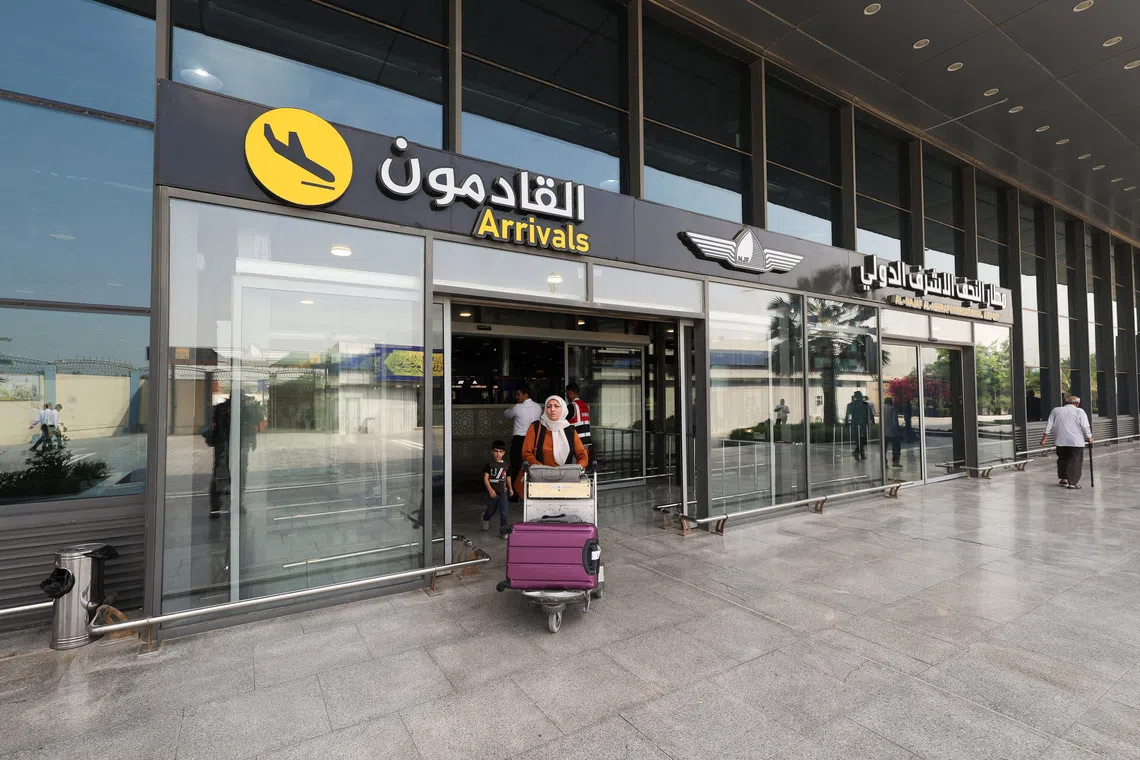
The severe sanctions on aviation add to what many describe as growing despair and malaise among many ordinary Iranians.
Borzou Daragahi for The Straits Times
Published Oct 05, 2026, 05:00 PM
Updated Oct 05, 2026, 10:36 PM
The US sanctions on Iran's aviation sector have severely restricted travel and commerce, causing cancellations and complicating access to medicines and essential goods.
These sanctions mainly hurt ordinary Iranians, increasing economic hardship with soaring inflation, job scarcity, and disrupted education and migration plans.
Experts doubt sanctions will force regime change, warning they may strengthen Iran's leadership while lacking a clear, cohesive US strategy.
ISTANBUL – Hossein-Reza’s plans to leave Iran for a trip to see friends and family in the Netherlands in October were waylaid by the US’ imposition of sanctions on the country’s aviation sector in August as part of Operation Economic Outcast – Washington’s attempt to isolate Iran economically.
Would he be able to secure a ticket to Amsterdam, he wondered? Would he be forced to travel by road to neighbouring Turkey or Armenia?
While some respond to such uncertainty with anxiety or even dread, Hossein-Reza, a 40-something documentarist, was relaxed.
After a year in Iran that included chaos and gunfire in the streets, warfare in the skies, internet blockages and economic devastation, as well as questions about the country’s very future, he is taking the travel hiccup in his stride.
“I never even try to book a ticket until a day or two before I have to leave,” he said in an interview, on the condition that his full name not be published.
The Iranians who spoke to the press did so under heavy risk, withholding their full names for fear of official reprisals for communicating with foreign journalists.
The US has placed some of the toughest financial restrictions on Iran ever imposed on an adversary – and the sanctions continue to intensify as the conflict drags on.
The pressure campaign has gone far beyond travel bans on targeted individuals or sanctions on the weapons trade or dual-use goods to include, since September, punishments of third-country companies that do business with 27 airlines and companies in Iran’s civilian airline sector and restrictions on the country’s auto and rail industries.
The result has complicated the supply of some crucial medicines into the country as well as any travel and commerce.
Flights to a number of neighbouring countries – including Iraq, Azerbaijan and Oman – have been cancelled.
However, air travel to Russia and China has not been affected, and sporadic flights to the major air hubs of Istanbul and Dubai continue.
A video posted on social media platform X on Sept 24 showed a flight crew aboard an Iranian Varesh Airlines flight from Tehran to the Tajikistan capital of Dushanbe returning home after its route through Azerbaijani airspace was denied.
“Iranians will be resilient as long as there is hope,” said one Western diplomat who recently left Tehran, speaking on condition of anonymity as he was not authorised to speak to the media. “But if there’s no light at the end of the tunnel, there is less reason to stay steadfast.”
Hamidreza Ahmadi, a Tehran tech entrepreneur, described growing frustration among ordinary Iranians as they struggle to understand the uncertainties the conflict has thrust upon their lives.
He described frustration over contradictory statements and goals by US President Donald Trump – from regime change, to a peace deal, to halting a nuclear programme supposedly destroyed in 2025 , to reopening the Strait of Hormuz, which was already open before the war began.
“Geopolitically, everyone’s very, very confused,” he said. “Like, what do you mean America’s almost out of munitions? How could that be? They see Iran is getting weaker. They feel that. But they also see a bunch of Iranian missiles and a bunch of drones landing.”
Iranians describe difficulties in securing jobs, with youth unemployment rates estimated to be as high as 50%, a freezing of investment and business expansions , as well as price increases, including for subsidised fuel and petroleum products that are the lifeblood of the Iranian economy.
Prices for some drugs have tripled, according to local reports, while food prices have soared.
Iran’s year-on-year inflation reached 84% in August.
“Sanctions are something that, wherever you are on the political spectrum, affect you on a daily basis, and nobody can see a way out of it,” Ahmadi said in an interview.
In theory, sanctions are supposed to punish the regime rather than ordinary people.
But compliance experts say companies effectively refrain from doing even non-restricted commerce with entities linked to a country as heavily sanctioned as Iran.
Brett Erickson, founder of Obsidian Risk Advisors, a US consultancy focused on international crime and due diligence, told The Straits Times: “Most companies are going to de-risk and just not assume the legal hurdles that need to be jumped through.
“And that’s something we see with Gaza and Yemen and so many countries where technically, it is allowed. But in reality, we see huge shortfalls as a result of companies not wanting to assume the risk.”
Pharmaceuticals and foods are specifically excluded from sanctions, but companies often refrain just to avoid the hassles and hurdles of any trade with Iran.
Trump administration officials and their supporters know that the sanctions hurt ordinary Iranians. But this is precisely the goal – raise public frustrations to a level where the people turn on the regime. Beyond sanctions, the US has very few options, experts said.
“The problem with sanctions is we’ve plucked all the low-hanging fruit,” Alan Eyre, a former US State Department official who was part of the team that negotiated the 2015 nuclear deal with Iran, said in an interview.
“We’ve plucked all the high-hanging fruit. We’ve cut the tree down. So it’s not as if there are a lot of super-duper effective sanctions that we haven’t used.”
The latest round of sanctions significantly differs from previous rounds because they focus on an entire sector of the economy, regardless of whether an individual or company is involved in any activity deemed harmful by the US.
Erickson said: “It essentially just cuts off the entire industry, regardless of whether it has a nexus to someone who is sanctioned by the US.
“It is a very significant measure. And again, it does need to be understood that the overwhelming hardship will be shouldered by the civilian population. Obviously, things can be transshipped into Russia and China and other countries that refuse to play ball, and that will be significant for the Iranian government.”
Observers are closely watching how aggressively Washington attempts to enforce sanctions on third countries such as Turkey or the United Arab Emirates, as well as China, which has vowed to ignore them.
But the sanctions may be the most severe that Iranians have faced, and potentially the hardest to circumvent.
Ali Ahmadi (no relation to Hamidreza Ahmadi), a fellow at the Switzerland-based Geneva Centre for Security Policy who regularly travels between Iran and the West, said: “They figure out how to operate within the parameters of the sanctions.”
Ali Ahmadi was recently in Tehran and booked a flight on an obscure airline, which was cancelled at the last minute, but he managed to rebook on a different airline. “When I called the website I was buying the tickets from, they said, pick one of the more reputable, bigger names because they already know how to get through the sanctions,” he recalled.
Others have found the new restrictions more challenging.
Maziar, a 42-year-old in Tehran, is struggling to bring his frail 86-year-old father home from a trip to visit relatives in California.
“I’ve been trying to figure out the least exhausting path for my dad to get back to Iran,” he said, asking that his family name not be disclosed.
“We were hoping to use the Dubai route. But that’s no longer an option. We’re going to wait it out a bit longer and hope for a better option, and if the situation doesn’t change, we’ll have to use the land border crossing via Turkey.”
Even Iranians sympathetic to the US are angered by the latest US sanctions.
One impact of the latest round of restrictions has been the cancellation of the English-language proficiency tests required for overseas employment or education because the companies running the paid exams fear the wrath of the US Treasury Department.
Iranians who spent years on plans to study or move abroad have suddenly found their dreams thwarted. “On paper, sanctions are supposed to make the government weaker, but how is cancelling tests making the government weaker?” said one Tehran resident, who asked that her name not be published.
Even as prices of food and medicine in Iran increase, there have been no reported shortages of luxury goods – another sign that the sanctions are mostly squeezing the poor.
Observers have criticised the US strategy as rudderless, aimed more at satisfying Washington hawks’ demands for action rather than part of a cohesive strategy.
Ahmadi from the Geneva Centre said: “Within the context of US policy as a whole, pressure for pressure’s sake has become ossified. Like you’ve got to do something.
“What’s the next measure? Do that. Istanbul Airport is probably kind of vulnerable to US sanctions. Okay, we’ll threaten to sanction them. There’s no strategy here.”
Iran experts, including former US officials, have publicly voiced doubt that ratcheting up economic pressure will convince the Iranian government to give in to US demands – in fact, it could have the opposite effect.
Eyre, the former State Department official, said: “The people running Iran think that if they just show any weakness in the face of all this pressure, it’s going to lead to them being swept out of power. That’s why sanctions are unlikely to work.”
Embargoes and economic sanctions
Oil prices/Crude oil
对航空业的严厉制裁加剧了许多普通伊朗民众日益增长的绝望和不安情绪。
博尔祖·达拉加希为《海峡时报》撰稿
发布于2026年10月5日下午5:00
更新于2026年10月5日晚上10:36
美国对伊朗航空业的制裁严重限制了旅行和贸易,导致航班取消,并使药品和必需品的获取变得更加复杂。
这些制裁主要伤害了普通伊朗民众,加剧了经济困难,导致通货膨胀飙升、就业机会稀缺,教育和移民计划受到干扰。
专家怀疑制裁能否迫使伊朗政权更迭,并警告称,由于缺乏清晰、连贯的美国战略,制裁可能会加强伊朗的领导层。
伊斯坦布尔——侯赛因-雷扎原计划于 10 月份离开伊朗前往荷兰探望亲友,但由于美国在 8 月份对伊朗航空业实施制裁,他的计划被打乱。这是“经济排斥行动”的一部分,华盛顿试图在经济上孤立伊朗。
他心想,自己能买到去阿姆斯特丹的机票吗?会不会被迫走陆路前往邻国土耳其或亚美尼亚?
有些人面对这种不确定性会感到焦虑甚至恐惧,但四十多岁的纪录片导演侯赛因-雷扎却很放松。
在伊朗度过了一年之后,他经历了街头的混乱和枪声、空中的战争、互联网封锁和经济崩溃,以及对国家未来的种种疑问,如今他能坦然面对这次旅行中的小插曲。
“我通常都是在出发前一两天才开始订机票,”他在接受采访时说道,但要求不公开他的全名。
接受媒体采访的伊朗人冒着极大的风险,由于害怕与外国记者交流而遭到官方报复,他们都隐瞒了自己的全名。
美国对伊朗实施了有史以来对敌对国家最严厉的金融限制——随着冲突的持续,制裁力度还在不断加大。
施压行动已经远远超出了对特定个人实施旅行禁令或对武器贸易或两用物项实施制裁的范围,自 9 月以来,还包括对与 27 家航空公司和伊朗民用航空部门公司有业务往来的第三国公司进行处罚,以及对该国汽车和铁路行业的限制。
这一结果使得一些关键药品的供应进入该国变得复杂,同时也影响了旅行和商业活动。
飞往包括伊拉克、阿塞拜疆和阿曼在内的多个邻国的航班已被取消。
然而,飞往俄罗斯和中国的航班并未受到影响,飞往伊斯坦布尔和迪拜等主要航空枢纽的零星航班仍在继续。
9 月 24 日,社交媒体平台 X 上发布的一段视频显示,一架伊朗瓦雷什航空公司从德黑兰飞往塔吉克斯坦首都杜尚别的航班,在穿越阿塞拜疆领空的航线被拒绝后,被迫返航。
一位近期离开德黑兰的西方外交官表示:“只要还有希望,伊朗人就会坚韧不拔。” 他要求匿名,因为他没有被授权接受媒体采访。“但如果看不到希望,那就没有理由继续坚持下去了。”
德黑兰科技企业家哈米德雷扎·艾哈迈迪描述了普通伊朗民众日益增长的沮丧情绪,他们难以理解这场冲突给他们的生活带来的不确定性。
他描述了美国总统唐纳德·特朗普自相矛盾的声明和目标所带来的沮丧——从政权更迭,到和平协议,再到停止据称已于 2025 年销毁的核计划,以及重新开放霍尔木兹海峡(该海峡在战争开始前就已经开放)。
“从地缘政治角度来看,大家都非常非常困惑,”他说。“比如,什么叫美国弹药几乎耗尽?这怎么可能?他们看到伊朗的实力在减弱,他们能感受到这一点。但他们也看到伊朗发射了大量导弹,无人机也大量降落。”
伊朗人表示,他们很难找到工作,青年失业率估计高达 50%,投资和商业扩张停滞不前,物价上涨,包括作为伊朗经济命脉的补贴燃料和石油产品的价格上涨。
据当地报道,某些药品的价格上涨了两倍,而食品价格也大幅上涨。
伊朗8月份的同比通货膨胀率达到84%。
“无论你的政治立场如何,制裁都会每天影响到你,而且没有人能看到摆脱制裁的办法,”艾哈迈迪在一次采访中说道。
理论上,制裁的目的是惩罚政权,而不是惩罚普通民众。
但合规专家表示,企业实际上会避免与受伊朗这样严厉制裁的国家的关联实体进行任何非限制性商业活动。
专注于国际犯罪和尽职调查的美国咨询公司 Obsidian Risk Advisors 的创始人 Brett Erickson 告诉《海峡时报》:“大多数公司都会降低风险,而不是承担需要克服的法律障碍。
“我们在加沙、也门以及许多其他国家都看到了这种情况,从技术上讲,这种做法是允许的。但实际上,由于企业不愿承担风险,导致出现了巨大的资金缺口。”
药品和食品被明确排除在制裁范围之外,但企业往往为了避免与伊朗进行任何贸易所带来的麻烦和障碍而选择不进行此类贸易。
特朗普政府官员及其支持者深知制裁会伤害普通伊朗民众。但这正是他们的目的——激起民众的不满,最终促使民众起来反对伊朗政权。专家表示,除了制裁之外,美国几乎别无选择。
“制裁的问题在于,我们已经摘尽了所有容易摘的果实,”曾参与2015年与伊朗达成核协议谈判的美国国务院前官员艾伦·艾尔在一次采访中说道。
“我们已经摘光了所有唾手可得的果实,把树都砍倒了。所以,并不是说还有很多超级有效的制裁措施我们没有使用。”
最新一轮制裁与以往几轮制裁有显著不同,因为它针对的是整个经济部门,而不管个人或公司是否参与了美国认为有害的任何活动。
埃里克森说:“这实际上切断了整个行业的联系,无论它是否与受到美国制裁的人有联系。”
“这是一项非常重要的措施。而且,必须再次强调,巨大的苦难将由平民百姓承担。显然,物资可以被转运到俄罗斯、中国和其他拒绝合作的国家,这对伊朗政府来说意义重大。”
观察人士正密切关注华盛顿如何积极地试图对土耳其、阿联酋等第三国以及誓言无视制裁的中国实施制裁。
但这些制裁可能是伊朗人面临的最严厉的制裁,也可能是最难规避的制裁。
经常往返于伊朗和西方之间的瑞士日内瓦安全政策中心研究员阿里·艾哈迈迪(与哈米德雷扎·艾哈迈迪无关)表示:“他们想方设法在制裁的框架内运作。”
阿里·艾哈迈迪最近去了德黑兰,预订了一家不知名航空公司的航班,结果航班在最后一刻被取消了。不过他设法改签到了另一家航空公司。“我打电话给我买票的网站,他们说,选一家信誉更好、规模更大的航空公司,因为他们知道如何绕过制裁,”他回忆道。
另一些人则觉得新的限制措施更具挑战性。
42岁的德黑兰居民马齐亚尔正努力将他体弱多病的86岁父亲从加州探亲之旅接回家。
“我一直在努力寻找一条最轻松的途径,让我的父亲能够返回伊朗,”他说,并要求不要透露他的姓氏。
“我们原本希望走迪拜路线,但现在这条路行不通了。我们会再等等看,希望能有更好的办法。如果情况没有改变,我们就只能走陆路,经土耳其过境了。”
即使是同情美国的伊朗人也对美国最新的制裁感到愤怒。
最新一轮限制措施的影响之一是取消了海外就业或教育所需的英语语言能力测试,因为举办这些付费考试的公司害怕美国财政部的惩罚。
那些筹划多年出国留学或移居的伊朗人,突然发现他们的梦想破灭了。“从理论上讲,制裁应该削弱政府,但取消考试怎么能削弱政府呢?”一位不愿透露姓名的德黑兰居民说道。
尽管伊朗的食品和药品价格上涨,但尚未有奢侈品短缺的报道——这再次表明制裁主要影响的是穷人。
观察人士批评美国的战略缺乏方向,其目的更多是为了满足华盛顿鹰派的行动要求,而不是一个连贯的战略。
日内瓦中心的艾哈迈迪说:“就美国整体政策而言,为了施压而施压的做法已经僵化了。就好像你必须做点什么似的。”
“下一步措施是什么?就这么做。伊斯坦布尔机场很可能容易受到美国制裁的影响。好吧,我们就威胁要制裁他们。这里没有什么策略。”
包括美国前官员在内的伊朗问题专家公开表示怀疑,加大经济压力能否说服伊朗政府向美国的要求屈服——事实上,这可能会产生相反的效果。
前国务院官员艾尔表示:“伊朗的掌权者认为,如果他们在所有这些压力面前表现出任何软弱,就会导致他们下台。这就是为什么制裁不太可能奏效的原因。”
禁运和经济制裁
石油价格/原油