‘Not the time to go soft’: Shanmugam signals tough laws for young scam mules after High Court ruling“现在不是手软的时候”:高等法院裁决后,尚穆根暗示将对年轻的诈骗犯制定严厉法律
A recent High Court ruling gave young mules probation and community sentences, contradicting sentencing guidelines. Read more at straitstimes.com.
新闻视频
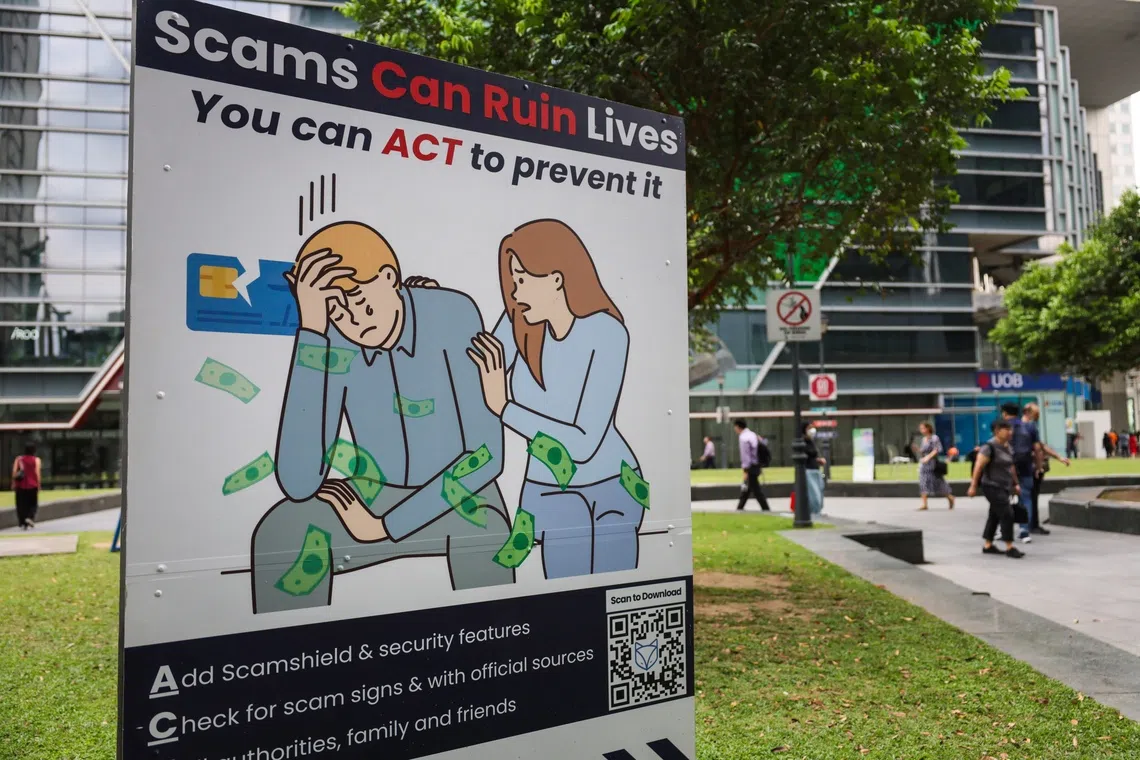
Responding to questions about young people and scams on Oct 6, Senior Minister K. Shanmugam said many young mules know they are doing something wrong.
Published Oct 06, 2026, 04:55 PM
Updated Oct 06, 2026, 05:00 PM
Home Affairs Minister K. Shanmugam announced plans for tougher laws to impose clearer deterrent sentences on scammers and young mules, following a High Court ruling granting probation and community sentences to youth offenders.
Shanmugam warned the High Court's approach encourages scam syndicates to recruit more youths.
Scams in Singapore caused over $4 billion in losses since 2019, heavily affecting elderly victims.
Follow our live coverage here.
SINGAPORE - New laws will be introduced soon to ensure deterrent sentences on those who facilitate scams regardless of age, following a recent High Court ruling that gave young scam mules probation and community sentences.
The legislation will make clear that the court’s ruling in that case is not to be followed, said Senior Minister K. Shanmugam, noting that while scammers are ultimately responsible, the crime was made possible because of the young scam mules who gave up their bank or Singpass accounts for money.
He told the House that the cost of scams has been devastating, especially on elderly victims who lost their life savings.
Responding to questions about young people and scams on Oct 6 , Shanmugam, who is also the Coordinating Minister for National Security, said many young mules know they are doing something wrong.
He said: “Many of the young people that we pick up and investigate know precisely what they were doing... they knew that they shouldn’t be doing it, but they were tempted by the $800, $1,000 that they were offered.”
In a ruling by the High Court on Sept 10, a three-judge panel consisting of Chief Justice Sundaresh Menon, Justice Ang Cheng Hock and Justice Hoo Sheau Peng allowed appeals by several young scam mules .
This included a 20-year-old who was 18 when he was offered $800 for a bank account, which was then used to open another bank account.
A 66-year-old victim was scammed into transferring almost $200,000 into this second account.
The High Court later sentenced the youth to probation, because it considered rehabilitation to be the primary sentencing consideration for young offenders.
Probation not appropriate
But this rationale contradicts the approach of the sentencing guidelines, which say probation and community sentences are generally not appropriate, said Shanmugam.
He said: “If young offenders are being treated more leniently simply because of their age, you can be sure that scam syndicates will have every incentive to recruit more young people as mules. We cannot and will not allow this to happen.”
The High Court ruling allowed four appeals, which saw four youths aged 20 to 21 getting probation instead of reformative training.
It also dismissed an appeal by the prosecution for a 17-year-old mule who was sentenced to a short detention order and community service instead of reformative training.
Shanmugam said the new laws to be introduced will make it clear that the Government has made a deliberate policy judgment that deterrence and prevention must carry greater weight for scam offences.
He said: “It is understandable for the court, which comprises two Court of Appeal judges including the Chief Justice, looking at the individual young offenders in front of them to feel sympathy for those individuals, and be inclined to impose rehabilitative sentences on youth offenders.
“However, the Court did not have before it the policy perspectives that I have just laid out, nor the data on the scale of the problem of scams and scammers – the huge amount of losses through scams, and the full human cost of such scams.”
Over $4 billion has been lost to scams here since 2019, with a record high of $1.1 billion lost in 2024 alone.
Shanmugam said scam losses have since fallen slightly after the Government pushed for tougher penalties for scammers and mules.
$2m scam losses daily
But scams continue to be a significant problem, costing victims an average of $2 million every day in the first half of 2026.
He said: “Scammers have continued to adapt and attempt to overcome our measures. So, this is certainly not the time to go soft.”
The Ministry of Home Affairs was particularly concerned that many young people are getting involved in scams offences, with more than 1,000 such youth investigated in 2025, said Shanmugam.
He said that same year, there were over 5,000 elderly scam victims, who lost a total of around $200 million.
He mentioned two other cases involving elderly victims, who lost hundreds of thousands of dollars in 2024 after falling for scams that used bank accounts from young scam mules.
Shanmugam said he had considered showing Parliament the photos and names of some of the victims, but did not as the victims did not want the stigma of being identified.
Cassandra Lee (West Coast-Jurong West GRC) said her residents have approached her saying they were deceived and manipulated into becoming mules or getting involved in scams.
She asked if the new laws to be proposed will consider what deterrence would be most effective for the young.
Shanmugam said that for every one such case alleging they were deceived, there are several others involving elderly who have lost their life savings to scams.
He said he recognises there will be some who were genuinely misled and it is possible for them to face a different sentence such as probation, but protecting people from losing their money to scams is still key.
He said: “When it comes to this, to me, deterrence is the primary factor to stop it from happening... as I said, this is not an occasion to go soft.”
David Sun is The Straits Times’ crime correspondent. He has a background in criminology and is a licensed private investigator.
Singapore Parliament
10月6日,高级部长尚穆根在回答有关年轻人和诈骗的问题时表示,许多年轻的洗钱者知道自己在做错事。
发布于 2026 年 10 月 6 日下午 4:55
更新于2026年10月6日下午5:00
内政部长尚穆根宣布计划制定更严厉的法律,对诈骗犯和年轻的洗钱者施加更明确的威慑性判决。此前,高等法院裁定对青少年罪犯判处缓刑和社区服务。
尚穆根警告说,高等法院的做法会鼓励诈骗团伙招募更多年轻人。
自 2019 年以来,新加坡的诈骗活动造成了超过 40 亿美元的损失,其中老年受害者受到的影响尤为严重。
请点击此处关注我们的实时报道。
新加坡——继高等法院最近一项裁决对年轻的诈骗犯判处缓刑和社区服务后,新的法律即将出台,以确保对那些协助诈骗的人,无论年龄大小,都处以具有威慑力的刑罚。
高级部长尚穆根表示,该立法将明确规定,不应遵循该案的法院裁决。他指出,虽然诈骗犯最终要为此负责,但犯罪之所以能够发生,是因为那些年轻的诈骗工具为了钱财而放弃了他们的银行或Singpass账户。
他告诉众议院,诈骗造成的损失是毁灭性的,尤其是对那些失去毕生积蓄的老年受害者而言。
10月6日,在回答有关年轻人和诈骗的问题时,同时也是国家安全统筹部长的尚穆根表示,许多年轻的洗钱者都知道自己在做错事。
他说:“我们抓捕和调查的许多年轻人都很清楚自己在做什么……他们知道自己不应该这样做,但他们被提供的 800 美元、1000 美元的报酬所诱惑。”
9月10日,高等法院由首席大法官桑达雷什·梅农、大法官洪成福和大法官胡秀萍组成的三人法官小组裁定,允许几名年轻的诈骗犯提出上诉。
其中包括一名 20 岁的男子,他 18 岁时有人出价 800 美元帮他开一个银行账户,然后这笔钱被用来开另一个银行账户。
一名 66 岁的受害者被骗,将近 20 万美元转入了这个第二个账户。
高等法院后来判处这名青少年缓刑,因为它认为对青少年罪犯进行改造是量刑的首要考虑因素。
缓刑不合适
尚穆根表示,这种理由与量刑指南的做法相矛盾,量刑指南指出缓刑和社区矫正通常不合适。
他说:“如果仅仅因为年龄就对年轻罪犯网开一面,诈骗团伙肯定会更有动机招募更多年轻人充当运钞车。我们不能也不会允许这种情况发生。”
高等法院的裁决允许了四项上诉,最终四名年龄在 20 至 21 岁之间的青年被判缓刑,而不是接受改造培训。
法院还驳回了检方对一头 17 岁骡子的上诉,该骡子被判处短期拘留令及社区服务,而不是接受改造训练。
尚穆根表示,即将出台的新法律将明确表明,政府已做出明确的政策判断,即对于诈骗犯罪,威慑和预防必须发挥更大的作用。
他说:“由两名上诉法院法官(包括首席大法官)组成的法庭,在审理面前的年轻罪犯案件时,对这些年轻人产生同情,并倾向于对年轻罪犯判处改造性刑罚,这是可以理解的。”
“然而,法院当时并没有掌握我刚才阐述的政策观点,也没有掌握有关诈骗和诈骗者问题的规模数据——诈骗造成的巨额损失,以及此类诈骗造成的全部人员伤亡。”
自 2019 年以来,这里因诈骗损失的金额已超过 40 亿美元,仅 2024 年一年,损失金额就高达 11 亿美元,创历史新高。
尚穆根表示,政府加大对诈骗犯和洗钱者(骡子)的处罚力度后,诈骗损失略有下降。
每天因诈骗损失高达200万美元。
但诈骗仍然是一个重大问题,在 2026 年上半年,受害者平均每天损失 200 万美元。
他说:“诈骗分子一直在不断调整策略,试图绕过我们的防控措施。所以,现在绝不是放松警惕的时候。”
尚穆根表示,内政部尤其关注许多年轻人卷入诈骗犯罪活动,2025年将有超过1000名此类青少年接受调查。
他表示,同年有超过 5000 名老年人成为诈骗受害者,总共损失了约 2 亿美元。
他还提到了另外两起涉及老年受害者的案件,他们在 2024 年因落入利用年轻诈骗犯的银行账户进行的骗局而损失了数十万美元。
尚穆根表示,他曾考虑向国会展示部分受害者的照片和姓名,但由于受害者不希望被公开身份,因此没有这样做。
卡桑德拉·李(西海岸-裕廊西集选区)表示,她的选民曾向她反映,他们被欺骗和操纵,成为洗钱工具或参与诈骗活动。
她询问即将提出的新法律是否会考虑对年轻人最有效的威慑措施。
尚穆根表示,每发生一起此类声称自己被骗的案件,就有好几起涉及老年人的案件,他们毕生积蓄都被诈骗分子骗走了。
他表示,他意识到有些人确实受到了误导,他们可能会面临不同的判决,例如缓刑,但保护人们免受诈骗造成的金钱损失仍然是关键。
他说:“就此事而言,我认为威慑是阻止此类事件发生的首要因素……正如我所说,这不是手软的时候。”
大卫·孙是《海峡时报》的犯罪记者。他拥有犯罪学背景,并且是一名持证私人侦探。
新加坡国会