Fresh grads taking longer to secure jobs, retrenched workers finding it harder to land new jobs: Jasmin Lau应届毕业生找工作所需时间更长,被裁员工找新工作也更难:刘嘉敏
The decline in the re-entry rate was most pronounced among clerical, sales and service workers, tertiary-educated residents and those aged below 30.
The decline in the re-entry rate was most pronounced among clerical, sales and service workers, tertiary-educated residents and those aged below 30.
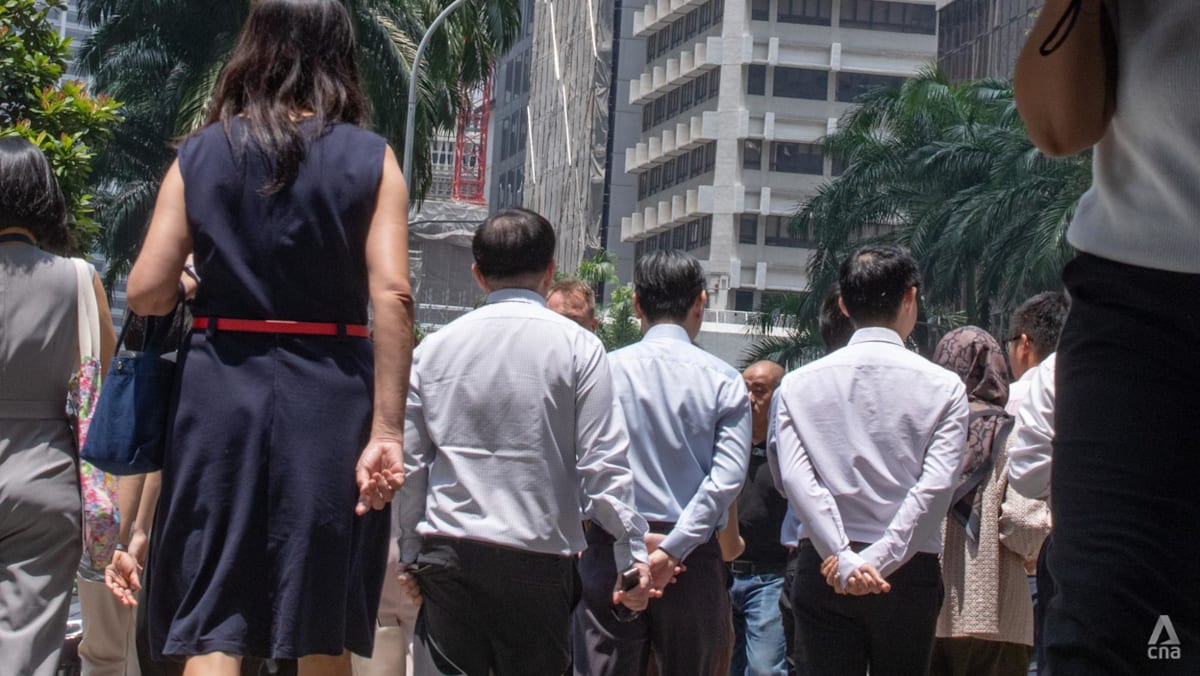
Office workers in Raffles Place on Sep 21, 2026. (File photo: CNA/Mak Jia Kee)
This audio is generated by an AI tool.
SINGAPORE: Fresh graduates are taking longer to secure full-time jobs and retrenched workers are also finding it harder to land new jobs, reflecting the softer hiring conditions in the labour market.
Acting Minister for Manpower Jasmin Lau on Tuesday (Oct 6) said the ministry is monitoring fresh graduate employment closely, especially for the 2026 cohort, whose six-month employment outcomes will be available soon.
Ms Lau was responding to parliamentary and supplementary questions about retrenched workers, support for mature workers and fresh graduates' employment rates. Retrenchments rose to 4,620 in the second quarter of the year, the highest level since late 2020.
She pointed to the Graduate Industry Traineeships that fresh graduates who are struggling to find employment can apply for, along with career services from the Skills and Workforce Development Agency.
CNA Games Guess Word Crack the word, one row at a time Buzzword Create words using the given letters Mini Sudoku Tiny puzzle, mighty brain teaser Mini Crossword Small grid, big challenge Word Search Spot as many words as you can Show More Show Less
On retrenchments, Ms Lau said re-entry outcomes have softened, with 54.9 per cent of retrenched residents returning to employment within six months in the second quarter of the year, down from 60.7 per cent in the first three months of the year.
“While seasonal hiring patterns partly explain the decline, the re-entry rate is lower than in previous years and shows a broader downtrend,” she said.
It was observed across industries, though the larger decreases were among those previously employed in manufacturing, information and communications, financial services and professional services.
“This reflects softer hiring demand in these sectors, which could contribute to longer re-entry,” she said, adding that transitioning to other sectors takes more time and effort.
Degree holders remained the largest group among retrenched residents, with their share rising from 51 per cent in 2021 to 66.4 per cent in 2025, said Acting Manpower Minister Jasmin Lau in parliament on Oct 6. Those in their 40s and 50s accounted for more than half of retrenched residents, she said.
Degree holders remained the largest group among retrenched residents, with their share rising from 51 per cent in 2021 to 66.4 per cent in 2025, said Acting Manpower Minister Jasmin Lau in parliament on Oct 6.
Those in their 40s and 50s accounted for more than half of retrenched residents, she said.
Different sectors recorded the lowest six-month re-entry rate for retrenched resident professionals, managers, executives and technicians (PMETs) from quarter to quarter.
But Ms Lau highlighted financial services as the sector that recorded the lowest rate most often over the past 14 quarters, followed by the wholesale trade sector.
Degree-holders continue to be the largest group affected by retrenchments, with the percentage increasing from 51 per cent in 2021 to 66.4 per cent in 2025.
Ms Lau said the statistics show there is “no single experience of retrenchment”.
“Some workers are able to move into new jobs relatively quickly, while others may face greater difficulties because of their skills, occupation, age, or the sector they were previously working in,” she said.
“Some are able to find new jobs with the same or higher wages, but others may experience pay reduction.”
ONGOING REVIEW OF EMPLOYMENT ACT
Ms Lau said the Manpower Ministry and its tripartite partners are reviewing the Employment Act, including retrenchment benefits, which are not currently a statutory requirement.
The review will cover whether stronger obligations on employers are warranted.
She said around 88 per cent of employers paid retrenchment benefits to employees.
Of the employers who did not pay retrenchment benefits, one in five indicated that they had financial difficulties.
“The rest said that they did not pay due to other reasons, including the lack of an obligation to do so, or because the employee was given other forms of support, such as keeping them on payroll for an extended period or employment assistance payout,” said Ms Lau.
To strengthen compliance, the tripartite partners are considering the possibility of administrative action against employers who do not pay retrenchment benefits in egregious cases.
For example, some employers may have the financial ability to pay retrenchment benefits but refuse to despite repeated engagements and warnings.
She added that there will need to be a balance between strengthening worker protections and maintaining reasonable business costs, as some employers face genuine financial difficulties.
“We do not want to inadvertently place more jobs at risk by imposing a rigid obligation on employers, regardless of their situation. We will provide an update on the employment review in due course,” she said.
The review also covers other support for retrenched workers, including bringing forward the Mandatory Retrenchment Notification period so that employment services can be offered at an earlier feasible time.
Ms Lau also said MOM is looking at how to better support workers who face longer transitions back into employment, including older workers and those in sectors undergoing significant restructuring.
RETRENCHMENTS AND AI, NON-RESIDENTS
Responding to a question about whether recent retrenchments were because of cyclical restructuring or AI adoption, Ms Lau said it is not clear at the moment.
This is because it is difficult to isolate the specific impact of AI adoption from broader business transformation and reorganisation.
MOM’s surveys indicate that only a small minority of firms adopting AI have reduced headcount, and more are creating new roles or redesigning jobs, she said, adding that MOM will refine its surveys and market-sensing mechanisms to monitor the impact of AI on jobs.
Regarding non-resident PMETs, Ms Lau said the likelihood of retrenchment was similar to residents, at 3.2 per 1,000 employees in the second quarter of the year.
The total number of S Pass and Employment Pass holders each declined by 900 in the April to May period this year.
“This decline was concentrated in outward-oriented sectors such as professional services, financial services, and information and communications, while resident employment in these sectors actually increased,” she said.
She added that MOM will continue to monitor labour market conditions, including employment outcomes for Singaporeans and the foreign workforce.
Get our pick of top stories and thought-provoking articles in your inbox
Stay updated with notifications for breaking news and our best stories
Join our channel for the top reads for the day on your preferred chat app
再就业率下降最明显的是文员、销售和服务人员、受过高等教育的居民以及 30 岁以下的人群。
2026年9月21日,莱佛士坊的上班族。(资料照片:CNA/麦嘉琪)
这段音频是由人工智能工具生成的。
新加坡:应届毕业生需要更长时间才能找到全职工作,被裁员工也更难找到新工作,这反映出劳动力市场招聘环境较为疲软。
人力部代理部长刘嘉敏周二(10月6日)表示,该部正在密切关注应届毕业生的就业情况,特别是2026届毕业生,他们的六个月就业结果即将公布。
刘女士是在回应议会质询和补充质询时,谈及裁员、对年长员工的支持以及应届毕业生的就业率等问题。今年第二季度裁员人数增至4620人,为2020年底以来的最高水平。
她指出,应届毕业生如果找不到工作,可以申请毕业生行业实习计划,此外,技能和劳动力发展署也提供职业服务。
CNA游戏 猜词游戏 逐行破解单词 流行词游戏 用给定的字母组成单词 迷你数独 小小谜题,挑战你的大脑 迷你填字游戏 小方格,大挑战 单词搜索 尽可能多地找出单词 显示更多 显示更少
关于裁员问题,刘女士表示,重新就业的情况有所好转,今年第二季度,54.9% 的被裁居民在六个月内重返工作岗位,低于今年前三个月的 60.7%。
“虽然季节性招聘模式可以部分解释这一下降趋势,但重新入职率低于往年,显示出更广泛的下降趋势,”她说。
各行各业都出现了这种现象,但降幅较大的主要是以前在制造业、信息通信业、金融服务业和专业服务业工作的人员。
她表示:“这反映出这些行业的招聘需求疲软,这可能会导致重新进入其他行业的时间更长。”她还补充说,转型到其他行业需要更多的时间和精力。
人力部代理部长刘嘉敏10月6日在国会表示,在被裁居民中,拥有大学学位的人群仍然是最大群体,其比例将从2021年的51%上升到2025年的66.4%。她还表示,40多岁和50多岁的人群占被裁居民总数的一半以上。
人力部代理部长刘嘉敏于 10 月 6 日在国会表示,在被裁减的居民中,拥有学位的人群仍然是最大的群体,其比例将从 2021 年的 51% 上升到 2025 年的 66.4%。
她说,40多岁和50多岁的人占被裁居民的一半以上。
不同行业的被裁员的常驻专业人员、经理、主管和技术人员 (PMET) 的六个月再就业率逐季下降。
但刘女士强调,在过去 14 个季度中,金融服务业的利率最低的次数最多,其次是批发贸易业。
受裁员影响最大的群体仍然是拥有学位的人群,这一比例从 2021 年的 51% 增加到 2025 年的 66.4%。
刘女士表示,统计数据显示“裁员经历并非千篇一律”。
她说:“有些工人能够相对快速地找到新工作,而另一些工人则可能由于他们的技能、职业、年龄或他们以前工作的行业而面临更大的困难。”
“有些人能够找到工资相同或更高的新工作,但另一些人可能会面临减薪。”
持续审查《就业法》
刘女士表示,人力部及其三方合作伙伴正在审查《雇佣法令》,其中包括裁员福利,这些福利目前并非法定要求。
此次审查将涵盖是否有必要对雇主施加更强有力的义务。
她说,约有 88% 的雇主向员工支付了裁员补偿金。
在未支付裁员补偿金的雇主中,五分之一表示他们遇到了财务困难。
刘女士说:“其余的人表示,他们没有支付是因为其他原因,包括没有义务这样做,或者因为员工得到了其他形式的支持,例如延长工资发放期或领取就业援助金。”
为了加强合规性,三方合作伙伴正在考虑对不支付裁员补偿金的严重雇主采取行政措施的可能性。
例如,有些雇主可能有能力支付裁员补偿金,但尽管多次协商和警告,他们仍然拒绝支付。
她补充说,需要在加强对工人的保护和维持合理的企业成本之间取得平衡,因为一些雇主确实面临财务困难。
她表示:“我们不希望因为对雇主施加僵化的义务,而不顾他们的实际情况,而无意中使更多就业岗位面临风险。我们将在适当的时候提供就业审查的最新进展。”
该审查还涵盖了对被裁工人的其他支持,包括提前强制裁员通知期,以便在更早的可行时间提供就业服务。
刘女士还表示,人力部正在研究如何更好地支持那些面临更长时间重返工作岗位过渡期的工人,包括年长的工人和那些在经历重大结构调整的行业工作的工人。
裁员和人工智能,非居民
当被问及最近的裁员是由于周期性重组还是人工智能的应用时,刘女士表示目前尚不清楚。
这是因为很难将人工智能应用的具体影响与更广泛的业务转型和重组区分开来。
人力部调查显示,只有少数采用人工智能的公司减少了员工人数,更多的公司正在创造新的职位或重新设计工作岗位。她补充说,人力部将改进其调查和市场感知机制,以监测人工智能对就业的影响。
关于非居民专业人士、经理、执行人员和技术人员(PMET),刘女士表示,他们被裁员的可能性与居民相似,今年第二季度每1000名员工中有3.2人被裁员。
今年4月至5月期间,S准证和就业准证持有者的总人数均减少了900人。
“这种下滑主要集中在专业服务、金融服务以及信息和通信等对外开放型行业,而这些行业的居民就业人数实际上有所增加,”她说。
她补充说,人力部将继续监测劳动力市场状况,包括新加坡人和外籍劳工的就业情况。
订阅我们的邮件,即可获取精选热点新闻和引人深思的文章。
订阅通知,第一时间获取突发新闻和精彩报道。
加入我们的频道,即可在您常用的聊天应用上获取当日热门文章。