S’pore to deepen integration, widen external ties as Asean chair in 2027: Vivian Balakrishnan新加坡将在2027年担任东盟轮值主席国期间深化一体化,拓展对外联系:维文·巴拉克里希南
These include ties with the EU and countries in Africa, South America and the Pacific Islands. Read more at straitstimes.com.
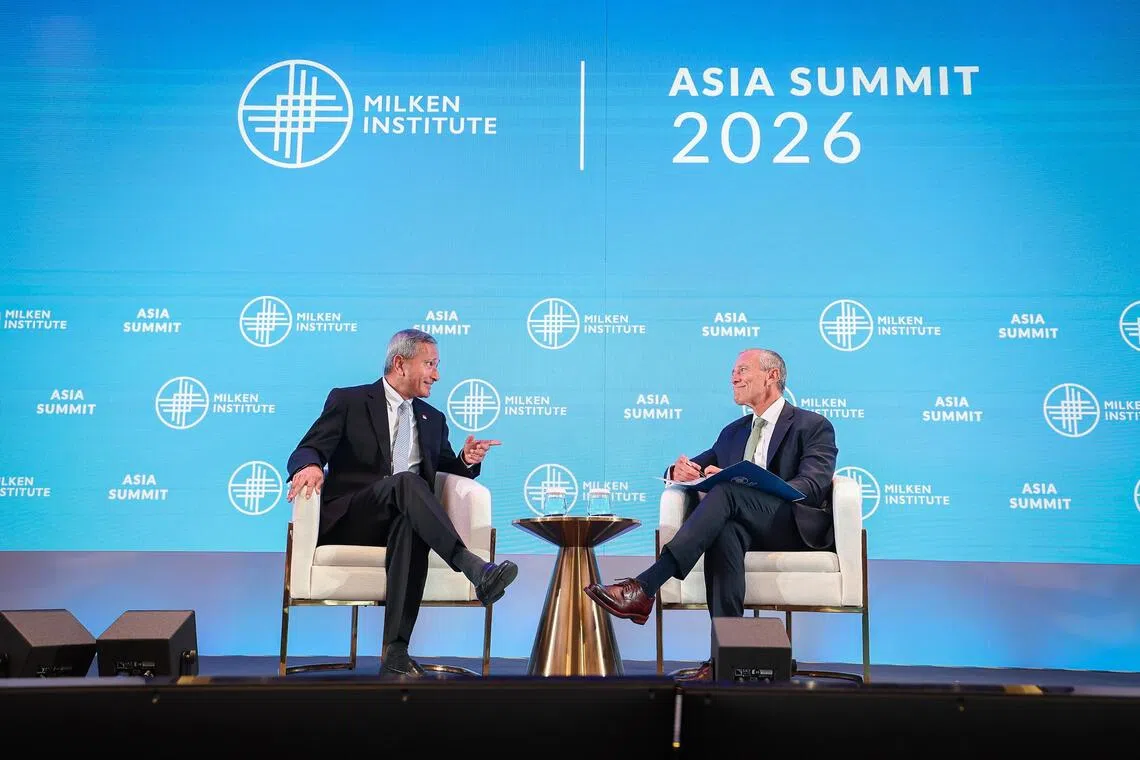
Foreign Affairs Minister Vivian Balakrishnan said ASEAN is aiming for deeper integration among its member countries and wider partnerships beyond just its traditional dialogue partners. PHOTO: MILKEN INSTITUTE
Published Oct 07, 2026, 08:30 PM
Updated Oct 07, 2026, 08:30 PM
- Singapore will use its 2027 ASEAN chairmanship to deepen regional integration and widen ties with the EU, Africa, South America, the Pacific Islands and Canada.
- Vivian Balakrishnan said ASEAN should be seen on its own merit, and not as an arena for superpower contestation. The bloc’s economy is significant and has great potential to grow further, he added.
- He said the world faces “great potential and peril”, but new rules and treaties on AI, biotechnology and other fields can help countries manage rapid change.
SINGAPORE - Singapore will aim to deepen integration between ASEAN member countries and widen partnerships beyond traditional dialogue partners when the Republic becomes chair of the regional bloc in 2027, said Foreign Minister Vivian Balakrishnan.
This includes doing more with the European Union and countries in Africa, South America, the Pacific Islands, and Canada, Balakrishnan said on Oct 7.
At a session of the Milken Institute Asia Summit 2026 being held here, he was asked by moderator chief executive of Milken Institute Richard Ditizio what he would consider a success at the end of Singapore’s term as ASEAN chair.
Singapore would consider its chairmanship a success if ASEAN’s economy continues to grow and become more integrated and if its strengths - such as in energy and technology - are brought to a point where the whole is more than the sum of its parts, said Balakrishnan.
In the midst of a breakdown in the world order and disruptions to supply chains, there are “rich pickings for middle and small powers” - provided that countries keep their heads, continue to build bridges and be constructive solution makers, he said during the fireside chat.
The minister noted that ASEAN countries together form the fourth largest economy in the world, and still has great growth potential in the next 20 years.
“So we want to be assessed on our own merit, and not as an arena for contestation between the superpowers and not as another arena for proxy wars,” he said.
Despite the geopolitical climate, countries in the region have recorded significant growth in the first half of 2026, said Balakrishnan, with Vietnam growing at over 8%, Singapore at 6.1%, and both Malaysia and Indonesia at over 5%.
In 2025, Taiwan overtook China as Singapore’s largest trading partner. The data points to artificial intelligence and semiconductors being a big part in this shift, he noted.
Calling this the beginning of another gilded age, Balakrishnan drew a parallel between the current moment and the last industrial revolution, when railroads were both great investments and also sources of great volatility.
“There’s the bubble word that’s floating all over the place. But in the long run, whatever happens with the short-term volatility, you know that these are technologies that are transforming economics and societies,” he added.
The opportunity is there for huge fortunes to be made, he added, provided that countries are able to come together to set international standards for emerging fields such as artificial intelligence and biotechnology and global commons such as space.
Asked if the global community can still build rules today that every country actually follows, Balakrishnan said it is possible, but with greater difficulty.
He cited the example of the United Nations High Seas Treaty, formally known as the Biodiversity Beyond National Jurisdiction agreement. Negotiations were presided over by Singaporean diplomat Rena Lee, and under her leadership the landmark treaty was adopted by consensus by UN members in 2023.
The treaty came into force on Jan 17 following ratification by more than 80 nations.
The foreign minister said it was not only possible but essential that the world continues to reach such agreements, to provide the “good brakes” necessary for the world to move fast and tap the potential in fields such as AI and synthetic biology.
“This is a moment of great potential and peril. This is a moment of great change and volatility,” he said.
“And If we can thread the needle - not just for Singapore, but for ASEAN as a whole - I think we’ve got quite a compelling narrative and great potential for ASEAN.”
AI/artificial intelligence
外交部长维文·巴拉克里希南表示,东盟的目标是深化成员国之间的融合,并拓展除传统对话伙伴之外的伙伴关系。图片:米尔肯研究院
发布于2026年10月7日晚上8:30
更新于2026年10月7日晚上8:30
- 新加坡将利用其 2027 年东盟轮值主席国身份,深化区域一体化,并扩大与欧盟、非洲、南美洲、太平洋岛屿和加拿大的联系。
维维安·巴拉克里希南表示,应该根据东盟自身的实力来看待它,而不是将其视为超级大国争夺的舞台。他还补充说,东盟的经济规模庞大,并且具有巨大的增长潜力。
他表示,世界面临着“巨大的潜力和危险”,但人工智能、生物技术和其他领域的新规则和条约可以帮助各国应对快速变化。
新加坡——新加坡外交部长维文·巴拉克里希南表示,新加坡将在2027年成为东盟轮值主席国,届时将致力于深化东盟成员国之间的融合,并将伙伴关系扩大到传统对话伙伴之外。
巴拉克里希南在 10 月 7 日表示,这包括与欧盟以及非洲、南美洲、太平洋岛屿和加拿大等国家开展更多合作。
在本次于此地举行的米尔肯研究院亚洲峰会 2026 的一次会议上,主持人、米尔肯研究院首席执行官理查德·迪蒂齐奥问他,在新加坡担任东盟轮值主席国的任期结束时,他认为怎样的成就才算成功。
巴拉克里希南表示,如果东盟经济继续增长并进一步一体化,并且其在能源和技术等方面的优势能够发挥到极致,使整体大于部分之和,那么新加坡将认为其担任主席国是成功的。
他在炉边谈话中表示,在世界秩序崩溃和供应链中断的背景下,“中小国家有很多机会”——前提是各国保持冷静,继续搭建桥梁,并成为建设性的解决方案提供者。
部长指出,东盟国家合计构成世界第四大经济体,并且在未来20年仍具有巨大的增长潜力。
“所以我们希望人们根据我们自身的实力来评判我们,而不是把我们当作超级大国争夺的战场,也不是把我们当作代理人战争的另一个战场,”他说。
巴拉克里希南表示,尽管地缘政治环境复杂,但该地区各国在 2026 年上半年仍实现了显著增长,其中越南增长超过 8%,新加坡增长 6.1%,马来西亚和印度尼西亚均增长超过 5%。
他指出,数据显示,人工智能和半导体行业在这一转变中发挥了重要作用,预计到2025年,台湾将超越中国,成为新加坡最大的贸易伙伴。
巴拉克里希南称这是另一个镀金时代的开始,并将当前形势与上次工业革命进行了比较,当时铁路既是巨大的投资,也是巨大的波动来源。
“现在到处都在谈论泡沫。但从长远来看,无论短期波动如何,你都知道这些技术正在改变经济和社会,”他补充道。
他补充说,只要各国能够齐心协力,为人工智能、生物技术等新兴领域以及太空等全球公域制定国际标准,就有机会创造巨额财富。
当被问及当今国际社会是否还能制定出每个国家都能真正遵守的规则时,巴拉克里希南表示,这是有可能的,但难度更大。
他以联合国公海条约为例,该条约正式名称为《国家管辖范围以外生物多样性协定》。谈判由新加坡外交官雷娜·李主持,并在她的领导下,这项具有里程碑意义的条约于2023年获得联合国成员国的一致通过。
该条约在获得 80 多个国家的批准后,于 1 月 17 日生效。
外交部长表示,世界继续达成此类协议不仅是可能的,而且是至关重要的,这能为世界快速发展和挖掘人工智能和合成生物学等领域的潜力提供必要的“良好刹车”。
“这是一个充满潜力和危险的时刻。这是一个充满变革和动荡的时刻,”他说。
“如果我们能够找到平衡点——不仅对新加坡,而且对整个东盟来说——我认为我们就拥有了一个非常有说服力的故事,以及东盟的巨大潜力。”
人工智能