Could NASA’s SR-71 Blackbird Be Modified To Reach Mach 4?NASA的SR-71黑鸟侦察机能否改装至4马赫?
The SR-71's airframe is capable of going beyond its known top speed and NASA may have good reason to push its limits via new engines.
新闻视频
By Howard Altman , Thomas Newdick , Tyler Rogoway
Published Oct 7, 2026 1:56 PM EDT
During his time as the lead propulsion engineer for SR-71 Blackbirds at NASA’s Dryden Flight Research Center , Tim Conners looked into how to push the iconic recon plane to fly faster than it had ever flown before. The world record for any crewed jet-powered aircraft is officially Mach 3.3, or 2,193 mph. It was set by a Blackbird in 1976 “on a straight-line course over Edwards Air Force Base in California .” In a recent interview with TWZ , Conners said he investigated whether there were ways to get Blackbird to approach Mach 4, equivalent to roughly a whopping 2,660 mph at altitude. Fast forward to today, with the possibility that NASA could be returning the SR-71 in some configuration to its test fleet, as well as its potential missions, the question of just how fast could the airframe go has become far more relevant than just a hypothetical exercise.
Conners spoke to us about his knowledge of plans to restore SR-71 #844, which had mysteriously disappeared from NASA’s Armstrong Flight Research Center, as well as its potential uses, a deep-dive interview here . Prior to the revelations about the missing Blackbird, speculation about NASA’s renewed interest in the type was sparked last month, when NASA Administrator Jared Isaacman showed the silhouette of an aircraft that immediately drew comparisons to SR-71 during a speech at the annual All-In Summit in Los Angeles, California. Isaacman pushed back on a direct link to the SR-71 but said his agency is working hard to get “back in the business of flying high and fast again.”
NASA Administrator Jared Isaacman talks at the All-In Summit about new high- and fast-flying X-planes with the eye-catching aircraft silhouette in the background. All-In Summit/YouTube screencap
Given that, we wanted to know what limited the SR-71’s speed in its original configuration and how fast Conners thought it could go modifications.
“The study that I did at Dryden was purely conceptual,” Conners explained of his work on the topic there in the early 1990s. “I asked questions of the Lockheed folks and the Pratt folks regarding limitations on speed. So stagnation temperature. What can we get to at altitude?”
The Blackbird, he said, “flew a trajectory that was usually operationally limited to 450 knots equivalent airspeed. If you look at the flight envelope, that defines the right edge of the envelope.”
SR-71 Blackbird. (Courtesy photo via USAF)
“The engines, however, were optimized to fly at about 500 knots equivalent airspeed, 475 to 500, and for whatever reason, there was a mismatch between what the engines were designed to do and what the airframe was ultimately optimized for, which was flight at around 450 knots,” the engineer added. “And you end up with that limitation now, the equivalent airspeed curve hooks up and to the right as you go up in altitude, so it sweeps out Mach number, and as you sweep out Mach number, the stagnation temperature is going up on you.”
“So you do reach a point, even at 500 KEAS [ knots equivalent airspeed ], where you end up with a constant value up at altitude once you’re in the stratosphere,” Conners said. “The Blackbird was trimmed or limited at that speed on the right side of the envelope, and that equated to a certain stagnation temperature. That limitation was driven primarily by the material strength of the engine front frame, from what it was described to me, and that’s what drove the analysis we did at NASA.”
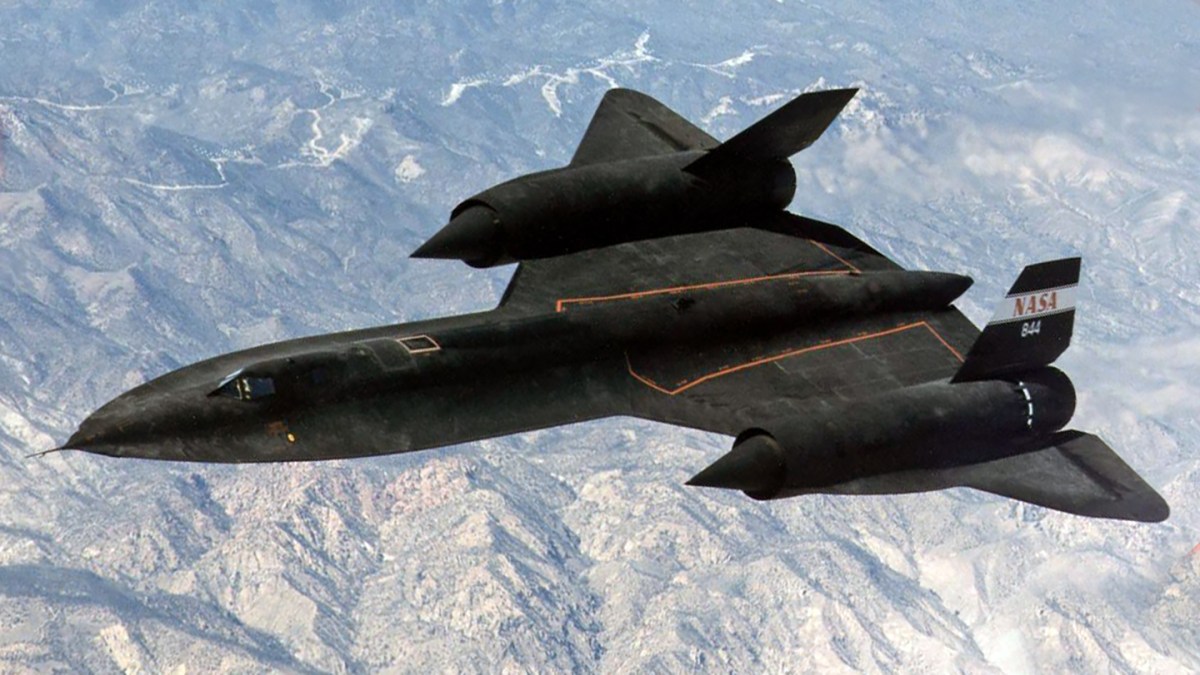
SR-71 tail number 844 during its service with NASA. (NASA)
To even consider pushing the aircraft past the world record speed, Conners said something had to be done to mitigate the tremendous effects of the extreme heat on the air entering the engines.
“We weren’t looking at active cooling of the frame by pumping coolant through it,” Conners recalled. “What we looked at was spray cooling of the incoming airflow to lower the bulk temperature, so it would only be used when you were accelerating beyond about Mach 3.4. You would only very briefly do Mach excursions to a higher Mach number, and then come back. That was the conops for that system.”
“This is a way to [get to a higher Mach range] briefly,” the engineer postulated. “You could probably get to a higher Mach number. The problem is that if you clog or freeze the system, if it fails while you’re at higher speed, you have to decelerate in a hurry to protect the assets.”
Among other impediments to breaking the speed record, the Blackbird’s existing power plant was not up to the job, according to Conners.
“So that weak link was the J58,” he explained. “It had the performance, but not the material strength. If we’re looking at alternate engines designed to handle the higher Mach capability, then that could put the limiter on the airframe at that point, which we were told at NASA was somewhere like up near Mach 4 for brief excursions.”
Aviation expert Paul F. Crickmore, who’s written several books about the Blackbird, told us that the aircraft was designed around a sustained cruise speed of Mach 3.2, with the primary critical limitation being aforementioned compressor inlet temperature (CIT).
Above 427 degrees Celsius (about 800 degrees Fahrenheit), the engines would be damaged, Crickmore noted. But if outside air temperature was colder, the aircraft could go faster before hitting that limit (in practice, Mach 3.3).
Temperature was just one factor in limiting how fast the SR-71 could travel, Crickmore explained. The shock waves from traveling so fast would also tamp down the Blackbird’s ultimate speed potential.
Paul Crickmore’s latest book on the SR-71, Lockheed Blackbird: Beyond the Secret Missions. The Missing Chapters . (Osprey Publishing)
“On the SR, you have to think three-dimensionally,” Crickmore explained. “But looking in just two dimensions, you would have an oblique shock wave on the nose, the first shock wave, and it would be at 90 degrees on either side. As the airplane got faster, that cone became more sharp until you got down to about 32 degrees. Now, at that speed, you’re at [Mach] 3.2. That oblique shock wave was still outside the envelope of the airplane – you don’t want to get that shockwave going anywhere near the flight controls. The faster you go, the narrower that cone, and the closer it gets to the wingtips, which is not good. This is the thing: People say, ‘Oh yeah, we can go maybe Mach 6.’ Well, right. But it’s not just about that. It’s about a lot of other things.”
The limiting factors imposed by the CIT value and the shockwave effect are also recalled by the late SR-71 pilot David Peters, recounted on the Habubrats SR-71 account on X.
“A little clarification on the speed. The issue is that I have been limited to less than Mach 3 on a few occasions because the outside air temperature was entirely above standard, and 427C came up at about [Mach] 2.95. On other occasions, like the Murmansk deal I got above 3.4 (3.49 on one occasion) and wasn’t close to 427C. The actual limiting airspeed is around 3.55; that is where the spike, being at full retraction loses the intercept on the shock wave and can no longer position it correctly in the inlet. Also, the overflow of the shock starts to go over the wing and interfere with the flight controls. So the limiting speed as configured would be about 3.55 so long as you don’t exceed 427C.”
For his part, Conners said that “shock effects at the inlet can be accommodated through rescheduling the inlet spike movement and perhaps making changes to the bypass schedules. None of that would necessarily be simple, and any changes would require careful envelope expansion. But it would not be impossible.”
Regardless of any other factors, Conners, the Blackbird engineer, remembered that his effort in boosting the jet’s speed never took off.
“It never got beyond me just sizing tank volume, considering different fluids that might work as a coolant, and then just gauging the relative appetite of NASA hierarchy for something like that,” Conners stated. “They weren’t interested in the risk. Nobody was asking for that Mach range.”
But that may be changing. It seems clear that one of the biggest challenges of getting the Blackbird back in the air will be its engines. They have sat for a long time, and getting them into a flyable condition could be the limiting issue. Beyond that, equipping the SR-71 with new engines also may represent the biggest opportunity for NASA getting a return on investment from its revived Blackbird.
In our interview , Conners told us that the feedback he heard about the remaining Blackbird J58 engines was “discouraging” because “the engines are indeed unserviceable.”
“I don’t believe that is based on an actual attempt to run them,” he explained. “It is based on inspection. Probably no surprise. They’ve sat idle, you know, for 27 years. That is what led to questions going back and forth regarding how the airframe would be powered. And that’s what led into, if you connect the dots, that’s where the airframe would be used as an engine test bed.”
Different engines “would have to be high-Mach bypass systems,” he noted. “We can speculate on which engine company might be developing those systems, but yeah, I don’t want to give it too much away because I don’t want us to lose the inside information that we got.”
Pratt & Whitney J58 engine. (National Air and Space Museum)
Also, the flight regime approaching Mach 4 would likely be one of the areas NASA is most interested in. It’s here where a combined cycle engine capable of hypersonic flight, one that contains both turbojet and ramjet or scramjet functions, would ‘hand-off’ propulsion from the turbojet to the other that is optimized for extreme speed. This is the same concept behind Lockheed’s SR-72 concept . Having an aircraft, and especially one that is not mired in deep classification and hidden from view, that can actually test this transitional flight regime could be of extreme value in unlocking a future where hypersonic flight is more accessible.
“Yeah, that could very well be what we’re looking at here,” Conners told us when we asked whether Blackbird’s open classification level is a driving factor in using it as a test bed for this research. “I’ve had friends ask that question this week. We were talking about the SR-72. Where is that at? I don’t know. I know people who went to work on it years ago. I’ve never heard anything since. So it could be that that’s so deep black that there’s no way that platform could be used as a test asset. So I think it’s precisely what you said. The Blackbird’s no longer classified, and that it’s possible that the engines that might be used in Blackbird wouldn’t be classified either.”
Lockheed’s ‘SR-72’ hypersonic plane concept. (Lockheed Martin Skunk Works)
So, reengining the SR-71 may solve two birds with one stone — providing a modern powerplant that won’t require the J58s to be revived and taking care of the inlet temperature issues discussed above that would allow the SR-71 airframe’s full potential to be exploited in testing. The fact that the jet can carry a massive payload on its back could allow it to provide critical testing of the handoff for dual cycle engine concepts.
This is just one use, of course. With the explosion in high-speed flight for defense purposes over the last decade, there are many other reasons to push a Blackbird to higher Mach numbers.
So with all this in mind, if we get the Blackbird back at all, maybe it will roll out with some major modifications that could indeed push it to new velocities.
Contact the author: howard@twz.com
Comments couldn’t be loaded. Please refresh the page.
作者:霍华德·奥特曼、托马斯·纽迪克、泰勒·罗戈韦
发布于美国东部时间2026年10月7日下午1:56
在担任NASA德莱顿飞行研究中心SR-71“黑鸟”侦察机首席推进工程师期间,蒂姆·康纳斯(Tim Conners)致力于研究如何让这款标志性的侦察机飞得比以往更快。目前,载人喷气式飞机的世界纪录官方值为3.3马赫,即2193英里/小时(约3500公里/小时)。这一纪录由一架“黑鸟”于1976年在加利福尼亚州爱德华兹空军基地上空直线飞行时创造。在最近接受TWZ采访时,康纳斯表示,他曾研究过是否有办法让“黑鸟”接近4马赫,相当于高空飞行速度达到惊人的2660英里/小时(约4300公里/小时)。如今,随着NASA有可能将SR-71以某种配置重新投入测试机队,并执行潜在任务,这款飞机究竟能飞多快的问题已不再仅仅是一个假设性的讨论,而是变得至关重要。
康纳斯向我们讲述了他所了解的SR-71 #844修复计划,这架飞机曾神秘地从NASA阿姆斯特朗飞行研究中心消失,以及它的潜在用途。点击此处阅读深度访谈。在SR-71失踪事件曝光之前,上个月NASA局长贾里德·艾萨克曼在加州洛杉矶举行的年度“全员参与峰会”(All-In Summit)上发表讲话时,展示了一架飞机的轮廓,这架飞机立刻让人联想到SR-71,引发了人们对NASA重新关注该机型的猜测。艾萨克曼否认了这架飞机与SR-71的直接联系,但他表示,NASA正在努力“重返高空高速飞行领域”。
美国国家航空航天局(NASA)局长贾里德·艾萨克曼在“全民参与峰会”(All-In Summit)上谈论新型高空高速X系列飞机,背景中引人注目的飞机轮廓清晰可见。(All-In Summit/YouTube截图)
鉴于此,我们想知道 SR-71 在其原始配置中的速度受到哪些限制,以及康纳斯认为改装后它的速度能达到多快。
康纳斯解释说,他在20世纪90年代初在德莱顿进行的这项研究“纯粹是概念性的”。“我向洛克希德公司和普惠公司的人询问了速度限制方面的问题,比如停滞温度,以及我们在高空能达到什么温度。”
他说,黑鸟战机的飞行轨迹“通常在作战操作中被限制在相当于450节的空速范围内。如果你看一下飞行包线,这定义了包线的右边缘。”
SR-71“黑鸟”侦察机。(图片由美国空军提供)
“然而,这些发动机的优化飞行速度约为500节(475到500节),但不知何故,发动机的设计目标与机身最终的优化目标(约450节的飞行速度)之间存在不匹配,”工程师补充道。“最终导致的就是这种限制,随着高度的增加,等效空速曲线向上向右弯曲,马赫数也随之降低,而随着马赫数的降低,滞止温度也会升高。”
康纳斯说:“所以,即使速度达到500节(相当于空速),一旦进入平流层,高度就会趋于稳定。黑鸟侦察机在飞行包线右侧的这个速度下进行了配平或限制,这相当于一个特定的停滞温度。据我了解,这种限制主要是由发动机前框架的材料强度造成的,这也是我们在NASA进行分析的依据。”
SR-71侦察机在NASA服役期间的尾号为844。(NASA)
康纳斯表示,要想让飞机突破世界纪录速度,就必须采取措施减轻极端高温对进入发动机的空气造成的巨大影响。
康纳斯回忆说:“我们当时并没有考虑通过泵送冷却液来主动冷却车架。我们考虑的是对进入的气流进行喷淋冷却,以降低整体温度,这样只有在加速到大约3.4马赫以上时才会用到。你只会非常短暂地进行更高马赫数的加速,然后就会返回。这就是该系统的运行概念。”
“这是一种可以短暂达到更高马赫数的方法,”工程师推测道。“你或许可以达到更高的马赫数。问题在于,如果系统堵塞或冻结,或者在高速飞行时发生故障,你必须迅速减速以保护设备。”
康纳斯表示,打破速度纪录的障碍之一是黑鸟号现有的动力装置无法胜任这项工作。
“所以,J58发动机就是那个薄弱环节,”他解释说。“它的性能不错,但材料强度不够。如果我们考虑使用其他能够承受更高马赫数的发动机,那么这可能会限制机身的飞行速度,而NASA告诉我们,短距离飞行时,这个限制点大约在4马赫左右。”
航空专家保罗·F·克里克莫尔(Paul F. Crickmore)曾撰写过多本关于黑鸟飞机的书籍,他告诉我们,该飞机的设计目标是持续巡航速度达到 3.2 马赫,主要的关键限制是前面提到的压缩机入口温度 (CIT)。
克里克莫尔指出,温度超过427摄氏度(约800华氏度)时,发动机就会损坏。但如果外界气温较低,飞机在达到极限速度(实际上是3.3马赫)之前可以飞得更快。
克里克莫尔解释说,温度只是限制SR-71飞行速度的因素之一。高速飞行产生的冲击波也会抑制黑鸟的极限速度。
保罗·克里克莫尔关于SR-71的最新著作《洛克希德黑鸟:秘密任务之外,缺失的章节》(Osprey出版社)。
“在SR上,你必须从三维角度思考,”克里克莫尔解释说。“但如果只看二维平面,你会看到机头处有一个斜激波,也就是第一道激波,它两侧呈90度角。随着飞机速度的增加,这个锥形区域会变得越来越尖锐,直到角度缩小到大约32度。在这个速度下,飞机的飞行速度达到了3.2马赫。这个斜激波仍然在飞机的飞行包线之外——你绝对不想让激波靠近飞行控制系统。速度越快,锥形区域就越窄,也就越靠近翼尖,这可不是什么好事。关键在于:人们会说,‘哦,我们或许能飞到6马赫。’没错。但这不仅仅关乎速度,还涉及到很多其他因素。”
已故 SR-71 飞行员大卫·彼得斯也回忆起 CIT 值和冲击波效应带来的限制因素,他在 X 上的 Habubrats SR-71 记述中讲述了这些情况。
关于速度,我需要稍作解释。问题在于,由于外部气温远高于标准值,我的飞行速度曾几次被限制在3马赫以下,而427C的出现频率大约在2.95马赫左右。在其他情况下,比如在摩尔曼斯克那次飞行,我的速度超过了3.4马赫(有一次甚至达到了3.49马赫),但427C的出现频率远未达到。实际的极限空速大约在3.55马赫左右;在这个速度下,由于尖峰处于完全收起状态,它无法截获激波,也无法再将其正确定位在进气道内。此外,激波的溢出气流会越过机翼,干扰飞行控制。因此,只要不超过427C,按照目前的配置,极限速度大约在3.55马赫左右。
康纳斯表示,“可以通过重新安排进水口峰值流量的移动时间,或许还可以调整旁通阀的运行时间表来应对进水口的冲击效应。这些措施未必简单,任何改动都需要仔细扩展方案。但这并非不可能。”
不管其他因素如何,黑鸟工程师康纳斯都记得,他提高喷气式飞机速度的努力从未成功。
康纳斯表示:“我当时只是估算储罐容积,考虑几种可能用作冷却剂的液体,然后评估NASA高层对这类项目的兴趣程度。他们对风险不感兴趣。没人要求达到那么高的马赫数。”
但这种情况或许正在改变。显然,让黑鸟重返蓝天的最大挑战之一在于其发动机。这些发动机已经闲置了很长时间,如何让它们恢复到适航状态可能是制约因素。除此之外,为SR-71配备新发动机也可能是NASA从其复兴的黑鸟项目中获得投资回报的最大机遇。
在我们的采访中,康纳斯告诉我们,他听到的关于剩余的黑鸟 J58 发动机的反馈“令人沮丧”,因为“这些发动机确实无法使用”。
“我不认为这是基于实际试运行的结果,”他解释说。“而是基于检查结果。这可能并不令人意外。你知道,它们已经闲置了27年。正因如此,关于机身如何获得动力的问题才反复出现。而如果你把这些点联系起来,就会发现,这架飞机最终会被用作发动机试验平台。”
他指出,不同的发动机“必须是高马赫数旁通系统”。“我们可以猜测哪家发动机公司可能正在开发这些系统,但是,是的,我不想透露太多,因为我不想让我们失去我们获得的内部信息。”
普惠J58发动机。(美国国家航空航天博物馆)
此外,接近4马赫的飞行状态很可能是NASA最感兴趣的领域之一。在这个状态下,能够进行高超音速飞行的组合循环发动机——它同时具备涡轮喷气发动机和冲压发动机或超燃冲压发动机的功能——可以将推进力从涡轮喷气发动机“移交给”后者,后者针对极高速度进行了优化。洛克希德·马丁公司的SR-72概念也采用了相同的原理。拥有一架能够实际测试这种过渡飞行状态的飞机,尤其是一架没有被严格保密、不为人知的飞机,对于开启未来高超音速飞行普及化进程具有极其重要的价值。
“没错,这很可能就是我们现在面临的情况,”康纳斯在我们问及黑鸟侦察机的公开保密级别是否是将其用作这项研究试验平台的关键因素时说道。“这周也有朋友问过我这个问题。我们当时在讨论SR-72。它现在怎么样了?我不知道。我认识一些几年前参与过SR-72项目的人,但之后就再也没有消息了。所以,SR-72可能因为保密级别太低而无法用作试验平台。因此,我认为你说的完全正确。黑鸟侦察机现在已经不再是机密,而且黑鸟侦察机可能使用的发动机也可能不再是机密。”
洛克希德·马丁公司的“SR-72”高超音速飞机概念。(洛克希德·马丁公司臭鼬工厂)
因此,为SR-71更换发动机或许能一举两得——既能提供无需修复J58发动机的现代化动力装置,又能解决上文讨论的进气温度问题,从而使SR-71机身在测试中发挥全部潜力。此外,该机能够携带大量有效载荷,这使其能够为双循环发动机概念的交接测试提供关键支持。
当然,这只是其中一种用途。过去十年间,高速飞行在国防领域的应用呈爆炸式增长,因此还有许多其他原因需要将黑鸟侦察机的飞行速度提升到更高的马赫数。
考虑到所有这些因素,如果我们能够让黑鸟战机回归,它或许会进行一些重大改进,从而真正将其速度提升到新的水平。
联系作者:howard@twz.com
评论加载失败,请刷新页面。