Glaring Lack Of Investment In Aircraft Shelters Highlighted By B-1B’s Sudden Retreat From U.K. AirbaseB-1B轰炸机突然撤离英国空军基地,凸显飞机掩体投资严重不足。
At this point, it could take a disaster for the USAF to invest in giving its prized assets sitting in the open on flightline physical cover from drone attacks.
新闻视频
By Joseph Trevithick
Published Oct 7, 2026 2:09 PM EDT
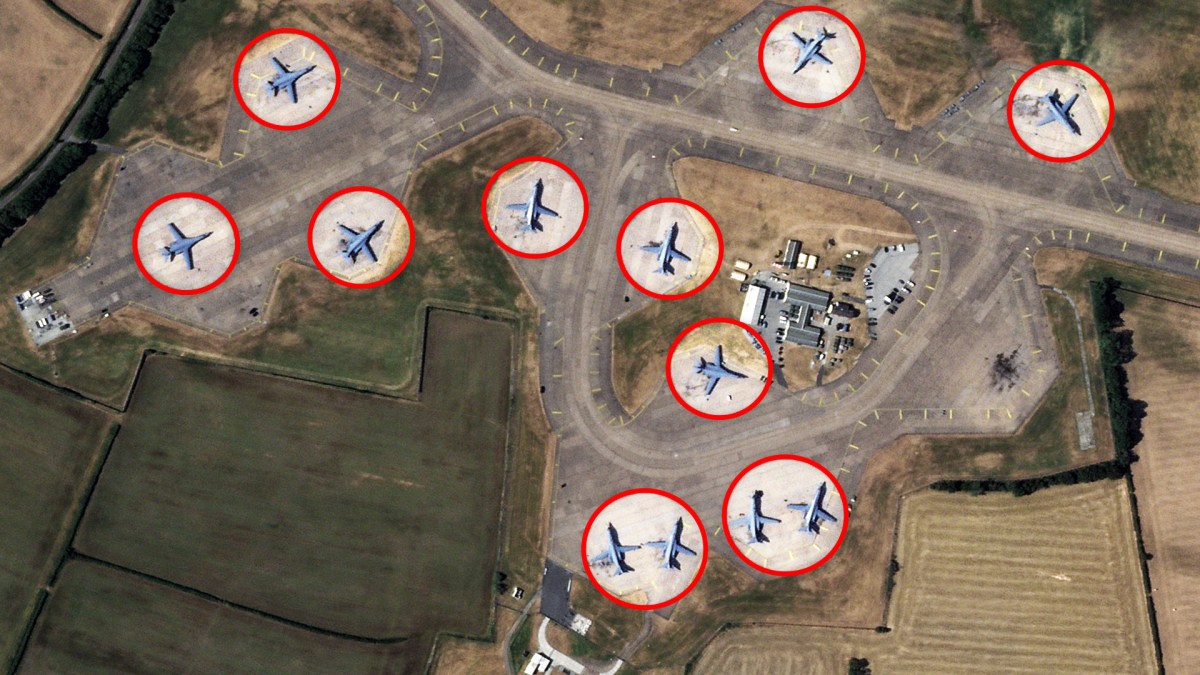
A satellite image of RAF Fairford on July 29, 2026, showing 12 B-1 bombers packed relatively tightly together out in open parking spaces. PHOTO © 2026 PLANET LABS INC. ALL RIGHTS RESERVED. REPRINTED BY PERMISSION
Multiple reports now say that U.S. Air Force B-1 Lancers left the United Kingdom over the weekend due to the threat of an Iranian-directed near-field drone attack broadly akin to Ukraine’s Operation Spiderweb that decimated Russian bombers. Though many specific details are still unconfirmed, this is an entirely plausible mode of attack that TWZ has been warning about for many years now .
Short- and long-range drone threats against parked aircraft have now morphed fully from theory to reality, as also demonstrated by losses in the course of the conflict with Iran , and even non-state actors are increasingly brandishing these capabilities. Despite the increasing dangers posed to planes out on open flightlines , the Pentagon continues to drag its feet on building hardened aircraft shelters and other fortified air base infrastructure .
Before the hasty and unexpected departure of the bombers on Sunday , B-1s had been deployed to RAF Fairford continuously since March, initially in support of Operation Epic Fury against Iran. A contingent of B-52s had also conducted strikes on Iran from Fairford, but left back in July . The base is a major operational hub for the U.S. military in the United Kingdom, and regularly hosts strategic aircraft, including bombers and U-2 spy planes.
Dan Rivers, U.S. correspondent for ITV News in the United Kingdom, was among the first to report on Monday that the B-1’s quick departure had been prompted by concerns about a potential Spiderweb-like drone attack ordered by Iran, citing an unnamed source. Other outlets have subsequently reported similar details , all sourced to anonymous U.S. and British officials.
Ukraine’s unprecedented Operation Spiderweb last year involved simultaneous covert near-field attacks using explosive-laden quadcopter-type drones on airbases across Russia. At least 10 Russian bombers, as well as a variety of other aircraft , all parked on open flightlines, were destroyed.
“They didn’t fly out by accident,” U.S. President Donald Trump told reporters during a gaggle at the White House on Monday when asked about why the B-1s had left Fairford. “There were some threats.”
A satellite image showing B-1s parked in the open at RAF Fairford on July 29, 2026. PHOTO © 2026 PLANET LABS INC. ALL RIGHTS RESERVED. REPRINTED BY PERMISSION
“I can’t tell you that, but if they did, they’ll suffer greatly,” Trump added in response to a separate question about whether Iran might have been managed to get weaponized drones into the United Kingdom.
“What you saw there was the Secretary of War [Pete Hegseth], out of an abundance of caution, trying to protect our guys,” U.S. Vice President J.D. Vance said during a separate press engagement on Monday. “We do feel, with some confidence, that the Iranians are – they’re trying to do what the Iranian state has done for 49 years, which is engage in acts of terrorism against the United States, and a lot of other people, as well. So, we are being extremely cautious.”
Another satellite image offering an overall view of RAF Fairford. Google Earth
It’s also worth noting here that British authorities had arrested five men on suspicion of driving bomb-laden vans toward the base back on September 27. Those individuals were released on bail after no explosives were found in the vehicles. U.S. and British Officials have also raised the possibility of an Iranian link to that incident .
“We’ve documented what happened [near Fairford] last week. I wouldn’t just directly tie that to the move that was made,” U.S. Secretary of State and National Security Advisor Marco Rubio also told members of the press on Monday . “The only reason why you guys are focused on how many planes are at Fairford is because of the threat that happened last week.”
“We have confidence in the security of all of our bases, because all of our bases are [sic] theoretically could be threatened at any moment,” he added.
Rubio’s comments notwithstanding, the remarks from Trump and Vance make clear that there was some recent threat intelligence that contributed to the decision to pull the bombers from Fairford. There are still many questions about the exact nature of the potential attacks, and how imminent, or not, the danger may have been.
Regardless, as mentioned, the prospect of a near-field drone attack on a base like Fairford carried out by actors in close proximity is extremely plausible, and the barrier to entry to such an operation is relatively low. Spiderweb may have thrust this reality into the public consciousness in dramatic fashion , but the danger well predates that operation, and even the start of Russia’s all-out invasion of Ukraine in 2022.
TWZ has been highlighting exactly these kinds of threats in the course of a decade or so now of regular reporting on drone incursions over U.S. and foreign military facilities and critical infrastructure , as well as American naval vessels operating offshore . Langley Air Force Base in Virginia and Barksdale Air Force Base in Louisiana , some of America’s most strategic airbases domestically, are among the facilities that have had to grapple with this in the past. After the Langley incident, in particular, it had become clear to the larger public what we had been reporting for many years, that the United States does not control the airspace over even its most critical military installations.
This all extends overseas, as well. In November 2024, there was a rash of drone sightings over and around several airbases in the United Kingdom, including RAF Fairford . This has been an issue more broadly in Europe in recent years , as well. This was only further underscored by an attempted drone attack on a Ukrainian An-124 at an airport in Germany in August, which authorities in that country have blamed on Russia .
New footage of yet another act of Russian terrorism on EU soil, showing the drone loaded with explosives on the tarmac at Leipzig/Halle Airport, just meters from a Ukrainian Antonov An-124 cargo aircraft. According to German authorities, the drone was carrying an improvised… https://t.co/eCZaLfz9yx pic.twitter.com/DbRz87wgIv — SPRAVDI — Stratcom Centre (@StratcomCentre) August 5, 2026
New footage of yet another act of Russian terrorism on EU soil, showing the drone loaded with explosives on the tarmac at Leipzig/Halle Airport, just meters from a Ukrainian Antonov An-124 cargo aircraft. According to German authorities, the drone was carrying an improvised… https://t.co/eCZaLfz9yx pic.twitter.com/DbRz87wgIv
A drone attack on Fairford would also not necessarily have had to come from somewhere very close by. Longer-range one-way attack drones are steadily proliferating, and can be launched using a variety of methods from positions on the ground, as well as vessels at sea. TWZ explored the very real threat of sea-based drone attacks, including ones conducted covertly, and Iran’s specific ability to carry them out globally, following the leak of an FBI alert back in March.
The proliferation of lower-end one-way-attack drones has ‘democratized’ precision-guided attacks, even for non-state actors . The fielding of automated targeting capabilities, driven by developments in artificial intelligence and machine learning, is also becoming more and more widespread. That technology will soon enable these weapons to find and strike even moving targets on their own. Even without anyone at the controls and without the drone putting out any detectable radio emissions, very effective precision attacks can still be launched at static targets, like known parking areas for aircraft at airbases, just by using basic map coordinates or Google Earth. It’s also worth pointing out here that the definition of a stand-off attack is becoming increasingly blurry, with even quadcopter-type drones capable of flying miles away to conduct a kamikaze attack on a target based on a set of GPS coordinates.
Ukrainian Saker UAV with AI capabilities. The video shows the process of target recognition. It has reportedly already been put to use several times against Russian targets. pic.twitter.com/NVNJyxUjGP — NOELREPORTS 🇪🇺 🇺🇦 (@NOELreports) January 25, 2024
Ukrainian Saker UAV with AI capabilities. The video shows the process of target recognition. It has reportedly already been put to use several times against Russian targets. pic.twitter.com/NVNJyxUjGP
Overall, it is an indisputable fact that aircraft sitting exposed on a flightline are particularly vulnerable to drone attacks, as well as other threats. This is something U.S. military officials have acknowledged themselves . Fairford, where B-1s and other bombers have no option but to park out in the open in well-established areas that are plainly visible from outside the base’s immediate perimeter, is indicative of how American military aircraft are generally positioned on the ground abroad and at home.
As we wrote all the way back in 2017:
“ Similar swarming strikes could be unleashed behind the front lines as well, with hugely expensive and low density/high demand combat aircraft being especially vulnerable to this sort of tactic—something General James Holmes alluded to inadvertently while speaking to the Air Force Association, stating:
‘Imagine a world where somebody flies a couple hundred of those and flies one down the intake of my F-22s with just a small weapon on it.’
Actually, it would be even easier to just strike the jets as they sit idle and vulnerable on the flight line. One swarm could see a whole squadron of tightly packed fighters destroyed without even having a chance to fight back. “
This picture of a B-1 at Fairford on March 7 shows how bombers and other aircraft are typically parked at the base. The line of photographers along the fence line also underscores how close those parking spots are to the base’s immediate perimeter. JUSTIN TALLIS / AFP via Getty Images
With all this in mind, a heated debate has emerged in the past few years in and around the U.S. military about the value of investing in new hardened aircraft shelters , as well as other fortified infrastructure.
To date, the U.S. Air Force, in particular , has put virtually all emphasis on surface-to-air missiles and other active defenses , as well as the dispersal of aircraft , over physical hardening. The conflict with Iran, in which a number of American military aircraft have been damaged or destroyed on the ground by drone and missile attacks, has underscored the limits of these strategies.
Second angle. pic.twitter.com/NUupdRkdm9 — OSINTtechnical (@Osinttechnical) March 29, 2026
Second angle. pic.twitter.com/NUupdRkdm9
“I’m not a big fan of hardening infrastructure,” Gen. Kenneth Wilsbach said at a roundtable at the Air and Space Forces Association’s main annual symposium in 2023, offering a prime example of this viewpoint. “The reason is because of the advent of precision-guided weapons … you saw what we did to the Iraqi Air Force and their hardened aircraft shelters. They’re not so hard when you put a 2,000-pound bomb right through the roof.”
Wilsbach was commander of Pacific Air Forces (PACAF) at the time. He subsequently became head of ACC and is now Chief of Staff of the Air Force, the service’s top officer.
“I think that I don’t want to spend a lot of money on hardening shelters. Unless you’re going to send something 100 feet or more underground, we can blow it up, and so can they,” Wilsbach said in an interview with Breaking Defense in July of this year when asked explicitly if his position changed. “So, the economics of building a shelter that is impervious to a strike doesn’t work.”
U.S. Air Force Chief of Staff Gen. Ken Wilsbach speaks during an all-call with personnel at RAF Mildenhall, another base in the United Kingdom, on July 13, 2026. USAF
“I think the economics favor defending your airspace, defending your ground space with systems that can defeat the incoming rounds, versus building a shelter,” he added. “Some people would argue, well, you should do both. Well, that’s even more expensive. And the other thing is, the shelter doesn’t go anywhere.”
It is fair to point out that typical above-ground hardened aircraft shelters are not invulnerable, especially to attacks involving ballistic, cruise, and certain air-launched threats. There are also substantial cost and other factors to consider when it comes to any major military construction effort.
That being said, having more hardened infrastructure also imposes costs and complexities on opponents, who have to dedicate more advanced and costly munitions and other resources to ensure targets are neutralized. Shelters have the knock-on benefit of complicating the targeting process for an enemy by obscuring where aircraft are or are not positioned, to begin with. An opponent has to treat shelters like they are full even if they are empty.
When thinking about hardened aircraft shelters, stereotypical Cold War-era reinforced concrete structures typically come to mind. However, they do not all have to be built to a one-size-fits-all standard with the same degree of hardening across the board to be useful. Shorter-range drone attacks are typically carried out by platforms carrying small explosive charges or that are designed to drop small bomblets . Even longer-range one-way-attack drones generally have smaller warheads than traditional missiles, they also hit with less kinetic energy.
A US Air Force F-16 fighter sits inside a traditional hardened aircraft shelter. USAF
A structure that shields against smaller blasts and shrapnel, also including from cluster munitions that can be readily scattered across wide areas, is one that then has to be addressed by more capable weapons. This could even include mobile or otherwise temporary shelters that offer sufficient concealment and protection.
This picture shows what the Air Force described as a “prototype portable camouflage, concealment, and deception hangar” in use during Exercise Hoodoo Sea in 2023. Air National Guard The prototype portable hangar intended to support camouflage, concealment, and deception efforts in use during an Air National Guard-led exercise in 2023. Air National Guard
Eliminating, or at least substantially mitigating, the lowest rung of threats creates a dilemma for opponents, who then have to decide whether it is even worthwhile to attempt certain types of attacks. There is clear value in narrowing the available options for the enemy and pushing them toward having to expend higher-end, more expensive munitions, that are available in smaller quantities, and that traditional active defenses may be better optimized to handle. As an example, it may be more viable to shoot down a small barrage of incoming cruise missiles than a swarm of dozens of drones.
Active defenses, especially surface-to-air missile batteries and interceptors to go with them, have historically been very expensive . Lower-end counter-drone-focused interceptors and directed energy weapons are helping to bring these costs down in some regards. Even so, those capabilities come at a significant cost.
There are magazine and stockpile depth issues at play here, too. This is something that has also been brought front and center by the conflict with Iran , which has fueled already long-standing concerns about the sufficiency of stockpiles of air defense interceptors, other critical munitions, and the capacity to replenish them quickly. This is something the British government, among others, is also grappling with, as you can read more about in our separate reporting here .
Furthermore, losses of aircraft on the ground are not without their own costs, which are even more lopsided if an opponent can simply use lower-cost weaponized drones. U.S. bombers are particularly expensive and prized assets that are in short supply compared to the level of demand, as seen during the height of combat operations earlier this year against Iran. When it comes to B-1s, specifically, there are only 45 of them left in service today. A dozen of them being knocked out in one go would have major repercussions strategically. Losing even one would also be a propaganda coup for whoever might be responsible.
How many shelters can we build for the upgrade cost of one Zumwalt class DDG that will probably be parted out in 10 years anyway? — Tyler Rogoway (@Aviation_Intel) October 5, 2026
How many shelters can we build for the upgrade cost of one Zumwalt class DDG that will probably be parted out in 10 years anyway?
On top of all this, the U.S. military simply will not always have the luxury of being able to rapidly relocate aircraft in response to threats. Moving a dozen bombers on short notice takes massive resources. It is not just aircraft that have to be repositioned, but supporting personnel and assets, as well as weapons and fuel. Having to shift to alternate locations could easily have negative impacts on tempo and other aspects of operations, especially in the midst of actual conflict. RAF Fairford is one of only a few bases globally that can support bomber operations for a prolonged period.
More recently, there have been signs of changing mindsets on the matter of hardening across the U.S. military . In January, Joint Inter-Agency Task Force 401 (JIATF-401), a focal point for counter-drone efforts the Pentagon established last year, issued explicit guidance regarding the use of netting , cables , and other kinds of passive physical defenses around bases and other critical infrastructure. A contracting notice in March also called attention to plans for new hardened underground facilities at Al Udeid Air Base in Qatar.
“There is value in some light protection against small, unmanned threats,” Gen. Wilsbach also told Breaking Defense in July. “Some of them — just nets that are up that keep a small, few-$100 drone from getting next to a $2 billion aircraft. That actually works, [and is] really cheap.”
A graphic included a contracting notice put out by authorities at Langley Air Force Base in 2024 showing how sunshade-type shelters at the base might be equipped with anti-drone nets. USAF
“It’s not either or,” Wilsbach said in a separate interview with Air & Space Forces Magazine in July. “The net keeps the small UAS [uncrewed aerial system] from getting close to an aircraft that you’re trying to protect… That’s a very inexpensive way to give you some modicum of protection without killing your checkbook on really exquisite defensive systems.”
In spite of these institutional developments, action to implement such recommendations on a broad basis has continued to lag. There still does not appear to be any major department-wide push to build new hardened aircraft shelters or other fortified structures at facilities globally. The U.S. Air Force does have a certain number of hardened aircraft shelters at bases now, especially in the Pacific and Europe.
This is all despite a very visible trend in the construction of new aircraft shelters and other hardened infrastructure elsewhere around the globe, including in China , Russia , North Korea , and Iran . Even before Operation Spiderweb, Russia had already initiated a large-scale effort to build new hardened shelters at various bases, especially on the occupied Crimean Peninsula , in the face of expanding Ukrainian drone and missile attacks.
Work underway in December 2024 on new hardened aircraft shelters and other infrastructure at Russia’s Belbek Air Base on the occupied Crimean Peninsula. PHOTO © 2024 PLANET LABS INC. ALL RIGHTS RESERVED. REPRINTED BY PERMISSION
Another satellite image taken on June 20, 2026, showing hardened aircraft shelters being built at Engels Air Base in southeastern Russia, which is a major bomber hub. PHOTO © 2026 PLANET LABS INC. ALL RIGHTS RESERVED. REPRINTED BY PERMISSION
“It is inappropriate to discuss matters of intelligence, and we will not discuss specific force protection measures,” a U.S. Air Force spokesperson told TWZ yesterday when asked about the reports that Iranian drone threats prompted the recent removal of the B-1s from Fairford. “The Department will continue to assess the threat environment surrounding our installations and take appropriate actions to protect our people, our platforms and the bases where our forces operate from.”
We still do not know exactly how serious or imminent any recent threat to the B-1s at Fairford was that contributed to their hasty departure. Regardless, the reports of concerns about potential drone attacks remain very plausible. The reality here is that a dozen bombers were yanked from a forward operating location in Europe without an adversary ever having to fire a shot. This is a problem set that is only growing, especially as lessons and expertise on low-end weaponized drones from the war in Ukraine are spreading around the globe.
A B-1 bomber seen parked out in the open at RAF Fairford on March 15, 2026. Matthew Horwood/Getty Images
Also needs to state this problem is growing rapidly, the war in Ukraine and expertise from it when it comes to low end weaponized drones is spreading around the globe. What happens if no flightline is safe
Erecting new aircraft shelters and other hardened infrastructure would not be a full solution to those threats by themselves. At the same time, they would be a valuable added layer of defense, and a passive one that would have a huge logistical footprint to operate once the initial investment is made. The lack of movement to better fortify American airbases globally is only becoming more and more glaring, and it remains to be seen if real action will not occur until lessons are learned in a most unfortunate way.
Contact the author: joe@twz.com
Comments couldn’t be loaded. Please refresh the page.
作者:约瑟夫·特雷维西克
发布于美国东部时间2026年10月7日下午2:09
2026年7月29日拍摄的英国皇家空军费尔福德基地卫星图像显示,12架B-1轰炸机相对紧密地停放在露天停机坪上。照片© 2026 PLANET LABS INC. 保留所有权利。经许可转载。
多份报告称,由于担心伊朗可能发动类似乌克兰“蜘蛛网行动”(该行动重创俄罗斯轰炸机)的近场无人机袭击,美国空军的B-1“枪骑兵”轰炸机已于上周末离开英国。尽管许多具体细节尚未得到证实,但这确实是一种极有可能发生的袭击模式,TWZ多年来一直对此发出警告。
针对停放飞机的短程和远程无人机威胁如今已完全从理论变为现实,伊朗冲突中的损失也证明了这一点,甚至非国家行为体也越来越多地炫耀这些能力。尽管停放在开放跑道上的飞机面临的危险日益增加,五角大楼在建造加固的飞机掩体和其他强化空军基地基础设施方面仍然进展缓慢。
在周日轰炸机匆忙且出人意料地撤离之前,B-1轰炸机自3月以来一直部署在费尔福德皇家空军基地,最初是为了支援针对伊朗的“史诗狂怒行动”。一支B-52轰炸机分队也曾从费尔福德基地对伊朗进行空袭,但已于7月撤离。该基地是美国军方在英国的主要作战枢纽,定期驻扎包括轰炸机和U-2侦察机在内的战略飞机。
英国独立电视台(ITV)驻美记者丹·里弗斯(Dan Rivers)周一率先报道称,B-1轰炸机迅速撤离是由于担心伊朗可能发动类似“蜘蛛网行动”的无人机袭击,他援引的是一位匿名消息人士的话。随后,其他媒体也报道了类似的细节,消息来源均为匿名的美国和英国官员。
去年,乌克兰史无前例地发动了“蜘蛛网行动”,使用装载炸药的四旋翼无人机对俄罗斯各地的空军基地同时发动了隐蔽的近场袭击。至少10架俄罗斯轰炸机以及其他各种飞机,全部停放在开放的跑道上,均被摧毁。
美国总统唐纳德·特朗普周一在白宫与记者会面时,被问及B-1轰炸机为何离开费尔福德空军基地时表示:“它们并非意外起飞。当时存在一些威胁。”
2026年7月29日,卫星图像显示B-1轰炸机停放在英国皇家空军费尔福德基地露天场地。照片© 2026 PLANET LABS INC. 保留所有权利。经许可转载。
“我不能告诉你,但如果他们真的这么做了,他们会遭受巨大的损失,”特朗普在回答另一个关于伊朗是否有可能将武器化无人机运入英国的问题时补充道。
美国副总统万斯周一在另一场新闻发布会上表示:“你们刚才看到的是,战争部长(皮特·赫格塞斯)出于高度谨慎,试图保护我们的人员。”他还说:“我们相当有把握地认为,伊朗人正在试图重蹈伊朗政府49年来的覆辙,即对美国以及其他许多国家发动恐怖主义袭击。因此,我们采取了极其谨慎的态度。”
另一张卫星图像展示了费尔福德皇家空军基地的全景。谷歌地球
值得注意的是,英国当局曾于9月27日逮捕了五名男子,他们涉嫌驾驶装满炸弹的货车驶向该基地。由于车内未发现爆炸物,这些人随后被保释。美国和英国官员也曾提出,伊朗可能与该事件有关。
“我们已经记录了上周(费尔福德附近)发生的事情。我不会直接把这件事和采取的行动联系起来,”美国国务卿兼国家安全顾问马可·卢比奥周一也对媒体表示。“你们之所以关注费尔福德有多少架飞机,唯一的原因就是上周发生的威胁事件。”
“我们对所有基地的安全都有信心,因为理论上我们所有的基地都可能随时受到威胁,”他补充道。
尽管鲁比奥发表了评论,但特朗普和万斯的言论清楚地表明,近期的一些威胁情报促成了将炸弹袭击者从费尔福德撤离的决定。关于潜在袭击的具体性质,以及危险的紧迫程度,仍然存在许多疑问。
无论如何,正如前文所述,像费尔福德这样的基地遭到近场无人机袭击的可能性极高,而且此类行动的准入门槛相对较低。“蜘蛛网行动”或许以戏剧性的方式将这一现实带入了公众视野,但这种危险早在该行动之前就已存在,甚至早于俄罗斯2022年全面入侵乌克兰。
在过去十多年里,TWZ一直持续报道无人机入侵美国和外国军事设施及关键基础设施,以及美国海军舰艇在近海作业的事件,并着重强调此类威胁。弗吉尼亚州的兰利空军基地和路易斯安那州的巴克斯代尔空军基地是美国国内最具战略意义的空军基地之一,过去都曾遭受过此类威胁。尤其是在兰利事件之后,公众更加清楚地认识到我们多年来一直在报道的事实:美国甚至无法控制其最关键军事设施上空的空域。
这种情况也蔓延到了海外。2024年11月,英国多个空军基地及其周边地区,包括费尔福德皇家空军基地,都出现了无人机出没的事件。近年来,这在欧洲也成为一个更广泛的问题。今年8月,一架乌克兰安-124运输机在德国机场遭到无人机袭击未遂,德国当局指责俄罗斯是幕后黑手,这进一步凸显了无人机问题的严重性。
最新视频显示,俄罗斯在欧盟境内再次发动恐怖袭击,一架装载爆炸物的无人机停在莱比锡/哈勒机场的停机坪上,距离一架乌克兰安东诺夫An-124运输机仅几米之遥。据德国当局称,该无人机携带的是简易爆炸装置…… https://t.co/eCZaLfz9yx pic.twitter.com/DbRz87wgIv — SPRAVDI — Stratcom Centre (@StratcomCentre) August 5, 2026
最新视频显示,俄罗斯在欧盟境内再次实施恐怖袭击,一架装载爆炸物的无人机停在莱比锡/哈勒机场的停机坪上,距离一架乌克兰安东诺夫An-124运输机仅几米之遥。据德国当局称,该无人机携带的是简易爆炸装置…… https://t.co/eCZaLfz9yx pic.twitter.com/DbRz87wgIv
对费尔福德的无人机袭击也未必必须来自近处。远程单向攻击无人机正在不断扩散,它们可以通过多种方式从地面或海上舰艇发射。今年3月,一份FBI警报泄露后,TWZ深入探讨了海上无人机袭击(包括秘密袭击)的现实威胁,以及伊朗在全球范围内实施此类袭击的具体能力。
低端单向攻击无人机的普及使得精确制导攻击“民主化”,甚至非国家行为体也能使用。人工智能和机器学习的发展推动了自动化目标瞄准能力的部署,并日益广泛。这项技术很快将使这些武器能够自主发现并打击移动目标。即使无人操控,无人机也不发出任何可探测的无线电信号,仅凭基本的地图坐标或谷歌地球,仍然可以对静态目标(例如空军基地的已知飞机停机坪)发动非常有效的精确攻击。此外,值得一提的是,远程攻击的定义正变得越来越模糊,即使是四旋翼无人机也能飞行数英里,根据一组GPS坐标对目标发动自杀式攻击。
乌克兰萨克尔无人机具备人工智能能力。视频展示了其目标识别过程。据报道,该无人机已多次用于打击俄罗斯目标。pic.twitter.com/NVNJyxUjGP — NOELREPORTS 🇪🇺 🇺🇦 (@NOELreports) January 25, 2024
乌克兰萨克尔无人机具备人工智能能力。视频展示了目标识别过程。据报道,该无人机已多次用于打击俄罗斯目标。pic.twitter.com/NVNJyxUjGP
总而言之,停放在跑道上且暴露在外的飞机极易遭受无人机袭击和其他威胁,这是不争的事实。美国军方官员也承认这一点。费尔福德空军基地的情况正是美国军用飞机在国内外地面部署的普遍方式。在那里,B-1轰炸机和其他轰炸机别无选择,只能停放在设施完善、从基地外围清晰可见的空旷区域。
正如我们在2017年所写的那样:
“类似的蜂群式打击也可以在前线后方发动,而那些造价极其昂贵、密度低、需求高的作战飞机尤其容易受到这种战术的攻击——詹姆斯·霍姆斯将军在空军协会的一次讲话中无意间提到了这一点,他说:
“想象一下,如果有人驾驶几百架这样的飞机,然后让其中一架带着小型武器飞进我的 F-22 战斗机的进气口。”
实际上,直接攻击停在跑道上、处于被动挨打状态的战机更容易。一次攻击就能摧毁一整个密集编队的战斗机中队,它们甚至连反击的机会都没有。
这张摄于3月7日费尔福德空军基地的B-1轰炸机照片,展示了轰炸机和其他飞机在该基地的典型停放方式。沿着围栏排成一排的摄影师也突显了这些停机位距离基地外围的距离之近。图片来源:JUSTIN TALLIS / AFP via Getty Images
考虑到所有这些因素,过去几年里,美国军方内外就投资建设新型加固飞机掩体以及其他加固基础设施的价值展开了激烈的辩论。
迄今为止,美国空军尤其将几乎所有精力都放在地对空导弹和其他主动防御系统以及飞机分散部署上,而忽视了实体防御工事的加固。与伊朗的冲突凸显了这些战略的局限性,在冲突中,多架美国军用飞机在地面遭到无人机和导弹袭击而受损或被摧毁。
第二个角度。pic.twitter.com/NUupdRkdm9 — OSINTtechnical (@Osinttechnical) 2026年3月29日
第二个角度。pic.twitter.com/NUupdRkdm9
“我不太赞成加固基础设施,”肯尼斯·威尔斯巴赫将军在2023年空军与太空部队协会年度研讨会的圆桌会议上说道,这便是一个很好的例证。“原因在于精确制导武器的出现……你们都看到了我们对伊拉克空军及其加固的飞机掩体做了什么。一枚2000磅重的炸弹直接穿透屋顶,它们就不是什么坚固的东西了。”
威尔斯巴赫当时是太平洋空军司令。后来他成为空军作战司令部司令,现在是空军参谋长,是空军的最高指挥官。
“我认为没必要花太多钱加固掩体。除非你打算建在地下100英尺(约30米)或更深的地方,否则我们都能把它炸掉,他们也能。”威尔斯巴赫今年7月接受《防务新闻》采访时,被问及他的立场是否有所改变,他这样说道。“所以,建造一个完全防空的掩体在经济上行不通。”
2026年7月13日,美国空军参谋长肯·威尔斯巴赫将军在英国米尔登霍尔皇家空军基地(另一个空军基地)与全体人员举行电话会议。
他补充道:“我认为,从经济角度来看,与其建造掩体,不如部署能够抵御来袭炮火的系统来保卫领空和地面。有些人可能会说,两者都应该做。但那样成本更高。而且,掩体是无法移动的。”
必须指出的是,典型的地面加固型飞机掩体并非坚不可摧,尤其难以抵御弹道导弹、巡航导弹以及某些空射武器的攻击。此外,任何大型军事建设项目都需要考虑巨大的成本和其他诸多因素。
话虽如此,更坚固的基础设施也会给对手带来成本和复杂性,他们必须投入更先进、更昂贵的弹药和其他资源来确保目标被摧毁。掩体还有一个附带的好处,那就是首先会遮蔽敌方飞机的位置,从而增加敌方瞄准的难度。即使掩体是空的,对手也必须将其视为已满员。
提到加固型飞机掩体,人们通常会想到冷战时期典型的钢筋混凝土结构。然而,并非所有加固型掩体都必须采用统一的标准,才能发挥作用。短程无人机攻击通常由携带小型爆炸装置或设计用于投掷小型子炸弹的平台执行。即使是远程单向攻击无人机,其弹头通常也比传统导弹小,动能也更低。
一架美国空军F-16战斗机停放在传统的加固型飞机掩体内。
能够抵御小型爆炸和弹片(包括可散布于大范围区域的集束弹药)的防御工事,需要使用威力更大的武器进行对付。这甚至包括提供足够隐蔽和防护的移动式或其他临时性掩体。
这张照片展示了空军所称的“便携式伪装、隐蔽和欺骗机库原型”,该机库在2023年“胡杜海”演习中使用。该原型便携式机库旨在支持伪装、隐蔽和欺骗行动,在2023年由空军国民警卫队主导的演习中使用。
消除或至少大幅降低最低级别的威胁,会给对手造成两难境地,迫使他们决定是否值得尝试某些类型的攻击。缩小敌人的可用选项,迫使他们动用数量较少、价格昂贵且更高端的弹药,显然具有重要价值。而传统的防御系统或许更适合应对这些弹药。例如,击落一小群来袭的巡航导弹可能比击落数十架无人机更为有效。
主动防御系统,特别是地对空导弹系统及其配套拦截器,历来造价昂贵。低端反无人机拦截器和定向能武器在某些方面有助于降低成本。即便如此,这些能力仍然需要付出巨大的代价。
这里也存在弹药库深度问题。伊朗冲突也使这个问题凸显出来,加剧了人们长期以来对防空拦截弹和其他关键弹药库存充足性以及快速补充能力的担忧。英国政府和其他一些国家也在努力应对这个问题,您可以在我们另一篇报道中了解更多详情(点击此处)。
此外,地面飞机的损失也并非没有代价,如果对手能够使用成本更低的武装无人机,损失将更加悬殊。美国轰炸机是极其昂贵且珍贵的资产,其供应量远低于需求,正如今年早些时候对伊朗的战斗高峰期所见。以B-1轰炸机为例,目前仅存45架在役。如果其中12架同时被击落,将产生重大的战略影响。即使只损失一架,对于幕后黑手而言,也是一次绝佳的宣传机会。
我们用升级一艘朱姆沃尔特级驱逐舰的成本能建造多少个掩体?反正这艘驱逐舰十年后可能就会被拆解出售。——泰勒·罗戈威(@Aviation_Intel)2026年10月5日
我们用升级一艘朱姆沃尔特级驱逐舰(DDG)的成本,可以建造多少个掩体?反正这艘驱逐舰可能10年后就会被拆解出售。
除此之外,美军并非总能随时根据威胁迅速调动飞机。短时间内调动十几架轰炸机需要耗费大量资源。需要重新部署的不仅是飞机,还有支援人员、装备、武器和燃料。被迫转移到其他地点很容易对作战节奏和其他方面造成负面影响,尤其是在实际冲突中。英国皇家空军费尔福德基地是全球少数几个能够长期支持轰炸机作战的基地之一。
最近,美国军方在安全加固问题上的观念出现了转变迹象。今年1月,五角大楼去年成立的负责反无人机工作的联合跨部门特遣部队401(JIATF-401)发布了明确的指导意见,涉及在基地和其他关键基础设施周围使用网、缆绳和其他被动式物理防御措施。3月份的一份合同公告也提到了在卡塔尔乌代德空军基地新建加固地下设施的计划。
威尔斯巴赫将军7月份接受《防务新闻》采访时也表示:“针对小型无人机威胁采取一些轻型防护措施是有价值的。有些措施——比如架设防护网——就能阻止价值几百美元的小型无人机靠近价值20亿美元的飞机。这确实有效,而且成本非常低廉。”
一张图表包含了兰利空军基地当局于2024年发布的一份合同通知,展示了该基地遮阳棚式掩体如何配备反无人机网。
“这不是二选一的问题,”威尔斯巴赫在7月份接受《空军与太空部队杂志》采访时表示。“防护网可以防止小型无人机靠近你试图保护的飞机……这是一种非常经济的方式,可以在不花费巨资购买真正精密的防御系统的情况下,为你提供一定程度的保护。”
尽管体制方面取得了这些进展,但落实这些建议的行动仍然滞后。目前似乎仍未出现任何部门层面的大规模行动,在全球范围内建造新的加固型飞机掩体或其他防御工事。美国空军目前在一些基地,尤其是在太平洋和欧洲的基地,确实拥有一定数量的加固型飞机掩体。
尽管全球其他地区,包括中国、俄罗斯、朝鲜和伊朗,都在大力建设新的飞机掩体和其他加固基础设施,但俄罗斯却并未采取上述行动。甚至在“蜘蛛网行动”之前,面对乌克兰无人机和导弹袭击的不断升级,俄罗斯就已经在多个基地,尤其是在被占领的克里米亚半岛,启动了大规模的加固掩体建设工程。
2024年12月,俄罗斯在被占领的克里米亚半岛别尔贝克空军基地,正在建设新的加固型飞机掩体和其他基础设施。照片© 2024 PLANET LABS INC. 保留所有权利。经许可转载。
另一张摄于2026年6月20日的卫星图像显示,位于俄罗斯东南部的恩格斯空军基地(一个重要的轰炸机枢纽)正在建造加固的飞机掩体。照片© 2026 PLANET LABS INC. 保留所有权利。经许可转载。
美国空军发言人昨日在接受TWZ采访时表示:“讨论情报事宜并不合适,我们也不会讨论具体的部队保护措施。”此前有报道称,伊朗无人机威胁导致B-1轰炸机近期从费尔福德空军基地撤离。发言人补充道:“国防部将继续评估我们设施周围的威胁环境,并采取适当措施保护我们的人员、平台以及部队行动基地。”
我们仍然不清楚近期费尔福德基地B-1轰炸机所面临的威胁究竟有多严重或多紧迫,才导致它们匆忙撤离。尽管如此,有关潜在无人机袭击的担忧仍然非常可信。事实是,十几架轰炸机在敌方甚至无需开火的情况下就被从欧洲前沿作战地点撤离。随着乌克兰战争中低端武装无人机的经验和技术在全球范围内传播,这个问题只会日益严重。
2026年3月15日,一架B-1轰炸机停放在英国皇家空军费尔福德基地露天。图片来源:Matthew Horwood/Getty Images
还需要指出的是,这个问题正在迅速恶化。乌克兰战争及其在低端武装无人机方面的技术正在全球蔓延。如果所有飞行跑道都不安全,那将会发生什么?
建造新的飞机掩体和其他加固基础设施本身并不能彻底解决这些威胁。但同时,它们确实能构成一道重要的额外防御屏障,而且是一种被动防御,一旦完成初始投资,后续的维护和运营将需要庞大的后勤保障。美国在全球范围内加强空军基地防御的行动迟缓日益凸显,而只有在以极其不幸的方式吸取教训之后,真正的行动才会到来,这仍有待观察。
联系作者:joe@twz.com
评论加载失败,请刷新页面。