British Commandos Emerge From German Submarine During Major NATO Exercise在北约大型演习期间,英国突击队员从德国潜艇中走出。
The largest U.K. Commando Force exercise in 15 years is preparing for potential contingencies across the North Atlantic and High North. The largest U.K. Commando Force exercise in 15 years is preparing for potential contingencies across the North Atlantic and High North.
新闻视频
Published Oct 7, 2026 4:13 PM EDT
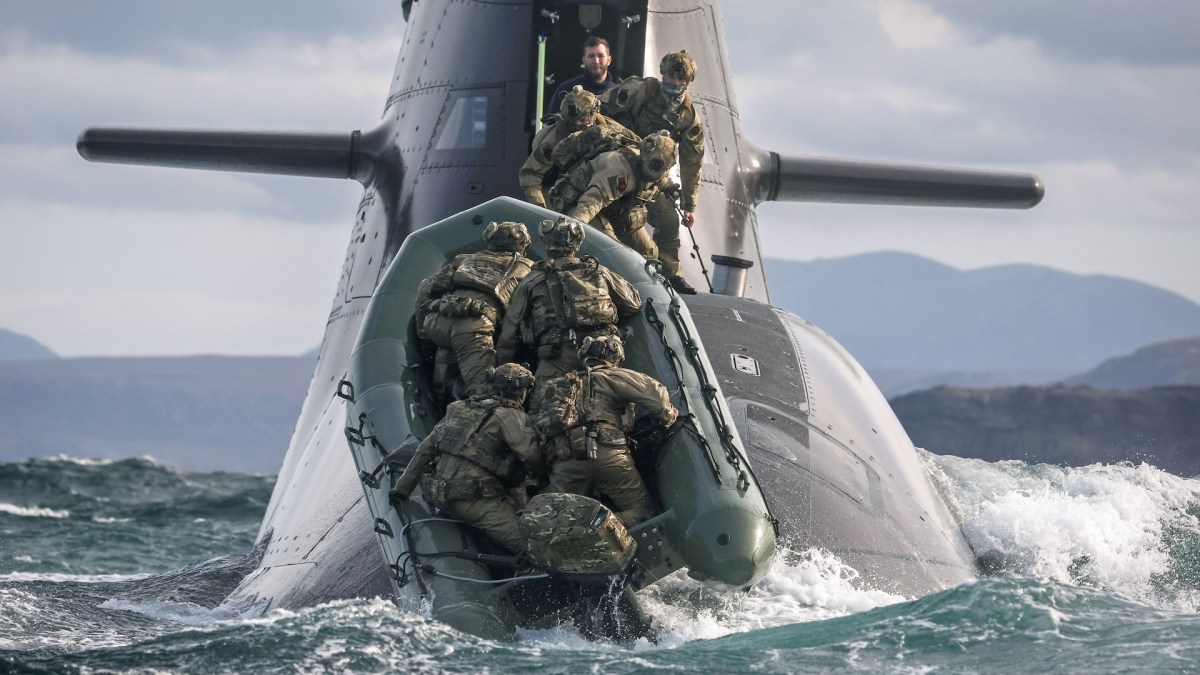
As part of the largest U.K. Commando Force exercise in 15 years, British special operators conducted a submarine insertion off Scotland, making use of a German Navy Type 212A — a boat you can read about in detail here . The maneuvers are the first time since the war in Afghanistan that all of the Commando Force’s specialist elements have operated together. The submarine insertion, conducted at Cape Wrath on September 29, is part of Exercise Strike Warrior, a major NATO drill intended to rehearse allied crisis-response and warfighting operations across the North Atlantic and High North.
The U.K. Royal Navy-led Commando Force specializes in amphibious, littoral, and expeditionary operations. It brings together Royal Marines commandos with specialist elements including reconnaissance, intelligence, targeting, artillery, logistics, and medical capabilities. The force is increasingly focused on smaller, dispersed teams operating across contested littoral environments.
Including elements of the Commando Force, more than 2,000 personnel from the United Kingdom, United States, Germany, Netherlands, Canada, and Norway are currently participating in Strike Warrior, with eight warships and 19 aircraft involved in activity spanning Scotland, the Western Isles, the North-West Approaches, Galloway, the Borders and the North Sea.
The submarine insertion underscores the type of maritime special operations the British Commando Force is now increasingly training to conduct. Personnel from 148 (Meiktila) Commando Forward Observation Battery, Royal Artillery, boarded the unnamed German attack submarine off Scotland before being infiltrated toward the coast. The sub provided intelligence, surveillance, and reconnaissance (ISR) support as the force approached the target area, after which the commandos conducted a discreet small-boat insertion using inflatable raiding craft.
British Commandos board the German U-boat off the north coast of Scotland during Strike Warrior 26. Crown Copyright
Once ashore, the commandos moved onto the cliffs and established an extemporized observation post. From there, they confirmed the simulated target and coordinated live naval surface fires against a simulated enemy position. Here, firepower was provided by the Portuguese Karel Doorman class frigate Dom Francisco de Almeida , presumably using its Oto Melara 76mm deck gun. Following the engagement, the team was extracted. The complete sequence incorporated submarine infiltration, small-boat insertion, covert reconnaissance and targeting, live naval gunfire, and withdrawal into a single mission profile.
The German submarine involved is particularly well suited to this kind of mission. Conventional diesel-electric attack submarines (SSK) lack the nuclear-powered endurance and sustained high speed of an SSN, but those characteristics are not necessarily what a short-range clandestine insertion mission requires. Modern SSKs such as Germany’s Type 212A are designed around extremely low acoustic signatures and can remain submerged for extended periods using air-independent propulsion, making them difficult to detect while operating in relatively shallow and constrained waters.
That combination is hugely valuable for special operations. An SSK can approach a coastline covertly, conduct ISR, release a small team and its boats, and withdraw without exposing a large surface vessel or maintaining the high-speed transit capability associated with a nuclear submarine. Its comparatively small size can also be advantageous when operating closer to shore, where depth, seabed conditions and the presence of coastal sensors can constrain larger submarines. Concentionally powered boats are also far cheaper to procure and operate and have smaller crews.
An SSN offers major advantages for longer-range deployments: far greater endurance, sustained speed, and the ability to carry and support larger payloads over intercontinental distances. These payloads can include dry deck shelters , and swimmer delivery vehicles , allowing allow divers easy exit and entrance while the boat is submerged and at standoff distance from the coast.
But for a mission whose essential requirement is to quietly loiter near a coast, put a small team ashore and leave, an SSK remains a highly relevant platform. Conventional submarines are particularly valuable to the kind of distributed littoral operations NATO is rehearsing in northern European waters.
The U.K. Royal Navy’s four Upholder class were its last diesel-electric submarines. They were withdrawn in 1994–95 and subsequently transferred to Canada . The Royal Navy today operates an all-nuclear submarine fleet .
The Upholders were also particularly suited to inshore operations, reconnaissance, and other missions demanding extreme quietness and maneuverability.
The Royal Canadian Navy long-range patrol submarine HMCS Victoria arrives at Naval Base Kitsap-Bangor for a port call and routine maintenance. This boat was formerly HMS Unseen with the U.K. Royal Navy. U.S. Navy photo by Lt. Ed Early/Released
With this in mind, TWZ has, in the past, examined whether the U.S. Navy should complement its all-nuclear submarine fleet with advanced conventional boats. Sweden’s Gotland demonstrated the value of these kinds of boats when it was leased to the U.S. Navy for adversary training and proved exceptionally difficult for American ASW forces to detect.
Swedish submarine HMS Gotland , left, HNLMS Tromp , center, and HMS Portland steam in formation with other NATO and partner nation ships during maneuvering drills as a part of exercise Dynamic Mongoose in 2015. U.S. Navy photo by Mass Communication Specialist 2nd Class Amanda S. Kitchner/Released
Returning to the Cape Wrath drill, the 148 Battery operations officer involved explained that “This level of complexity and coordination of live assets has not been achieved by 148 for nearly 30 years.”
“We wanted to demonstrate to our partners across the United Kingdom Commando Force, wider U.K. Defense and NATO SOF community the type of missions we are prepared to execute against future threats,” the officer added.
148 Battery secures a remote beach in Cape Wrath during Exercise Strike Warrior 26. Crown Copyright
Multinational integration is central to the exercise. Strike Warrior is testing the ability of the British Commando Force to plug into a much larger allied force in which submarines, surface combatants, aircraft, drones, and small specialist teams can contribute different parts of the same operation.
Earlier in Strike Warrior, 148 Battery also directed fires from the Dutch Karel Doorman class frigate HNLMS Van Amstel and Royal Canadian Navy Halifax class frigate HMCS St. John’s after establishing observation posts. Those ships were operating as part of Standing NATO Maritime Group One .
HNLMS Van Amstel from the Royal Netherlands Navy during Exercise Strike Warrior. Crown Copyright
The exercise also provides a snapshot of how Britain’s commandos have evolved since their intensive employment in Afghanistan. The Royal Marines’ Future Commando Force concept emphasizes smaller, more dispersed formations capable of operating in contested littoral environments, with greater reliance on maritime mobility, uncrewed systems, long-range fires, and allied capabilities.
Strike Warrior combines those elements, with the exercise including amphibious landings, boarding operations, intelligence and surveillance missions, maritime security, and anti-submarine warfare , alongside drone missions involving strikes and combat resupply. Other elements have practiced establishing protected medical facilities.
The geography of Strike Warrior is equally significant. The exercise extends across Scotland and its surrounding waters, including the Western Isles and out into the North Sea, placing the Commando Force in the maritime environment connecting the highly strategic North Atlantic , Norwegian Sea , and northern European approaches.
That region has become increasingly important to NATO planning because of the difficulty of monitoring and controlling such a large maritime battlespace. Submarines, maritime patrol aircraft, surface combatants, drones, and long-range weapons all have roles to play, while the geography provides numerous opportunities for small forces to operate from the coast and islands.
The United Kingdom has been repeatedly using the region and the wider High North as a training ground for this type of activity. Earlier this year, British commandos conducted a submarine insertion during Exercise Cold Response in Norway using the German Navy’s Type 212A submarine U-35 . That also involved submarine infiltration, small-boat deployment, establishment of an observation post, and the direction of allied naval fires.
Royal Marines on Exercise Cold Response in North Norway training in extreme cold conditions while exercising boat drills within the fjords of Norway. Crown Copyright
Strike Warrior expands that concept considerably and across a much larger battlespace, providing an opportunity to test not simply individual capabilities but the ability to combine them during a sustained NATO exercise.
The exercise began September 28 and concludes October 9.
For the British Commando Force, the significance extends beyond the dramatic imagery of troops emerging from a German submarine at Cape Wrath. After years in which British commandos were heavily committed to land-based counterinsurgency operations, the exercise is intended to put them firmly back in a maritime and high-end warfighting context.
This is the kind of operation that the U.K. Commando Force is now preparing to conduct alongside NATO partners in the increasingly contested waters of the North Atlantic and High North.
Contact the author: thomas@thewarzone.com
Comments couldn’t be loaded. Please refresh the page.
发布于美国东部时间2026年10月7日下午4:13
作为英国突击队15年来规模最大的演习的一部分,英国特种作战人员在苏格兰附近海域进行了潜艇渗透行动,使用的潜艇为德国海军212A型——您可以在这里阅读关于这艘潜艇的详细信息。这是自阿富汗战争以来,突击队所有专业兵种首次协同作战。此次潜艇渗透行动于9月29日在拉斯角进行,是“打击勇士”演习的一部分。“打击勇士”是北约一项大型演习,旨在演练盟军在北大西洋和高北地区的危机应对和作战行动。
英国皇家海军领导的突击队部队专精于两栖、近岸和远征作战。它汇集了皇家海军陆战队突击队员以及侦察、情报、目标定位、炮兵、后勤和医疗等专业兵种。该部队日益注重在复杂近岸环境中开展小型分散作战。
包括突击队在内的来自英国、美国、德国、荷兰、加拿大和挪威的2000多名人员目前正在参加“打击勇士”演习,共有8艘军舰和19架飞机参与行动,行动范围涵盖苏格兰、西部群岛、西北通道、加洛韦、边境地区和北海。
这次潜艇渗透行动凸显了英国突击队目前日益重视的海上特种作战类型。皇家炮兵第148(梅克蒂拉)突击队前沿观察连的人员登上了一艘未命名的德国攻击潜艇,该潜艇位于苏格兰附近海域,随后突击队员潜入海岸。在突击队接近目标区域的过程中,潜艇提供了情报、监视和侦察(ISR)支持。之后,突击队员使用充气突击艇进行了一次隐蔽的小艇渗透行动。
在“打击勇士26”行动中,英国突击队员登上停泊在苏格兰北部海岸附近的德国U型潜艇。版权所有
登陆后,突击队员们登上悬崖,建立了一个临时观察哨。他们从那里确认了模拟目标,并协调舰艇对模拟敌方阵地进行实弹射击。此次射击的火力由葡萄牙卡雷尔·多尔曼级护卫舰“多姆·弗朗西斯科·德·阿尔梅达”号提供,据推测使用了其奥托·梅莱拉76毫米舰炮。交战结束后,突击队撤离。整个行动流程包括潜艇渗透、小型艇投放、秘密侦察和目标定位、实弹射击以及撤离,全部整合在一个任务框架内。
参与此次行动的德国潜艇尤其适合执行此类任务。常规柴电攻击潜艇(SSK)缺乏核动力攻击潜艇(SSN)的续航能力和持续高速航行能力,但这些特性并非短程秘密渗透任务的必要条件。现代SSK,例如德国的212A型潜艇,其设计以极低的声学特征为核心,并可利用不依赖空气推进系统长时间潜航,这使得它们在相对较浅且水域受限的区域作战时难以被探测到。
这种组合对于特种作战来说极具价值。SSK可以隐蔽地接近海岸线,执行情报、监视和侦察(ISR)任务,释放一支小型作战小组及其艇员,然后撤离,既不会暴露大型水面舰艇,也不像核潜艇那样需要高速航行能力。其相对较小的尺寸在近岸作战时也具有优势,因为在这些区域,水深、海底状况以及岸基传感器的存在都会限制大型潜艇的行动。此外,采用传统动力的潜艇采购和运营成本也低得多,而且所需艇员也更少。
攻击型核潜艇(SSN)在远程部署方面具有显著优势:续航能力更强、航速更持久,并且能够在洲际范围内携带和支持更大的有效载荷。这些有效载荷可以包括干式甲板舱和潜水员运输艇,使潜水员能够在潜艇潜航且与海岸保持一定距离的情况下轻松进出。
但对于那些只需在海岸附近悄悄徘徊、派遣一小队人员上岸后便离开的任务而言,常规潜艇仍然是一种非常重要的平台。对于北约正在北欧水域演练的那种分布式近岸作战而言,常规潜艇尤其具有价值。
英国皇家海军的四艘“捍卫者”级潜艇是其最后一批柴电潜艇。它们于1994年至1995年间退役,随后移交给加拿大。如今,英国皇家海军拥有一支全部由核动力潜艇组成的舰队。
“捍卫者”级潜艇也特别适合近岸作战、侦察以及其他需要极高静音性和机动性的任务。
加拿大皇家海军远程巡逻潜艇“维多利亚”号抵达基察普-班戈海军基地进行港口访问和例行维护。该艇原为英国皇家海军“无形”号潜艇。美国海军中尉埃德·厄尔利拍摄/发布
鉴于此,TWZ过去曾探讨过美国海军是否应该用先进的常规潜艇来补充其全部核潜艇部队。瑞典的哥特兰号潜艇就展现了这类潜艇的价值。该艇曾被租借给美国海军用于假想敌训练,并被证明极难被美国反潜部队探测到。
2015年,瑞典潜艇“哥特兰”号(左)、荷兰皇家海军“特罗姆普”号(中)和英国皇家海军“波特兰”号与其他北约及伙伴国舰艇在“动态猫鼬”联合军演中进行编队航行。美国海军二级大众传播专家阿曼达·S·基奇纳拍摄/发布
回到 Cape Wrath 演习,参与的 148 炮兵连作战官解释说:“148 炮兵连近 30 年来都没有达到过如此复杂程度的实物资产协调。”
“我们希望向我们在英国突击队、更广泛的英国国防部和北约特种作战部队的合作伙伴展示我们准备执行的应对未来威胁的任务类型,”这位军官补充道。
在“打击勇士26”演习中,第148炮兵连负责守卫雷斯角一处偏远海滩。版权所有
多国协同作战是此次演习的核心。“打击勇士”演习旨在检验英国突击队融入规模更大的盟军部队的能力,该部队包括潜艇、水面作战舰艇、飞机、无人机和小型专业小组,它们可以在同一行动中发挥不同的作用。
在“打击勇士”行动的前期阶段,148炮兵连在建立观察哨后,还指挥了荷兰卡雷尔·多尔曼级护卫舰“范·阿姆斯特尔”号和加拿大皇家海军哈利法克斯级护卫舰“圣约翰”号的火力。这些舰艇当时隶属于北约第一常设海上集群。
荷兰皇家海军“范·阿姆斯特尔”号驱逐舰在“打击勇士”演习期间。版权所有
此次演习也展现了英国突击队自阿富汗高强度作战以来发生的变化。皇家海军陆战队的“未来突击队”概念强调规模更小、部署更分散的部队,能够在交战激烈的近岸环境中作战,更加依赖海上机动性、无人系统、远程火力以及盟军能力。
“打击勇士”演习融合了上述要素,演习内容包括两栖登陆、登船作战、情报监视任务、海上安全和反潜作战,以及涉及无人机打击和战斗补给的任务。其他演习项目还包括建立受保护的医疗设施。
“打击勇士”演习的地理范围同样意义重大。此次演习横跨苏格兰及其周边水域,包括西部群岛,并延伸至北海,使突击队置身于连接战略地位极其重要的北大西洋、挪威海和北欧海域的海上环境中。
由于监测和控制如此广阔的海上战场难度极大,该区域对北约的战略规划变得日益重要。潜艇、海上巡逻机、水面作战舰艇、无人机和远程武器都将发挥重要作用,而该地区的地理环境也为小型部队从海岸和岛屿开展行动提供了诸多机会。
英国曾多次将该地区及更广阔的北高地作为此类行动的训练基地。今年早些时候,英国突击队在挪威举行的“寒冷反应”演习中,利用德国海军的212A型潜艇U-35进行了一次潜艇渗透演练。演练内容包括潜艇渗透、小型艇部署、建立观察哨以及指挥盟军舰炮火。
英国皇家海军陆战队在挪威北部参加“寒冷反应”演习,在极寒条件下于挪威峡湾内进行船艇演练。版权所有
“打击勇士”演习大大扩展了这一概念,并将其扩展到更大的战场空间,提供了一个机会,不仅可以测试单个能力,还可以测试在北约持续演习中将这些能力结合起来的能力。
此次演习从9月28日开始,10月9日结束。
对英国突击队而言,此次演习的意义远不止于士兵们在拉斯角从德国潜艇中走出的震撼画面。多年来,英国突击队一直致力于陆地反叛乱行动,而此次演习旨在让他们重新回到海上高端作战环境中。
英国突击队目前正准备与北约伙伴在竞争日益激烈的北大西洋和高北海域开展此类行动。
联系作者:thomas@thewarzone.com
评论加载失败,请刷新页面。