Singapore’s Asian Games performance goes beyond medals but ‘hard’ to judge without knowing targets: Observers新加坡在亚运会上的表现不仅仅体现在奖牌数量上,但由于不了解目标,很难对其进行评判:观察员
Their comments come after officials said that Singapore's athletes had met their "internal medal projections" though these were not made public.
Their comments come after officials said that Singapore's athletes had met their "internal medal projections" though these were not made public.
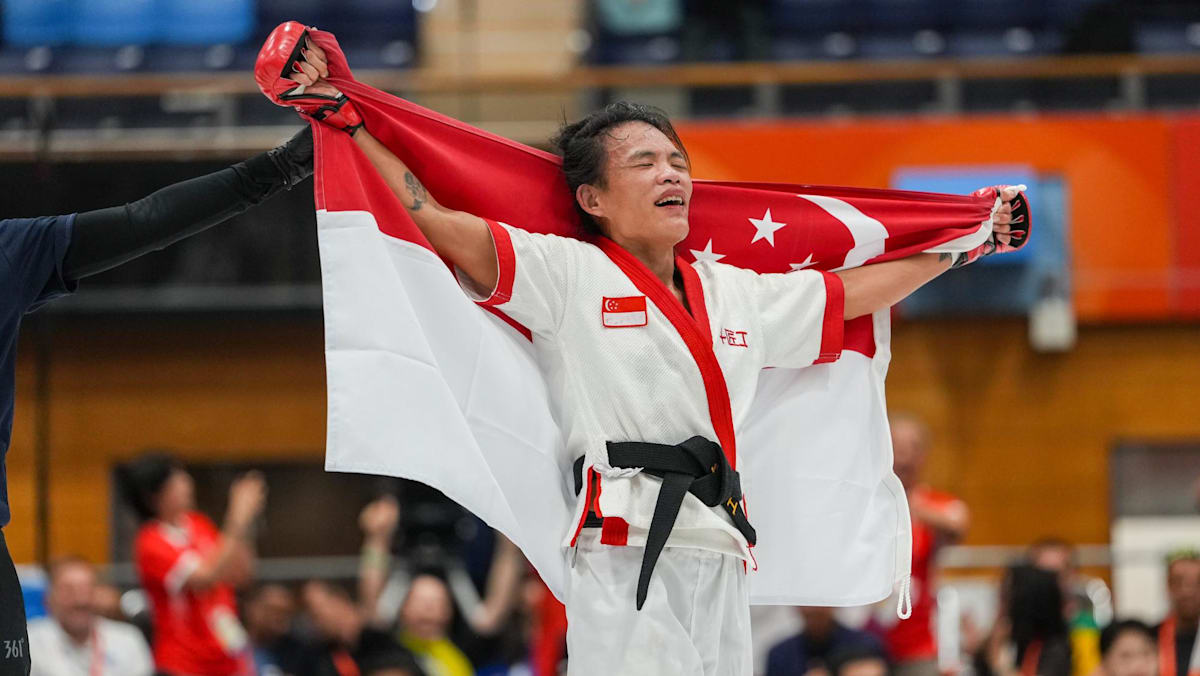
Singapore’s mixed martial arts fighter Tiffany Teo celebrates after winning gold after the women’s traditional 60kg final at the Asian Games at Nagoya City Inae Sports Center, Japan, on Sep 22, 2026. (Photo: SNOC/Lim Weixiang)
This audio is generated by an AI tool.
SINGAPORE: Singapore's performance at the recently concluded Asian Games should be judged on more than its medal tally – with personal bests, national records and the emergence of young athletes among other measures of progress, said observers and members of the sporting fraternity.
But some also questioned the decision by top sports officials to keep medal targets out of the public eye, saying greater transparency was needed for Singaporeans to gauge its sporting development.
Their comments come after officials said on Sunday (Oct 4) that Singapore's young contingent of athletes had met " internal medal projections " and that most of them had achieved their targets.
Singapore's 300 athletes, competing across 27 sports, brought home two gold medals, nine silvers and seven bronzes.
CNA Games Guess Word Crack the word, one row at a time Buzzword Create words using the given letters Mini Sudoku Tiny puzzle, mighty brain teaser Mini Crossword Small grid, big challenge Word Search Spot as many words as you can Show More Show Less It was the joint-lowest number of gold medals since 1998, although the nine silvers were the most Singapore has clinched at the meet. Asked why the projections were not made public, officials said there was a "trade-off", adding that doing so would have "multiplied" the pressure faced by athletes. But they did not rule out disclosing such targets publicly in future.
It was the joint-lowest number of gold medals since 1998, although the nine silvers were the most Singapore has clinched at the meet.
Asked why the projections were not made public, officials said there was a "trade-off", adding that doing so would have "multiplied" the pressure faced by athletes. But they did not rule out disclosing such targets publicly in future.
Singapore National Olympic Council secretary-general Mark Chay, TeamSG chef de mission Goh Kee Nguan, Chief of the High Performance Sports Institute Low Jiaren and Sport Singapore Chief of Sport Development Group Dr Su Chun Wei speak during a Team SG Asian Games wrap-up press conference at the Nagoya Harbour Hall in Nagoya, Japan, on Oct 4, 2026. (Photo: CNA/Wallace Woon)
WHAT DOES MEETING 'INTERNAL PROJECTIONS' MEAN?
Members of the sporting fraternity who spoke to CNA were split over whether medal targets should be made public.
While some agreed with officials that public targets could place unnecessary pressure on athletes, others said openness about goals at this level of competition was important for accountability.
Several pointed out that it was difficult for the public to understand what it meant for athletes to have met projections, when these aims had never been disclosed.
Without a yardstick against which to assess the results, people would naturally compare the medal tally with those of previous Games, they added.
Veteran sports administrator Low Teo Ping said: "It's hard to really say where they're coming from, when it's only after the Games then you come up with these statements."
Mr Low, who has served as Singapore's chef de mission at several major Games and held top positions such as vice-president of the Singapore National Olympic Council and head of the Singapore Sailing Federation, said athletes could be fielded at regional Games with different objectives, such as gaining experience or competing to win.
Clearer communication before a Games would help the public understand those objectives and better assess the progress of Singapore sport, he said.
"It's before the games that is more important (to say) that we intend to achieve this, we intend to achieve that," he added.
"Even if you don't put down a (projected) medal tally, that's fine. But be clear that we intend to go and gain experience, or we intend to, in fact, excel."
Some sports associations said pre-Games expectations provide important context for assessing athletes' performances.
"Those projections would presumably have taken into account the athletes competing, their form, the events available and the strength of the competition," said Mr Delane Lim, general secretary of the Tchoukball Association of Singapore.
"But at the same time, when we are looking at the joint-lowest number of gold medals since 1998, I think it is fair to reflect on what 'meeting expectations' means."
At the 1998 Games in Bangkok, Singapore won two golds, three silvers and nine bronzes.
Mr Lim distinguished between projections – based on sports officials' assessments of athletes' capabilities, the strength of their competitors and other factors – and broader ambitions for "where we want Singapore sport to go".
"Perhaps the more important question is whether our benchmarks and expectations are keeping pace with those ambitions, particularly as sporting standards across Asia continue to improve," he said.
Former journalist Jose Raymond agreed, noting that Singapore once aspired to break into Asia's top 10 and had come close to doing so.
Singapore finished 21st out of 46 nations and territories at this year's Asian Games.
Mr Raymond, who covered the 2006 Asian Games in Doha as a journalist, recalled Singapore winning eight gold medals at the meet.
"Today, we are walking away from an Asian Games 20 years on, with two gold medals and we are saying the internal targets were met. Then something is wrong because we have not moved forward. We've moved backwards," added the managing director of a public relations company.
"It is very hard for us to reconcile with that because we don't know what the internal projections were."
Others who spoke to CNA, however, stressed the importance of looking beyond the number of gold medals, or even the overall medal tally, when assessing the progress of Singapore's athletes.
Highlighting the haul of nine silver medals at the Games , former Singapore Olympic swimmer Tao Li said it is still an encouraging sign, "because it shows that more of our athletes are getting close to the top level in Asia".
"We also had first-ever medals in badminton singles, golf and MMA, so I think it shows Singapore is becoming more competitive across a wider range of sports," she said.
Ms Tao, who now runs her own swimming academy, added that the spread of medals matter too.
While multiple medals in one sport demonstrate strength in that area, medals across different sports "is stronger evidence that Singapore’s overall sporting system is developing well and sustainably", she said.
This year's Games also produced several firsts, with shuttler Loh Kean Yew winning silver for Singapore's first badminton singles medal and golfer Shannon Tan securing the country's first golf medal with a bronze, while sprinter Shanti Pereira became the first woman to win the 200m twice .
Mr James Walton, sports leader for Singapore and Asia Pacific at professional services firm Deloitte, said personal bests and national records can be a "more relevant measure" for athletes competing at regional or world level.
"While a medal may not always be possible due to the sheer excellence of our competitors on the international arena, if an athlete achieves a national record, a personal best, or even a season’s best, then they should be considered to have done their nation proud," he said.
Heading into the Games this year, chef de mission Goh Kee Nguan urged athletes to focus on producing their best performances against Asia's top competitors.
"We are not going to Nagoya to count medals, especially before the Games begin," he said on the sidelines of the Team Singapore flag presentation ceremony on Aug 29.
"But we are there to make sure that the athletes compete, and we will compete all we can to win as much as we can."
This year's Games was far from the first time Singapore competed regionally without first publicly setting any goal or projection, said observers.
Ahead of the 2018 meet, for instance, then-Minister for Culture, Community and Youth Grace Fu said there were no "specific" targets for the Singapore contingent.
Then-chef de mission Lee Wung Yew said: “Everybody has their KPIs (key performance indicators), but we try to limit the kind of stress that they will go through, so why count the chickens before they hatch ?"
There have, however, also been years when Singapore publicly declared its medal aspirations.
In 2010, Team Singapore announced that it aimed to better the 2006 Games tally of 27 medals, and bring home 30 to 33 medals. The athletes eventually won 17 – four golds, seven silvers and six bronzes.
Members of Team Singapore's men's rugby sevens team pose for a photograph during the closing ceremony of the 2026 Asian Games at the Paloma Mizuho Stadium in Nagoya on Oct 4, 2026. (Photo: CNA/Wallace Woon)
HOW MUCH PRESSURE IS TOO MUCH?
Some observers who support keeping projections internal said public targets could add to the pressure athletes already face when representing the nation.
"Public medal targets can raise the stakes in a way that goes beyond normal competitive pressure. Once an athlete is labelled a champion, the public can begin to treat winning as the only acceptable outcome," said Ms Tao.
"A loss is then framed not simply as part of sport, but as a failure."
She added that this misses the nature of high-performance sport, where results are never guaranteed and athletes can still come up against someone better on the day despite their preparations.
"Athletes understand that pressure comes with competing at the highest level," said Ms Tao.
"What they should not have to carry is the weight of relentless judgment whenever they fall short of a public expectation."
Nominated Member of Parliament Kenneth Goh pointed out that each Games features a mix of experienced athletes and young debutants.
Those who are more seasoned competitors are generally better accustomed to handling pressure, said the associate professor at Singapore Management University and president of Singapore Aquatics.
"But we also have junior athletes. They are in a developmental stage, so we also want to be mindful about that."
About two-thirds of Singapore's contingent this year were making their Games debut, with an average age of 23.
Assoc Prof Goh believes it is important to be discerning about what is expected of athletes in different settings.
He cited career athletes in the NBA, NFL and major club football, who are paid large salaries and expected by fans to perform.
He added that many national athletes here make personal sacrifices to train and represent Singapore while also juggling their livelihoods.
"When it comes to our national athletes, we are on the same side as them, so we do whatever we should be doing whatever it takes to support them," said Assoc Prof Goh.
"If that support means not putting undue pressure on public expectations, then I think that's the right approach."
However, some observers believe pressure – including from the public – is part and parcel of competing at such a high level.
Mr Low said that even without publicly declaring targets, athletes and sports administrators would typically already have an idea of their medal prospects based on past performances and assessments of their competitors.
"I think they will just go down and do the best that they can. Why would it be any different (whether the goals are public or not)?" he said.
Mr Raymond added: "It's not as though the pressure is (solely) on the athletes. The pressure is on all of us to back the athletes."
The medal count can also help the public assess the returns on the resources invested in supporting them, he added.
Asked about the implications of Singapore not publicly setting out its medal aspirations, Mr Low said it could erode public confidence.
The way to manage public expectations and the pressure that comes with them is through greater transparency, he said.
Officials could, for instance, be clear about sports that are still developing and where athletes are being sent primarily to gain valuable competitive experience, while spelling out what is expected of more established athletes in stronger disciplines.
Mr Low said: "It's through communication, through more communication."
A single handpicked story that we think you shouldn't miss. Just one a day.
Get our pick of top stories and thought-provoking articles in your inbox
Stay updated with notifications for breaking news and our best stories
Join our channel for the top reads for the day on your preferred chat app
此前,官员们表示新加坡运动员已经达到了“内部奖牌预测”,尽管这些预测并未对外公布。
2026年9月22日,在日本名古屋市稻江体育中心举行的亚运会女子传统60公斤级决赛中,新加坡综合格斗选手张婷婷(Tiffany Teo)夺得金牌后庆祝。(图片:新加坡奥委会/林伟祥)
这段音频由人工智能工具生成。
新加坡:观察人士和体育界人士表示,评判新加坡在最近结束的亚运会上的表现,不应仅仅看奖牌数量,还应看个人最佳成绩、国家纪录以及年轻运动员的涌现等其他进步指标。
但也有人质疑体育高层官员不公开奖牌目标的决定,认为新加坡需要提高透明度,以便新加坡人能够衡量其体育发展水平。
此前,官员们于周日(10 月 4 日)表示,新加坡的年轻运动员队伍已经达到了“内部奖牌预测”,并且他们中的大多数人都实现了目标。
新加坡派出 300 名运动员参加 27 个体育项目的比赛,共获得两枚金牌、九枚银牌和七枚铜牌。
CNA游戏 猜词游戏 逐行破解单词 流行词游戏 用给定的字母组成单词 迷你数独 小谜题,脑力挑战 迷你填字游戏 小方格,大挑战 单词搜索 尽可能多地找出单词 显示更多 显示更少 这是自1998年以来金牌数最少的一次,尽管新加坡获得的9枚银牌是该届赛事中最多的。当被问及为何没有公开预测结果时,官员们表示这其中存在“权衡”,并补充说,公开预测结果会“成倍”增加运动员面临的压力。但他们并未排除未来公开此类目标的可能性。
虽然新加坡获得的9枚银牌是自1998年以来的最低纪录,但金牌数却是最低的。
当被问及为何不公开预测数据时,官员们表示这其中存在“权衡”,并补充说,公开数据会“加剧”运动员面临的压力。但他们并未排除未来公开此类目标的可能性。
2026年10月4日,新加坡国家奥林匹克理事会秘书长蔡明辉、新加坡代表团团长吴启源、新加坡高水平运动学院院长刘嘉仁以及新加坡体育理事会体育发展组组长苏春伟博士在日本名古屋港湾大厅举行的新加坡代表团亚运会总结新闻发布会上发表讲话。(图片:CNA/Wallace Woon)
“内部预测”会议是什么意思?
接受 CNA 采访的体育界人士对于是否应该公开奖牌目标存在分歧。
虽然有些人同意官员们的观点,认为公开目标可能会给运动员带来不必要的压力,但也有人表示,在这个级别的比赛中,公开目标对于问责制至关重要。
一些人指出,当这些目标从未公开时,公众很难理解运动员达到预期目标意味着什么。
他们补充说,如果没有衡量结果的标准,人们自然会将奖牌总数与往届奥运会的奖牌总数进行比较。
资深体育管理人员刘德平表示:“很难说他们的想法是从哪里来的,因为这些声明都是在奥运会结束后才发表的。”
曾担任新加坡代表团团长参加多届大型运动会,并担任过新加坡国家奥林匹克理事会副主席和新加坡帆船协会主席等要职的罗先生表示,运动员参加区域性运动会的目的各不相同,例如积累经验或争取胜利。
他表示,在奥运会举办前进行更清晰的沟通,将有助于公众了解这些目标,并更好地评估新加坡体育的发展情况。
“更重要的是在比赛开始前表明我们打算实现这个目标,我们打算实现那个目标,”他补充道。
“即使你没有给出(预计的)奖牌总数,那也没关系。但要明确表明我们的目的是去积累经验,或者说,我们的目标是取得优异成绩。”
一些体育协会表示,赛前预期为评估运动员的表现提供了重要的背景信息。
新加坡巧克球协会秘书长德兰·林先生表示:“这些预测想必已经考虑到了参赛运动员、他们的状态、可供选择的比赛项目以及比赛的激烈程度。”
“但与此同时,考虑到金牌数量是自 1998 年以来的最低水平之一,我认为有必要反思一下‘达到预期’意味着什么。”
在1998年曼谷奥运会上,新加坡获得两枚金牌、三枚银牌和九枚铜牌。
林先生区分了预测(基于体育官员对运动员能力、竞争对手实力和其他因素的评估)和更广泛的“我们希望新加坡体育发展到什么程度”的愿景。
“或许更重要的问题是,我们的基准和期望是否与这些雄心壮志保持同步,尤其是在亚洲各地的体育水平不断提高的情况下,”他说。
前记者何塞·雷蒙德对此表示赞同,并指出新加坡曾渴望跻身亚洲前十强,而且一度非常接近这一目标。
新加坡在今年的亚运会上,在46个国家和地区中排名第21位。
雷蒙德先生曾以记者的身份报道了 2006 年多哈亚运会,他回忆说新加坡在那届比赛中获得了八枚金牌。
“今天,我们带着两枚金牌离开亚运会,距离上次亚运会已经过去了20年,我们却说内部目标已经达成。这肯定有问题,因为我们没有进步,反而退步了。”一家公关公司的总经理补充道。
“我们很难接受这个结果,因为我们不知道内部预测是什么。”
然而,其他接受亚洲新闻台采访的人士则强调,在评估新加坡运动员的进步时,不应只看金牌数量,甚至奖牌总数。
新加坡前奥运游泳选手陶莉强调,新加坡在本届奥运会上获得了九枚银牌,这仍然是一个令人鼓舞的迹象,“因为它表明,我们越来越多的运动员正在接近亚洲的顶尖水平”。
“我们还在羽毛球单打、高尔夫和综合格斗项目中首次获得了奖牌,所以我认为这表明新加坡在更广泛的体育项目中变得越来越有竞争力,”她说。
陶女士现在经营着自己的游泳学院,她补充说,奖牌的分布也很重要。
她表示,虽然在一项运动中获得多枚奖牌表明该领域实力雄厚,但在不同运动项目中获得奖牌“更有力地证明新加坡的整体体育体系正在良好且可持续地发展”。
今年的运动会也诞生了几个第一,羽毛球运动员罗建耀为新加坡赢得了第一枚羽毛球单打奖牌,高尔夫球运动员陈香农为新加坡赢得了第一枚高尔夫奖牌,而短跑运动员珊蒂·佩雷拉成为第一个两次赢得200米冠军的女子运动员。
德勤会计师事务所新加坡及亚太区体育主管詹姆斯·沃尔顿先生表示,对于参加区域或世界级比赛的运动员来说,个人最佳成绩和国家纪录可能是“更相关的衡量标准”。
他说:“虽然由于国际赛场上竞争对手的卓越表现,获得奖牌并非总是可能,但如果一名运动员创造了国家纪录、个人最佳成绩,甚至是赛季最佳成绩,那么他们就应该被认为为国家赢得了荣誉。”
今年奥运会开赛前,代表团团长吴启源敦促运动员们专注于与亚洲顶尖选手竞争,争取发挥出最佳水平。
“我们去名古屋不是为了清点奖牌,尤其是在奥运会开始之前,”他在8月29日新加坡代表团升旗仪式的间隙说道。
“但我们到场是为了确保运动员们能够参赛,我们也会尽全力去争取尽可能多的胜利。”
观察人士表示,今年的运动会远非新加坡第一次在未事先公开设定任何目标或预期的情况下参加区域性比赛。
例如,在 2018 年会议之前,时任文化、社区及青年部长傅海燕表示,新加坡代表团没有“具体”目标。
时任代表团团长李荣耀说:“每个人都有自己的关键绩效指标(KPI),但我们尽量减少他们所承受的压力,所以为什么要过早地数小鸡呢?”
然而,也曾有几年新加坡公开宣布其夺牌目标。
2010年,新加坡代表队宣布,他们的目标是超越2006年奥运会27枚奖牌的成绩,争取获得30至33枚奖牌。最终,运动员们获得了17枚奖牌——4枚金牌、7枚银牌和6枚铜牌。
2026年10月4日,在名古屋帕洛玛瑞穗体育场举行的2026年亚运会闭幕式上,新加坡男子七人制橄榄球队队员合影留念。(图片:CNA/Wallace Woon)
多少压力才算过大?
一些支持将预测结果内部化的观察人士表示,公开的目标可能会增加运动员代表国家时已经面临的压力。
陶女士表示:“公开设定的奖牌目标会提高竞争压力,使其超出正常的竞技压力。一旦运动员被贴上冠军的标签,公众就可能开始将获胜视为唯一可接受的结果。”
“这样一来,失败就不再仅仅被视为体育运动的一部分,而是被视为一种失败。”
她补充说,这种观点忽略了高水平竞技体育的本质,在高水平竞技体育中,成绩永远无法保证,即使运动员做好了充分的准备,比赛当天仍然可能会遇到更优秀的对手。
陶女士说:“运动员们都明白,在高水平的比赛中,压力是不可避免的。”
“他们不应该背负的是,每当他们未能达到公众期望时,都要承受无情的评判。”
委任议员吴庆炎指出,每届运动会都既有经验丰富的运动员,也有初次参赛的年轻选手。
新加坡管理大学副教授兼新加坡水上运动协会主席表示,经验更丰富的竞争者通常更习惯于应对压力。
“但我们也有青少年运动员。他们正处于成长阶段,所以我们也要考虑到这一点。”
今年新加坡代表团约有三分之二的成员是首次参加奥运会,平均年龄为 23 岁。
吴副教授认为,要清楚不同环境下对运动员的期望非常重要。
他以NBA、NFL和主要俱乐部足球中的职业运动员为例,这些运动员拿着高薪,球迷们也期望他们能有出色的表现。
他还补充说,新加坡许多国家级运动员为了训练和代表新加坡参赛,同时还要兼顾自己的生计,为此做出了个人牺牲。
“对于我们的国家运动员,我们与他们站在同一阵线,所以我们会尽一切努力去支持他们,”吴副教授说。
“如果这种支持意味着不对公众期望施加不必要的压力,那么我认为这是正确的做法。”
然而,一些观察人士认为,压力——包括来自公众的压力——是高水平竞争中不可避免的一部分。
刘先生表示,即使不公开宣布目标,运动员和体育管理人员通常也会根据过去的表现和对竞争对手的评估,对自己的奖牌前景有所了解。
“我认为他们会全力以赴,做到最好。目标公开与否又有什么区别呢?”他说道。
雷蒙德先生补充道:“压力并非仅仅落在运动员身上。我们所有人都有压力支持运动员。”
他还补充说,奖牌数量还可以帮助公众评估投入到支持奖牌方面的资源的回报。
当被问及新加坡不公开阐述其奖牌目标会产生什么影响时,刘先生表示,这可能会削弱公众的信心。
他表示,管理公众期望及其带来的压力的方法是提高透明度。
例如,官员们可以明确指出哪些体育项目仍在发展中,运动员被派往这些项目主要是为了获得宝贵的比赛经验,同时阐明对实力更强的项目中更成熟的运动员的期望。
罗先生说:“这要通过沟通,通过更多的沟通。”
每天一篇,我们精心挑选一篇您不容错过的精彩故事。
订阅我们的邮件,即可获取精选热点新闻和引人深思的文章。
订阅通知,第一时间获取突发新闻和精彩报道。
加入我们的频道,即可在您常用的聊天应用上获取当日热门文章。