Commentary: Team Singapore should not shy away from ambitious medal targets评论:新加坡队不应回避雄心勃勃的奖牌目标。
The seed of future sporting success is planted through high targets set today, says former Team Singapore chef de mission Nicholas Fang.
新闻视频
The seed of future sporting success is planted through high targets set today, says former Team Singapore chef de mission Nicholas Fang.
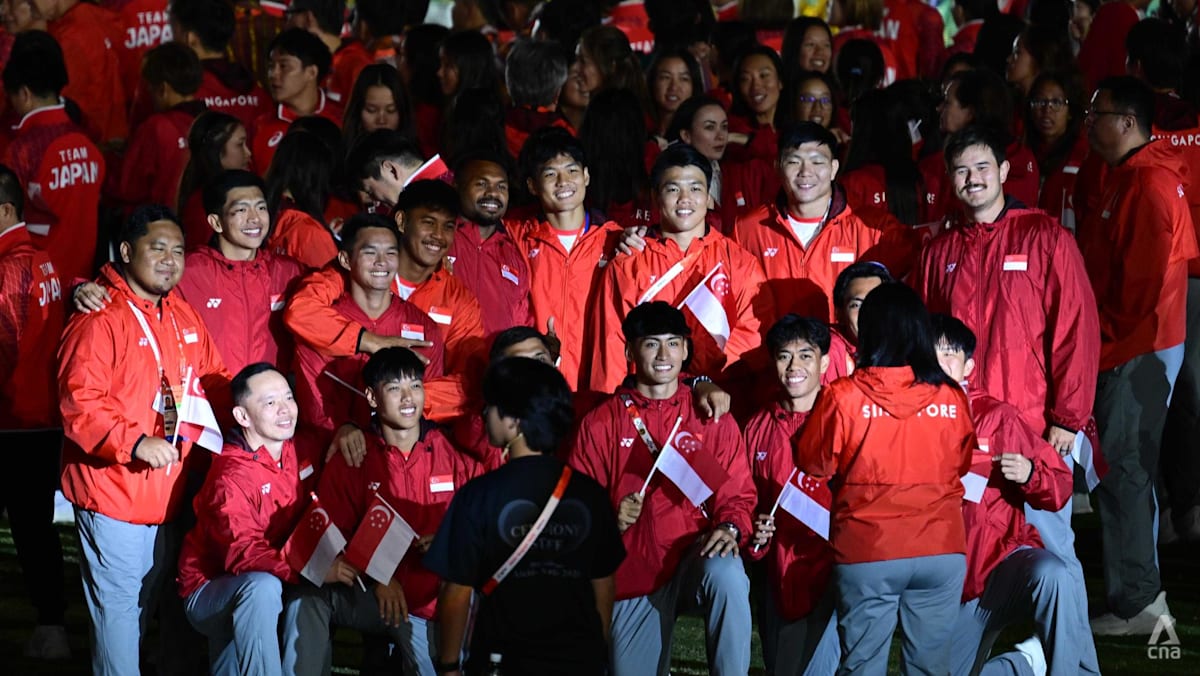
Members of Team Singapore's men's rugby sevens team pose for a photograph during the closing ceremony of the 2026 Asian Games at the Paloma Mizuho Stadium in Nagoya on Oct 4, 2026. (Photo: CNA/Wallace Woon)
This audio is generated by an AI tool.
SINGAPORE: This year’s Asian Games, which drew to a close on Sunday (Oct 4), marked several highs for Team Singapore.
Singapore’s athletes brought home a total of two golds, nine silvers and seven bronzes, across nine different sports, ranging from traditional powerhouses for the republic like sailing and swimming, but also included breakthrough performances in badminton and golf.
Singaporean fencers, long a dominant force at the SEA Games, also had their best-ever showing at the Asian Games with three impressive medals.
Beyond the final medal tally, the grit and determination displayed not just by the medal-winners, but all the athletes who entered the fray in Japan, provided much gripping entertainment and excitement for Singaporeans following the action.
CNA Games Guess Word Crack the word, one row at a time Buzzword Create words using the given letters Mini Sudoku Tiny puzzle, mighty brain teaser Mini Crossword Small grid, big challenge Word Search Spot as many words as you can Show More Show Less
PROGRESSION IN SPORTS
But sports fans are notoriously hard to please. Much has been made of the fact that the two golds secured in Nagoya were Singapore’s lowest in nearly 30 years. This should be balanced against the fact that the nine silver medals was the highest in history.
Progression in sports is rarely a predictable straight line. In many cases, myriad factors will determine if an athlete stands on the top step of the podium – including individual preparation to achieve peak form at the right moment, conditions of the field of play on the day of the competition, and the form of competitors.
Thus, the two golds bagged at this year’s Asian Games, compared to the three achieved at the 2022 edition in Hangzhou, do not necessarily demonstrate a lack of progress.
Instead, the fact that the 2026 team of mostly debutants set 10 national records and achieved 23 personal best performances should highlight that they had prepared well and delivered their very best.
Further context that should be considered includes the fact that bowling, a sport that Singaporeans have typically performed well in, was excluded from this year’s Games.
The fact that Team Singapore is bringing back medals across a broader range of sports is also heartening. Singapore can potentially look ahead to more events and athletes contributing to the tally in the future.
Another criticism that has surfaced in the wake of the Games is the fact that no medal targets had been made public prior to the competition.
Sport Singapore officials said in their post-event assessment that the athletes had met “internal medal projections” , which raised questions over why such projections had not been made public when taxpayers’ funds had been used to fund the sporting endeavours.
Singapore’s regional rivals like Indonesia and Malaysia had announced their targets, but the Singapore officials said this could increase the pressure on athletes and coaches.
There might also be concern that the inability to achieve declared targets would be seen as a failure.
While I can understand this position, I am reminded of a quote by American track sprinter Michael Johnson: “Pressure is nothing more than the shadow of great opportunity.”
He not only welcomed the pressure that came from declaring his own competition goals, but even sought to push himself further, most famously by asking his sponsor to make a pair of shimmering gold shoes to wear in the 1996 Olympic competition.
This could have been a foolish move that deliberately raised the stakes, but he embraced it to motivate himself and maybe even seed some fear or doubt in the minds of his competitors.
Perhaps this is a perspective that could help national athletes, coaches and officials in the event that medal targets are set and made public.
I believe it is good to set targets that might be seen as aspirational or a stretch based on current levels. When I was president of Fencing Singapore some 15 years ago, I told the media that we aimed to win five gold medals at a SEA Games.
At that time, we were struggling to bring back more than one or two golds, and some commentators called my comments unrealistic, among other less polite adjectives.
We didn’t achieve that target, and I explained the team’s performances without apologising for setting out the goals publicly. I believed it was the duty of sport leaders to signal clearly where we want the sport to go, and also our confidence and belief in our athletes to get there.
At last year’s SEA Games in Bangkok, Team Singapore fencers cemented their dominant status in the region by winning a record eight gold medals out of a possible 12, improving on their seven-gold haul two years earlier.
The seed of success is planted through high targets and goals set today, as long as there is public awareness that success in sports will not always be linear, and that sometimes losses are merely stepping stones to future wins.
GEARING UP FOR 2029 SEA GAMES
As we look ahead to the 2029 SEA Games which will take place at home in Singapore, I am sure that the expectations on Team Singapore will grow in the next three years.
Rather than shy away, athletes can welcome the home ground support, and seize the opportunity to achieve something for the country and themselves.
My dream for Team Singapore is to top the medal table at the 2029 SEA Games. We have never achieved this feat, but it is something that any host nation can and should aim for.
We came close in 2015 when we last hosted the biennial sports event. We have demonstrated in Nagoya and elsewhere that they have what it takes to stand shoulder to shoulder against the best sporting talent in the region.
I will be the happiest Singaporean if we achieve that lofty goal. In the meantime, the journey there will bring invaluable lessons as we continue working towards becoming a true sporting nation.
Nicholas Fang is a former national fencer and triathlete, and a former sports administrator. A former Nominated Member of Parliament, he was Chef de Mission for Team Singapore at the 2015 SEA Games, and is managing director of sports consultancy Novastella.
Get our pick of top stories and thought-provoking articles in your inbox
Stay updated with notifications for breaking news and our best stories
Join our channel for the top reads for the day on your preferred chat app
新加坡国家队前领队方尼古拉斯表示,未来体育成功的种子是通过今天设定的高目标播下的。
2026年10月4日,在名古屋帕洛玛瑞穗体育场举行的2026年亚运会闭幕式上,新加坡男子七人制橄榄球队队员合影留念。(图片:CNA/Wallace Woon)
这段音频由人工智能工具生成。
新加坡:今年的亚运会于周日(10月4日)落下帷幕,新加坡队取得了多项佳绩。
新加坡运动员在九个不同的体育项目中共获得两枚金牌、九枚银牌和七枚铜牌,涵盖了新加坡的传统强项,如帆船和游泳,以及羽毛球和高尔夫等项目,并取得了突破性成绩。
新加坡击剑队一直是东南亚运动会的一支劲旅,在亚运会上也取得了有史以来最好的成绩,获得了三枚令人瞩目的奖牌。
除了最终的奖牌总数之外,不仅是奖牌获得者,所有在日本参赛的运动员所展现出的勇气和决心,也为关注比赛的新加坡人带来了许多扣人心弦的娱乐和激动人心的时刻。
CNA游戏 猜词游戏 逐行破解单词 流行词游戏 用给定的字母组成单词 迷你数独 小小谜题,挑战你的大脑 迷你填字游戏 小方格,大挑战 单词搜索 尽可能多地找出单词 显示更多 显示更少
体育运动的进步
但众所周知,体育迷们很难取悦。新加坡在名古屋奥运会上仅获得两枚金牌,这是近30年来的最低纪录,这一点被大肆渲染。然而,我们也应该注意到,新加坡获得的九枚银牌却是历史最高纪录。
体育竞技中的进步很少是一条可预测的直线。在很多情况下,众多因素决定着运动员能否登上领奖台的最高处——包括个人为在关键时刻达到最佳状态所做的准备、比赛当日的场地条件以及竞争对手的状态。
因此,与 2022 年杭州亚运会获得的 3 枚金牌相比,今年亚运会获得的 2 枚金牌并不一定表明缺乏进步。
相反,2026 年这支主要由新人组成的队伍创造了 10 项全国纪录,并取得了 23 项个人最佳成绩,这应该足以说明他们准备充分,发挥出了最佳水平。
还应考虑的另一个背景是,保龄球这项新加坡人通常表现出色的运动,被排除在今年的运动会之外。
新加坡代表队在更多体育项目中斩获奖牌,这令人振奋。新加坡未来有望在更多项目中取得佳绩,并有更多运动员为奖牌榜贡献力量。
奥运会结束后出现的另一个批评意见是,赛前没有公布任何奖牌目标。
新加坡体育理事会官员在赛后评估中表示,运动员们达到了“内部奖牌预测”,这引发了人们的质疑:既然是用纳税人的钱来资助体育活动,为什么这些预测没有公开?
新加坡的区域竞争对手,如印度尼西亚和马来西亚,已经公布了他们的目标,但新加坡官员表示,这可能会增加运动员和教练的压力。
人们也可能担心,未能实现既定目标会被视为失败。
虽然我能理解这种立场,但我不禁想起美国田径短跑运动员迈克尔·约翰逊的一句名言:“压力只不过是巨大机遇的阴影。”
他不仅欣然接受了宣布自己比赛目标所带来的压力,甚至还试图进一步挑战自己,最著名的例子就是要求赞助商制作一双闪闪发光的金色鞋子,以便在 1996 年奥运会比赛中穿着。
这原本可能是一个愚蠢的举动,故意提高赌注,但他欣然接受,以此激励自己,甚至可能在竞争对手心中埋下恐惧或怀疑的种子。
如果设定并公布奖牌目标,或许这种观点可以帮助国家运动员、教练员和官员。
我认为设定一些具有挑战性或远大的目标,以目前的水平来看,是件好事。大约15年前,我担任新加坡击剑协会主席时,曾告诉媒体,我们的目标是在东南亚运动会上赢得五枚金牌。
当时,我们连一两枚金牌都很难赢回来,一些评论员称我的说法不切实际,还用了其他一些不太礼貌的形容词。
我们没能实现那个目标,我解释了团队的表现,并没有为公开设定目标而道歉。我认为,体育领导者有责任清晰地表明我们希望这项运动朝着哪个方向发展,以及我们对运动员实现目标的信心和信念。
在去年曼谷举行的东南亚运动会上,新加坡击剑队以创纪录的8枚金牌(总共12枚金牌)巩固了其在该地区的统治地位,比两年前的7枚金牌成绩有所提高。
成功的种子是通过今天设定的高目标和目标播下的,前提是公众意识到体育运动中的成功并不总是线性的,有时失败只是通往未来胜利的垫脚石。
为2029年东南亚运动会做好准备
展望即将在新加坡举行的2029年东南亚运动会,我相信未来三年人们对新加坡队的期望将会越来越高。
运动员们不应退缩,而应欢迎主场球迷的支持,并抓住机会为国家和自己取得一些成就。
我梦想新加坡队能在2029年东南亚运动会上荣登奖牌榜榜首。我们从未实现过这个目标,但这是任何东道国都可以而且应该努力追求的目标。
2015年我们上次举办这项两年一度的体育盛会时,我们离冠军仅一步之遥。我们在名古屋和其他地方已经证明,他们有能力与该地区最优秀的体育人才并肩作战。
如果我们能够实现这个远大的目标,我将是最幸福的新加坡人。与此同时,在通往目标的道路上,我们也会汲取宝贵的经验教训,继续努力成为真正的体育强国。
方尼古拉斯曾是国家击剑运动员和铁人三项运动员,也曾担任体育管理职务。他曾任国会委任议员,担任2015年东南亚运动会新加坡代表团团长,现任体育咨询公司Novastella的董事总经理。
订阅我们的邮件,即可获取精选热点新闻和引人深思的文章。
订阅通知,第一时间获取突发新闻和精彩报道。
加入我们的频道,即可在您常用的聊天应用上获取当日热门文章。