Monroe to Donroe: A ‘dead’ doctrine’s revival for current operations从门罗到唐罗:一项“已死”的理论在当前作战中的复兴
Barack Obama declared the Monroe doctrine "dead." Under Trump, it finds new life.
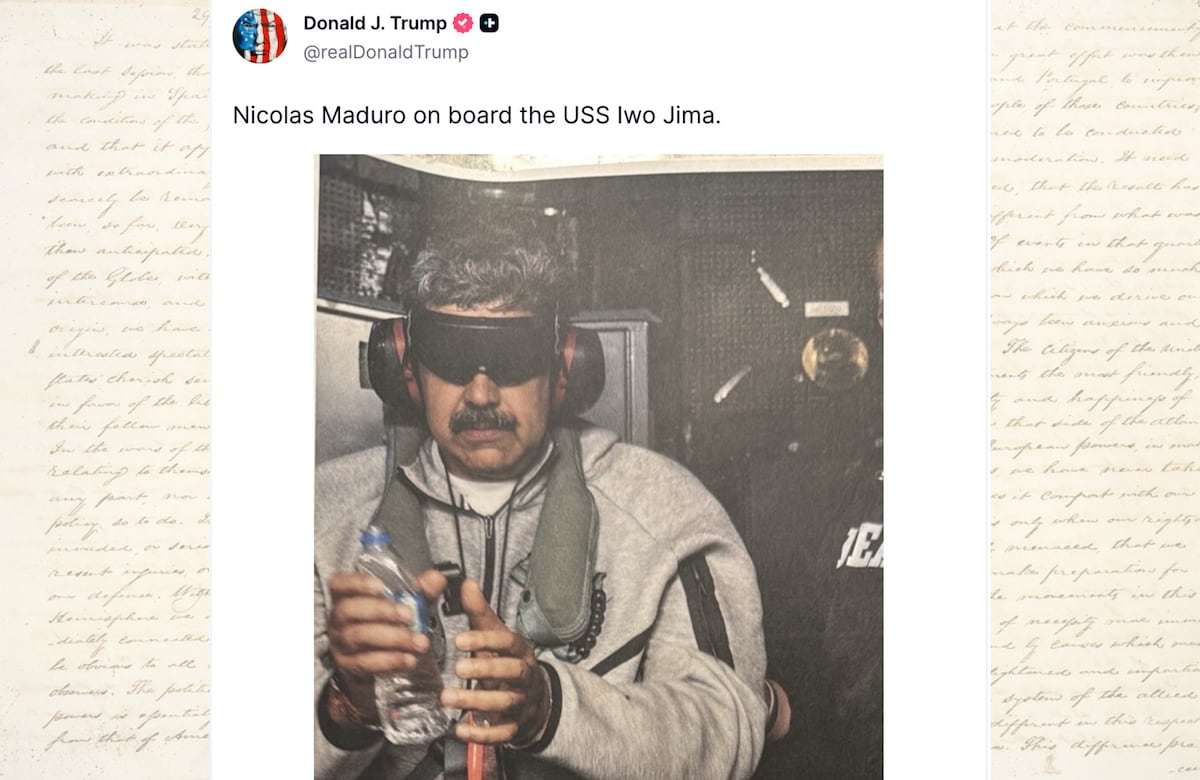
With the ousting of Venezuelan President Nicolás Maduro on Saturday, U.S. President Donald Trump cited the Monroe Doctrine, the 200-year-old lodestar of U.S. diplomacy — which the Obama administration declared dead in 2013.
“We have superseded it by a lot,” Trump told reporters Saturday.
“They now call it the ‘Donroe Doctrine.’ American dominance in the Western Hemisphere will never be questioned again,” he said.
First articulated by President James Monroe during a Dec. 2, 1823, congressional address, Monroe warned European powers to accept that the Western Hemisphere was solely within America’s sphere of interest and it “soon became a watchword of U.S. policy in the Western Hemisphere,” according to the National Archives .
Both Monroe and his secretary of state, John Quincy Adams, feared European excursions within the newly independent Latin America countries and the doctrine was designed to break the New World from the Old.
Decades prior, Adams’ own father, John Adams, who would become the country’s second president, spelled out this fear during the 1782 Preliminary Articles of Peace negotiations between the United States and Britain to British commissioner Richard Oswald.
When taunted by Oswald for being “afraid of being made the tools of the powers of Europe,” Adams replied bluntly: “Indeed I am.”
“It is obvious,” he continued, “that all the powers of Europe will be continually maneuvering with us to work us into real or imaginary balances of power. They will all wish to make us a make-weight candle, when they are weighing out their pounds. Indeed, it is not surprising; for we shall very often, if not always, be able to turn the scale. But I think it out to be our rule not to meddle.”
Since Monroe first uttered the foreign policy, however, the Monroe Doctrine has been codified and used to justify American interventions is Latin America.
Forty-two years later, the declaration, combined with the ideas of Manifest Destiny, “provided precedent and support for U.S. expansion on the American continent,” writes the State Department .
In 1865, the U.S. government, in support of Mexican President Benito Juárez, exerted military and diplomatic pressure that enabled Juárez to remove Emperor Maximilian, who had been placed on the throne by the French government.
The Monroe Doctrine came into its own and acquired its imperialist character, however, under President Theodore Roosevelt and his “Big Stick” foreign policy.
In his 1904 message to Congress, Roosevelt issued his own corollary, tying action to the doctrine.
“Chronic wrongdoing ... may in America, as elsewhere, ultimately require intervention by some civilized nation,” he said.
“And in the Western Hemisphere,” Roosevelt noted, “the adherence of the United States to the Monroe Doctrine may force the United States, however reluctantly, in flagrant cases of such wrongdoing or impotence, to the exercise of an international police power.”
Acting as an “international police power” saw the U.S. annex Hawaii, seize Puerto Rico, the Philippines and Guam, intervene in Cuba, Nicaragua, Haiti and the Dominican Republic and help foment Panama’s secession from Colombia to pave the way for the Panama Canal.
The Cold War led to further interventions regarding fruit in Guatemala and oil in Iran, Mark T. Gilderhus, a former diplomatic history professor at Texas Christian University, wrote in 2006.
Couched in rhetoric emphasizing commitments to solidarity and democracy, Gilderhus wrote, the doctrine had “consistently served U.S. policy makers as a means for advancing what they understood as national strategic and economic interests.”
Yet in the latter half of the 20th century, the Monroe Doctrine and empire building fell out of vogue.
Under the Trump administration, however, the policy is back in fashion.
On Saturday, Maduro and his wife, Cilia Flores, were extracted from their home in the capital of Venezuela and arrived in New York to face U.S. charges of participating in narco-terrorism.
Trump emphasized that Venezuela, under Maduro’s rule, had been “increasingly hosting foreign adversaries in our region and acquiring menacing offensive weapons that could threaten U.S. interests.”
On Saturday, Trump defended his Cabinet’s move by citing the Monroe Doctrine, describing Maduro’s actions as being “in gross violation of the core principles of American foreign policy dating back more than two centuries.”
He also cited one factor that appears to be decisive: oil.
“We want to surround ourselves with good neighbors, we want to surround ourselves with stability, and we want to surround ourselves with energy. We have tremendous energy in that country. It’s very important that we protect it. We need that for ourselves. We need that for the world,” he said.
In recent months, Venezuela has emerged as a focus for Trump because, as the Wall Street Journal reports , it encapsulates a number of his priorities, including deporting migrants, fighting drug traffickers, asserting U.S. power across the Western Hemisphere and securing access to the country’s massive oil reserves.
Maduro’s extraction is the most assertive American action regarding regime change since the 2003 invasion of Iraq and the toppling of Saddam Hussein.
“America will never allow foreign powers to rob our people or drive us … out of our own hemisphere,” Trump said. “The future will be determined by the ability to protect commerce and territory and resources that are core to national security.”
Laid out in the November U.S. National Security Strategy, the administration cites the Monroe Doctrine and, like Roosevelt, dubbed its policy in the Western Hemisphere the “Trump Corollary.”
“After years of neglect, the United States will reassert and enforce the Monroe Doctrine to restore American preeminence in the Western Hemisphere, and to protect our homeland and our access to key geographies throughout the region,” the document said.
“We will deny non-Hemispheric competitors the ability to position forces or other threatening capabilities, or to own or control strategically vital assets, in our Hemisphere. This ‘Trump Corollary’ to the Monroe Doctrine is a common-sense and potent restoration of American power and priorities, consistent with American security interests,” it continued.
Maduro’s government has called the American seizure “imperialist.”
“If we normalize the kidnapping of a head of state, no country is safe,” Maduro’s son, Nicolás Maduro Guerra, said Monday.
“Today it’s Venezuela, tomorrow it could be any nation that refuses to submit. This is not a regional problem, it is a direct threat to global stability, to humanity and to the sovereign equality of nations.”
Claire Barrett is an editor and military history correspondent for Military Times. She is also a World War II researcher with an unparalleled affinity for Sir Winston Churchill and Michigan football.
随着委内瑞拉总统尼古拉斯·马杜罗于周六被推翻,美国总统唐纳德·特朗普援引了门罗主义——这一拥有200年历史的美国外交准则——奥巴马政府在2013年宣布其已死。
“我们已经远远超越了它,”特朗普周六告诉记者。
“他们现在称之为‘唐罗主义’。美国在西半球的主导地位将永远不会再受到质疑,”他说。
据美国国家档案馆记载,詹姆斯·门罗总统于 1823 年 12 月 2 日在国会发表讲话时首次阐述了这一观点,他警告欧洲列强要接受西半球完全属于美国的势力范围这一事实,并且“这很快成为美国在西半球政策的口号”。
门罗和他的国务卿约翰·昆西·亚当斯都担心欧洲列强入侵新独立的拉丁美洲国家,而这一理论旨在将新世界与旧世界割裂开来。
几十年前,亚当斯的父亲约翰·亚当斯(后来成为美国第二任总统)在 1782 年美国与英国之间的和平初步条款谈判中,向英国专员理查德·奥斯瓦尔德明确表达了这种担忧。
当奥斯瓦尔德嘲讽亚当斯“害怕成为欧洲列强的工具”时,亚当斯直截了当地回答说:“我的确害怕。”
“显而易见,”他继续说道,“欧洲列强会不断地与我们周旋,试图将我们纳入他们所设想或现实的权力平衡之中。他们都想把我们当作衡量自身实力的筹码。这其实并不奇怪;因为我们常常,即便不是总是,也总能扭转乾坤。但我认为,我们的原则是不干涉他们。”
然而,自从门罗首次提出外交政策以来,门罗主义就被编纂成法,并被用来为美国干预拉丁美洲的行为辩护。
四十二年后,该宣言与“昭昭天命”思想相结合,“为美国在美洲大陆的扩张提供了先例和支持”,美国国务院写道。
1865年,美国政府支持墨西哥总统贝尼托·华雷斯,施加军事和外交压力,使华雷斯得以罢黜法国政府扶植的皇帝马克西米利安。
然而,门罗主义在西奥多·罗斯福总统及其“大棒”外交政策的领导下,才真正发展成熟并具有了帝国主义的特征。
罗斯福在 1904 年向国会发表的咨文中提出了自己的推论,将行动与该理论联系起来。
他说:“在美国,如同在其他地方一样,长期存在的违法行为最终可能需要某个文明国家的干预。”
罗斯福指出:“在西半球,美国坚持门罗主义可能会迫使美国,尽管不情愿,但在出现这种公然的不当行为或无能为力的情况下,行使国际警察权。”
作为“国际警察力量”,美国吞并了夏威夷,占领了波多黎各、菲律宾和关岛,干预了古巴、尼加拉瓜、海地和多米尼加共和国,并帮助煽动巴拿马脱离哥伦比亚,为修建巴拿马运河铺平了道路。
德克萨斯基督教大学前外交史教授马克·T·吉尔德胡斯在 2006 年写道,冷战导致了对危地马拉水果和伊朗石油的进一步干预。
吉尔德胡斯写道,这一理论披着强调团结和民主承诺的外衣,“一直以来都被美国决策者视为推进他们所理解的国家战略和经济利益的手段”。
然而,在 20 世纪后半叶,门罗主义和帝国扩张逐渐不再流行。
然而,在特朗普政府时期,这项政策又重新流行起来。
周六,马杜罗和他的妻子西莉亚·弗洛雷斯从委内瑞拉首都的家中被带走,抵达纽约,面临美国指控,罪名是参与毒品恐怖主义。
特朗普强调,在马杜罗的统治下,委内瑞拉“越来越多地在我们地区安插外国敌对势力,并获取可能威胁美国利益的具有威胁性的进攻性武器”。
周六,特朗普援引门罗主义为内阁的举动辩护,称马杜罗的行为“严重违反了美国两百多年来奉行的核心外交政策原则”。
他还提到了一个似乎起决定性作用的因素:石油。
“我们希望与好邻居为伍,我们希望生活在稳定的环境中,我们希望充满活力。那个国家拥有巨大的能量。保护它至关重要。这不仅对我们自身有益,对世界也同样重要。”他说道。
近几个月来,委内瑞拉已成为特朗普关注的焦点,因为正如《华尔街日报》报道的那样,它体现了他的许多优先事项,包括驱逐移民、打击毒品走私、在西半球确立美国的力量以及确保获得该国巨大的石油储备。
马杜罗下台是美国自 2003 年入侵伊拉克推翻萨达姆·侯赛因政权以来,在政权更迭方面采取的最强硬的行动。
特朗普说:“美国绝不会允许外国势力掠夺我们的人民,或将我们驱逐出我们自己的半球。未来将取决于我们保护商业、领土和对国家安全至关重要的资源的能力。”
该政府在 11 月份发布的《美国国家安全战略》中援引了门罗主义,并像罗斯福一样,将其在西半球的政策称为“特朗普推论”。
“经过多年的忽视,美国将重申并执行门罗主义,以恢复美国在西半球的主导地位,并保护我们的国土和我们进入该地区关键地区的通道,”该文件称。
“我们将阻止非西半球竞争对手在我们西半球部署兵力或其他威胁性能力,或拥有或控制具有战略意义的重要资产。这一对门罗主义的‘特朗普推论’,是对美国实力和优先事项的合情合理且强有力的恢复,符合美国的安全利益。”声明继续说道。
马杜罗政府称美国的此次行动是“帝国主义”行为。
“如果我们把绑架国家元首的行为正常化,那么没有哪个国家是安全的,”马杜罗的儿子尼古拉斯·马杜罗·格拉周一表示。
“今天可能是委内瑞拉,明天就可能是任何一个拒绝屈服的国家。这不是一个地区性问题,而是对全球稳定、对人类以及对各国主权平等的直接威胁。”
克莱尔·巴雷特是《军事时报》的编辑和军事历史记者。她也是一位二战研究员,对温斯顿·丘吉尔爵士和密歇根大学橄榄球队有着无与伦比的热爱。