This Soviet Twin-Rotor Helicopter Design Was A High-Speed Rival To The Mi-24 Hind这款苏联双旋翼直升机设计是米-24“雌鹿”直升机的高速竞争对手。
The futuristic-looking Kamov V-50 was planned to fly a range of missions at 250 miles per hour.
新闻视频
Updated Nov 25, 2020 4:53 PM EST
The V-50 helicopter, on which the Soviet design bureau Kamov began work in the late 1960s, was a radical concept for a multirole combat helicopter that was ambitiously pitched to both the army and the navy. With tandem twin rotors, gunship-style cockpits, and modular weapons options, the V-50 was designed to swoop into battle at speeds far in excess of most of its rotorcraft contemporaries.
Helicopters had only really emerged as trusted weapons of war during the 1950s, before coming of age during the U.S. conflict in Southeast Asia and, in parallel, in French hands in that country’s campaigns in North Africa. For much of the Cold War, rotorcraft development, with a few exceptions, tended to be fairly conservative, with designers sticking to proven concepts and creating enduring families of interrelated types, like the U.S. military’s iconic Bell H-1 Huey and Sikorsky H-53 series.
In the Soviet Union, meanwhile, this rotary-wing conservatism expressed itself in a long line of fairly conventional, albeit increasingly larger and more capable, transport helicopters for the ground forces from the Mil design bureau. Meanwhile, Kamov developed a family of more compact types tailored for the Soviet Navy, with coaxial contra-rotating rotors that helped reduce their “footprint” on the flight decks of smaller warships.
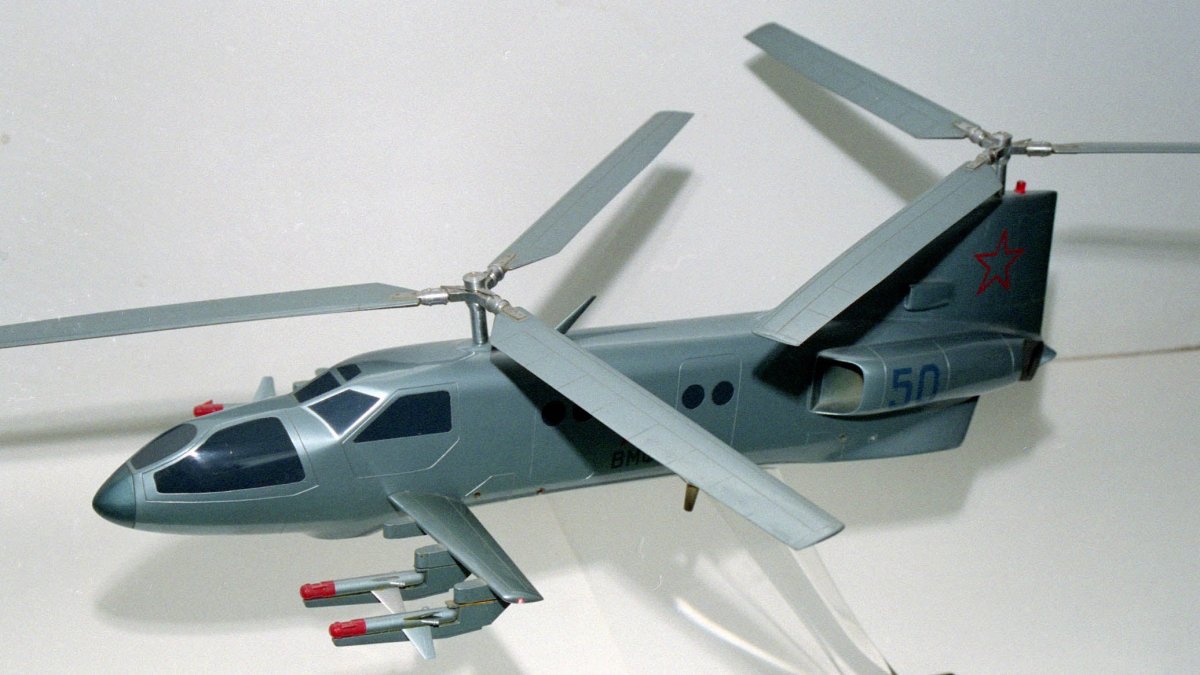
An official company model of the proposed V-50, in Soviet Navy markings. , PIOTR BUTOWSKI
Kamov, however, also proposed a very different and far more radical helicopter design, the V-50, as a “universal helicopter” that would be able to serve both the ground forces and the navy and that was expected to reach a speed of almost 250 miles per hour. In contrast, the now-iconic Mi-8 Hip , which was then entering service as a standard assault transport for the Soviet Army, had a maximum speed of 155 miles per hour.
Meanwhile, in the United States, manufacturers were also looking at ways of increasing the speed of military rotorcraft, leading to the remarkable Lockheed AH-56 Cheyenne , a gunship that adopted a compound design, with conventional main and tail rotors backed up by a pusher propeller in the tail. Despite problems that eventually led to the cancelation of the production contract in 1969, the Cheyenne demonstrated a speed of 247 miles per hour in level flight, putting it very much in the same performance bracket as the planned V-50.
The Sikorsky-Boeing SB>1 , a new compound coaxial helicopter design first flown in early 2019, is planned to achieve 290 miles per hour but hasn’t hit that speed yet.
The idea of a common airframe for both land-based and maritime applications was novel, too, since, up until this point, most helicopters had been developed to fulfill the requirements of either the army or the navy, since the operating conditions, mission spectrum, avionics, and weaponry for these services were so different. With the V-50 design, however, Kamov sought to overcome this challenge, with an airframe that could be adapted for roles as diverse as anti-submarine warfare (ASW), reconnaissance, or anti-tank operations. In another example of forward-thinking, equipment would be provided in modular packages for each specific mission.
For the assault role, the eight paratroops could embark and disembark via twin doors in the fuselage side. , PIOTR BUTOWSKI
Significantly, Kamov also broke with its in-house tradition of coaxial contra-rotating rotors, the technology for which had been developed by Nikolay Kamov himself soon after the end of World War II. Instead, the V-50 design utilized a pair of tandem rotors, arranged like those of the American CH-47 Chinook, among other contemporary designs, aligned with a very narrow fuselage. The tandem twin rotors were almost certainly the brainchild of Igor Erlikh, who led the design team and who, in the late 1950s, had designed the Yakovlev Yak-24 Horse , the first mass-produced Soviet helicopter to adopt a tandem-rotor arrangement. Meanwhile, the V-50’s narrow fuselage was intended to ensure the V-50 would reach its planned high operating speeds.
A preserved example of the Yakovlev Yak-24 Horse at Monino, outside Moscow., Alan Wilson/Wikimedia Commons
The chosen powerplant was a pair of the new Isotov TV3-117 turboshafts, which were also selected for the Mi-24 Hind assault helicopter that was first flown in prototype form in September 1969. These engines were rated at 1,900 shaft horsepower at takeoff and were later also used to re-engine the Mi-8/17.
Kamov’s helicopter design was to be flown by two pilots seated in tandem, below separate glazed canopies. In a land-based assault role, the V-50’s narrow fuselage could accommodate eight paratroops, while offensive armament would be carried on external hardpoints under long stub wings attached to the forward fuselage. The anti-armor missiles proposed for the land-based version would have been replaced with anti-ship missiles, or other naval weapons, on the maritime V-50. While the ground-based version had provision for a gun turret under the nose, this was switched for a search radar in the naval equivalent.
A close-up of the anti-tank guided missile armament. , PIOTR BUTOWSKI
There is no record of what type of missiles the production V-50 might have carried, but available official models of the design suggest it would have been fitted, initially at least, with four 9M17M Falanga-M manually controlled anti-tank guided missiles (ATGMs), known to NATO as the AT-2 Swatter . These first-generation air-launched ATGMs were replaced in the early 1970s by the 9M17P Falanga-P, which introduced a much more effective semi-automatic command to line of sight (SACLOS) guidance technique.
The V-50 project continued until a fairly advanced stage, including wind-tunnel tests, but the Soviet Army ultimately decided not to order it, since they considered the Mi-24 would fulfill their requirements for an assault-transport helicopter. As it turned out, the Hind would actually require a complete overhaul before it was a genuinely satisfactory aircraft and, in the process, it would lose its original “greenhouse” cockpit glazing for the stepped-tandem seating arrangement that was chosen for the V-50 and almost every other assault helicopter/gunship.
The original Mi-24 Hind configuration, with the angular “greenhouse”-style cockpit seating the flight crew and, optionally, a technician. , Riyaah/Wikimedia Commons
With the Soviet Army unconvinced by the V-50, the idea of a modular helicopter to serve the requirements of both ground and naval forces evaporated. The Soviet Navy also decided to follow a more conservative path for its new ship-based ASW and search and rescue rotorcraft. It opted for the Ka-27 Helix , which was externally very similar to its Ka-25 Hormone predecessor, albeit with the new TV3-117 engines that had been pitched for the V-50.
The potential of the V-50 had, however, alerted the Soviet Navy’s attention to the idea of a maritime assault helicopter, a class of rotorcraft to which it had not previously devoted much attention. It would be several more years, however, until the navy actually put these plans into action and developed the Ka-29 assault helicopter on the basis of the Ka-27. Overall, this was far less ambitious than the V-50, essentially being a minimum-change version of the Helix with a crew cabin and armament. Series production of the Ka-29 was only launched in 1984.
A Russian Navy Ka-29 assault helicopter., Dmitry Ryazanov/Wikimedia Commons
Ultimately, in the absence of a production V-50 “universal helicopter,” the Mi-24 and Ka-27 were destined to continue as the mainstays of the Soviet Union’s army aviation and ship-based helicopter fleets, respectively, until the end of the Cold War in 1991.
In its final configuration, with stepped tandem cockpits, heavy armament carried on stub wings, and a cabin with accommodation for a squad of soldiers, the Hind ultimately shared some broad design similarities with the V-50 concept, and its success as a troop-transporting gunship means that it remains in production today.
An upgraded Russian Aerospace Forces Mi-24PN helicopter., Igor Dvurekov/Wikimedia Commons
As it was, Kamov would have to wait a while longer to finally achieve success with a combat helicopter for the ground forces. This was the Ka-52 Hokum , for which the company stuck with its tried and tested coaxial contra-rotating rotors, combined with an unorthodox side-by-side crew seating arrangement. The Ka-52’s path to frontline service was protracted, however, and although the helicopter first flew in 1982, the program was interrupted by the demise of the Soviet Union, and it didn’t begin to be operationally fielded by the Russian Air Force until 2011.
Today, the development of high-speed, multirole military helicopters is also very much on the agenda in the United States and elsewhere, with major programs including Future Vertical Lift that promises to provide the U.S. military with a family of future rotorcraft to replace its entire fleet of legacy types. In Europe, Russia , and likely in China, too, armed forces are also starting to look at future helicopter designs that stress speed and versatility, and potentially harness exotic propulsion concepts.
With an eye once again on high-speed rotary-wing flight, Russia’s Central Aerohydrodynamic Institute, also known by its Russian acronym TsAGI, has recently been looking at different concepts for a compound helicopter, apparently intended for rescue and light utility roles in the Arctic region, which you can read more about here .
While today’s Ka-52 may be a suitable successor to the stillborn V-50 in the gunship role, we will never know whether Kamov’s radical tandem-rotor concept from the late 1960s would have fulfilled its promise had the program continued.
Thanks to Piotr Butowski.
Contact the author: thomas@thedrive.com
Comments couldn’t be loaded. Please refresh the page.
更新于美国东部时间2020年11月25日下午4:53。
V-50直升机是苏联卡莫夫设计局在20世纪60年代末开始研发的,它是一款激进的多用途战斗直升机,雄心勃勃地向陆军和海军推介。V-50采用串列双旋翼、武装直升机式座舱和模块化武器系统,其设计目标是以远超同时代大多数旋翼机的速度俯冲作战。
直升机真正成为可靠的战争武器是在20世纪50年代,之后随着美国在东南亚的冲突以及法国在北非战役中对直升机的运用而日臻成熟。在冷战的大部分时间里,旋翼机的发展(除少数例外)往往相当保守,设计师们坚持采用成熟的设计理念,并创造出一系列相互关联的经典机型,例如美国军方标志性的贝尔H-1“休伊”和西科斯基H-53系列。
与此同时,在苏联,这种旋翼机的保守主义体现在米尔设计局为地面部队研制的一系列相当传统、但尺寸越来越大、性能越来越强的运输直升机上。而卡莫夫则为苏联海军开发了一系列更为紧凑的机型,这些机型采用同轴反转旋翼,有助于减少其在小型军舰飞行甲板上的占用空间。
这是公司官方制作的V-50原型机模型,采用苏联海军涂装。——彼得·布托夫斯基
然而,卡莫夫还提出了一种截然不同且更为激进的直升机设计方案——V-50,这是一款“通用直升机”,能够同时为陆军和海军服务,预计速度可达近250英里/小时。相比之下,如今已成为标志性机型的米-8“河马”直升机,当时正作为苏联陆军的标准突击运输机服役,其最大速度仅为155英里/小时。
与此同时,在美国,制造商们也在探索提高军用旋翼机速度的方法,由此诞生了卓越的洛克希德AH-56“夏延”武装直升机。该机采用复合式设计,拥有传统的主旋翼和尾旋翼,尾部还配备了一个辅助推进螺旋桨。尽管最终导致生产合同在1969年被取消,但“夏延”在平飞中展现出了247英里/小时的速度,使其性能与计划中的V-50相当。
西科斯基-波音 SB>1 是一款新型复合共轴直升机设计,于 2019 年初首次试飞,计划达到每小时 290 英里的速度,但尚未达到该速度。
用于陆基和海上应用的通用机身理念也十分新颖,因为在此之前,大多数直升机都是根据陆军或海军的需求而开发的,毕竟这两个军种的作战条件、任务范围、航空电子设备和武器装备都截然不同。然而,卡莫夫在V-50的设计中力图克服这一挑战,打造出一种可以适应反潜作战、侦察或反坦克作战等多种不同任务的机身。另一个体现其前瞻性的地方是,每项特定任务所需的设备都将以模块化组件的形式提供。
执行突击任务时,八名伞兵可以通过机身侧面的双舱门上下飞机。——皮奥特·布托夫斯基
值得注意的是,卡莫夫公司也打破了其内部采用同轴反向旋转旋翼的传统,这项技术是尼古拉·卡莫夫本人在二战结束后不久开发的。V-50的设计采用了一对串联旋翼,其排列方式与美国CH-47“支奴干”直升机以及其他一些当时的机型类似,并与非常窄的机身相连。这种串联双旋翼的设计几乎可以肯定是伊戈尔·埃尔利赫的创意,他领导了设计团队,并在20世纪50年代末设计了雅科夫列夫“雅克-24‘马’”,这是第一款采用串联旋翼布局的苏联量产直升机。同时,V-50的窄机身旨在确保其能够达到预期的高速飞行。
莫斯科郊外莫尼诺保存的雅科夫列夫 Yak-24 马的例子。, Alan Wilson/Wikimedia Commons
选定的动力装置是两台新型的伊索托夫TV3-117涡轴发动机,这两台发动机也被选用于米-24雌鹿攻击直升机,该直升机于1969年9月首次以原型机形式试飞。这些发动机起飞时的额定轴功率为1900马力,后来也被用于为米-8/17直升机重新安装发动机。
卡莫夫设计的直升机由两名飞行员串联乘坐,分别位于独立的玻璃座舱内。作为陆基突击直升机,V-50的窄机身可容纳八名伞兵,进攻性武器则挂载在连接于机身前部的长短翼下方的外挂点上。陆基版计划配备的反装甲导弹在舰载版V-50上将被反舰导弹或其他舰载武器取代。陆基版机头下方预留了炮塔安装位置,而舰载版则将其替换为搜索雷达。
反坦克导弹武器的特写镜头。,皮奥特·布托夫斯基
目前尚无记录表明量产型V-50可能携带何种导弹,但现有的官方设计模型表明,它至少在初期会配备四枚9M17M“法兰加-M”手动控制反坦克导弹(ATGM),北约称之为AT-2“扫射者”。这些第一代空射反坦克导弹在20世纪70年代初被9M17P“法兰加-P”取代,后者采用了更为高效的半自动指令瞄准线(SACLOS)制导技术。
V-50项目进展到相当成熟的阶段,包括风洞试验,但苏联陆军最终决定不订购,因为他们认为米-24能够满足他们对突击运输直升机的需求。事实证明,米-24实际上需要彻底改造才能成为一款真正令人满意的飞机,而在这个过程中,它不得不放弃原有的“温室式”座舱玻璃,转而采用V-50以及几乎所有其他突击直升机/武装直升机所采用的阶梯式串联座椅布局。
最初的米-24雌鹿直升机配置,其棱角分明的“温室”式座舱可容纳机组人员,并可选配一名技术人员。(图片来源:Riyaah/Wikimedia Commons)
由于苏联陆军对V-50并不满意,旨在满足陆军和海军需求的模块化直升机的构想也随之破灭。苏联海军也决定为其新型舰载反潜和搜救旋翼机采取更为保守的方案,最终选择了Ka-27“螺旋”直升机。该机外形与Ka-25“激素”直升机非常相似,只是配备了原本计划用于V-50的新型TV3-117发动机。
然而,V-50的潜力引起了苏联海军对海上突击直升机的关注,此前海军对这类旋翼机并未给予太多重视。但直到几年后,海军才真正将这些计划付诸实践,并在Ka-27的基础上研发出Ka-29突击直升机。总体而言,Ka-29远不如V-50那样雄心勃勃,它本质上只是在Helix直升机的基础上增加了乘员舱和武器装备,并进行了最小程度的改动。Ka-29的批量生产直到1984年才正式启动。
一架俄罗斯海军卡-29攻击直升机。图片来源:Dmitry Ryazanov/Wikimedia Commons
最终,由于没有生产型 V-50“通用直升机”,米-24 和卡-27 注定要分别继续作为苏联陆军航空兵和舰载直升机队的主力,直到 1991 年冷战结束。
最终的配置是阶梯式串联座舱、短翼上搭载重型武器,以及可容纳一队士兵的座舱。米-24雌鹿最终与V-50概念机有一些大致的设计相似之处,而它作为运兵炮艇的成功意味着它至今仍在生产。
俄罗斯空天军升级版米-24PN直升机。图片来源:Igor Dvurekov/Wikimedia Commons
事实上,卡莫夫公司还需要等待一段时间才能最终成功研制出一款适用于地面部队的作战直升机。这款直升机就是卡-52“霍昆”(Ka-52 Hokum),该公司沿用了其久经考验的同轴反转旋翼设计,并采用了非传统的并排双座布局。然而,卡-52的服役之路却十分漫长。尽管该机于1982年首飞,但由于苏联解体,该项目被迫中断,直到2011年才开始在俄罗斯空军正式列装作战。
如今,高速多用途军用直升机的研发在美国和其他地区也备受重视,其中一项重要项目是“未来垂直起降”(Future Vertical Lift)计划,该计划旨在为美军提供一系列未来旋翼机,以取代其现有的全部老旧机型。在欧洲、俄罗斯,以及很可能还有中国,各国军队也开始关注未来直升机的设计,这些设计强调速度和多功能性,并可能采用一些新颖的推进技术。
俄罗斯中央空气流体动力学研究所(简称 TsAGI)再次将目光投向高速旋翼飞行,最近一直在研究复合式直升机的不同概念,显然是为北极地区的救援和轻型通用任务而设计的,您可以在这里阅读更多相关信息。
虽然今天的 Ka-52 可能是夭折的 V-50 在武装直升机领域合适的继任者,但我们永远不会知道,如果卡莫夫在 20 世纪 60 年代末提出的激进的串列旋翼概念继续下去,它是否能够实现其承诺。
感谢 Piotr Butowski。
联系作者:thomas@thedrive.com
评论加载失败,请刷新页面。