Healthcare's new challenge is 'living well', but women spend more years in ill health: Ong Ye Kung医疗保健面临的新挑战是“健康生活”,但女性患病的时间更长:王乙康
Mr Ong, who is Minister for Health and Coordinating Minister for Social Policies, was speaking about women's health in a dialogue with former first lady of the United States Jill Biden at a forum in Singapore.
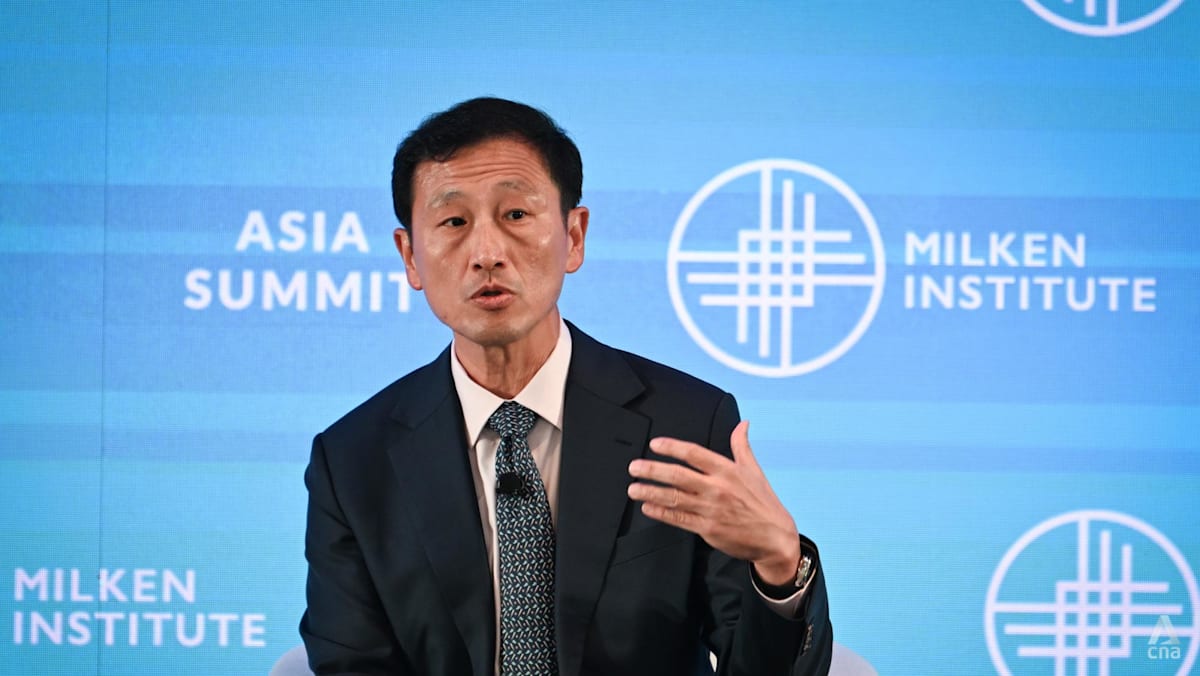
Mr Ong, who is Minister for Health and Coordinating Minister for Social Policies , was speaking about women's health in a dialogue with former first lady of the United States Jill Biden at a forum in Singapore.
Minister for Health and Coordinating Minister for Social Policies Ong Ye Kung speaking at the Milken Institute Asia Summit on Oct 8, 2026. (Photo: CNA/Syamil Sapari)
This audio is generated by an AI tool.
SINGAPORE: Modern healthcare systems are shifting from fighting infectious diseases to delivering “healthy longevity” , an area where women face more biological hurdles and health vulnerabilities than men , said Minister for Health Ong Ye Kung on Thursday (Oct 8).
Speaking at the Milken Institute Asia Summit in Singapore, Mr Ong, who is also Coordinating Minister for Social Policies, said that as people live longer, it is less about survival and more about living well – bridging the gap between a lifespan and the number of years spent in good health, also known as the morbidity gap .
"What you want is the gap between lifespan and healthspan to be as short as possible. In Singapore, that's about 10 years. For women it is 12 years. For men, it's slightly less than 10 years,” said Mr Ong.
“Although women live four and a half years longer than men on average in Singapore, half of that is spent in ill health."
He was speaking to Dr Jill Biden, the former first lady of the United States from 2021 to 2025 and the chair of the Milken Institute Women's Health Network, in a conversation about the future of health. The session was moderated by Ms Esther Krofah, the executive vice president of Health at the Milken Institute.
The Milken Institute is an American non-profit, non-partisan think tank that organises the Milken Institute Asia Summit annually.
The 13th edition, which runs from Oct 7 to 9 at the Four Seasons Hotel, is attended by leaders in business, finance, government, technology and health and had an expected turnout of 1,500 participants from 50 countries.
Asked about Singapore’s ability to invest in sex-specific health research and preventative health treatments, Mr Ong said that Singapore spends around 4.5 per cent of its gross domestic product (GDP) on healthcare, with an average life expectancy of 84 years .
Because of this, the country has the "fiscal headroom" to divide its resources between acute care and preventive care.
"Many health ministers do not have the luxury of investing more into preventive care, or their healthcare workers can't handle it. So Singapore has a unique opportunity," said Mr Ong.
"I hope Singapore can be that urban environment (where) we provide that test bed that makes things work, and that will encourage industry to say this is worth investing (in), and Singapore is one reference point that you can look at."
CNA Games Guess Word Crack the word, one row at a time Buzzword Create words using the given letters Mini Sudoku Tiny puzzle, mighty brain teaser Mini Crossword Small grid, big challenge Word Search Spot as many words as you can Show More Show Less
Chair of the Milken Institute Women's Health Network Dr Jill Biden (centre), speaking at the Milken Institute Asia Summit on Oct 8, 2026. (Photo: CNA/Syamil Sapari)
"DEMEDICALISING" DISEASE PREVENTION
Responding to Ms Krofah’s question about how Singapore’s Healthier SG has “(changed) the trajectory of health”, Mr Ong said that the idea behind Healthier SG is “take a leap of faith to say that preventive care works, population health works”.
“If we do things early, we can stall or delay or avoid the onset of non-communicable diseases, chronic diseases, cancer, and this is the biggest challenge in the healthcare system today,” he said.
Launched by the Ministry of Health (MOH) in July 2023, Healthier SG focuses on preventive health, where Singaporeans and permanent residents aged 40 and above are encouraged to sign up with their regular general practitioner (GP) or nearby polyclinic to create a personalised health plan.
Close to 60 per cent of eligible Singapore residents aged 40 and above have enrolled in Healthier SG and are following up for preventive care, with many others already receiving specialist care for chronic conditions.
"In most countries, the model is the GP is a gatekeeper. So if you want to go to a hospital, go through the GP first. In our case, the GP is not the gatekeeper. The GP is a pathfinder," said Mr Ong.
The initiative is part of the government's bid to "demedicalise" non-communicable disease prevention as much as possible and increase its access within the community , said Mr Ong.
By checking in with the GP every year and undergoing regular examinations, one can go through the necessary health checks, vaccinations, and be connected with community resources to stay healthy, he said.
"Preventive health and population health has to be made accessible. It is not in the clinic, it is in the community. It's in the homes," said Mr Ong.
Through the Healthier SG check-up, a general practitioner can identify a woman's risk for hereditary breast and ovarian cancer. The government also provides financial assistance for panel testing for breast cancer and ovarian cancer related genes such as BRCA1 and BRCA2, after which further preventive measures will also be subsidised and supported by the government.
Women at risk of osteoporosis and sarcopenia can also receive the appropriate tests under Healthier SG and can be referred to Active Ageing Centres (AACs), where they can access fitness training, coaches, and weightlifting training.
Osteoporosis is a medical condition that makes bones weak and brittle, while sarcopenia refers to the age-related gradual loss of muscle mass.
"You don't have to sign up for an expensive gym package, all you need is a couple of dumbbells, a resistance band, and you can do a lot," said Mr Ong.
PREVENTIVE, PREDICTIVE, PERSONALISED HEALTH
In the future, Mr Ong said healthcare infrastructure will have to be expanded, including improving its IT systems, harnessing AI technology and encouraging more predictive systems, such as the January 2027 rollout of the first AI model under Healthier SG to make predictions for diabetes and high cholesterol.
The government is also in the phase of mapping the genome sequence for around 450,000 Singaporeans, and may eventually raise the number further, he said.
Doing so allows for doctors to advise patients on an individual basis regarding their risk level and the most suitable preventive measure to take to prevent severe diseases, among other things.
"The future of healthcare is the 3Ps: it's preventive, it's predictive, and it's personalised," said Mr Ong.
Dr Biden said that she hoped that the US would follow in Singapore's footsteps in encouraging preventive health, such as getting bone density scans at an earlier age.
"Women really want a roadmap about where their health is, where it's going, and that should really start when women get their first periods, and then all through till the end of life, and so that they know what's going to happen… We have to look at it as a steady continuum," said Dr Biden.
She then suggested that the US take a page out of Singapore’s approach by prioritising healthy ageing and not concentrate narrowly on menopause when it comes to women’s health.
“ We have to look beyond, and we have to come up with evidence-based studies, and do our recommendations for women," said Dr Biden.
Asked whether he has had any difficulty encouraging behavioural change in rolling out community health hubs, Mr Ong said it is not difficult in the case of women.
"I think women are very open-minded to clinicians' advice, to community advice. Men, we are stubborn," said Mr Ong, who earlier noted that over 70 per cent of the participants at AACs are women.
"But I'm generally optimistic because of the larger trend… that people do feel that they are living longer and they want to have a healthy life and they are open to suggestions."
Get our pick of top stories and thought-provoking articles in your inbox
Stay updated with notifications for breaking news and our best stories
Join our channel for the top reads for the day on your preferred chat app
卫生部长兼社会政策统筹部长王乙康先生在新加坡的一个论坛上与美国前第一夫人吉尔·拜登就女性健康问题展开对话。
卫生部长兼社会政策统筹部长王乙康于2026年10月8日在米尔肯研究院亚洲峰会上发表讲话。(图片:CNA/Syamil Sapari)
这段音频由人工智能工具生成。
新加坡:卫生部长王乙康周四(10月8日)表示,现代医疗保健系统正在从对抗传染病转向实现“健康长寿”,而女性在这一领域面临的生物学障碍和健康脆弱性比男性更多。
王乙康先生在新加坡举行的米尔肯研究院亚洲峰会上发表讲话时表示,随着人们寿命的延长,生存不再是问题,而是如何过上好日子——弥合寿命与健康生活年限之间的差距,也就是所谓的发病率差距。王乙康先生同时也是社会政策统筹部长。
“我们希望寿命和健康寿命之间的差距尽可能短。在新加坡,这个差距大约是10年。女性是12年。男性则略少于10年,”翁先生说。
“虽然新加坡女性的平均寿命比男性长四年半,但其中一半时间是在病痛中度过的。”
他与吉尔·拜登博士(2021年至2025年担任美国第一夫人,现任米尔肯研究院女性健康网络主席)就健康未来进行了对话。此次对话由米尔肯研究院健康执行副总裁埃丝特·克罗法女士主持。
米尔肯研究院是一个美国非营利性、无党派智库,每年组织米尔肯研究院亚洲峰会。
第 13 届大会于 10 月 7 日至 9 日在四季酒店举行,商业、金融、政府、科技和医疗领域的领导人出席了此次大会,预计将有来自 50 个国家的 1500 名参与者参加。
当被问及新加坡是否有能力投资于性别相关的健康研究和预防性健康治疗时,王先生表示,新加坡将国内生产总值 (GDP) 的约 4.5% 用于医疗保健,平均预期寿命为 84 岁。
正因如此,该国才有“财政余地”将资源分配到急症护理和预防性护理上。
“许多国家的卫生部长没有余力加大对预防性医疗的投入,或者他们的医护人员无法应对。因此,新加坡拥有一个独特的机会,”王先生说。
“我希望新加坡能够成为一个城市环境,在这里我们可以提供一个试验平台,让各种想法得以实现,从而鼓励业界认为这是值得投资的,而新加坡可以成为一个值得参考的标杆。”
CNA游戏 猜词游戏 逐行破解单词 流行词游戏 用给定的字母组成单词 迷你数独 小小谜题,挑战你的大脑 迷你填字游戏 小方格,大挑战 单词搜索 尽可能多地找出单词 显示更多 显示更少
米尔肯研究院女性健康网络主席吉尔·拜登博士(中)于2026年10月8日在米尔肯研究院亚洲峰会上发表讲话。(图片:CNA/Syamil Sapari)
疾病预防的“去医疗化”
针对克罗法女士提出的“新加坡更健康的SG计划如何改变了健康轨迹”的问题,王先生表示,“更健康的SG计划”背后的理念是“大胆相信预防保健有效,人口健康有效”。
他说:“如果我们及早采取措施,就能阻止、延缓或避免非传染性疾病、慢性病、癌症的发生,而这正是当今医疗保健系统面临的最大挑战。”
由卫生部 (MOH) 于 2023 年 7 月推出的“更健康的新加坡”计划,侧重于预防保健,鼓励 40 岁及以上的新加坡公民和永久居民向其常规全科医生 (GP) 或附近的综合诊所注册,以制定个性化的健康计划。
近 60% 的 40 岁及以上符合条件的新加坡居民已加入“健康新加坡”计划,并正在接受预防性护理,还有许多人已在接受慢性病专科护理。
“在大多数国家,全科医生是守门人。所以如果你想去医院,首先要找全科医生。但在我们这里,全科医生不是守门人,而是引路人,”翁先生说。
王先生表示,这项举措是政府努力“尽可能地将非传染性疾病预防去医疗化”,并提高社区内预防的可及性的一部分。
他表示,通过每年与家庭医生进行检查并定期接受体检,人们可以进行必要的健康检查、接种疫苗,并与社区资源建立联系,从而保持健康。
“预防保健和全民保健必须普及。它不在诊所,而在于社区,在于家庭,”翁先生说。
通过“健康新加坡”体检,全科医生可以识别女性患遗传性乳腺癌和卵巢癌的风险。政府还为乳腺癌和卵巢癌相关基因(例如BRCA1和BRCA2)的基因检测提供经济援助,之后政府还将补贴和支持进一步的预防措施。
有骨质疏松症和肌肉减少症风险的女性也可以在“健康新加坡”计划下接受相应的检查,并可转介至“活力老龄化中心”(AAC),在那里她们可以获得健身训练、教练指导和举重训练。
骨质疏松症是一种使骨骼脆弱易碎的疾病,而肌肉减少症是指与年龄相关的肌肉质量逐渐丧失。
“你不需要办昂贵的健身卡,你只需要几个哑铃、一根阻力带,就可以做很多运动,”翁先生说。
预防性、预测性、个性化健康
王先生表示,未来医疗保健基础设施必须扩大,包括改进其信息技术系统、利用人工智能技术以及鼓励更多预测系统,例如在“更健康的新加坡”计划下于 2027 年 1 月推出的第一个人工智能模型,用于预测糖尿病和高胆固醇。
他还表示,政府目前正处于对约 45 万新加坡人进行基因组序列测序的阶段,最终可能会进一步增加这一数字。
这样做可以让医生根据患者的具体情况,就其风险等级以及为预防严重疾病而应采取的最合适的预防措施等问题,向患者提供建议。
“医疗保健的未来在于3P:预防、预测和个性化,”翁先生说。
拜登博士表示,她希望美国能够效仿新加坡,鼓励预防性健康措施,例如更早进行骨密度扫描。
拜登博士说:“女性真正想要的是一份关于她们健康状况的路线图,了解她们的健康状况现状和未来发展方向。这份路线图应该从女性初潮开始,一直持续到生命终结,这样她们才能知道将会发生什么……我们必须把它看作一个持续的过程。”
她随后建议美国借鉴新加坡的做法,优先考虑健康老龄化,而不要在女性健康方面只关注更年期。
拜登博士说:“我们必须放眼未来,必须拿出基于证据的研究,并为女性提出建议。”
当被问及在推广社区卫生中心的过程中是否遇到过鼓励行为改变的困难时,翁先生表示,对于女性来说这并不困难。
“我认为女性非常乐于接受临床医生和社区的建议。而男性则比较固执,”翁先生说道。他此前曾指出,AACs 的参与者中超过 70% 是女性。
“但我总体上持乐观态度,因为大趋势是……人们确实觉得自己寿命更长了,他们想要拥有健康的生活,并且他们乐于接受建议。”
订阅我们的邮件,即可获取精选热点新闻和引人深思的文章。
订阅通知,第一时间获取突发新闻和精彩报道。
加入我们的频道,即可在您常用的聊天应用上获取当日热门文章。